AI Litigation: How to Use New Tech to Upgrade Old Workflows
The Impact of Artificial Intelligence on Litigation
Artificial intelligence can change how much time lawyers spend on routine litigation work. Research can move faster, discovery documents can take less time to prepare, and large amounts of case information can become easier to review.
Attorney judgment still controls the final work product. AI simply changes how some of the underlying work gets handled.
Optimizing Research
Ask a lawyer who practiced before online legal databases about research, and you will probably hear how much time it once required.
Digital repositories changed that. Client expectations changed along with them. Research that once might have taken several days can now be expected much sooner.
AI is pushing that timeline again.
Some legal research systems use natural language processing to understand questions written in ordinary language and identify potentially useful authorities.
More advanced systems may use retrieval-augmented generation, which combines search with generated responses that draw from selected source material.
These tools can shorten the first stage of research considerably. Lawyers still need to check the authorities, read the underlying cases, and decide how the law applies to the facts in front of them.
Saving Time
AI litigation tools can reduce the amount of manual work involved in the discovery response process.
Discovery is a good example because much of the work follows a repeatable structure. Requests have to be reviewed, objections considered, client information collected, and responses drafted in the correct format.
Briefpoint focuses specifically on this part of litigation. Its AI platform helps lawyers prepare and propound interrogatories, RFAs, and RFPs while supporting the formatting requirements of all 50 states and 98 federal district courts.
According to Briefpoint, firms using the software save more than 30 hours per case on average.
Automation can help maintain consistent language as well. Attorneys remain responsible for reviewing the responses and making the case-specific decisions that affect what is ultimately served.
Reducing Barriers to Legal Assistance
Legal services can be expensive, and some people abandon legitimate claims because they do not know where to begin or cannot afford extensive legal help.
Software has made certain types of legal information easier to access. Some services can explain procedures, collect basic case information, or prepare initial documents based on information supplied by a user.
There are clear limits. An automatically generated suit may still contain weak claims, procedural errors, or incorrect assumptions about the law. Easier access to legal tools therefore creates a separate need for careful review before anything reaches a court.
Skill Development for Legal Professionals
AI litigation tools are becoming part of everyday legal work, which means attorneys and support staff need to know how to use them responsibly.
AI is not designed to take over the work of legal professionals. Lawyers still have to evaluate the facts, apply the law, communicate with clients, and make strategic decisions.
The practical challenge is learning where AI saves meaningful time and where human review needs to remain intensive.
Training should cover the actual software used in the practice, its limitations, data handling practices, and the steps lawyers are expected to take before relying on an output. As the technology changes, those internal standards will probably need to change with it.
Better Decision Making
Some litigation tools are beginning to help lawyers organize information in ways that can support strategy.
A system might identify recurring issues in prior cases, surface similar rulings, or summarize patterns in a large body of documents. Predictive tools may provide another layer of information about how comparable matters have developed.
None of those outputs can tell a lawyer what the final outcome of a case will be.
They can, however, give attorneys another source of information to consider when evaluating a claim, preparing an argument, or deciding how much weight to place on a particular piece of evidence.
Reviewing Large Volumes of Evidence
Large cases and lawsuits can involve thousands of emails, records, attachments, and other documents that attorneys need to sort through before they can understand what is actually important.
AI models can help with that first pass. Machine learning systems can group similar documents, identify recurring names or topics, and surface material that may deserve closer review.
Some AI applications can also summarize lengthy records or help lawyers search case materials using ordinary questions rather than rigid search terms.
Generative AI technology can make this process more accessible, but the results still need human review. AI outputs may miss context, misunderstand a document, or place too much weight on information that turns out to be minor.
Data protection deserves attention here as well. Evidence can contain confidential business records, personal information, and privileged communications, so firms should understand how a provider handles uploaded material before using AI technologies on case files.
Used carefully, these tools can make document-heavy litigation easier to review while leaving evidentiary and strategic decisions with the attorney.
Customer Service
AI can play a limited role in client communication as well.
A chatbot, for example, can collect basic information before a lawyer responds or answer routine administrative questions about scheduling and document submission.
When a human response is required, the lawyer may already have some of the background needed to address the issue.
More sensitive conversations still call for a person. Clients dealing with litigation may be discussing financial loss, business problems, or personal harm, and automated responses are rarely a good substitute for careful legal communication in those situations.
How to Integrate AI Into Your Legal Practice
Bringing AI into a litigation practice works best when you start with a specific problem rather than adopting software simply because it is new.
Look at where lawyers and staff spend the most time, then decide which parts of that work are reasonable candidates for automation.
Assess Your Needs and Goals
Start with the work that consumes hours without requiring a new legal judgment every few minutes.
Discovery drafting may be one example. Initial document review, routine summaries, and repetitive formatting may be others.
Then decide what improvement you are actually looking for. You may want to reduce drafting time, improve consistency, or make a growing caseload easier to manage.
Clear priorities make software comparisons much easier. They also give you something concrete to measure after a tool has been introduced.
Research AI Tools for Litigation
Litigation software covers a wide range of work, so focus on what each product actually does.
Common categories include:
- Legal research
- Document drafting
- Discovery management
Briefpoint, for example, is built around written discovery. Other products focus on document review, case research, or broader matter analysis.
Pay attention to how the software handles source material, what review controls it gives attorneys, and how information is stored. An impressive demonstration means very little if the product does not fit the work your practice handles every week.
Choose the Right Tools
The best choice will depend on the work you want to improve. Start with the functions you expect people to use frequently. Then look at how the software fits with your current systems and what safeguards exist for client information.
A useful checklist includes:
- Features: Does the software handle the litigation work you want to improve?
- Ease of use: Can attorneys and staff learn it without adding unnecessary friction?
- Cost: Does the expected time savings justify the price?
- Compatibility: Can it work with the systems already used in your practice?
- Scalability: Will it remain useful as matter volume changes?
- Security: Is client data protected from AI training or use to train AI models?
Train Your Team
Buying software does not mean people will know how to use it well.
Training should focus on real tasks people already perform. A discovery lawyer could practice reviewing generated objections. Litigation support staff could learn how documents are uploaded, organized, and exported.
People should understand what the system can handle and where they are expected to intervene.
Training should cover mistakes, too. Showing users what a bad output looks like can be just as useful as demonstrating the ideal workflow.
Start With a Pilot Project
A limited pilot gives you a chance to see how the software performs on real work before expanding its use.
You might start with one discovery matter or a defined category of routine documents.
During the pilot, look at:
- Time saved
- Accuracy of the output
- Problems users encountered
- Attorney review time
- Changes needed in the workflow
The point is to gather enough information to decide whether the software deserves a larger role.
Integrate AI Into Workflows
Once a tool has performed well in a pilot, map out where it fits into the existing process.
Suppose a litigation team is reviewing a large production. Software might handle an initial pass through the documents and identify material that deserves closer attention. Attorneys can then spend more time on documents that affect strategy, privilege, or important factual disputes.
Discovery drafting can follow a similar model. AI may prepare an initial response, while the lawyer reviews objections and revises the language before service.
People should know where automation begins, where it ends, and who is responsible for the final decision.
Monitor Performance and Outcomes
Keep measuring the tool after the rollout.
Useful metrics may include:
- Time saved
- Error rates
- Cost per matter
- Adoption rates
- Attorney review time
- Client feedback
A product that looked useful during procurement may behave differently once it is handling real matters every week.
Regular review gives the practice a chance to adjust the workflow, retrain users, or stop using a tool that is creating more work than it removes.
Prioritize Ethical and Legal Compliance
AI creates its own set of legal and professional questions.
Privacy is one concern. Depending on the information being processed, lawyers may need to consider laws such as the California Consumer Privacy Act, GDPR, HIPAA, or the Electronic Communications Privacy Act.
Cybersecurity laws can come into play as well. Unauthorized access to protected systems may raise issues under the Computer Fraud and Abuse Act.
Lawyers should understand how a vendor stores information, which related services may receive access to it, and whether data is used for training or another secondary purpose.
AI-generated work should receive attorney review before it is filed, served, or relied on. Incorrect citations, missing context, or inaccurate summaries can create real problems once they enter the record.
Are Humans Still Superior?
AI can handle a growing amount of legal work, but it cannot reproduce the judgment that develops through years of practice.
A lawyer has to understand the client, the procedural posture, opposing counsel, the judge, and the practical consequences of a decision. Software operates on the information it receives.
Trained professionals are therefore unlikely to disappear from legal practice. Their work may change as routine tasks become easier to automate.
The effect on legal assistants and other support roles is harder to predict. Some responsibilities may become more automated, while others may shift toward reviewing outputs and managing technology-assisted processes.
New Case Areas
AI litigation also covers lawsuits arising from the technology itself. Copyright claims have received much of the attention so far, with plaintiffs alleging that AI developers used protected works to train models without permission.
Claims may involve direct copyright infringement or contributory copyright infringement of intellectual property, depending on the facts.
Book authors, visual artists, media companies, and other rights holders have sued AI developers over training data and generated outputs. OpenAI Inc. and Stability AI are among the companies named in these disputes.
Courts are still working through questions involving fair use, proof of copying, and unauthorized use. Some rulings may reach appellate courts through an interlocutory appeal before a final outcome.
Procedural issues could grow as similar claims accumulate. Some cases may raise questions about class action treatment or multi-district litigation.
Major rights holders are watching these developments closely because the rulings could affect how AI companies obtain training material and how copyright owners enforce their rights.
Legal Aspects AI May Influence
Copyright receives much of the attention, but it is only one area where artificial intelligence is creating new legal questions.
Privacy Matters
AI systems may process enormous amounts of personal information.
Facial recognition technology has already produced disputes over biometric information, consent, and surveillance. Other AI products may create privacy concerns when they ingest communications, location data, consumer records, or other personal information.
The legal issue often comes down to what data was collected, how it was obtained, what notice the person received, and whether the company had permission to use it.
Antitrust
The AI market requires enormous amounts of computing power, data, and capital.
As a small number of companies gain significant control over models and infrastructure, regulators may examine licensing arrangements, distribution agreements, or other conduct that could limit competition.
AI-related antitrust litigation may therefore focus on familiar legal questions even though the technology itself is new.
Liability
AI can create difficult questions about responsibility when a product causes injury or financial loss.
A product liability case involving autonomous technology, for example, might examine a design defect in the underlying system. Expert testimony could become important in explaining how the model behaved and whether a safer alternative was available.
Potential defendants might include a developer, manufacturer, operator, or another business involved in providing the system.
Courts will have to determine how existing liability rules apply when a product makes decisions with limited direct human involvement.
Discrimination
AI systems learn from data, and problems in that data can affect the results they produce.
An automated hiring system might treat certain applicants differently. A tenant-screening tool could produce unequal outcomes. Facial recognition software has raised its own concerns about accuracy among different demographic groups.
Discrimination claims involving AI will often turn on how the system was built, what information it considered, and what effect its use had on the plaintiffs.
Companies deploying these products should understand the legal rules that already apply to the underlying decision, even when AI is involved.
It’s Time to Bring AI Into Your Litigation Workflows
AI can take a meaningful amount of repetitive work off your plate, particularly when you apply it to tasks with a clear process and keep attorney judgment where it belongs.
Discovery is a strong place to start. Briefpoint helps lawyers draft and respond to interrogatories, RFAs, and RFPs in all 50 states and 98 federal district courts.
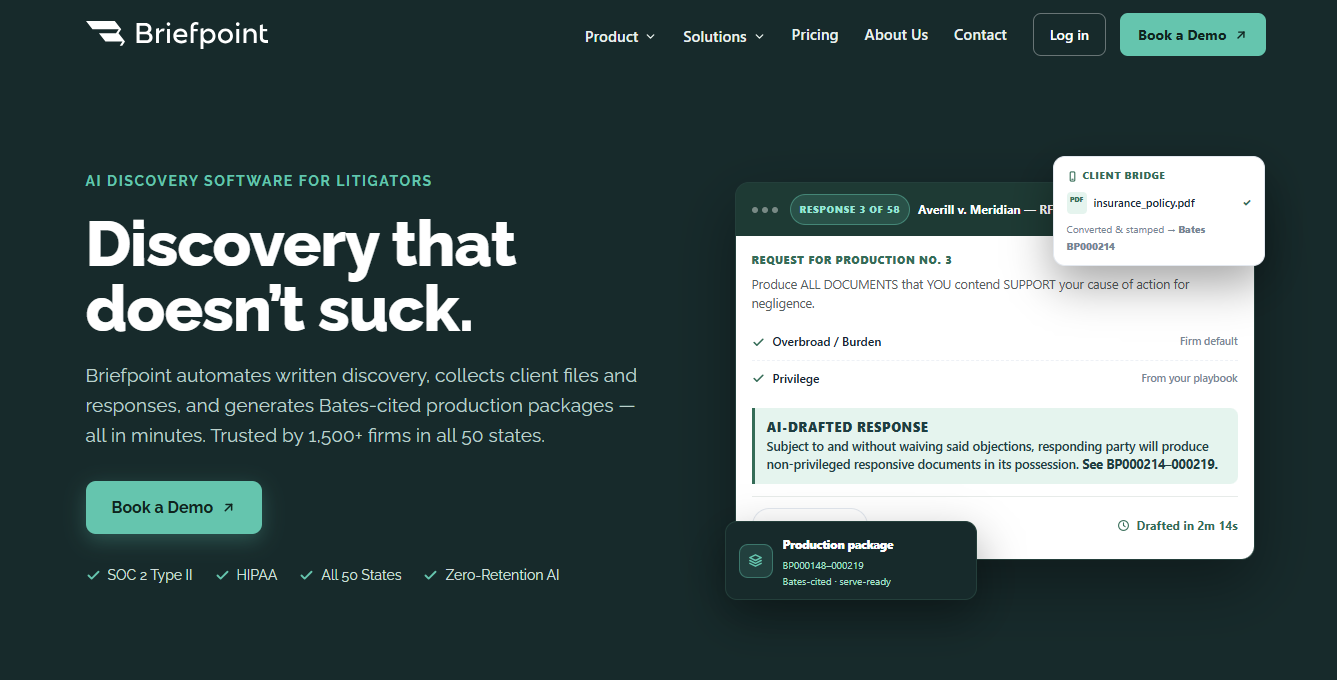
You can generate discovery requests from a complaint, apply firm-approved objection and response language through Discovery Playbooks, and export Word-ready drafts for review.
Briefpoint Bridge can collect client answers and files through a secure link, including plain-English questions and Spanish translation.
For document-heavy RFPs, Autodoc finds responsive files, creates Bates-cited responses, and prepares a Bates-numbered production package.
All of that can remove hours of underlying discovery work while leaving the final decisions in your hands.
Want to see what your discovery process could look like with less manual drafting?
