5 Best AI Legal Research Tools in 2026
What Makes a Legal Research Tool “AI-Powered”?
A legal research tool earns the label “AI-powered” when it does more than pull up cases based on matching words.
Traditional databases are built around keyword logic. Legal AI, on the other hand, looks at context, relationships between cases, and the substance of your question. That one distinction changes how legal professionals approach research.
Most modern AI tools rely on natural language processing. That means you can type a full question the way you’d say it out loud, and the system works to understand what you’re actually trying to solve.
From there, generative AI technology may assist with drafting, summarizing, or organizing findings, which helps move research forward faster.
You’ll usually see capabilities like:
- Natural language search: Interprets full questions and delivers relevant case law and legal materials without complicated search strings.
- Case summarization: Condenses lengthy opinions into readable explanations of holdings and reasoning.
- Generative drafting support: Assists with research memos, argument outlines, and analysis tied to cited authority.
- Citation analysis: Reviews how courts have treated a case and identifies stronger precedent.
In practice, legal AI supports everyday legal tasks, helping you analyze information and build arguments in a much faster, more organized way.
How We Chose These AI Legal Research Tools
Plenty of platforms claim to use AI. For this list, we focused on tools that actually support legal research in a significant way and fit into real legal workflows. The priority was practical value for legal teams and law firms, and not just flashy features that look good in a demo.
We examined how each platform functions as an AI assistant, how it handles core research tasks, and how well it supports broader legal operations. Tools that simply repackage traditional search didn’t make the cut.
Here’s what we looked for:
- Real AI functionality: Uses AI for summarization, analysis, drafting support, or predictive insights rather than basic keyword matching.
- Practical use for legal teams: Addresses common research slowdowns inside law firms and day-to-day legal work.
- Workflow compatibility: Fits naturally into existing legal workflows without requiring a complete shift in process.
- Strong legal database: Provides reliable access to case law, statutes, and other primary legal materials.
- Credibility and adoption: Trusted and actively used by legal professionals in real practice settings.
Top AI Legal Research Tools to Choose From
If you’re exploring AI legal research tools, you likely want something that helps you get to the point faster. So, below are several platforms that bring real AI into the research process and can make your day-to-day work feel more manageable:
1. Lexis+ AI
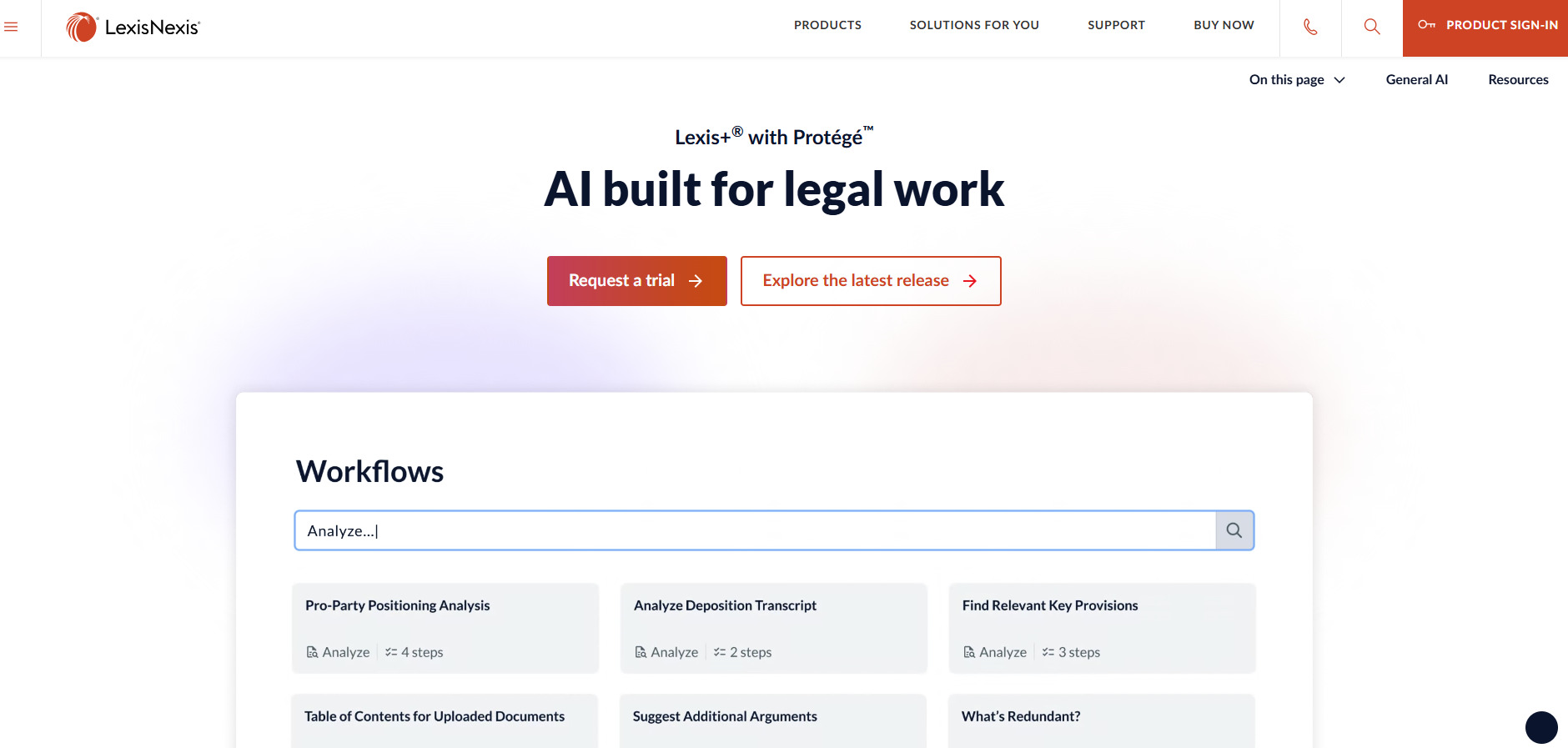
Lexis+ AI builds on the traditional Lexis research platform but adds a conversational layer that feels closer to working with an AI assistant.
Rather than sorting through long result lists, you can ask direct legal questions and receive structured answers grounded in real legal precedents. It’s designed for legal professionals who want faster analysis without stepping outside a trusted research database.
Source: LexisNexis.com
The platform also introduces Protégé Legal AI and Protégé General AI, powered by a proprietary AI model trained with legal context in mind. This distinction matters in the legal industry, where accuracy and source transparency carry real weight.
Best Features
- Conversational research: Ask complex legal questions in plain language and receive answers supported by cited authority.
- Protégé Legal AI: Built specifically for legal analysis and research tasks.
- Protégé General AI: Assists with drafting, summarizing, and refining written work.
- Document drafting support: Generates outlines, memos, and argument summaries grounded in legal precedents.
- Shepard’s integration: Validates citations and shows how courts have treated a case.
Pros
- Strong foundation in the established Lexis research database
- AI responses tied to verifiable legal precedents
- Useful for both large firms and solo practitioners
2. Westlaw Advantage
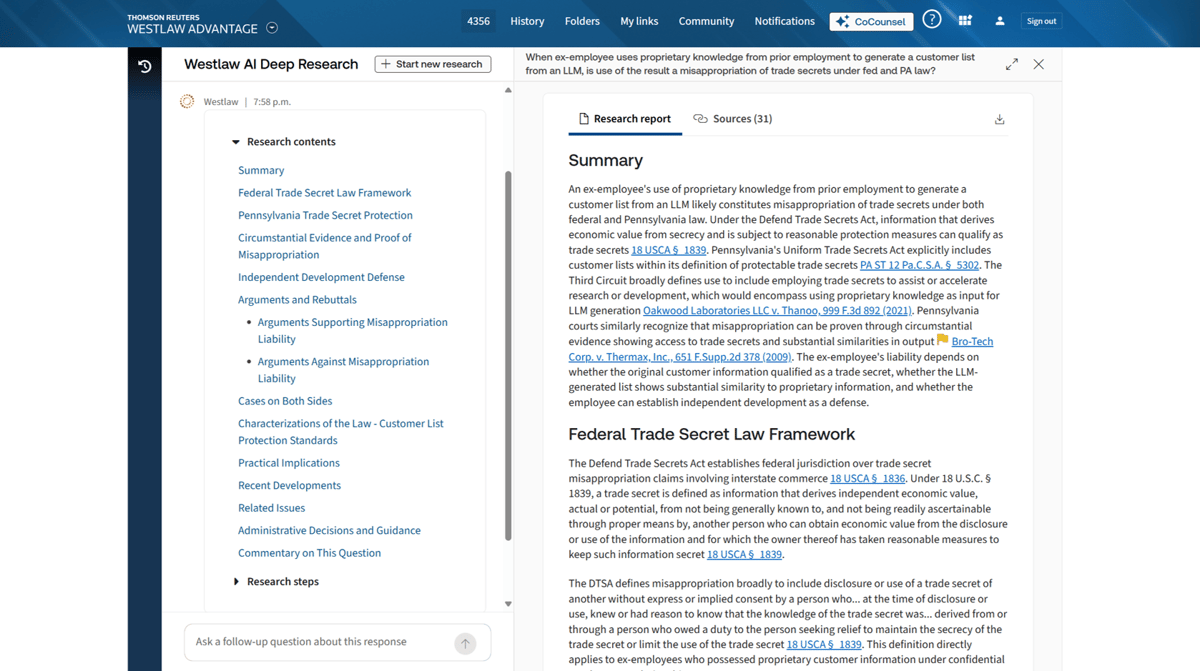
Westlaw Advantage builds on the long-standing Westlaw research platform while layering in advanced AI capabilities aimed at faster, more focused analysis.
It keeps the familiar research structure many legal professionals already know, but adds tools designed to reduce the time spent sorting through dense opinions and secondary sources.
Source: G2
The platform integrates advanced AI to refine search results, highlight key passages, and surface relevant authorities tied to your issue.
It also incorporates a generative AI tool that assists with drafting and deep research tasks, which can help you move from raw case law to structured analysis quickly.
If your team relies heavily on Westlaw’s database, the upgrade centers on making research more direct and aligned with real-world legal standards.
Best Features
- AI-enhanced search: Delivers more precise results based on context and not just keywords.
- Generative drafting assistance: Helps create research summaries and structured outlines from cited authorities.
- Key passage extraction: Highlights relevant sections within lengthy legal documents.
- Citation analysis tools: Tracks how courts have treated a case and measures the authority strength.
- Integrated research environment: Combines traditional Westlaw resources with advanced AI features.
Pros
- Strong, established research database
- Advanced AI layered into a familiar workflow
- Helpful for complex research tied to evolving legal standards
3. Bloomberg Law
Bloomberg Law combines legal research, litigation analytics, and business intelligence into a single platform. It’s widely used in the legal field, particularly by enterprise teams that need more than case lookup.
The focus isn’t only on finding authority, but also on understanding how courts, judges, and opposing counsel tend to operate in real litigation.
Source: Pro.BloombergLaw.com
Its AI-driven features help review multiple documents at once, extract relevant insights, and analyze trends tied to specific judges or practice areas. That can be especially useful in complex matters where context matters as much as precedent.
Bloomberg Law also integrates Practical Law resources to give you access to guidance notes, model documents, and practice insights that support everyday legal practice and even legal education settings.
Best Features
- Litigation analytics: Provides judge, court, and opposing counsel insights based on past rulings.
- AI-powered document analysis: Reviews multiple documents and surfaces key themes or risks.
- Brief analyzer: Evaluates arguments and suggests additional authority.
- Practical Law integration: Offers practice notes and drafting guidance.
- Business intelligence tools: Connect legal research with company and market data.
Pros
- Strong analytics for enterprise teams
- Combines research, drafting support, and business insight
- Useful for writing legal documents and strategic case preparation
4. Casetext (CoCounsel)
Casetext, known for its CoCounsel legal assistant, brings generative AI directly into research and document-heavy work.
The platform was built with legal context in mind, so responses are grounded in cited authority rather than broad, uncited content. Its foundation makes it particularly useful when accuracy and traceability matter.
Source: ThomsonReuters.com
CoCounsel Legal is structured around practical assignments inside modern legal tech workflows. It can review court documents, analyze complex documents, and identify relevant legal issues without requiring hours of manual reading.
When you’re handling large volumes of legal content, features like summarizing documents and issue spotting can reduce the time spent digging through pages of material.
Best Features
- AI research assistant: Answers legal questions with cited authority tied to primary sources.
- Document review support: Analyzes complex documents and flags key risks or arguments.
- Summarizing documents: Condenses lengthy court documents into structured explanations.
- Deposition and contract analysis: Reviews materials and highlights relevant passages.
- Task-based interface: Organizes research and review tools around specific legal assignments.
Pros
- Strong grounding in the legal context
- Helpful for reviewing large sets of court documents
- Designed around practical research and analysis tasks
5. Harvey AI
Harvey AI is positioned as an enterprise-grade research and drafting platform built on large language model technology.
It’s used primarily by major firms and in-house teams that want generative support layered into complex legal workflows. Unlike traditional databases, Harvey focuses heavily on analysis, legal drafting, and synthesis rather than pure case lookup.

Source: Harvey.ai
The platform assists with reviewing legal information, analyzing primary law, and generating structured outputs such as legal briefs and internal memos. It can also draft legal documents based on prompts, which reduces manual effort in early-stage drafting.
Because it often integrates with internal firm knowledge systems, Harvey is typically adopted by larger legal tech companies and enterprise legal departments rather than smaller practices.
That said, it operates differently from research platforms tied directly to a proprietary case database. As with many third-party AI tools, outputs should be carefully reviewed against authoritative sources before finalizing any legal writing.
Best Features
- Generative drafting support: Helps draft legal documents, legal briefs, and research summaries.
- Primary law analysis: Interprets statutes and case law within a structured response.
- Large document review: Synthesizes complex materials into usable insights.
- Knowledge integration: Connects with internal firm documents for contextual responses.
Pros
- Reduces manual effort in early drafting stages
- Strong generative capabilities for legal writing
- Popular among large enterprise teams
What Kind of Legal Research Tool Do You Need?
Choosing the right tool starts with an honest look at how you actually work. Some platforms focus on case law and litigation research, while others lean into contract drafting, document review, or analytics. However, very few do everything equally well.
You might also find that one tool isn’t enough. A research-heavy litigation process may rely on a database with strong citation analysis, while a transactional team may need AI support to analyze contracts and generate clause suggestions.
The right setup often depends on the mix of matters you handle.
Here are a few questions to guide your decision:
- Do you focus on litigation research? Look for strong case law coverage, citation tracking, and judge analytics.
- Do you handle high-volume contracts? Choose tools built for reviewing legal documents, contract drafting, and structured clause analysis.
- Do you need drafting support? Generative features can speed up memos and summaries, though human oversight remains critical.
- Are errors costly in your practice area? Prioritize platforms with clear citations and verification tools to reduce risk and support fewer errors.
The best choice aligns with your daily workload. In many firms, combining tools creates a more balanced research and drafting system.
AI Research Is Step One, Discovery Drafting Is Next
AI legal research tools help you analyze authority and shape your arguments. After that work is done, you still have to draft and serve the discovery. For many litigators, that’s where hours disappear.
Briefpoint focuses specifically on written discovery. It handles interrogatories, requests for production, and requests for admission, generating objection-aware drafts that open directly in Microsoft Word.
You stay in control of strategy and edits, but the repetitive formatting and structure are handled for you.
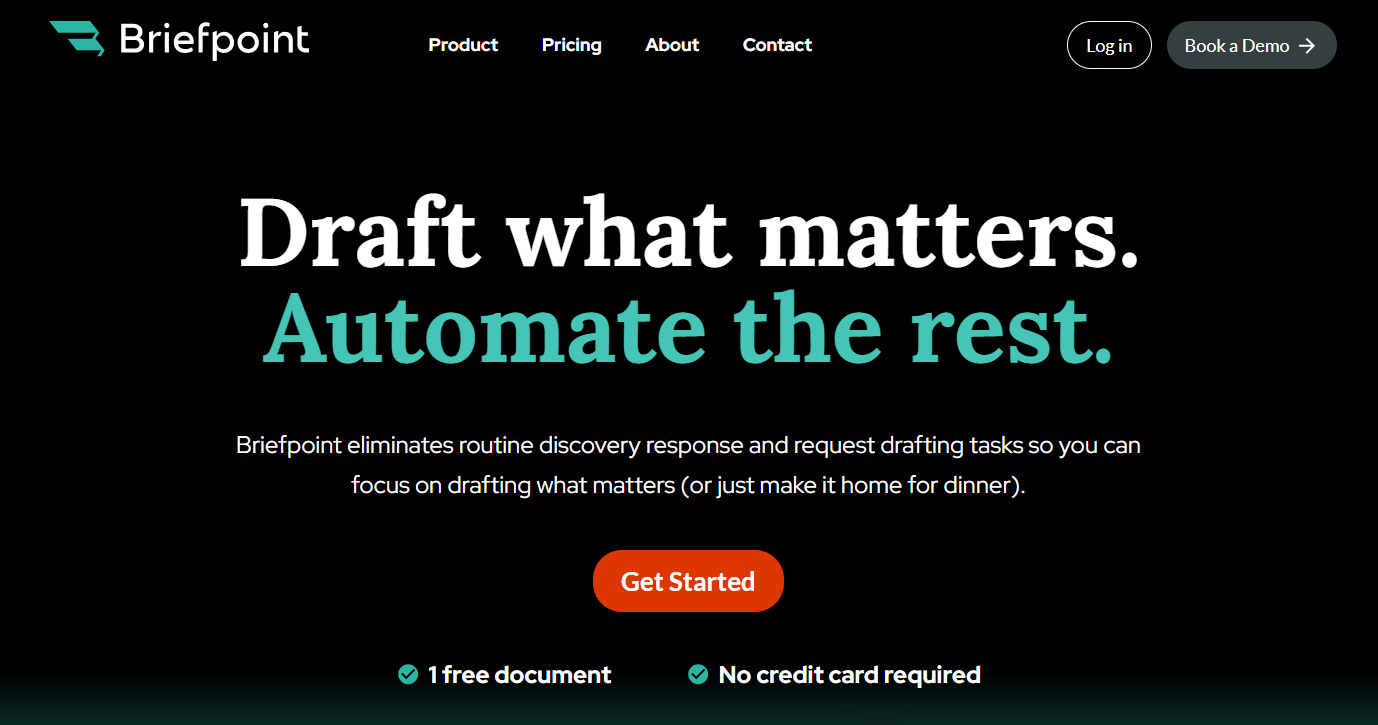
The workflow covers the full cycle. You can generate targeted discovery from a complaint, collect client responses in plain English, and produce polished drafts in minutes.
And with Autodoc, you can upload productions and case files, then generate Bates-cited Word responses and production packages with page-level citations. What often takes weeks of review can be reduced to a single upload and download.
Firms use it to cut drafting time dramatically while keeping objections consistent and up to date. It’s SOC 2 Type II certified, requires no setup, and works in all 50 states and federal courts.
