A Practical Guide to Legal AI Tools In 2026
What Kinds of AI Do Legal Professionals Use?
Legal AI covers several types of technology. Some systems focus on a narrow legal workflow, while others support many different parts of a legal practice.
Understanding the basic technology makes it easier to see why certain products are better suited to research, document review, or drafting.
Natural Language Processing (NLP)
Natural language processing helps software interpret and work with written language.
In legal settings, NLP can help identify clauses, summarize complex legal language, extract legal terminology, and sort large volumes of text.
An AI assistant might review a long legal document and identify every section dealing with termination, indemnification, or payment obligations. Another tool might convert dense language into a more readable summary before an attorney performs a closer review.
These systems can be especially useful when legal teams have to process large amounts of text quickly.
They still require review. Legal language depends heavily on context, so an automated summary should be treated as a starting point rather than a final legal conclusion.
Machine Learning
Machine learning allows software to identify patterns from large datasets.
In the legal field, machine learning can support risk detection, document classification, contract analysis, and prediction based on past case outcomes.
A system might compare thousands of agreements and identify clauses associated with prior disputes. Litigation tools may examine case law, court filings, or judicial decisions to surface patterns that could be relevant to strategy.
AI models can process more material than a person could reasonably review in the same amount of time, but the usefulness of the result still depends on the quality of the underlying data and the question being asked.
Generative AI
Generative AI creates new text based on instructions and source material.
Gen AI has become particularly visible because it can help with initial drafting, summarization, and answering legal questions in conversational language.
Legal generative AI tools may help with:
- Drafting briefs
- Contract drafting
- Document analysis
- Summarizing case materials
- Preparing client communications
- Creating first-pass research summaries
A legal AI product may combine generative AI with other technologies such as search, citation retrieval, document databases, or firm-specific knowledge.
That extra grounding can make a dedicated legal product more useful than general-purpose tools for work that requires reliable legal information.
Document Automation Engines
Document automation focuses on structured drafting.
Instead of creating each document from scratch, users provide matter details and the software places that information into an approved format or template.
These systems can support document generation for agreements, discovery requests, pleadings, forms, and other recurring documents.
More advanced products can combine automation with AI-powered review, which allows the software to prepare a draft and identify missing or unusual information before a legal professional checks the final version.
Classification and Tagging Systems
Classification tools organize large groups of files based on content.
During a discovery process, for example, software may categorize documents according to topic, privilege indicators, responsiveness, or other criteria.
That can make document review much more manageable when a legal team is working through thousands of emails or attachments.
Similar technology appears in contract repositories, compliance systems, and case management platforms where information needs to be organized consistently.
Chatbots and Virtual Assistants
Some AI tools work through a conversational interface.
A legal AI assistant may help staff find a document, summarize an agreement, answer internal process questions, or prepare a first response to a routine request.
Law firms may also use chat-based tools for basic client interaction, scheduling, or intake.
Client data and sensitive legal data require extra care in these situations. Firms should understand where information is stored, which AI models process it, and what data security protections the provider offers.
Predictive Models
Predictive tools use historical data to estimate likely outcomes or identify trends.
A litigation system might analyze past rulings in a particular court. Contract software might look at historical agreements to identify terms associated with delays or disputes.
These tools do not provide guaranteed outcomes or accurate answers to every question. Their role is to give attorneys another source of information to consider alongside legal reasoning, experience, and the facts of the matter.
Best Ways to Apply AI to Legal Work
Legal AI works best when it is applied to a defined process.
Some tasks involve large amounts of repetitive reading or drafting. Others require searching through structured legal information. These are areas where AI can often provide useful support without replacing the person responsible for the legal decision.
1. Document Automation
Many legal documents contain recurring structures and information.
A generative AI system can prepare an initial draft using matter details, templates, or prior work. That can reduce the time spent drafting documents that follow a familiar pattern.
Document automation can support work such as agreements, correspondence, discovery documents, and internal forms.
Some products include legal document review as part of the process. They may identify missing provisions, compare language with an approved template, or flag risks before an attorney reviews the result.
For example, an in-house team preparing a large batch of vendor agreements could use automation for the first-pass review and drafting stage, then send exceptions to transactional lawyers for closer attention.
The legal professional still owns the final document. AI simply reduces the amount of routine preparation required to get there.
2. Contract Management
AI-powered tools can support several parts of the contract lifecycle.
During contract drafting, software may suggest language based on templates or approved positions. During contract review, it can compare clauses, identify missing terms, or summarize agreements for the reviewer.
A contract analysis system may also flag risks such as unusual termination language or obligations that fall outside company policy.
According to Weshare, automating contract management can speed up negotiations by nearly 50% and reduce payment errors.
Common capabilities include:
- Tracking renewals
- Identifying non-standard language during legal drafting
- Comparing terms
- Extracting key obligations
- Creating reports
- Highlighting potential risk
These tools can be valuable for transactional lawyers and in-house counsel managing a high volume of agreements.
3. Legal Research
Legal research is one of the clearest areas where AI can shorten routine work.
Traditional research tools already give lawyers access to large legal research databases. Newer legal research platforms add conversational search, summarization, and AI-assisted analysis.
A system with strong legal research capabilities can search case law, statutes, commentary, and other legal sources to identify material related to a specific issue.
Legal teams may use research tools to:
- Find relevant authorities
- Compare decisions
- Review court filings
- Summarize opinions
- Identify related legal issues
- Locate secondary sources
Platforms may incorporate content such as Practical Law or other curated databases in addition to publicly available data.
Law students can benefit from these systems too, although they still need to learn how to read authorities and verify citations rather than relying on generated summaries.
4. Administrative Tasks
A large share of legal work involves coordination rather than legal analysis.
Legal operations may include scheduling, billing, case management, file organization, intake, and reporting.
AI can support these areas by:
- Drafting routine client communications
- Generating billing descriptions
- Sorting files
- Scheduling reminders
- Organizing case information
- Updating internal systems
AI may also be built into practice management platforms rather than offered as a separate product.
These improvements can help legal professionals spend less time on repetitive administrative work while keeping legal workflows moving.
5. Risk Management
Risk detection is another common use of AI legal software.
A system can review a contract, policy, or other legal document and identify terms that differ from an approved standard.
During contract review, for example, AI may flag risks involving indemnification, renewal, liability caps, or payment terms.
Legal teams can use those findings to prioritize the sections that deserve closer review.
The technology can be useful for in-house legal teams handling large volumes of documents because it provides a structured first look before an attorney begins deeper analysis.
6. Predictive Analytics
Predictive analytics uses historical information to identify patterns that may help inform future decisions.
A litigation tool might compare similar cases and surface how judges have ruled on related issues. A contract system might identify terms frequently associated with disputes or delayed performance.
The output can inform strategy, but it should not substitute for legal reasoning.
AI legal tools are most useful here when the attorney understands what data the model considered and treats the prediction as one input among many.
7. Client Service
AI can support client service in relatively simple ways.
A FindLaw and Thomson Reuters survey found that 59% of legal consumers contact only one attorney before making a decision. Faster responses can therefore make a meaningful difference.
AI-powered systems can help with:
- Initial intake
- Appointment scheduling
- Routine status updates
- Basic client questions
- Follow-up reminders
The technology can improve response times while keeping staff focused on client interaction that needs personal attention.
Confidentiality concerns still apply. Firms should be careful about what client information goes into general tools and understand how vendors handle sensitive data.
What Are the Benefits of AI Legal Tools?
AI adoption is becoming part of everyday work in the legal industry. Bloomberg Law has noted that generative AI is expected to have a lasting role in legal practice.
The practical benefits depend on the product and workflow, but common advantages include:
- Faster drafting: AI can prepare a starting point for legal briefs, contracts, correspondence, and other documents.
- More efficient research: Legal research tools can surface relevant authorities faster.
- Faster document review: AI can help sort and summarize large amounts of material.
- Better risk detection: Contract analysis tools can flag risks that deserve closer attention.
- More consistent workflows: Automation can apply templates or approved processes more reliably.
- Reduced routine work: AI can handle repetitive legal tasks that take time away from substantive work.
- Better access to information: Search tools can make internal legal information easier to locate.
The main advantage is time. When routine work takes less effort, attorneys have more room for analysis, strategy, and client service.
Legal AI Tools vs. General AI Tools
Legal AI software and general AI tools can look similar on the surface, but they are built for different purposes.
General-purpose tools may be useful for brainstorming, summarization, rewriting, or basic document drafting. Some offer a free version, while paid tiers may provide priority access or additional features.
Dedicated legal tools usually add legal-specific functionality around the underlying AI. That may include verified case law, citation checking, contract databases, legal terminology, document workflows, or integrations with Microsoft Word.
A legal product may also provide stronger controls around client data and confidentiality.
General tools can still be useful, but they require more caution when the task depends on authoritative legal sources or sensitive legal data.
For substantive legal research, legal document analysis, or work that will affect a client matter, a system built around legal content will usually provide a better foundation.
What Should You Look for in Legal AI Software?
The legal tech market is expanding quickly, and products vary considerably.
Before adding an AI tool to your legal practice, look beyond the headline features.
Consider:
- Source quality: Does the system rely on verified legal information?
- Citation support: Can you check where its legal conclusions came from?
- Data security: How does it protect confidential information and client data?
- Workflow fit: Does it support the legal workflows you actually use?
- Integrations: Can it work with Microsoft Word, case management software, or other systems?
- Review controls: Can attorneys easily edit or verify the output?
- Specialization: Is it designed for the legal task you need, or is it a general assistant?
- Support: Does the provider offer useful onboarding and training?
Even strong AI-powered tools can produce mistakes. A polished answer should never be mistaken for a verified one.
Is Legal AI Here to Stay?
AI adoption in law is moving well beyond experimentation.
Harvard Law professor David Wilkins has discussed how generative AI may reshape the legal profession as the technology becomes capable of more sophisticated work.
The direction is already visible. Legal research tools now include AI-assisted search. Contract platforms include automated analysis. Practice management systems are adding AI features, and document platforms can summarize or classify files.
The American Bar Association has also been closely following the professional and ethical implications of artificial intelligence in law.
Legal AI will continue to change, but the most useful products will probably be the ones that fit directly into existing work rather than forcing attorneys to rebuild their entire process around a new system.
Can AI Replace Lawyers?
The question “will AI replace lawyers?” comes up whenever a new generation of AI technology appears.
The more realistic answer is that AI changes parts of the job.
AI can summarize information, prepare initial drafts, identify patterns, and handle routine legal tasks. It cannot take responsibility for legal advice, understand every strategic consideration in a matter, or replace the professional judgment involved in representing a client.
Legal services depend on more than document production. Attorneys interpret uncertain facts, deal with opposing counsel, make judgment calls, and explain consequences to clients.
AI is not replacing human lawyers in those roles.
The technology is more useful as support for enabling attorneys to work through repetitive tasks faster while keeping the decisions that require human judgment in human hands.
Put Legal AI to Work Where It Saves the Most Time
AI can help with research, contract analysis, document review, administrative work, and drafting. The best use case depends on the work your legal team handles every day.
Discovery is one workflow where specialized automation can make a significant difference.
Briefpoint helps law firms draft and respond to interrogatories, RFAs, and RFPs in all 50 states and 98 federal district courts.
Attorneys can review and revise their drafts in Word, while Discovery Playbooks can surface previously approved objection and response language during drafting.
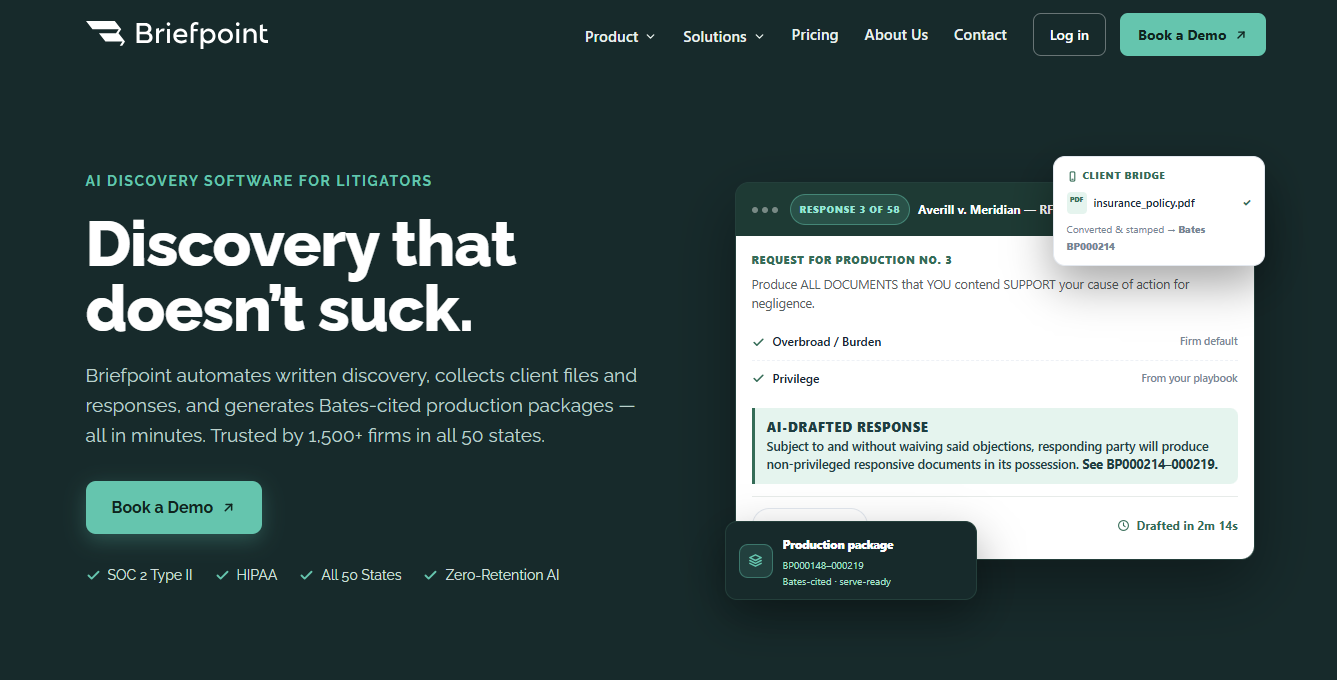
Bridge gives clients a secure link for answering interrogatories and uploading documents, including support for English and Spanish. Autodoc can search case files for responsive documents, prepare RFP responses with Bates citations, and create production materials for attorney review.
That makes Briefpoint a focused option for legal teams that want to automate discovery work while keeping attorney oversight at the center of the process.
Book a demo to see how it fits into your workflow.
