What Is an AI RFP Response Generator and How Does It Work?
What Is an AI RFP Response Generator and How Does It Work?
An AI RFP response generator is not a tightly defined software category in legal tech. You may see similar tools described as AI RFP software, RFP automation software, RFP response software, or AI discovery software.
In legal discovery, RFP means request for production. The response process involves reviewing each request, identifying responsive documents, drafting responses and objections, and preparing production materials.
AI can automate parts of that work and reduce the repetitive document review and drafting your firm handles manually.
So, what can an AI RFP response generator realistically handle, and where should human review stay involved?
What Is an AI RFP Response Generator?
An AI RFP response generator is software that uses artificial intelligence to help prepare RFP responses in legal discovery.
It may analyze RFP documents, identify requirements, review case files, locate responsive material, and create initial drafts for attorney review, among many other functions.
Traditional or legacy RFP tools may rely heavily on templates, manual search, and previously saved responses. Newer AI RFP response software can interpret requests in context and search case materials based on the substance of each request.
An AI-native platform may use generative AI or AI agents for tasks such as answer generation and document matching. A knowledge base or knowledge library may provide additional matter-specific information when the platform supports it.
The software still needs to fit legal discovery. RFP automation in this context should help attorneys respond to requests for production while keeping control of the final response and production.
How Is AI RFP Software Different From Traditional RFP Software?
Legal AI RFP software supports requests for production, while commercial RFP software supports the request-for-proposal process.
These systems may help teams complete RFPs through collaborative workflows involving the sales team, sales operations, sales enablement, and solution consulting.
They can search past proposals, past responses, approved responses, security documents, and content libraries to provide instant answers and help users select the right one for each requirement.
This approach can improve proposal quality, process security questionnaires, and build compliance matrices. Some platforms even provide reusable compliance matrices and unlimited users for larger response groups.
How Does an AI RFP Response Generator Work?
The exact RFP response process depends on the AI platform, but legal RFP software generally begins with the requests and the case materials that may contain responsive information.
The system reads each request, identifies what is being sought, and searches the available documents for relevant material. From there, AI can assist with drafting responses, applying discovery objections, and preparing files for attorney review.
More advanced RFP automation software may support a larger portion of the RFP lifecycle, including document analysis, first draft generation, review workflows, and production preparation.
Legal teams still need visibility into the source material. Response accuracy depends on the software finding the right documents and giving attorneys a practical way to verify the generated work.
Here’s how a typical workflow may unfold:
1. Upload the RFPs and Case Files
The process starts with the materials the AI needs to analyze the requests.
A litigation team may upload the RFP documents along with relevant case files, such as the complaint and potential production materials. The software can then analyze the requests in the context of the matter and determine which documents may be responsive.
Some AI RFP tools may connect with document repositories such as Google Drive or other knowledge management systems. Those integrations can reduce the need to manually maintain copies of the same case information in several places.
Security also deserves attention when case materials are involved. Features such as role-based access controls, audit trails, and appropriate security policies can help firms manage access to sensitive documents.
Good software should make it easy to trace generated work back to the underlying case material before anything is finalized.
2. Analyze Each Request for Production
Next, the system reads each individual request for production. AI can identify requirements within the request and determine what documents or information the requesting party is seeking. The software may then structure the requests so reviewers can work through them in an organized sequence.
Legal RFPs can contain overlapping language or several requests aimed at related records. AI RFP software can reduce some of the manual work involved in reviewing large request sets line by line and organizing the response process.
The analysis stage can also help the software determine what information it needs to search for in the uploaded case materials.
Accurate interpretation matters because a poorly analyzed request can lead to irrelevant document matches or an incomplete draft response.
3. Find Responsive Documents
A large part of legal RFP automation involves finding documents that respond to each request.
AI RFP response software can search uploaded case files and identify materials that appear relevant based on the wording and context of the request. An AI assistant may use natural-language analysis to find responsive information even when the document does not use the exact same phrasing.
A knowledge base or broader knowledge management system may provide additional case context where supported, but the primary focus remains the actual documents available for production.
Search quality has a direct effect on response accuracy. The software needs to surface the right material and give reviewers a practical way to confirm each match.
For attorneys, that can mean less time manually comparing every request against a large collection of files and more time reviewing the documents the system identifies as potentially responsive.
4. Draft Responses and Objections
Once the relevant material has been identified, the AI can begin drafting responses.
Legal RFP response software may create substantive answers and applicable objections based on the wording of each request and the case context. First draft generation can give attorneys a usable starting point rather than requiring them to prepare every response manually.
The system may also reuse approved content or approved answers, such as objection language your firm has previously reviewed. Maintaining consistency can be useful when the same team handles similar discovery issues regularly.
Review workflows remain important. Generated language may need to be narrowed, expanded, or otherwise refined before service.
Human review gives the attorney a chance to confirm that the response accurately addresses the request, reflects the responsive materials, and complies with applicable legal requirements.
5. Add Bates Citations
Bates citations help connect written RFP responses to the documents being produced.
When responding to RFPs, an attorney may need to identify the specific pages or files that correspond to each request. AI RFP response software can automate part of that work by applying Bates numbers and inserting references into the written response.
Briefpoint’s Autodoc, for example, generates Word responses containing page-level Bates citations and creates a Bates-numbered production package. Attorneys can review the files and edit the generated response before service.
Automating these references can save time when a production contains many documents. It also gives reviewers a clearer path from the drafted response to the underlying material.
The attorney can then verify that the Bates citations point to the correct pages before finalizing the production.
6. Prepare the Production for Review
The final stage before service should involve a structured attorney review.
Legal RFP response software may provide review workflows that let users confirm responsive files, inspect drafted objections, and check Bates references before anything leaves the firm.
Role-based access controls can help manage who can view or edit sensitive materials, while audit trails can provide a record of activity within the system.
Some platforms may support integrations with collaboration tools such as Microsoft Teams or Google Chat, a browser extension, or web portals, although those features vary.
The legal review itself remains focused on the discovery response. Attorneys may need to confirm responsive documents, remove privileged material, check compliance requirements, and edit the written responses.
What Can an AI RFP Response Generator Automate?
An AI RFP response generator can remove a significant amount of repetitive work from the legal RFP process, particularly when a matter contains large numbers of requests or production documents.
Common automation capabilities include:
- Parsing incoming RFP documents and identifying requirements
- Reviewing case files for potentially responsive material
- Matching documents to individual requests
- Supporting first-draft generation for written responses
- Reusing approved content and approved answers where appropriate
- Drafting responses and objections
- Applying Bates numbers to production documents
- Adding Bates citations to written responses
- Routing work through review workflows
- Helping attorneys refine answers before service
RFP AI platforms vary in scope. Some focus mainly on answer generation, while more advanced systems can support more of the full RFP lifecycle from initial document review through production preparation.
Intelligent automation can reduce repetitive work, but higher quality responses still depend on accurate source documents and informed human review.
Why Use AI to Generate RFP Responses?
The biggest advantage of AI RFP response software is speed on work your firm would otherwise handle manually. Reviewing case files against a long set of requests can take substantial time, particularly when the production contains many potentially responsive documents.
AI can help your team move through the entire RFP lifecycle more efficiently while keeping attorneys in control of the final work.
You can expect benefits like:
- Faster drafting: You can start with an initial response instead of writing every answer and objection from scratch.
- Easier document review: AI can search case files based on meaning, which can make responsive material easier to locate.
- Better consistency: Drafts can stay closer to approved content and previously reviewed objection language.
- Stronger response accuracy: Source references, audit trails, and review workflows give you more ways to check generated work before service.
- More time for review: The same team can spend less time on repetitive document matching and more time evaluating the responses that need closer attention.
Where Briefpoint Fits Into RFP Response Automation
Briefpoint focuses on the legal meaning of RFP: requests for production.
Autodoc lets you upload the complaint, RFPs, and case files. Briefpoint searches the files for documents responsive to each request and generates a captioned Word response with objections, substantive answers, and page-level Bates citations.
It can also create the Bates-numbered production package that accompanies the response.
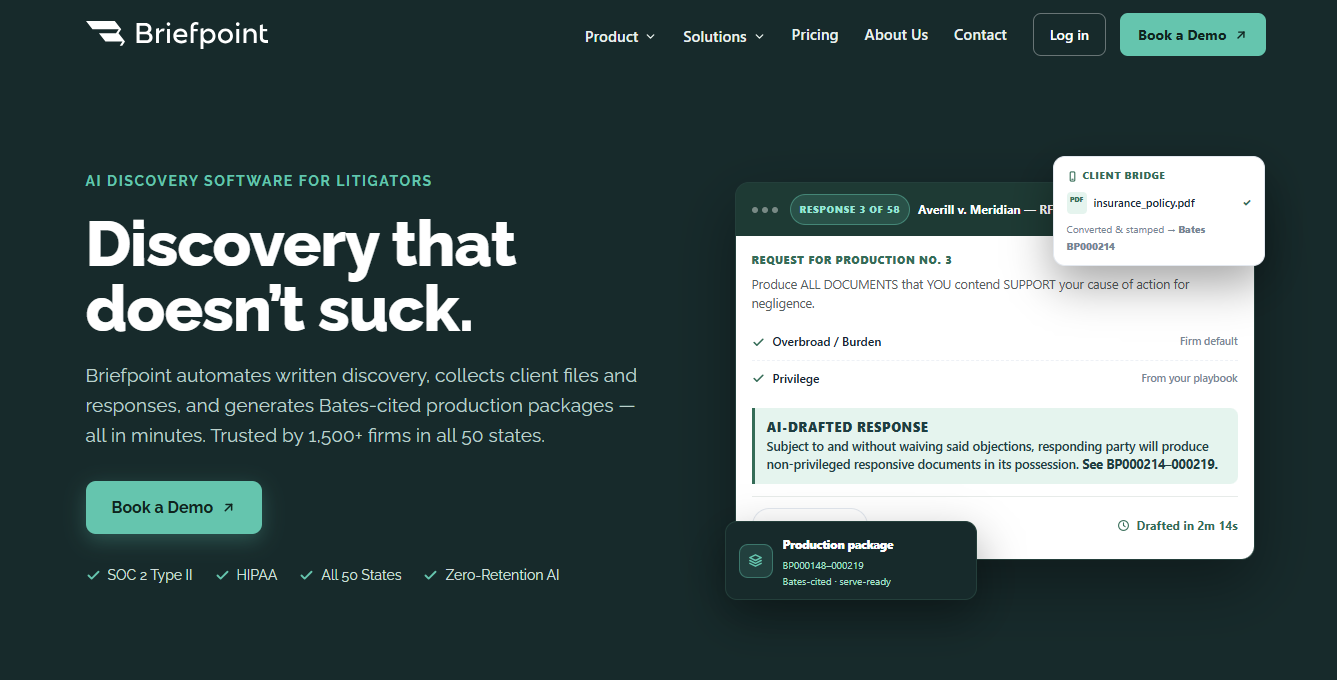
Of course, attorneys keep control over the final work. Briefpoint lets users confirm or deselect files, flag privileged materials, and edit the generated language in Word before service.
Briefpoint’s RFP automation is built specifically around litigation discovery and the work involved in responding to Requests for Production.
If your firm spends hours mapping production documents to individual requests and drafting responses, automating those steps can make the process much easier to manage.
See how Briefpoint can simplify your next RFP response and production. Book a demo today.
