RFP Responses Examples: How to Respond to Common Requests
What Is a Request for Production?
A request for production is part of the discovery process in a lawsuit. It’s a formal written request that one party sends to another, asking for documents, records, or files that contain necessary information about the case.
These could include:
- Contracts
- Emails
- Reports
- Financial statements
- Any materials that help clarify the facts in dispute
The goal of an RFP is to make sure both sides have access to the same information before going to court. This makes sense because it allows each party to prepare its arguments based on complete and accurate evidence.
When a law firm receives an RFP, it reviews each request carefully, gathers the relevant materials, and decides which documents can be shared. Privileged or confidential data must be reviewed and redacted before being produced.
Managing the RFP process manually takes time and increases the chance of missing important files. To handle it more efficiently, many firms use RFP automation tools that organize, tag, and produce documents automatically.
This saves hours of work and gives both the firm and the client confidence that every request has been handled correctly and consistently throughout the discovery process.
What Makes a Strong RFP Response
A strong RFP response depends on the case, the client, and the type of legal documents requested. But usually, here’s what makes an RFP response clear, defensible, and useful to both sides.
- Complete and accurate: It includes all the information requested, organized by request number and supported with clear references or exhibits.
- Concise and focused: The response avoids unnecessary detail and keeps the language direct. Each answer should make sense without long explanations.
- Well-structured: Every response lists the request first, followed by the reply. This helps readers follow the document easily.
- Relevant and precise: The response focuses only on materials related to the request and avoids mixing unrelated topics.
- Transparent: When documents are withheld or redacted, the reason is clearly stated. This helps demonstrate fairness in the discovery process.
- Professional tone: Even when objecting, the wording stays neutral and polite.
Sometimes, it’s also helpful to include additional information that clarifies how the data was collected or reviewed.
Overall, a good RFP response should demonstrate that the producing party handled the process carefully and in good faith. This shows both preparation and respect for the opposing side’s right to review evidence.
Common RFP Response Examples
These examples show how law firms usually structure their replies to different types of requests for production. They’re based on common discovery situations and demonstrate how to stay professional, clear, and compliant with court rules.
Each sample RFP response reflects a different scenario:
1. Full Compliance Response
A full compliance response is used when the request is clear, properly limited, and seeks documents that are relevant and non-privileged. In this situation, the producing party has no basis for objection and can provide everything requested.
This type of response is common when the documents are easy to identify and directly tied to the client’s problem at the center of the case. It also demonstrates transparency and supports regulatory compliance when accurate record production is required.
Request No. 1:
Produce all contracts signed between Plaintiff and Defendant from January 2021 through December 2023.
Response:
Defendant will produce all responsive documents. The legal team reviewed every contract within the requested time frame, confirmed that each document is accurate and complete, and attached the full set as Exhibit A.
No documents are being withheld. All materials were collected directly from the client’s files and verified before submission.
This example shows a thorough, direct reply written in active voice. It explains what actions the team took (reviewing, confirming, and attaching) and makes it clear that production is complete.
The language is confident, transparent, and easy to read, which helps maintain credibility during discovery.
2. Partial Compliance Response
A partial compliance response comes into play when a request goes beyond what the case actually requires. Some portions may be relevant and appropriate for production, while others reach too far in time, scope, or subject matter.
In those moments, the goal is to respond carefully rather than broadly. A disciplined process helps separate what truly relates to the dispute from what does not, which reduces the risk of critical errors.
Clear drafting that mirrors the client’s language also keeps the response tight and avoids unnecessary words that can create confusion later.
Request No. 2:
Produce all internal emails between company executives regarding the product recall from 2020 to 2023.
Response:
Defendant objects to this request as overly broad and not limited in scope or time. After review, the legal team identified relevant communications concerning the Model X recall between March and August 2023.
Defendant will produce those emails as Exhibit B. All unrelated or privileged communications have been withheld.
This one shows how to comply in part while keeping the response reasonable. It demonstrates that the team reviewed the request, narrowed the focus, and provided only what was relevant.
Plus, the wording stays factual and professional, which acknowledges the discovery objection but still shows cooperation and good faith in the production process.
3. Objection Due to Scope or Relevance
An objection based on scope or relevance is appropriate when a request stretches beyond the issues in dispute or seeks detailed information that does not meet the legal criteria for discovery.
Courts generally look at factors such as proportionality, relevance, and burden, so the response should reflect those considerations.
Before you submit an outright refusal, it takes careful review and effort to confirm that the materials truly fall outside proper bounds. When drafted clearly, this type of objection protects sensitive information while showing that the decision rests on defined standards.
Request No. 3:
Produce all employee performance evaluations from 2018 to 2024.
Response:
Defendant objects to this request on the grounds that it seeks irrelevant and confidential information not related to the issues in dispute. The request also lacks reasonable limits in time and subject matter. No documents will be produced in response.
This response shows a clear and professional objection. It explains the reason for refusing production (irrelevance and confidentiality) without unnecessary language. The response stays direct and avoids emotional or defensive wording.
A well-written objection like this helps protect client data while keeping the tone neutral and respectful, which can make future negotiations or revisions to the request smoother.
4. Clarification or Request for Narrower Terms
A clarification response is useful when a request is too vague to answer as written. Sometimes the wording lacks key dates, specific entities, or technical details that would allow for a focused search.
Rather than guessing and risking overproduction, the responding party can ask for more detail and propose narrower terms.
This approach keeps the process efficient, avoids confusion across larger matters involving more clients, and shows a willingness to cooperate while maintaining reasonable limits.
Request No. 4:
Produce all documents related to communications with third-party vendors.
Response:
Defendant objects to this request as vague and overly broad. It is unclear which vendors or time period the request covers.
Defendant requests clarification or a narrower scope limited to specific vendors and relevant projects. Once clarified, Defendant will review and produce responsive documents.
This type of response shows professionalism while maintaining control of the discovery process. It acknowledges the request, identifies the pain points, and invites clarification instead of rejecting the RFP issuer outright.
That approach demonstrates cooperation and helps avoid unnecessary disputes about scope or interpretation later in the case.
5. Extension or Need for Additional Time
An extension request is appropriate when the volume or complexity of materials makes immediate production unrealistic. Large document sets, archived business records, or the need for deeper research can require more time to review properly.
Asking for sufficient time signals diligence, not delay. It shows that the responding party intends to provide a complete and accurate production rather than rush through the process.
When handled professionally, this type of response reflects responsible case management and helps maintain working relationships throughout discovery, especially in matters involving ongoing services or operational records.
Request No. 5:
Produce all reports and internal communications concerning the termination of the joint venture.
Response:
Defendant has begun collecting and reviewing the requested materials, but requires additional time to complete the process. The legal team expects to finish review and production within 14 days.
Defendant will notify Plaintiff immediately once the responsive documents are ready for delivery.
This example reflects a practical and honest update. It shows that the responding party is taking action, managing the workload responsibly, and keeping communication open.
RFP Formatting and Best Practices
A well-organized response makes the legal drafting process smoother and helps both sides review materials without confusion. Consistency across documents is key, especially when handling multiple RFPs in one case.
A clear format also reduces errors and gives the court more insight into how the documents were collected and reviewed.
Here are a few best practices for creating an effective RFP response:
- Use a clear structure: List each request, followed by its response. Keep numbering consistent throughout the entire process.
- Keep tone and language professional: Avoid unnecessary explanations or defensive language.
- Reference exhibits properly: Link each response to exhibits or attachments when relevant.
- Include an RFP cover letter: Summarize what’s being produced, note any objections, and provide contact details for follow-up.
- Work from a standard template: Templates save time, help maintain accuracy, and make future RFPs easier to manage.
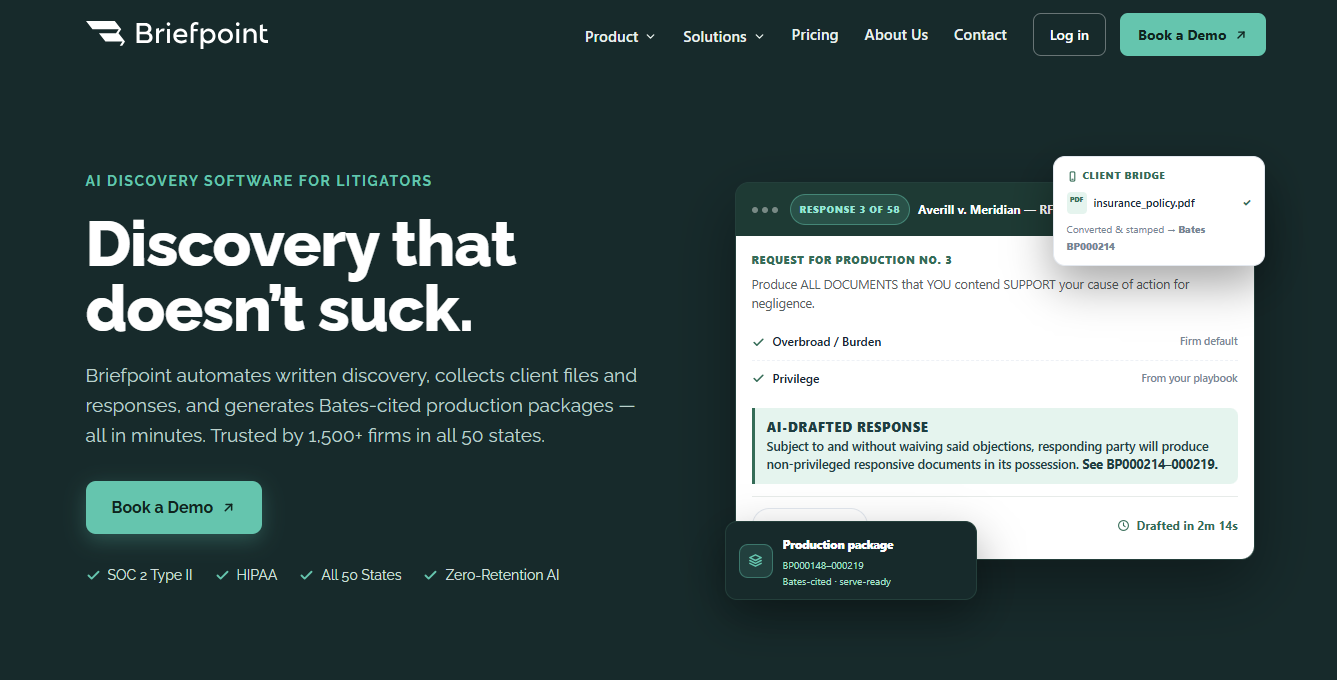
Automation tools like Briefpoint’s Autodoc make this far simpler. Autodoc auto-drafts every RFP, cites exact Bates pages, and packages the finished response with its production, ready for review in seconds.
In other words, it replaces weeks of manual review with one upload.
Book a demo to see it firsthand.
Automating RFP Responses
RFP software helps legal teams create accurate responses to requests for production as quickly and efficiently as possible.
It takes over the repetitive parts of the job, like collecting files, applying Bates numbers, formatting discovery responses, and organizing attachments. With those tasks out of the way, your team can focus on higher-level work.
If you’ve ever managed discovery manually, you know how time-consuming it can be to search through folders, rename files, and double-check references.
Automation replaces those steps with a structured system that identifies responsive documents, fills in RFP templates, and keeps everything consistent across cases.
Here’s what automated RFP tools often handle:
- Auto-draft responses: Build complete answers from uploaded files or data sources.
- Apply Bates numbers automatically: Assign clear page identifiers in seconds.
- Locate responsive materials: Detect and attach relevant files to each request.
- Support collaboration: Allow attorneys, paralegals, and other team members to review and edit in one shared workspace.
Automation lets your team spend less time on administrative work and more time supporting clients and refining case strategies.
It also keeps a reliable record of each action taken, so that every RFP response stays organized, consistent, and defensible throughout the discovery process.
End Repetitive RFP Work With Briefpoint Autodoc
RFP responses demand careful review, clear objections, accurate citations, and consistent formatting. Briefpoint helps your team handle those steps faster while keeping attorneys in control of the final response.
Upload the requests and production documents, and Autodoc drafts responses in seconds, links each answer to the exact Bates-numbered pages, and prepares a production package for review.
Every response remains fully editable, so your team can adjust language, confirm citations, and apply firm-specific preferences before service.
Briefpoint can also help you propound and respond to RFPs, RFAs, and interrogatories in every U.S. state and federal district. The platform supports AI-assisted objections, formatted Word exports, and reusable response language that keeps work consistent across matters.
For firms managing frequent or document-heavy discovery, Autodoc reduces manual review and gives attorneys a clearer path from production files to a finished response.
