How to Automate RFP Responses for Legal Discovery
How to Automate RFP Responses for Legal Discovery
A request for production can look manageable when it first lands in your inbox. Then you start working through dozens of requests, searching case files, checking what has already been produced, and drafting responses one by one.
A lot of those routine tasks follow a repeatable pattern, which makes them strong candidates for automation. The right tools can help you move through the RFP response process faster while keeping attorney review where it belongs.
So, how do you automate RFP responses without losing control over the substance? Start with the workflow itself.
1. Review the Requests
Start with the RFP documents exactly as they were served. Understand each request in context before you decide how to respond or what documents might be responsive.
Manual review usually means reading the full set and sorting RFP questions one at a time. RFP response automation can speed up the first pass by extracting individual requests and putting them into a structured workspace.
Your review should cover points like:
- What information or documents the requesting party is seeking
- Any defined terms that affect the scope of a request
- Requests that appear duplicative or unusually broad
- Potential privilege or confidentiality concerns
- Deadlines and procedural requirements
AI RFP software can help organize the RFP data, but attorney judgment remains important here. A request may appear straightforward while still raising an objection or requiring a narrower interpretation.
2. Organize Case Information and Documents
Your source material may include pleadings, correspondence, records, prior responses, and documents collected from the client. RFP response software can search those files much more accurately when the information is organized and accessible.
A practical setup might include:
- Case files
- Client documents
- Previous responses
- Prior productions
- Firm-approved objection language
Some automation tools connect with document repositories or services like Google Drive, while others require direct uploads.
Legal teams may organize prior responses, approved answers, and case materials in a content library or knowledge base. The software can then connect discovery requests with case-specific evidence.
Good knowledge management can reduce repetitive manual work later in the matter. It also lowers the chance that someone works from outdated answers or overlooks a useful source document.
3. Generate Draft Responses
Drafting each response from a blank page is one of the easiest parts of the RFP process to automate.
AI RFP response software can read the request and generate answers based on the information available to it. In legal discovery, the resulting language may include a substantive response, objections, or a statement explaining what responsive documents will be produced.
Good software should draft accurate answers from the available case record rather than inventing missing details.
You can use automation to generate:
- Draft responses to individual requests
- Standard language drawn from approved content
- Case-specific substantive answers
- Initial objections for attorney review
Natural language processing helps the software understand how each request is written and connect it with relevant answers or source material.
Response accuracy still depends heavily on the information supplied. An AI RFP platform cannot produce accurate responses from incomplete case files, so missing facts should be identified and resolved before the draft becomes final.
4. Apply Objections and Response Language
Many RFP responses contain language your firm has already used and approved in other matters. Rebuilding those sections manually wastes time and can create unnecessary inconsistencies.
RFP automation software can help apply preferred objections and standard response language to the appropriate requests.
Useful automation may include:
- Selecting discovery objections from firm-approved language
- Reusing approved answers where appropriate
- Applying jurisdiction-specific wording
- Flagging responses that require individualized review
A well-maintained knowledge base becomes particularly useful here. Rather than relying on whoever happens to remember how a similar request was handled, the software can draw from approved content or relevant past responses.
Legal review should still determine whether an objection actually fits the request. Automating responses should make the first draft easier to prepare, not turn standard language into an automatic answer for every request.
Review workflows can then route questionable responses to the right attorney before anything moves further through the RFP response management process.
5. Identify Responsive Documents
For document-heavy requests, locating responsive files can consume far more time than drafting the written response.
Traditionally, someone searches folders and opens individual documents before manually mapping them to each request. AI-powered RFP software can reduce much of that manual effort by comparing each request against the available case files.
The workflow can look like this:
- Upload the RFPs and available documents.
- Let the software analyze what each request seeks.
- Review the documents identified as potentially responsive.
- Remove privileged or irrelevant material.
- Confirm what should be included in the production.
AI agents and related automation tools can perform repetitive tasks such as document classification and matching, while a reviewer handles the decisions that require legal judgment.
A strong system should also show why a file was associated with a particular request. Transparent review makes it easier to check response accuracy and prevents the software from becoming a black box.
6. Review and Revise the Draft
Automation can get you much closer to a finished response, but the generated work still needs review.
Read each draft against the original request and the underlying case information. Look for language that is too broad, incomplete, unsupported, or inconsistent with another response.
Pay particular attention to:
- Factual accuracy
- Objections
- Responsive document selections
- Privilege issues
- Consistency with prior responses
Review workflows can make this stage easier when multiple people are involved. Collaboration tools can give attorneys, paralegals, and litigation staff a clearer way to review changes and manage assignments within the legal RFP response process.
Audit trails can provide another layer of visibility by recording changes and review activity.
Always remember that AI can help produce higher-quality responses and reduce drafting time, but careful review is still what turns a draft into work product you are comfortable serving.
7. Prepare Documents for Production
Once responsive documents have been approved, you need to turn the selected material into an organized production.
Depending on your workflow, RFP software may help with:
- Converting documents into the required format
- Applying Bates numbers
- Linking produced pages to individual responses
- Removing documents that should not be produced
- Building the final production package
A compliance matrix can help track requests and confirm that each one has been addressed.
For legal requests for production, each request should have a clear, traceable response.
Good automation software can connect the written response with the actual documents being produced. Linking the two reduces manual cross-checking and gives reviewers a clearer view of what supports each response.
Production preparation is a particularly valuable area for workflow automation because so much of the work follows repeatable rules.
8. Finalize and Serve the Response
Your last step is a complete review of the written responses and production package.
Confirm that every request has been addressed, the intended documents are included, and any Bates references match the actual production. Check objection language one final time and make sure privileged material has been handled appropriately.
Before service, confirm:
- All RFP responses are complete.
- Citations and document references are correct.
- The production matches the final response.
- Required formatting is in place.
Automation can help you respond faster, but the final decision to serve should stay with the lawyer responsible for the matter.
Once the response is complete, preserve the final version along with the underlying RFP documents. Previous responses can become valuable resources if a supplemental response is required later.
A well-organized record also makes future automation easier because the system has reliable past responses to reference rather than incomplete drafts or outdated answers.
Legal RFP Responses vs. Proposal RFP Responses
In legal discovery, RFP means request for production, whereas in procurement and sales, it normally means request for proposal. The two workflows may use similar terminology, but they require different software capabilities.
Commercial RFP platforms help proposal teams and proposal managers respond to RFPs, reuse past proposals, and answer the same questions in security and compliance questionnaires or due diligence questionnaires.
Features such as compliance matrix automation can help proposal professionals organize requirements, improve proposal quality, prepare winning responses, and monitor win rates.
These capabilities are useful for business proposals, but they do not replace the discovery-specific drafting, objection, document review, privilege, and production features that law firms need.
What Is RFP Automation Software?
RFP automation software is what can help you carry out many of the steps above with far less manual work. Rather than handling every request, draft, document search, and production task separately, the software can bring more of the RFP response process into one workflow.
Depending on the platform, it may help you:
- Review and organize incoming requests
- Generate draft responses and objections
- Search case files for responsive documents
- Match documents to individual requests
- Apply Bates numbers
- Prepare the final production package
Some platforms use natural language processing or AI agents to interpret request language and connect it with relevant case material.
What Features Should RFP Response Automation Software Have?
The best RFP response software should fit the legal discovery work you actually need to automate.
For legal RFP response automation, look for:
- Document analysis: The software should identify potentially responsive material from uploaded case files.
- Draft responses: It should create tailored responses based on the request and available information.
- Response management: You should be able to review, revise, and finalize individual answers efficiently.
- Production support: Look for capabilities that connect responsive documents to the written response.
- Knowledge management: Useful systems can preserve approved language and previous responses for later use.
- Review controls: Human reviewers should be able to verify selections and edit generated work.
- Security: Look for appropriate safeguards such as enterprise-grade security when sensitive legal documents are involved.
- Audit trails: Visibility into activity and edits can support internal review.
The learning curve deserves consideration too. Powerful automation software provides little benefit if routine work still takes excessive setup.
How Briefpoint Automates RFP Responses
Briefpoint is built specifically for legal discovery and automating requests for production.
For requests for production, Autodoc lets you upload the complaint, RFPs, and production or case files.
Briefpoint searches the uploaded material for documents responsive to each request, then generates an editable Word response with substantive answers and page-level Bates citations. It can prepare a Bates-numbered production package alongside the response.
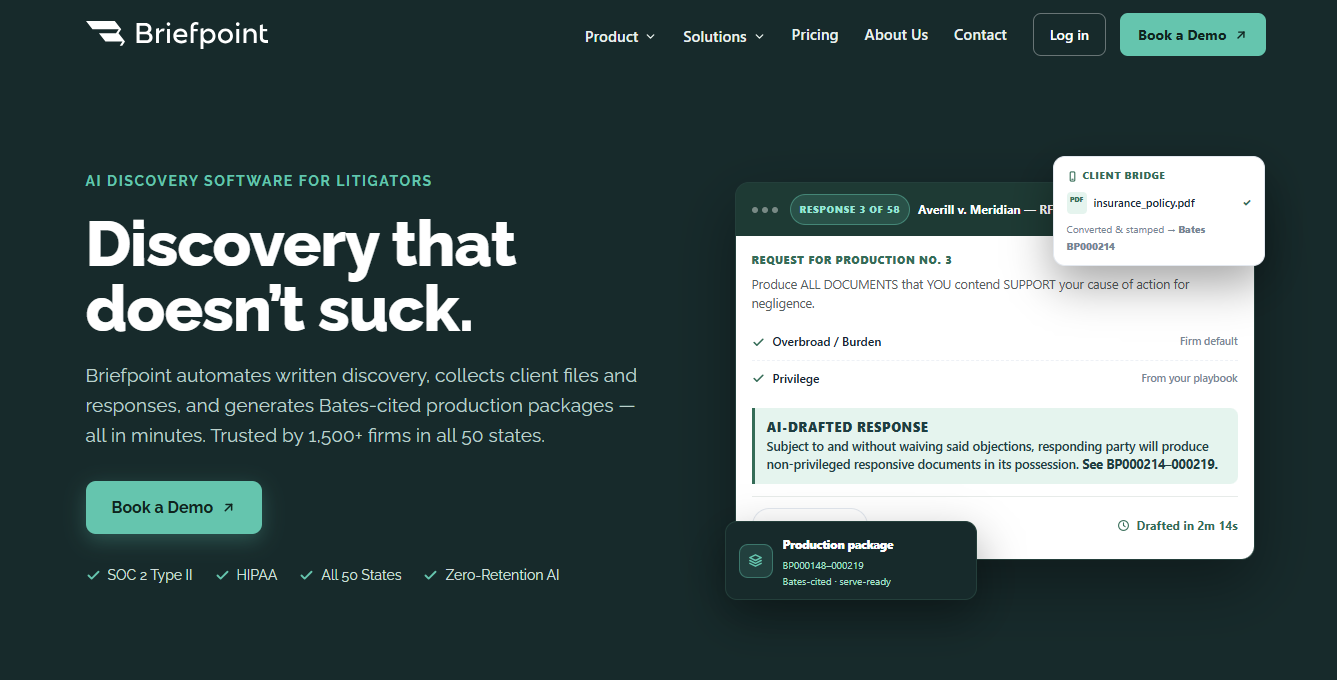
You can review the files it found, deselect documents, flag privileged material, and edit the response before service. Typical drafting runs about 3 to 10 seconds per request.
The platform also supports discovery drafting in all 50 states and 98 federal district courts. Supplemental Responses can update earlier discovery responses as the case develops rather than requiring your team to rebuild the set from scratch.
For firms trying to automate RFP work, the result is a connected workflow from incoming requests to attorney-reviewed production.
