How to Use AI for Privilege Review
What Is AI Privilege Review?
Privilege review is the process of examining discovery materials to determine which documents may be protected from disclosure, usually under attorney-client privilege or the work product doctrine.
In a manual privilege review, attorneys often have to go through large document sets one file at a time, which can take a lot of time when a case involves substantial discovery.
AI privilege review helps narrow that workload. Software can analyze document content, metadata, communication patterns, and prior coding decisions to identify potentially privileged documents for closer review.
For example, say a production contains thousands of emails between employees, outside counsel, and other participants.
An AI tool may flag messages that appear to involve requests for legal advice, then place those documents higher in the review queue. From there, an attorney can read the communication in context and decide how it should be handled.
How Does AI Work in Privilege Review?
Once you understand the basic role AI can play in privilege review, it helps to look a little closer at what may be happening behind the scenes.
Different AI tools use different methods, so the exact process can vary depending on the AI platform and how it was built, but common approaches include:
- Natural language processing: Some systems use natural language processing to analyze wording and context, which can help surface communications that appear to involve legal advice or litigation strategy.
- Metadata and relationship analysis: Certain tools may look at details such as senders, recipients, domains, and document relationships to help identify likely privilege candidates.
- Similarity and classification models: AI may compare documents with files that human reviewers have already coded, then flag similar material for review.
- Generative AI assistance: Some platforms use generative AI to summarize documents, explain why a file may be sensitive, or help reviewers work through large sets more quickly.
- AI prompts: In systems that support prompting, reviewers may use AI prompts to ask targeted questions about a document or communication.
7 Ways to Use AI for Privilege Review
AI can support privilege review in several practical ways, especially when you are working through a large volume of potentially sensitive material.
Here are seven ways you can use it to make the review process more focused and manageable:
1. Identify Communications Involving Attorneys
A useful first step is finding communications that involve lawyers or legal departments. Some AI tools can scan metadata and participant information to surface messages that may warrant closer attention during privilege review.
You might use AI to flag communications involving:
- Outside counsel
- In-house legal departments
- Known attorney email domains
- Employees contacting lawyers directly
- Attachments tied to legal discussions
Those signals can help you narrow a large document set much faster. They can also make it easier to spot conversations that contain privileged information or relate to legal advice.
For example, if an employee emails outside counsel about how to respond to a threatened lawsuit, the communication may be protected by attorney-client privilege. AI can help surface that exchange early so it reaches the right part of the review queue.
When you use it this way, AI supports privilege calls by helping you find communications that are more likely to deserve closer analysis.
2. Detect Language That May Indicate Legal Advice
AI can help pick up on wording that suggests someone is asking for legal guidance or responding to it. Depending on the platform, the system may look for phrases tied to obtaining legal advice, legal exposure, compliance concerns, or proposed next steps on a legal issue.
For instance, an email that says, “Can you advise us on our obligations before we respond?” is more likely to deserve a closer look than a routine update that simply copies a lawyer.
The same applies when an attorney arguably functions in both a business and legal capacity, since privilege analysis often depends on the purpose of the communication.
Language analysis can make it easier to pull potentially privileged content from a much larger document set. It may be especially useful when business leaders, employees who owe fiduciary duties, and legal personnel are all discussing the same issue from different angles.
Since attorney-client privilege protects communications made for legal advice, wording and context can provide useful signals during review.
3. Find Potential Attorney Work Product
Attorney work product generally refers to materials prepared in anticipation of litigation, often by lawyers or at their direction. The category can cover a wide range of legal work, such as internal strategy notes, draft arguments, witness preparation materials, and analyses of claims or defenses.
AI can help locate those documents by looking beyond obvious labels or file names. A system might consider the language in a document, its timing, the people involved, and how closely it connects to a dispute or other legal matters.
Say a law firm has thousands of files tied to a case. Notes created by contract attorneys after reviewing witness statements may be strong work product candidates, even if the documents are not clearly labeled as legal work.
Timing can be especially useful here. Materials created once litigation is underway, or when there is a reasonable expectation of litigation, may deserve more attention than similar documents created during ordinary business activity.
4. Group Related Email Threads and Document Families
Privilege review can become time-consuming when connected files appear in different parts of the document set. AI can help bring related material together so you can follow the surrounding context before making a decision.
Useful groupings may include:
- Email threads: Reconstruct longer conversations so you can see how a legal discussion developed over time.
- Parent documents and attachments: Keep attachments connected to the messages or files they came from, which can make document review easier to follow.
- Near-duplicate files: Surface similar versions of the same document so differences are easier to spot.
- Document families: Group related files together when privileged material may appear in one part of a larger set.
Organizing files this way can reduce the amount of manual work involved in piecing conversations back together. Plus, it gives human review a clearer picture of how each document fits into the broader legal work.
5. Prioritize Documents for Attorney Review
Large document sets can make privilege review feel like a sorting problem before it becomes a legal one. AI can help by ranking documents according to signals that may indicate a higher likelihood of privilege, so attorneys can spend their time on the files most likely to require closer analysis.
Higher-priority documents might include:
- Communications with outside counsel
- Messages sent for the purpose of obtaining legal advice
- Drafts tied to litigation strategy
- Documents similar to known privileged communications
- Files involving sensitive legal issues or specific circumstances
- Communications that include both legal and business discussions
Many practitioners already use some form of prioritization during document review, and AI can make that process more targeted. So, rather than moving through a collection in a fixed order, reviewers can start with the strongest privilege candidates and work outward from there.
That can be especially helpful when privileged communications make up only a small portion of a much larger production. It may also help surface a privilege problem earlier, which can give the legal team more time to investigate borderline documents before anything is produced.
6. Apply Privilege Decisions More Consistently
Once you have a solid set of privilege calls, AI can help you check how consistently those decisions are being applied to the rest of the collection.
Many tools use machine learning or similar classification methods to build privilege models from earlier coding and generate privilege predictions for related documents.
Say you have already marked several emails about the same legal issue as privileged. If a very similar message later appears among non-privileged materials, the system may flag it for another look.
The reverse can happen too, which can help you catch overinclusive coding before it creates extra work.
Consistency becomes even more important when several people review documents and make judgment calls at different points in the process. AI can help you compare those decisions and spot outliers that may deserve a second pass.
Courts have noted the importance of reasonable discovery procedures, and in some cases a court identified privilege issues on its own initiative. A more consistent review process can give you another layer of quality control before production.
7. Help Prepare Privilege Logs
Privilege logs can take a surprising amount of time to prepare, especially when the underlying information has to be pulled from hundreds or thousands of documents.
AI can help with the administrative side of that process by extracting details from documents and organizing them into a format that is easier to review.
Depending on the system, it may help pull information such as the date, sender, recipients, document type, and a short description of the subject matter. It can also help connect those details to earlier privilege coding or work completed under counsel’s direction.
For example, if your review set includes a large number of withheld emails, AI may generate draft log entries using the available metadata and document content. You can then refine the descriptions before the log is finalized.
Compared with a fully manual review, this can reduce a lot of repetitive data entry. It can be particularly useful when client data is spread throughout a large production, and you need a consistent way to organize the information that supports each privilege claim.
What Are the Benefits of Using AI for Privilege Review?
AI can make privilege review a lot easier to manage, especially when you are dealing with a large production, and only a small share of the documents are likely to be privileged. The main advantage is that it helps you get to the important material faster.
Some of the biggest benefits include:
- Faster review: AI can surface likely privileged documents early, which can cut down the time spent working through a fully manual review.
- Better prioritization: Communications tied to providing legal advice or litigation strategy can move higher in the queue.
- More consistent decisions: Similar documents can be compared with earlier privilege calls, making unusual or conflicting coding easier to catch.
- Stronger work product review: AI may help identify material that falls under work product protection, which protects materials prepared in anticipation of litigation.
- Less repetitive work: Tasks like pulling metadata or drafting privilege log entries can take less time.
- More room for legal judgment: Attorneys can focus on harder questions, including borderline privilege issues or legal research tied to a particular dispute.
For you, the practical benefit is a review process that feels less like sorting through everything manually and more like working from a better-organized starting point.
What Are the Risks of AI Privilege Review?
AI can speed up privilege review, but the risks are significant enough that you need clear controls around how the technology is used.
Privileged material is highly sensitive, and even a strong system can miss context or handle data in ways that create problems later.
Key risks include:
- Inaccurate privilege predictions
- Overreliance on automated classifications
- Sensitive client data being sent to a third-party platform
- Data being retained for model training or other training purposes
- Unclear access controls or storage practices
- Inconsistent treatment of mixed legal and business communications
- Disclosure risks involving regulators or government authorities
- Loss of context in long email threads or document families
- Weak audit trails for privilege decisions
Security and confidentiality deserve particular attention here. Before using an AI tool, you should at least understand how it stores data, who can access it, and what happens to submitted documents after processing.
Privilege also rests heavily on the trusting human relationship between lawyer and client. Technology can support the review process, but careless handling of protected communications can create consequences that are difficult to reverse.
Pair AI Privilege Review With a Faster Discovery Workflow
AI can make privilege review easier to manage when discovery involves a large volume of documents.
It can help you surface likely privileged communications, identify potential work product, organize related files, prioritize review, and prepare privilege logs with less manual effort.
The bigger advantage comes from using AI as part of a broader discovery workflow. Once privilege issues are sorted out, the next challenge is getting responses drafted, client information collected, and production materials ready to serve.
Briefpoint can help with that part of the process.
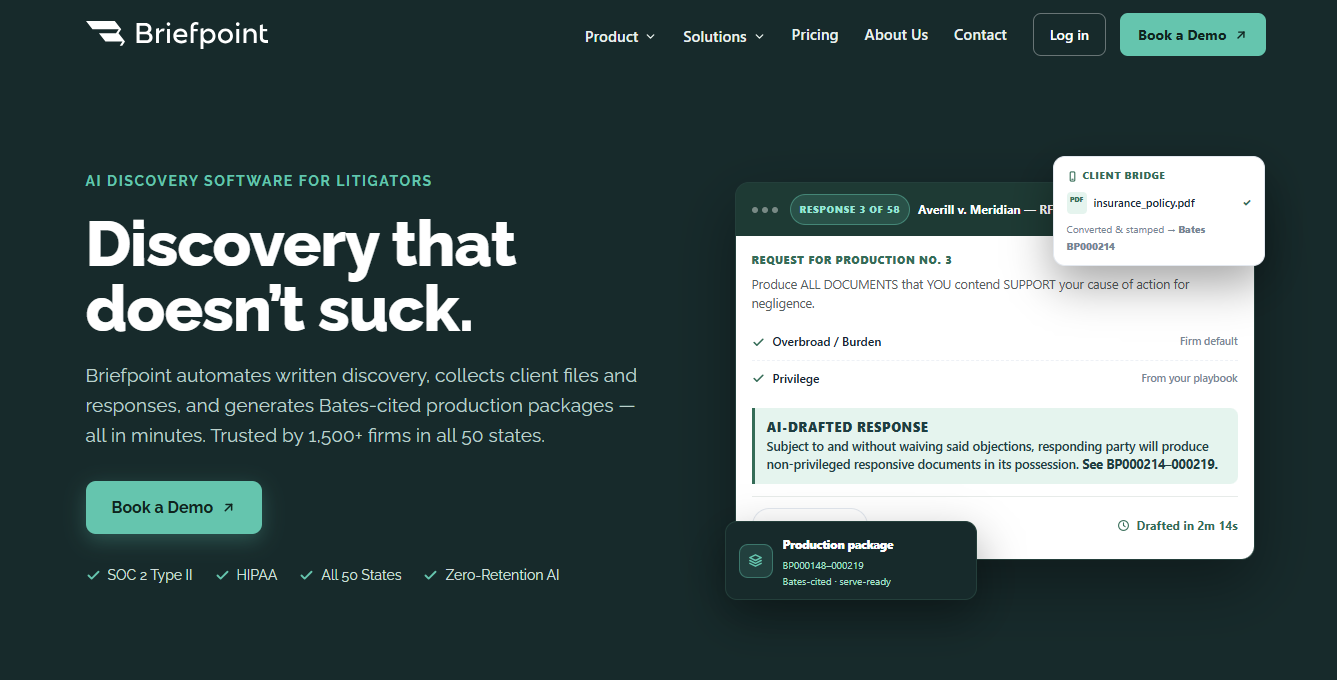
The platform automates written discovery, collects client files and responses, finds documents responsive to RFPs, and generates Bates-cited production packages. It also supports discovery workflows in all 50 states and 98 federal district courts.
If you want to spend less time on repetitive discovery work after privilege review, book a Briefpoint demo and see how much of the remaining process you can automate.
