What an AI Legal Assistant Can Do for Your Firm
What Is an AI Legal Assistant?
An AI legal assistant is software that helps you handle routine legal work with less human input and manual effort. Basically, it responds to written instructions and uses the information you provide to complete a specific task.
In some cases, the tool may focus on one area, such as discovery drafting. Other platforms support a wider part of your legal workflow and can help with document review or first drafts.
For you, that can mean less time spent starting from a blank page. It may also make repetitive work easier to manage when a matter involves a large volume of information.
At the same time, not every AI assistant is built for legal use. Specialized legal AI is designed around common legal documents and the way law firms already work, which can make it a better fit than a general writing tool.
As these platforms continue to develop, an AI assistant is becoming a practical option for firms that want to move routine legal work along more efficiently.
How Do AI Legal Assistants Work?
AI legal assistants use language models and other forms of machine learning to interpret your instructions. You enter a request in everyday language, and the software analyzes the words, context, and any documents you provide before generating a response.
The process usually involves a few core technologies:
- Natural language processing: This allows the tool to understand legal questions and identify what you are asking it to do.
- Large language models: These models recognize patterns in written material and generate new text based on your prompt and source files.
- Document analysis: Some platforms can search case materials, extract relevant details, and connect information found in different files.
- Workflow automation: Specialized tools apply the technology to routine tasks, such as preparing discovery drafts or reviewing contracts.
The results depend heavily on the information available to the platform. A general AI assistant may rely mostly on your prompt, while legal software can use uploaded matter files or structured templates.
Despite labels such as “AI lawyer,” these tools function as software systems rather than independent legal professionals. Their capabilities also vary, so one platform may answer general legal issues while another is built for a specific workflow.
Practical Uses for an AI Legal Assistant
An AI legal assistant can support many parts of your day-to-day work, though its uses are not limited to the examples below.
Here are some of the most practical ways legal teams are putting these tools to work:
Finding Relevant Legal Authority
Legal research can take hours when you are working through a broad issue or dealing with unfamiliar case law. An AI legal assistant can help narrow the field by searching available data and pointing you toward potentially useful citations.
For example, you could ask the tool to find cases discussing a specific discovery dispute in your jurisdiction. From there, it may return a short list of authorities and explain how each one connects to your question.
Still, the quality of the result depends on the platform and the resources it can access. In general, tools connected to reliable legal databases are better suited for this work than general-purpose assistants, since legal knowledge needs to come from current and verifiable sources.
Preparing First Drafts
An AI legal assistant can give you a workable first version based on your instructions and the source material you provide.
Depending on the type of document, that support may include:
- Letters: Draft routine correspondence using the facts, purpose, and tone you specify.
- Clauses: Suggest language for a particular provision or revise existing wording to fit the situation.
- Summaries: Turn a long document into a shorter overview that highlights the information you need.
- Wills: Help organize initial language from client details and a selected template.
You can also refine the draft through follow-up prompts. For example, you might ask for clearer wording or a version that matches your firm’s usual style. This makes the tool useful for getting the structure in place before the document moves further through your workflow.
Reviewing Contracts
Contract review can slow things down when you need to compare dense language against your legal needs. An AI legal assistant can help you move the process forward by flagging unusual terms and drawing attention to sections that may need a closer look.
For instance, you might upload a vendor agreement and ask the tool to identify clauses that differ from your preferred language. It could point out a broad indemnity provision or a renewal term that deserves more attention.
One advantage is speed. Rather than reading every page with the same level of focus from the start, you can use the tool to highlight likely pressure points and give the review a clearer direction.
The usefulness of that output will still depend on how well the platform understands the contract and the context you provide.
Handling Discovery Work
Once discovery begins, the volume of requests and documents can grow quickly. A specialized AI legal assistant can take on parts of that workload and help keep the process organized.
Its capabilities may include:
- Drafting requests: Prepare interrogatories or requests for production from the case details you provide.
- Preparing responses: Create initial answers and objections for review.
- Reviewing documents: Match potentially responsive files to individual requests.
- Organizing production: Prepare covered materials with Bates numbers and supporting response language.
Some platforms also collect client input through a secure link, then place those answers into the correct requests. That ability can reduce manual copying and make the overall workflow easier to track.
The level of support will depend on the software. General legal services tools may offer basic drafting, while discovery-focused platforms are built around the specific demands of litigation practice.
Keeping Case Information Organized
One useful role for an AI legal assistant is giving your team a clearer view of the information already in a matter. It can make case files easier to search and help connect details that sit in separate documents.
For example, you could ask for references to a specific witness, a summary of recent filings, or insights tied to a particular issue. That gives you a faster way to locate context before you decide what to review more closely.
Some platforms can also track new material as it is added, which helps everyone stay up to date without relying on scattered notes. The result is a more accessible case record that supports faster handoffs and fewer repeated searches.
Supporting Client Communication
AI can help with the routine messages that take up more time than they should. That may be a quick update before an appointment or a chat response to a basic question.
Common uses include:
- Drafting client updates
- Preparing appointment reminders
- Writing follow-up messages
- Answering simple chat questions
- Sending instant status updates
- Organizing intake responses
For your team, this can make it easier to keep communication moving without writing every message from scratch. Clients also get clearer updates and fewer long gaps between replies, which can build confidence in the way their matter is being handled.
Of course, certain conversations will still need a personal response, particularly when the topic is sensitive, or the client needs detailed guidance. Routine communication, though, is often a good fit for AI support.
What to Look for Before Choosing a Tool
The right AI legal assistant should fit the work your team already handles and give you clear answers about how it uses your information. Before choosing a plan, look closely at the features that will affect everyday use.
Key factors include:
- Legal fit: Check that the platform is trained for the work you handle rather than offering general web-based assistance.
- Confidentiality: Find out how client information is stored and if files are encrypted during transfer and at rest.
- Data use: Confirm if your prompts or documents are used to train the system.
- User controls: Look for permissions that let you decide which users can access each matter.
- Pricing: Compare the total cost of the plan, including usage limits and charges for additional seats.
- Workflow compatibility: Test how easily the app fits into your current process and what manual work will remain.
- Support: Ask what happens when the tool cannot complete a task or the output does not pass review.
Put AI to Work Where It Counts
An AI legal assistant is most useful when it supports a clear part of your workflow. General tools may help with research or first drafts, while specialized software can take on work that follows a more defined legal process.
Briefpoint is built specifically for written discovery.
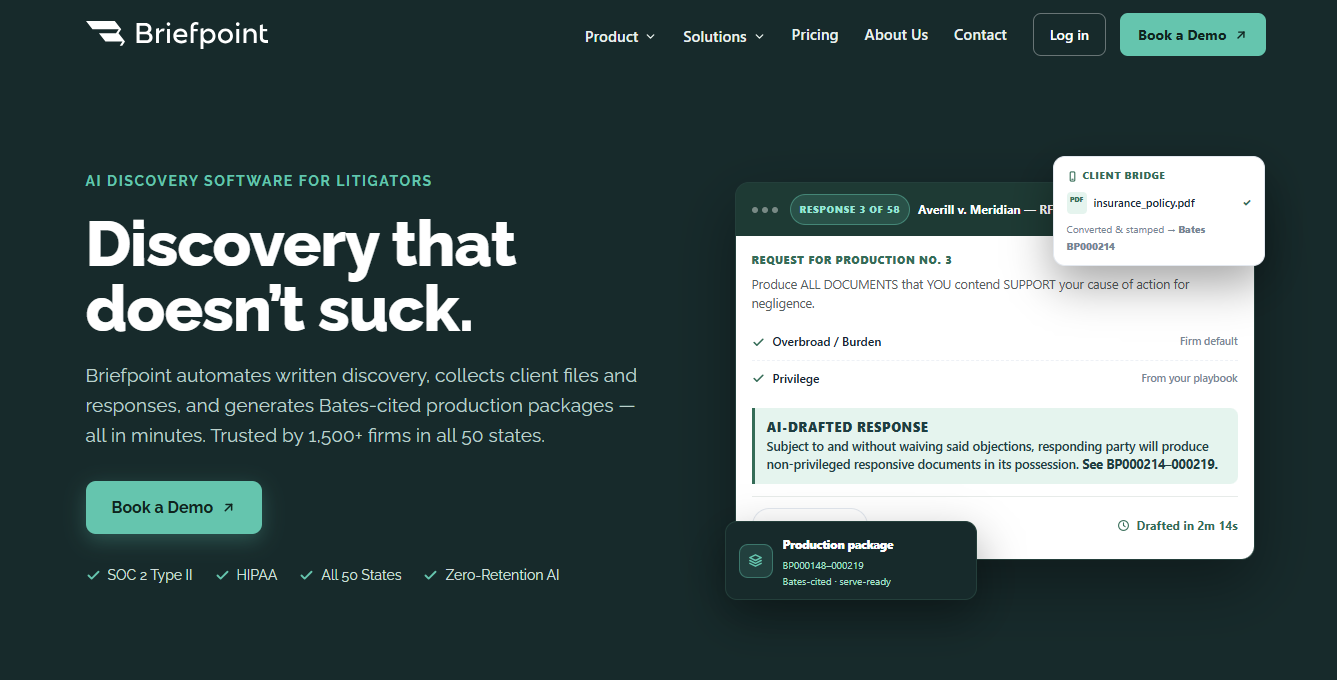
Autodoc reviews case files for responsive documents, then prepares Bates-cited Word responses and a Bates-numbered production package.
Meanwhile, Client Bridge collects client answers and files through a secure link, while Supplemental Responses lets your team update prior discovery responses without rebuilding the document.
The platform also supports interrogatories, requests for admission, and requests for production in every U.S. state and federal district court.
Book a demo to see how Briefpoint can reduce the manual work surrounding discovery.
