What Happens During the eDiscovery Process?
What Happens During the eDiscovery Process?
Most cases now involve a huge amount of digital material. Emails, cloud files, text messages, business records, and other electronic records can all contain facts that affect the outcome of a dispute.
The eDiscovery process gives legal professionals a structured way to find and handle all that material. A good workflow helps you narrow down relevant data, preserve it properly, review it for legal significance, and produce what the other side is entitled to receive.
Much of the work happens long before anyone sends a production. You have to identify where information lives, decide what should be preserved, collect it in a defensible way, and reduce a potentially enormous data set into something attorneys can realistically review.
Here’s how the process works from beginning to end, along with the challenges that can make eDiscovery expensive and the technology that can make the workload easier to manage.
What Is eDiscovery?
eDiscovery, short for electronic discovery, is the process of identifying, preserving, collecting, reviewing, and producing electronic information that may be relevant to a lawsuit or another legal proceeding.
The information involved is commonly called electronically stored information (ESI). ESI can include digital material such as email, electronic documents, database records, mobile data, and content stored in business applications.
Electronic discovery is closely connected to the broader discovery process, but the digital nature of the evidence creates extra considerations.
A spreadsheet, for example, may contain metadata that would never appear on a printed copy. Or a conversation could exist in a messaging application even though no equivalent paper documents exist.
Legal teams may need eDiscovery during the civil litigation process, internal investigations, or inquiries from regulatory agencies. The process can involve huge volumes of electronic data, so identifying and narrowing the material early can have a significant effect on the amount of work required later.
The Main Stages of the eDiscovery Process
The eDiscovery Reference Model, often called the EDRM, is commonly used to describe the major stages involved in handling electronic evidence.
However, real cases do not always move through those stages in a perfectly straight line since there are a lot of variables that can enter the picture.
Still, breaking the work into clear stages makes a large eDiscovery project easier to understand and manage.
1. Identify Potential Sources of Relevant Information
The identification phase starts with a basic question: Where could useful information be located?
Legal teams first need to understand the factual issues in the case and identify people who may have created, received, or stored potentially relevant information. From there, they can map the systems and devices that could contain evidence.
Possible data sources may include company email accounts, cloud storage, employee laptops, collaboration tools, or business databases.
However, less obvious sources can become important too. Mobile data and social media posts, for instance, may contain communications directly connected to a dispute.
A legal team investigating a contract dispute might begin with the people involved in negotiations, then trace where their communications and drafts were stored. That may lead to email accounts, a contract repository, or shared folders.
Still, good data identification does not mean collecting every file a company possesses. The initial task is to determine where potentially relevant data may exist and define a reasonable scope.
An early case assessment can help here. Attorneys can examine the claims, likely custodians, time periods, and estimated data volume before committing resources to a large collection. That way, the team has a clearer picture of the data identified for possible preservation and collection.
2. Preserve Electronically Stored Information
Once relevant sources are known, attention turns to data preservation.
Organizations may have ordinary deletion policies that automatically remove old email or other electronic records. Employees may replace devices, delete files, or leave the organization. So, relevant material can disappear if normal practices continue after a duty to preserve has arisen.
A legal hold is commonly used to tell custodians that certain information must be retained. The instructions should be clear enough that recipients understand what information is covered and what they need to do.
Preservation can apply to much more than files sitting on a computer. Potentially relevant ESI might exist in cloud applications, messaging systems, or other places where data can change quickly.
Teams should document their preservation work as well. Records showing when a hold was issued, which custodians received it, and how sources were protected can become important if preservation is later questioned.
Strong information governance can make the job considerably easier. Organizations that already understand their retention systems and data storage practices can usually respond faster when litigation begins.
3. Collect Potentially Responsive Data
Preserved information must then be gathered for review.
Data collection can range from a relatively small export of an employee’s mailbox to a much larger effort involving several systems. Collection methods need to account for the original characteristics of the data, including metadata that may carry evidentiary significance.
The volume can grow quickly. A few custodians may generate thousands of messages and attachments over the relevant period, while larger organizations may hold terabytes of digital data.
For example, a workplace dispute could require collection from an employee’s email account and internal chat history. A commercial case may involve files stored in cloud storage or records held inside a business application.
Collection therefore needs to remain tied to the scope established earlier. Pulling every available file may increase eDiscovery costs while filling the review database with irrelevant data.
Security deserves close attention during collection as well. Case files can contain personal information or privileged and confidential information. Organizations may have obligations under data privacy rules, internal policies, and applicable data protection regulations.
A defensible collection process should account for both discovery obligations and data protection concerns while maintaining a clear record of how the electronic data was obtained.
4. Process and Prepare Data for Review
Raw collected data is rarely ready for attorney review. The processing phase converts the collection into a form that can be searched and reviewed efficiently.
Common processing steps include:
- Removing duplicate files so reviewers do not examine identical material repeatedly
- Extracting searchable text from electronic documents
- Grouping related emails and attachments so reviewers can follow a conversation
- Filtering records by date, file type, or other case-specific criteria
Processing can significantly reduce the review population. For instance, a collection may contain the same attachment in hundreds of inboxes. Processing technology can identify those duplicates before attorneys spend time reviewing them individually.
Plus, filters can remove clearly irrelevant data, while other tools can organize structured data, such as database exports, into a more usable format.
The resulting review set gives attorneys a more manageable collection of potentially relevant documents for further analysis. The exact steps used to process data will vary based on the file types, source systems, and software involved.
5. Review Documents for Relevance and Privilege
The review phase is where attorneys begin deciding what the collected material means for the case.
Reviewers typically determine if an item is responsive to a request and if it contains relevant information. They may need to apply issue tags or identify material requiring special treatment due to privilege or confidentiality.
Document review can be one of the most labor-intensive parts of eDiscovery because the review population may still contain thousands or millions of items after processing.
Technology can reduce some of the burden. Search tools can narrow documents based on keywords or other criteria, while predictive coding and advanced analytics can help prioritize material that appears more likely to be relevant.
Nevertheless, human judgment remains central. Legal teams review documents in light of the claims, defenses, requests, and governing rules. Software may help organize the workload, but attorneys still have to evaluate legal significance and privilege.
For example, a keyword search might surface an email discussing a disputed payment. The reviewer still needs to determine if the message is actually relevant, responsive to a request, or protected by attorney-client privilege.
A well-managed review process should include quality checks so coding decisions remain consistent. Reviewers may also revisit earlier decisions as their understanding of the evidence develops.
6. Analyze Evidence and Key Case Information
Review determines which documents deserve attention. Analysis asks what those documents tell you.
Attorneys can use the reviewed material to identify important events, test factual theories, and connect communications with other evidence, just to name a few functions.
Modern eDiscovery technology can support the analysis of digital evidence through search and visualization tools. Advanced analytics may reveal patterns involving communication or recurring concepts that would be difficult to spot through linear review alone.
Analysis may help legal teams:
- Build a timeline from emails, messages, and other electronic records
- Identify communication patterns between key custodians
- Compare statements against supporting documents
- Find additional records that deserve further analysis
The analytical stage can support litigation strategy as well as internal investigations. Investigators may use electronic information to establish how an event unfolded or identify additional people whose records deserve examination.
Strong analysis depends heavily on the quality of the earlier stages. Poor collection can leave gaps. Overly broad processing can bury useful evidence. Inconsistent review can make relevant documents harder to find.
When each stage has been handled carefully, the legal team can work from a cleaner set of relevant evidence and make better-informed decisions about the case.
7. Produce Responsive Documents
Once review is substantially complete, responsive material must be prepared for production.
Producing electronically stored information can involve several technical and procedural choices. Parties may agree on production formats early in the case, while court rules can influence how material should be exchanged.
Some files may be produced in native form, and others may be converted into image-based formats. Productions can include metadata fields or accompanying load files when required.
Redactions need careful handling when a relevant document contains information that should not be disclosed. Privileged material may need to be withheld and documented separately according to applicable requirements.
Teams may apply Bates numbers so individual pages or files can be referenced consistently later in the case. Production sets should also be checked before release to confirm that withheld or excluded material has not been included inadvertently.
Federal litigation can bring additional obligations under the Federal Rules of Civil Procedure, while state civil procedure rules may impose their own requirements.
Remember: The exact production approach depends on the forum, agreements between the parties, and the nature of the electronic information.
8. Manage Post-Production Discovery Work
Production rarely marks the end of discovery activity. The other side may raise questions about missing information, challenge search methods, or request clarification about a production. New facts can surface as depositions occur or additional records become available.
Legal teams may need to conduct supplemental searches or review newly discovered electronic records. Another custodian could become relevant, for example, or previously unavailable files might need to be collected.
Keeping a clear record of earlier decisions makes later work much easier. Teams should be able to trace which sources were searched, what date ranges were used, how documents were reviewed, and what was ultimately produced.
Post-production work may include supplemental productions when additional relevant documents are identified.
A closing review can be useful once the case is complete. Legal departments and law firms can examine where delays occurred and refine their data management practices before the next case begins.
Common Challenges During eDiscovery
Even an effective eDiscovery process can become expensive when the volume or complexity of information grows.
One common challenge is simply finding all of the potentially relevant material. Business data may be spread between employee devices and cloud systems. Newer sources, such as collaboration applications, can add another layer of complexity.
Other frequent problems include:
- Excessive data volume: Collecting too broadly can leave reviewers sorting through large amounts of information with little connection to the dispute.
- Preservation issues: Weak legal hold procedures can create questions about missing or altered evidence.
- Review costs: Large document populations can require significant attorney time, particularly when review is mainly manual.
- Privacy concerns: Collections may contain employee records or other sensitive information governed by data privacy obligations.
- Changing technology: New communication tools and emerging trends in workplace technology continually create new forms of electronic information.
- Regulatory obligations: Litigation procedures can overlap with regulatory compliance duties or separate regulatory requirements.
Storage creates costs too. Large case databases can require substantial data storage, particularly when originals, processed files, and production copies all need to be retained.
The best way to control complexity is to make deliberate decisions early. Narrower collection criteria and clear preservation practices can reduce unnecessary work later while still supporting applicable legal and regulatory requirements.
How Can eDiscovery Software Help?
eDiscovery software helps legal professionals manage large quantities of electronic data more efficiently than a purely manual workflow.
A typical document review platform lets reviewers search, filter, tag, and organize documents in one workspace. Some systems add analytics that help identify related records or prioritize material for review.
Modern tools can support several parts of the workflow, such as:
- Collection and processing: Software can bring electronic records into a searchable environment and prepare them for review.
- Search and review: Reviewers can use filters, coding tools, and search criteria to narrow the document population.
- Analytics: Features such as predictive coding can help surface material that may deserve earlier attention.
- Collaboration: Built-in collaboration tools can help reviewers coordinate decisions and track progress.
- Production: Some platforms can prepare reviewed records in agreed production formats while preserving related metadata.
Cloud-based eDiscovery solutions can make large review environments easier to scale.
All things considered, the right eDiscovery software depends on expected data volume, security needs, review complexity, and existing legal processes. Good software should enable legal teams to reduce routine technical work while keeping legal decisions in attorneys’ hands.
Where Briefpoint Fits Into the Discovery Process
eDiscovery platforms often focus on collection, data processing, review, and analysis.
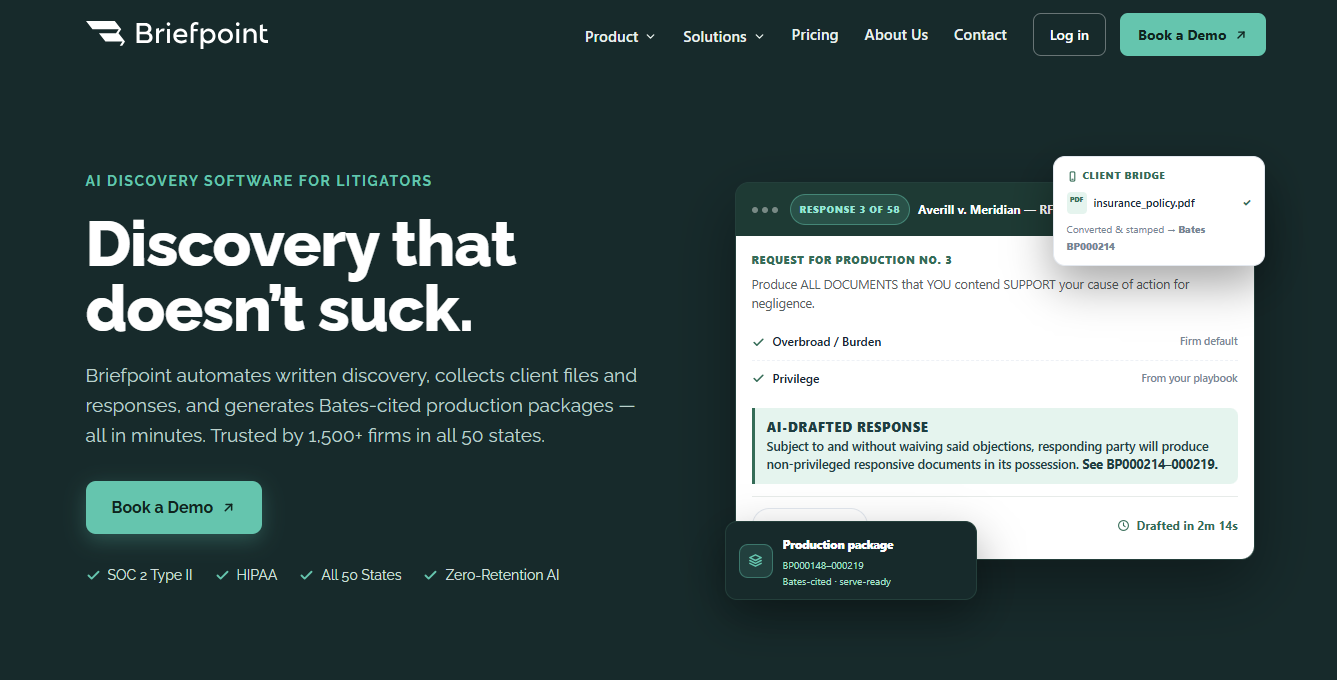
Briefpoint handles a later part of the discovery process, where responsive case files need to become written discovery responses and production packages.
For requests for production, Briefpoint’s Autodoc can search uploaded case files for responsive documents, generate Word-formatted responses with Bates citations, and prepare a Bates-numbered production package.
Briefpoint can also help draft and respond to interrogatories, requests for admission, and requests for production in the applicable jurisdiction’s format.
Client Bridge lets clients provide responses and upload documents for attorney review, while Supplemental Responses can incorporate new information later.
For modern legal teams and law firms, Briefpoint can reduce the manual work involved in turning responsive files into discovery work product while keeping final review in attorney hands.
