A Clear Legal Discovery Definition for Lawsuits
A Clear Legal Discovery Definition for Lawsuits
Discovery is one of the most important stages of a lawsuit because it gives both sides access to information they may need before trial. It can involve written questions, document requests, depositions, and other methods of gathering evidence.
If you are new to litigation, the process can seem broad at first. What can you ask for? What does the other side have to provide? And how does all of that information actually get used?
Understanding the legal discovery definition gives you a useful starting point. Below, we’ll break down what discovery means, why it plays such a major role in litigation, the main types you may encounter, and how the process typically works from beginning to end.
What Is Legal Discovery?
Legal discovery is the part of the legal process where each side gathers information from the other party before trial. It gives attorneys a clearer picture of the facts, evidence, and positions involved in a case so they can prepare their arguments and evaluate what may happen next.
One party can send discovery requests asking the other side to provide discovery in several forms, such as written answers, documents, records, or testimony.
Some information may be discoverable even if it would not ultimately be used at trial, as long as it falls within the scope allowed by the applicable court rules.
For example, a plaintiff might request records connected to the claims in the lawsuit, while a defendant may ask for information that supports the damages being sought.
There are limits, however. Certain communications or materials may be protected by litigation privilege or another recognized protection and therefore excluded from discovery.
Put simply, discovery is the formal process of obtaining relevant information before a case reaches trial.
Why Is Discovery Important in a Legal Case?
Discovery gives each side a chance to understand the evidence before trial and prepare around the actual facts of the case.
Essentially, it can reveal weaknesses in a party’s case, clarify what the other party is likely to argue, and help attorneys decide what deserves closer attention.
Some of the main reasons discovery is important include:
- Finding relevant evidence: Discovery can help identify relevant documents, specific documents, witness information, and other materials connected to the dispute.
- Testing the other side’s position: Opposing parties can request information that may support or challenge claims, defenses, or damages.
- Obtaining sworn testimony: A person may be questioned under oath during a deposition, giving attorneys a clearer record of what they are likely to say later.
- Narrowing the issues: Discovery can show which facts are disputed and which are largely settled, which may assist with trial preparation or settlement discussions.
- Protecting privileged material: Not everything must be produced. Communications covered by legal advice privilege and certain other documents may remain protected.
The process is intended to reduce surprises and give both sides a fair opportunity to prepare for the circumstances of the case.
What Are the Main Types of Legal Discovery?
The main types of legal discovery give each side different ways to gather information before trial. The exact rules can vary by jurisdiction, but most cases rely on a few common methods, such as:
- Interrogatories: Written questions sent to another party, who usually has an obligation to answer them in writing and under oath.
- Requests for production: A party seeking evidence can ask the other side to provide copies of relevant materials, such as contracts, emails, photographs, or electronic data.
- Requests for admission: These ask a party to admit or deny specific facts, which can help narrow the issues that still need to be proven.
- Depositions: Depositions involve the oral examination of a party, witness, or other person under oath, with the testimony recorded for later use.
- Subpoenas: A subpoena can require a nonparty to provide documents or appear for testimony when relevant information is held outside the parties to the case.
How Does the Legal Discovery Process Work?
The legal discovery process usually follows a set sequence, although the exact procedure can change based on the court or jurisdiction. Each stage helps the parties exchange information and address issues that come up along the way:
1. Identify What Information Is Needed
Before sending discovery, you need a clear idea of what information could support your own case or test the other side’s position. In layman’s terms, this means working out what facts you still need and where the supporting evidence might be found.
Attorneys may look for information such as:
- Key records: Documents that are directly relevant to the claims or defenses.
- Electronic information: Emails, messages, databases, or other electronically stored material.
- Witness information: Details about people who may have knowledge of important events.
- Third-party evidence: Records or testimony held by a non-party when those materials could affect the case.
Requests can seek categories of information rather than naming every individual document. Even so, discovery has limits. Material protected by legal professional privilege generally does not have to be disclosed.
2. Serve Discovery Requests
Once the needed information has been identified, the requesting side formally serves discovery requests on the appropriate party. The form of the request depends on what you are trying to obtain.
For example, an attorney who wants details about how an incident happened might serve written interrogatories.
If the case turns on communications between the parties, a request for production could ask the recipient to disclose relevant emails or messages. Information held by a non-party may require a subpoena.
Discovery requests have to comply with procedural rules governing issues like scope, timing, and service.
Overly broad requests can draw discovery objections, while vague wording may make it harder to obtain useful responses. Clear requests make it easier for the responding side to understand what has been requested and determine what must be produced.
3. Review and Gather Responsive Information
After discovery requests arrive, the responding side reviews them and begins locating information that falls within their scope. Attorneys usually work through the requests carefully so they can determine what is responsive and what may be protected.
Relevant material might be stored in physical files, email systems, shared drives, or other sources. The responding party should preserve potentially discoverable evidence once litigation is reasonably anticipated.
Deliberately trying to destroy documents or other relevant evidence can lead to serious consequences, including court sanctions in some circumstances.
The review process can involve separating responsive material from unrelated information and identifying anything that may be protected by legal professional privilege. Large matters may require substantial document review before a complete response can be prepared.
4. Prepare Discovery Responses and Objections
The responding party then prepares formal answers, produces responsive material, or raises valid objections where appropriate. Different discovery methods have different response requirements, so the exact format will depend on the request and applicable procedural rules.
An objection may be appropriate when a request is overly broad, seeks protected information, or falls outside the permissible scope of discovery. Attorneys may also object when a request is unclear enough that the responding party cannot reasonably determine what must be disclosed.
Responses should address each request separately and explain objections with enough detail to make the basis clear.
Courts generally expect parties to participate in discovery in good faith, so unsupported or blanket objections can create further disputes and may eventually lead to a motion to compel.
5. Produce Documents and Other Evidence
Once responsive material has been reviewed, the responding party produces the information that falls within the request. Production can include physical records, electronic files, photographs, or other documentation in the party’s possession, custody, or control.
The material may need to be organized in a particular format under court rules or an agreement between the parties. Lawyers may also need to search several sources before production is complete, especially when records are stored in different systems or held by different people.
Protected or irrelevant material can be withheld when the rules allow it, but the responding party may need to identify the basis for doing so. Accurate production gives both sides a clearer evidentiary record as the proceedings move forward.
6. Take Depositions When Needed
Depositions allow lawyers to question a party, witness, or other person under oath before trial. They are often used when written discovery leaves important factual questions unresolved or when an attorney wants to understand how someone may testify later.
For example, suppose the pleadings describe conflicting versions of a business meeting. A lawyer might depose a person who attended and ask detailed questions about what was said, who was present, and what happened afterward.
The testimony becomes part of the case record and may be used to evaluate credibility or prepare for later examination.
Depositions are usually scheduled in advance, and both sides have an opportunity to participate. The subject of the questioning generally must stay within the permitted scope of discovery.
7. Resolve Discovery Disputes
Disagreements sometimes arise over what must be produced or how a request should be answered. Courts often expect lawyers to try to resolve those issues before asking a judge to step in.
Common discovery disputes may involve:
- Scope: One side believes the request seeks information beyond what is relevant to the case.
- Privilege: A party argues that certain material is protected and should not be disclosed.
- Incomplete responses: The requesting side believes important information or documentation is missing.
- Production issues: The parties disagree about format, timing, or the extent of a reasonable search.
If the parties cannot reach an agreement, the requesting side may ask the court for relief, such as a motion to compel.
8. Use Discovery to Prepare the Case
Once discovery has produced enough information, lawyers begin using what they learned to shape the next stage of the case. The evidence can confirm parts of a claim, expose weaknesses, or change how an attorney approaches later proceedings.
Discovery may affect decisions about settlement, witness preparation, motions, and trial strategy. A document found during production could support a key factual point, while deposition testimony may reveal that a witness remembers events differently from what the pleadings suggested.
The record built through discovery gives attorneys a stronger factual basis for deciding how to advance the case. It can also help narrow the issues that remain genuinely disputed before the matter reaches trial.
Put Routine Discovery Work on a Faster Track With Briefpoint
Legal discovery can shape how well you understand a case before trial, but preparing written discovery often takes hours that could be spent on higher-level legal work.
Briefpoint helps reduce that burden with AI built specifically for the discovery process.
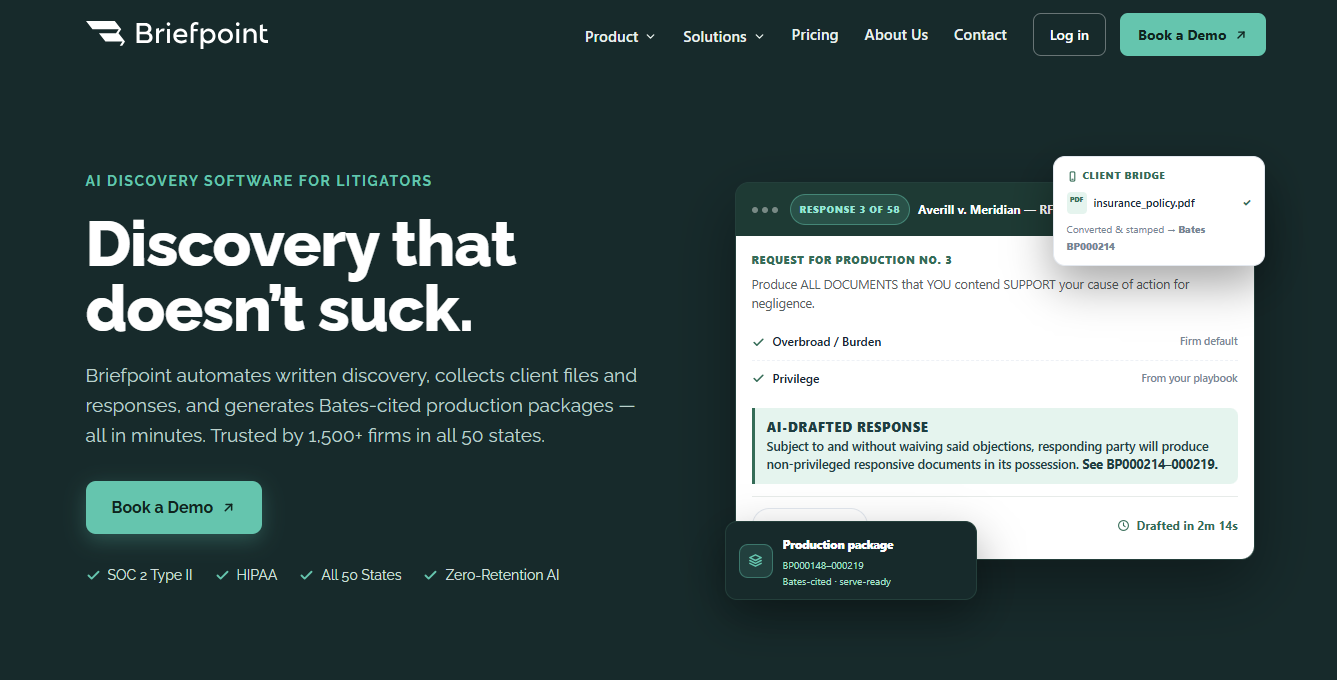
Briefpoint can draft and respond to interrogatories, RFAs, and RFPs in your jurisdiction’s format. You can collect client answers through secure links, turn those responses into Word-ready drafts, and prepare Bates-cited production packages when documents need to be served.
Discovery Playbooks can also help keep objection and response strategies consistent from one matter to the next.
The platform is used by more than 1,000 law firms and supports all 50 states plus 98 federal district courts.
If written discovery is taking too much time from your caseload, book a Briefpoint demo and see how much of the process you can automate.
