Request for Production Examples for Civil Litigation
Request for Production Examples for Civil Litigation
Requests for production (RFPs) help you get evidence held by another party during discovery. Depending on the case, that could mean contracts, medical records, photographs, or electronically stored information (ESI).
Strong requests are specific enough to tell the responding party what you want while staying within the permitted scope of discovery.
In this guide, we’ll look at practical request for production examples, when these requests are used, and what you can ask another party to produce.
What Is a Request for Production?
A request for production is a written discovery request asking another party to produce documents, electronically stored information, tangible things, or other discoverable material.
A plaintiff might request business records from a defendant that relate to allegations in a complaint. A defendant could seek photographs or medical records connected to the plaintiff’s claims.
Under Federal Rule of Civil Procedure 34, a party may also request permission to inspect, copy, test, or sample certain items or property within another party’s possession, custody, or control. Each item or category must be described with reasonable particularity.
State civil procedure rules may set different requirements for service, format, objections, and response deadlines, so attorneys should confirm the rule that applies in their court.
When Are Requests for Production Used?
Requests for production are usually served during discovery when one party needs relevant documents or other evidence controlled by someone else.
Common uses include:
- Supporting a claim or defense: A party may request records that help prove or challenge allegations in the case.
- Investigating an incident: In a collision case, for example, requests could seek photographs of the vehicle involved, maintenance records, or material created after the accident.
- Following up on other discovery: Responses to interrogatories or deposition testimony may identify documents worth requesting.
- Obtaining digital evidence: Relevant data may exist in email, electronic files, databases, or other forms of ESI.
- Inspecting physical items: Requests for production can cover tangible things and, in some cases, access to property for inspection or testing.
The requested material still has to fall within the permitted scope of discovery. A responding party may raise objections based on issues such as privilege, relevance, proportionality, or undue burden.
What Can You Request in a Request for Production?
An RFP can reach much more than traditional paper documents.
Common categories include:
- Business and written records: You can request material such as contracts, invoices, reports, notes, or correspondence when it relates to the dispute.
- Electronically stored information: ESI may include email, electronic documents, databases, or other stored data. A requesting party may also specify a production format under applicable rules.
- Photographs and recordings: Images, video, or other media can be requested when relevant to the claims or defense.
- Tangible things: Physical objects may be subject to inspection, copying, testing, or sampling.
- Property: Certain requests may seek access to a location for inspection when the property itself is relevant to the controversy.
Privilege, privacy, proportionality, and burden can affect what ultimately gets produced. Drafting should account for those limits from the start.
5 Common Request for Production Examples
Sample requests can help with wording, but they should be adapted to the facts of the case. Definitions, dates, parties, and the requested material should all reflect the dispute you are actually handling.
1. Contracts and Agreements
Contracts often become relevant when the parties disagree about their obligations, payment terms, or performance.
A sample request might read:
Sample request: Produce all contracts and written agreements between Plaintiff and Defendant concerning the services identified in the Complaint.
The wording ties the document requests to a specific relationship and subject. If later amendments are important, the request can also cover documents relating to changes in the original agreement.
In turn, a broader request for every contract ever created by an entity could invite a discovery objection based on scope or burden.
2. Emails and Other Communications
Communications can show what people knew, when information was shared, and how someone responded to an event.
For example:
Sample request: Produce all email correspondence between Defendant and its employees concerning the incident alleged in the Complaint from January 1, 2026, through March 31, 2026.
A defined topic and date range can make the request easier to interpret.
Relevant communication may also have occurred through other means, so drafting should reflect the channels actually used in the case. If text messages or another communication platform are important, those sources can be identified directly in the request.
3. Financial Records
Financial records may become important when the case involves damages, payments, lost income, or another monetary issue.
For example:
Sample request: Produce documents reflecting payments made under the contract identified in the Complaint from January 1, 2025, through December 31, 2025.
Responsive material could include records such as invoices or receipts if they relate to the disputed amount.
The requested period should have a reasonable connection to the claims. Asking for two years of records may make sense in one dispute but create an unnecessary burden in another.
4. Medical Records
Medical records are common in personal injury discovery when treatment or claimed damages are disputed.
A sample request could read:
Sample request: Produce medical records and bills relating to treatment Plaintiff received for injuries allegedly caused by the collision identified in the Complaint.
The request focuses on records connected to the claimed injuries rather than the plaintiff’s entire medical history.
Depending on the facts, further requests may address earlier or later treatment when it has a relevant connection to causation or damages. Privacy protections and jurisdiction-specific rules can also affect how medical information is requested and produced.
5. Electronic Files and Digital Evidence
Relevant evidence often exists only in digital form. Electronic files may also contain metadata or other data that a paper copy would not preserve.
For example:
Sample request: Produce electronically stored information concerning maintenance performed on the vehicle involved in the collision during the two years preceding the date of the incident.
Federal Rule of Civil Procedure 34 allows a requesting party to specify the form in which electronically stored information should be produced. California procedure also permits a demand to state the requested form or forms for ESI.
Attorneys should consider production format during drafting if metadata, native files, or other electronic information has evidentiary importance.
Make RFP Drafting and Production Easier With Briefpoint
Sample requests give you a useful starting point, but the final wording still needs to fit your case, jurisdiction, and discovery strategy.
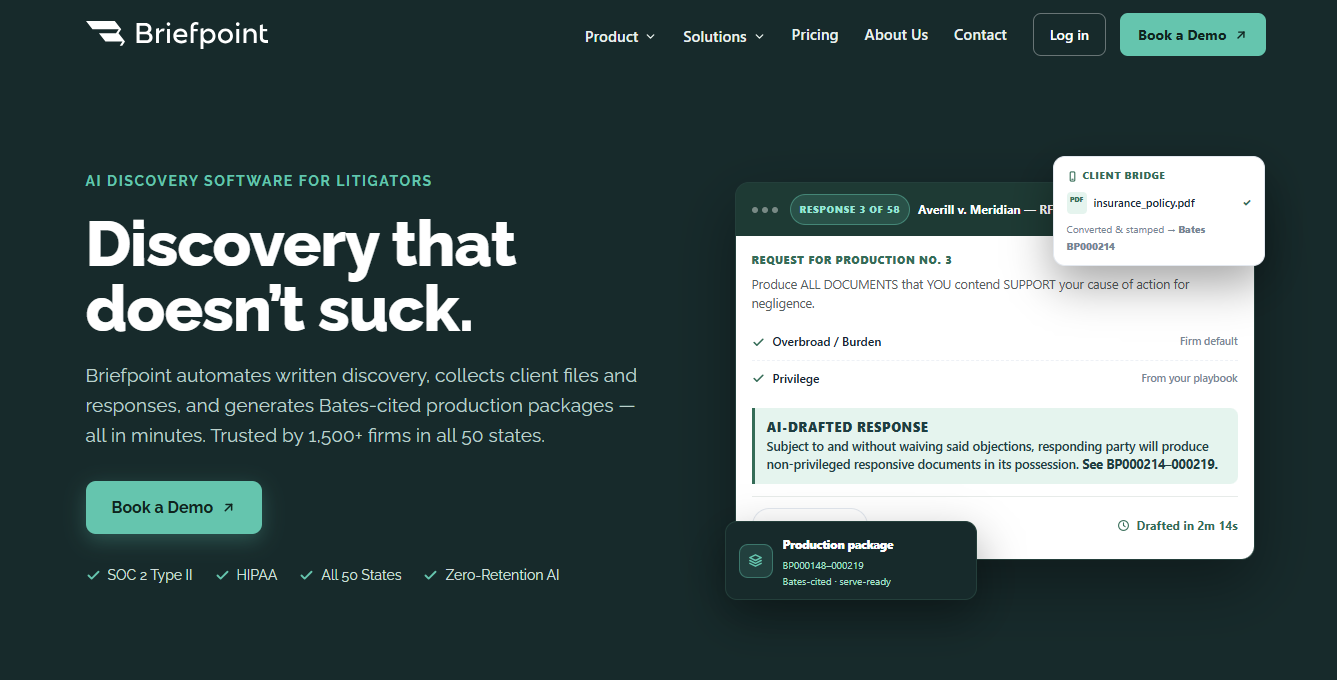
Briefpoint can help law firms handle more of that work in one workflow. Its platform can draft discovery requests from case allegations and help prepare responses to incoming RFPs.
For production, Briefpoint reads the requests, identifies responsive documents in uploaded files, and generates Word responses with page-level Bates citations. It can also create a Bates-numbered production package for review and service.
Attorneys remain in control of the final work product, including which files are produced and how responses are edited before service.
If your firm handles requests for production regularly, Briefpoint can help shorten the path from discovery request to production-ready response.
