A Guide to AI Discovery Response Software for Law Firms
A Guide to AI Discovery Response Software for Law Firms
Discovery work is starting to look different as AI moves deeper into litigation workflows. You can now use software to analyze a discovery request, pull from case documents, draft responses, and support document production without treating every single step as a separate manual task.
AI discovery response software is built around that shift. Instead of functioning like a general writing assistant, it works with the legal discovery process itself, including written discovery, objections, client data, and responsive documents.
For law firms handling personal injury, mass tort, or any other document-heavy litigation, that can change how quickly a team moves from incoming requests to attorney review.
So, what should you actually expect from AI discovery response software?
In this guide, we’ll look at what AI discovery response software can handle, how it works, and which features are worth paying attention to when choosing a platform for your firm.
What Is AI Discovery Response Software?
AI discovery response software helps legal professionals prepare answers and objections to written discovery requests using information from the case.
Many platforms rely on generative AI, natural language processing, or machine learning (or a combination of multiple tools) to analyze the discovery request and case facts.
Depending on the system, the software may review pleadings, client data, prior responses, or other case files before drafting responses.
General document production AI works differently. A broad AI writing tool can generate legal text from a prompt, but it may have limited awareness of the record unless you provide the necessary context.
Some legal AI systems are designed primarily for research, contract work, or general drafting rather than discovery.
On the other hand, purpose-built AI discovery software can connect more parts of the workflow. For instance, it may identify responsive documents for an RFP, prepare discovery objections, collect client answers, and create a draft in Microsoft Word.
The distinction becomes important when accuracy depends on what is actually contained in the case documents.
What Can AI Discovery Response Software Handle?
The exact capabilities vary, but AI discovery tools can support several parts of legal discovery.
- Written discovery responses: AI can help with drafting responses to interrogatories, requests for admission, and RFP responses using the information available in the record.
- Objections: Some platforms analyze each request and suggest objections based on the wording, jurisdiction, or firm preferences.
- Interrogatory answers: Software can organize client information and case facts into draft interrogatory answers that attorneys can revise before service.
- Responsive document review: More advanced AI systems can analyze a document set and identify potentially responsive documents tied to individual production requests.
- Document production: Some platforms can prepare production files, apply Bates numbers, and connect citations in the response to the underlying evidence.
- Discovery requests: Certain systems can also help attorneys draft discovery requests to serve on another party.
AI discovery can support other litigation tasks as well. Information uncovered during the discovery process may later help with case analysis, trial prep, or strategy.
How Does AI Discovery Response Software Work?
Most AI discovery responses begin with the materials your team already has. The software reviews those materials and prepares draft work for attorney review, while the final legal judgment stays with the lawyer.
A typical workflow may look like this:
- Upload the requests: The firm provides the incoming discovery along with relevant case files or other case documents.
- Analyze the record: AI reviews the requests and available data to understand the case type, allegations, and information being requested.
- Prepare drafts: The system generates proposed answers or objections. Some tools can reference prior responses or established firm preferences.
- Collect missing information: Client communication tools may turn formal questions into simpler prompts that clients can answer online.
- Find supporting documents: AI can search a production or document set for files that appear responsive to specific RFPs.
- Review the response: Attorneys examine the drafts, cited documents, and proposed objections before anything is served.
Generally, the workflow lets a firm respond faster while keeping attorney review in place for accuracy, privilege, and litigation strategy.
What Features Should AI Discovery Response Software Have?
AI discovery software should fit how your firm responds to discovery in practice. A product that produces polished text may still create extra legal work if attorneys have to rebuild the response or manually verify every source.
Look closely at how the software uses documents, handles client information, and supports review.
A plaintiff firm handling medical records, for example, may need strong document analysis and production tools. Another team may care more about standardized objections or collecting interrogatory answers from clients.
The learning curve deserves attention too. Most firms already have established workflows, so introducing software that requires major process changes can offset some of the time savings.
Security should be part of the evaluation from the start because discovery files may contain sensitive evidence or personal client data.
The following capabilities are particularly useful when evaluating AI discovery response software.
Case-Specific Response Drafting
Discovery responses need to reflect the actual record.
Look for software that can analyze the complaint, discovery requests, client answers, and other relevant documents before drafting responses. Case-specific context can produce more useful drafts than a general AI system working from a short prompt.
For example, an RFP response may depend on information contained in medical records or files previously produced in the case. Software that can review those sources has more context than an AI tool generating a generic answer.
Prior responses can also help maintain consistency when supplemental discovery arrives later.
Of course, attorneys should still review the finished draft. Leveraging AI can save time on manual drafting, but the lawyer remains responsible for the final response and the strategy behind it.
Jurisdiction-Specific Objections and Formatting
Discovery rules vary between jurisdictions, and local formatting requirements can affect the finished document.
Useful software should account for the court or jurisdiction connected to the case when preparing objections and response documents. Generic language may require substantial editing if it does not match applicable practice.
Formatting matters too. A draft becomes far more useful when captions, numbering, request text, and response formatting are already organized correctly.
Briefpoint, for example, supports all 50 states and 98 federal district courts, with users able to review and revise the output in Word.
Your team should still evaluate every objection based on the request, the record, and the strategy for the case.
Source-Grounded Answers
Strong AI discovery response software should make it easy to see where an answer came from.
Source grounding can connect a proposed response to case files, client answers, or documents contained in the production. The feature gives attorneys a clearer path for checking accuracy before approving the draft.
A system that only performs simple keyword searches may miss context or surface documents that contain the right terms but have little relevance to the request. More advanced analysis can examine the meaning of the request and compare it with the underlying record.
For instance, an RFP seeking evidence supporting a particular allegation may require analysis of several files rather than a search for the wording of the complaint.
Clear sourcing makes review more practical and reduces the risk of treating an unsupported AI answer as established fact.
Client Response Collection
A large part of responding to discovery involves getting information from the client.
For one, emailing formal interrogatories to a client can create delays because legal language is often difficult to understand. Software with built-in client communication can translate the request into clearer questions and organize the answers for the legal team.
Briefpoint’s Client Bridge sends clients a secure browser-based link, presents questions in plain language, and flows their answers into Word-ready drafts. The platform also allows clients to upload documents through the same workflow.
Features like these can be useful in personal injury matters where clients may need to supply factual information or records before attorneys can complete discovery responses.
The attorney can then review the client’s answers, clarify anything incomplete, and revise the final language before service.
Responsive Document Matching
RFP responses can become labor-intensive when the request requires reviewing a large collection of documents.
Responsive document matching uses AI to analyze the request and compare it with files available in the case. The system can then surface documents that appear relevant to the requested category.
Technology-assisted review has long helped legal teams prioritize documents during larger discovery reviews. AI discovery response tools apply related concepts closer to the response workflow, where attorneys need to connect individual requests with specific evidence.
For example, a request seeking records supporting claimed medical expenses might require the system to analyze uploaded medical records and related case files.
Bates Citation and Production
Finding responsive documents is only one part of an RFP workflow. Someone still has to prepare those documents for production and connect the response to the files being produced.
Software with built-in production capabilities can reduce those extra steps. Useful functions may include Bates numbering, page-level citations, or preparation of a production package.
Briefpoint’s Autodoc searches uploaded case files for responsive documents and generates Word-formatted RFP responses with Bates citations. It can also create a Bates-numbered production package tied to the responses.
A connected workflow can save litigation support staff from manually tracking which documents correspond to each request.
Custom Templates and Firm Preferences
Most firms develop their own approach to discovery over time. So, good software should allow attorneys to maintain preferred response language, objection strategies, and document formatting rather than forcing every case into a generic template.
Customization becomes particularly useful when several attorneys work on similar litigation. Established preferences can provide consistency while still allowing the lawyer handling the case to adjust each response.
Firm-specific settings can also reduce reliance on outdated templates stored in old matters. The system can start from current preferences while using case facts from the active file.
Briefpoint’s Discovery Playbooks are designed to apply a firm’s objection and response strategy across cases and flag potential inconsistencies before service.
Look for controls that let your firm update those preferences as strategy, rules, or internal practices change.
Security and Data Controls
Discovery can contain highly sensitive information, so security deserves careful review before client data enters any AI system.
Ask how the provider stores uploaded documents, what happens to information sent to its AI models, and how long data remains on the platform. Firms should also examine access controls, encryption, compliance certifications, and policies governing the use of customer data.
Security requirements may become even more important in case types involving medical records or other confidential information.
Legal professionals should also evaluate those protections against their own ethical duties, client requirements, and internal security policies before adopting any AI tool.
Automate the Discovery Response Process With Briefpoint
Discovery software becomes more useful when it can handle the work surrounding the draft, not simply generate legal language.
Briefpoint covers written discovery from initial requests through response and production. You can upload interrogatories, RFAs, or RFPs and generate jurisdiction-formatted responses with objections.
Client Bridge helps collect answers and documents directly from clients, while Autodoc analyzes case files to locate responsive documents for RFP responses.
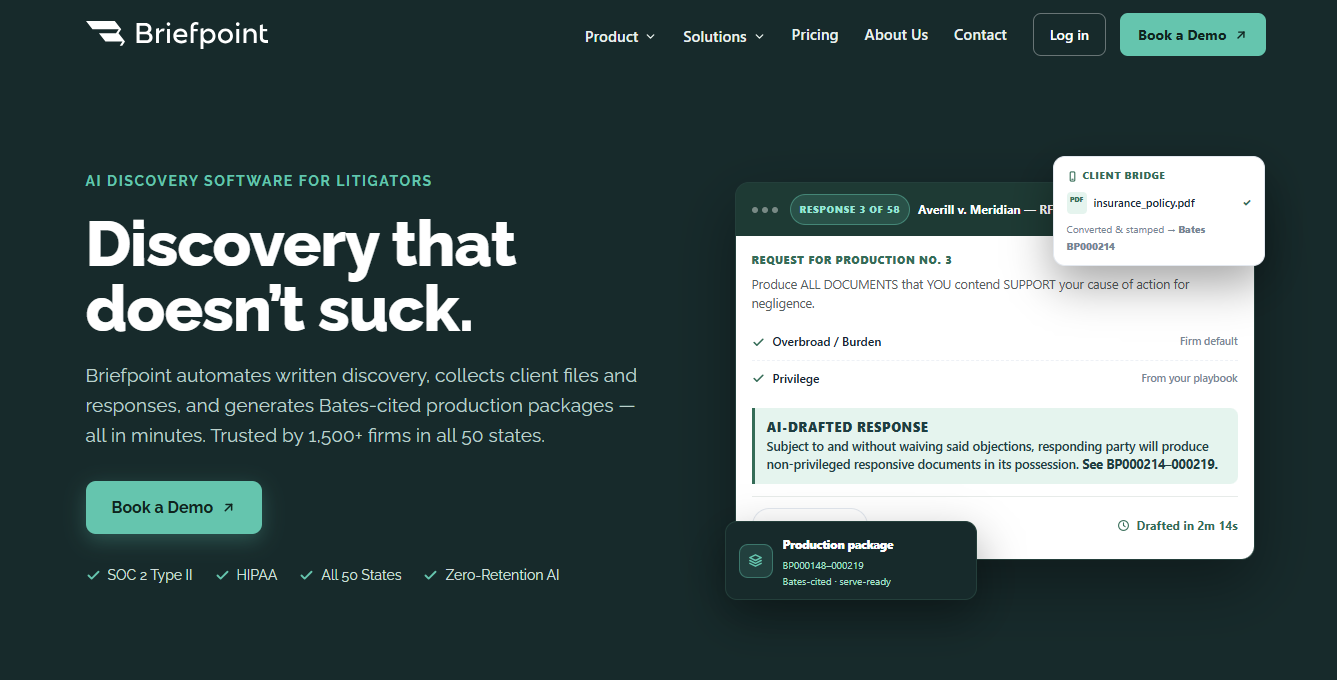
The resulting work can be reviewed and revised in Microsoft Word. For document production, Briefpoint can generate Bates-cited responses along with a Bates-numbered production package.
Those capabilities give attorneys and litigation support staff a practical way to reduce manual work while keeping review and case strategy in their hands.
See how Briefpoint can help your firm spend less time drafting discovery responses and more time moving the case forward. Book a demo today.
