How Law Firms Are Using Discovery AI
What Is Discovery AI?
Discovery is the legal process of exchanging information and evidence between parties before trial. It can include written requests, document production, client responses, and other work that helps each side understand the facts of the case.
Discovery AI refers to the use of artificial intelligence to support parts of that process. Depending on the software, AI can help prepare discovery documents, review incoming requests, organize client-provided information, or assist with finding responsive material.
Some discovery AI solutions use specialized AI models trained or configured for legal work. That distinction is important. General-purpose AI may generate useful text, but legal discovery has specific rules, formats, and procedural requirements that can vary by jurisdiction.
For you, the practical benefit is less time spent on repetitive discovery work and more time available for substantive legal review. AI can handle much of the initial drafting and processing, while the attorney still reviews the work before anything is finalized or served.
How Does AI Work in the Discovery Process?
AI can support discovery at several points during litigation, especially where the work involves large amounts of information or repetitive drafting.
Most tools combine automation with AI models that can do things like interpret requests, generate draft language, and help sort relevant case material.
Common uses include:
- Drafting discovery documents: Generative AI can prepare first drafts of interrogatories, requests for admission, and requests for production based on case details and attorney input.
- Reviewing incoming requests: AI-powered tools can analyze discovery requests, flag potential issues, and help prepare draft responses or objections for attorney review.
- Document review: AI can assist with finding potentially responsive files, improving speed and efficiency when the document set is large.
- Client information collection: Some solutions help organize client answers and supporting files so the information is easier to review and use in a response.
- Case organization: AI agents can support tasks related to research, document handling, and discovery tracking while keeping the attorney involved in final decisions.
What Types of Discovery Can AI Help With?
AI can support several common forms of written discovery. The exact capabilities depend on the software, but many tools can assist with work such as:
- Interrogatories: AI can help draft questions, review incoming interrogatories, and prepare initial responses based on case information.
- Requests for admission: These tools can help organize each request and generate draft admissions, denials, or qualified responses for attorney review.
- Requests for production: AI can analyze document requests, help identify potentially responsive records, and support the preparation of written responses.
- Document production: Some platforms can organize responsive files, apply Bates numbers, and connect produced records to the relevant discovery requests.
- Supplemental discovery: AI can also help review prior responses and identify areas that may need updates as new information becomes available.
The strongest use cases tend to involve repetitive work that still requires legal judgment before anything is served.
What Are the Benefits of Using AI for Discovery?
AI can make discovery work easier to manage when your team is under pressure to move quickly without giving up control over quality.
The biggest benefits tend to show up in a few practical areas, like:
Faster Turnaround
AI can process discovery requests and case information far faster than a fully manual workflow. Steps like drafting, document review, and information sorting can all move forward sooner, which helps when deadlines are tight or demand starts to climb.
Again, your team still reviews the work, but less time goes toward repetitive setup and first-pass tasks. That can make the overall discovery process feel much more manageable during busy periods.
Better Consistency and Accuracy
Well-configured discovery technology can apply the same response logic and review standards throughout a matter. Consistency becomes extra useful when several reviewers are working on related requests or large sets of records.
AI can also help flag missing information, conflicting details, or areas that need closer attention. Attorney review remains important, but a more consistent starting point can support better accuracy and quality.
Lower Discovery Costs
Manual discovery work can consume a significant amount of attorney and staff time. AI can reduce some of that workload, which may lead to cost savings for law firms and in-house teams handling frequent or high-volume matters.
Employees can spend less time on routine processing and devote more attention to work that needs legal analysis. Firms may also be able to handle higher demand without adding the same level of staffing.
Stronger Control Over Information
Discovery often involves large data flows, sensitive records, and other information that may raise privilege concerns. AI can help organize those materials and make relevant information easier to review without forcing your team to work through every file in the same way.
Good governance remains important. Your team should still control access, review how data stays protected, and decide how AI-generated work is used before anything leaves the firm.
More Time for Legal Judgment
Repetitive discovery work can take up hours that could be spent on deeper case analysis. AI can handle parts of the initial processing while attorneys keep control over final decisions and the finished work product.
Extra time can support better diligence and give your team more space to develop a stronger understanding of the case. Key insights may also become easier to spot when less attention is tied up in routine document handling.
How Briefpoint Uses AI Throughout the Discovery Lifecycle
Briefpoint applies AI to written discovery from the first draft through client collection and production. Its tools cover several stages of the workflow, so you can keep more of the work inside one platform.
With Briefpoint, you can:
Draft and Propound Discovery
Briefpoint can draft interrogatories, requests for admission, and requests for production based on the complaint and case information you upload. It supports all 50 states and 98 federal district courts, with output formatted for the relevant jurisdiction.
For example, if you represent a plaintiff in a negligence case, Briefpoint can analyze the allegations in the complaint and generate targeted discovery requests tied to those issues.
The platform can generate more than 70 targeted requests from allegations, while its objection-aware drafting is designed to avoid common problems in propounded discovery.
You can then review the draft and revise it in Word before serving it. That keeps the attorney in control while reducing the amount of time needed to build the initial set from scratch.
Prepare Discovery Responses
Incoming discovery can be uploaded directly into Briefpoint, which drafts responses to interrogatories, RFAs, and RFPs with objections included. The platform works within the jurisdictional format of the matter and produces drafts that attorneys can review and revise in Word.
Briefpoint can also apply your preferred objection and response strategy through Discovery Playbooks. The feature is designed to carry firm policies into future matters and identify contradictions before responses are served.
Useful parts of the response workflow include:
- Draft answers and objections for attorney review
- Apply established discovery response preferences
- Keep response strategy more consistent between matters
- Generate Word-ready output for final editing
Collect Client Answers With Client Bridge
Client Bridge handles the part of discovery that usually requires repeated emails, attachments, and follow-ups. Briefpoint converts legal discovery questions into plain-English prompts and sends clients a secure link they can open from any device without installing an app.
Clients can answer questions and upload requested documents through the same link. English and Spanish are supported, and the collected information can flow back into the discovery draft for attorney review.
A dense interrogatory asking a client to identify people with knowledge of an incident, for instance, can appear to the client as a much simpler question, such as asking who knows what happened. Briefpoint keeps the legal drafting on the attorney side while making the client-facing part easier to complete.
Find Responsive Documents With Autodoc
Autodoc focuses on RFP responses and document production. You upload the complaint, requests for production, and the relevant case or production files. Briefpoint then searches the uploaded folders and identifies documents responsive to each request.
The workflow is built around responsiveness rather than requiring a preliminary relevance review. Briefpoint reports processing speeds of roughly 3 to 10 seconds per request after the files have been processed.
Autodoc can then:
- Match responsive documents to individual RFPs
- Draft the written response
- Add page-level Bates citations
- Apply Bates numbering to the production
- Package the files for service
You can verify where the system searched before relying on the output, which gives the attorney a chance to check that the underlying documents match.
Prepare Bates-Cited Production Packages
After responsive documents have been identified, Briefpoint can generate the written RFP response and the corresponding production together. The Word response includes objections, substantive answers, and citations to the relevant Bates pages.
Briefpoint also applies Bates numbers to every page in the production package. Firms can customize the Bates prefix and starting number to follow their own naming conventions.
The final output can include:
- Word-formatted RFP responses
- Page-level Bates citations tied to responsive files
- Bates-numbered documents
- A production package prepared for service
Briefpoint cites a case study in which a mid-sized California litigation firm reduced a typical 40-RFP workflow from 30 to 40 hours to minutes using Autodoc.
Manage Supplemental Discovery
Discovery may continue to change after the first response set goes out. Briefpoint supports supplemental responses for interrogatories, RFAs, and RFPs, which lets you add new information without overwriting the original response.
Prior responses remain available for reference, while updated client information collected through Client Bridge can feed back into the workflow for attorney review.
Having the earlier and supplemental versions connected can make ongoing discovery easier to follow. You can see what was previously served, add new information as the case develops, and prepare a separate supplemental document without rebuilding the response set manually.
Take a More Practical Approach to Discovery AI
As you can see from the workflow above, Briefpoint can support a large part of the discovery process in one place.
It can help draft requests and responses, collect client information through Client Bridge, identify responsive documents with Autodoc, and prepare Bates-cited production packages for review.
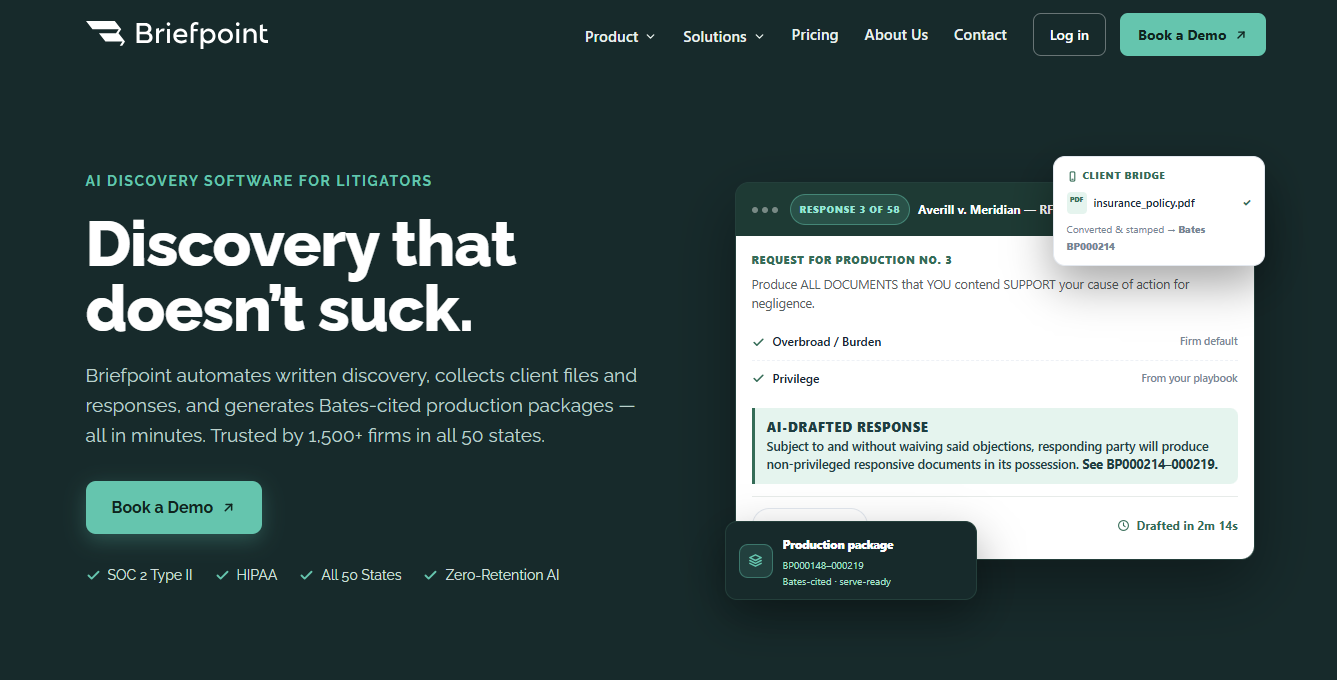
That gives users a practical way to reduce repetitive discovery work while maintaining attorney control over the final output. For firms committed to handling discovery more efficiently without sacrificing quality, Briefpoint can make a noticeable difference in day-to-day work.
See how Briefpoint can support your discovery workflow. Book a demo today.
