5 Ways to Use AI for Trial Preparation
Not surprisingly, artificial intelligence is starting to play a larger role in that process. Law360 Pulse’s 2026 AI Survey found that 70% of law firm attorneys use AI at least once a week, with trial preparation among the areas seeing increased use.
Of course, AI is best treated as a support tool rather than a substitute for legal judgment. When you put it to use, it can help you move through large amounts of case information more efficiently and give you more time to focus on strategy and other work that calls for closer attorney involvement.
With that in mind, here are some of the ways you can use AI for trial preparation.
1. Organize and Summarize Case Materials
A large part of trial prep involves getting a firm handle on the record. Depending on the case, attorneys may be working with hundreds or even thousands of pages spread among case files, discovery productions, correspondence, and other legal documents.
AI tools can help litigation teams sort through that material faster and pull out key information that may deserve closer review.
For example, you can use AI to summarize lengthy documents, group materials by topic, identify repeated names or events, and surface relevant documents tied to a particular issue in the case.
Common materials may include:
- Pleadings
- Deposition transcripts
- Witness statements
- Expert reports
- Discovery responses
- Exhibits
- Emails and correspondence
- Medical or business records
Plus, AI can be particularly useful when the record involves large datasets or a long procedural history. You might ask it to create a concise summary of a deposition or identify portions of several legal documents related to the same factual dispute.
2. Build Timelines and Identify Key Facts
A case can look very different once the events are laid out in chronological order. AI can help legal teams pull dates and other key details from the record, then organize them into a timeline that is easier to review during trial prep.
From there, you can start looking for patterns or inconsistencies that may affect your case strategy. AI may also help connect important events with supporting evidence, which can save time when you are dealing with a long factual record.
In a personal injury case, for example, you might use AI to line up treatment dates with accident reports and witness accounts so you can see how the story develops over time. In a business dispute, legal tech could help match contract events with communications or other records tied to the same period.
For attorneys handling a fact-heavy matter, a well-built timeline can be a powerful tool. It gives you a clearer structure for detailed analysis and can help enhance efficiency as you decide which facts deserve the most attention at trial.
3. Prepare Witnesses and Deposition Materials
Witness preparation usually takes several rounds of review, especially when testimony needs to line up with a long record. AI can help you get through some of that groundwork faster by pulling together prior statements, deposition testimony, and documents tied to a particular witness.
You can then use those materials to support more focused deposition prep and strategic planning. For example, AI may help you draft:
- Targeted questions based on prior testimony
- Witness examination outlines
- Cross-examination questions tied to specific inconsistencies
- Topic lists for areas that need clarification
- Summaries of statements that may come up at trial
A witness who gave slightly different accounts at two points in the case, for instance, may deserve closer attention before testimony begins. AI can help surface those differences and point you back to the source material so you can decide how significant they are.
Used with attorney review, the result can be a more organized preparation process and a clearer path toward getting witnesses trial-ready.
4. Develop Trial Themes and Arguments
Once the factual record is organized, AI can help you test how different legal arguments fit together and where your case may be vulnerable.
From there, lawyers can use it to compare possible theories, summarize relevant precedents, or review case law tied to a particular issue before deciding which direction deserves more attention.
For example, you might ask an AI tool to compare two competing legal theories and identify the facts that support each one. Then, you can use that analysis to refine an opening statement or stress-test the reasoning behind a planned closing argument.
AI can support legal research at this stage as well, particularly when you want a faster way to locate potentially relevant authority or understand how courts have approached a similar issue.
Of course, any case law or citations still need to be verified carefully, but the initial research can give you a useful starting point.
For courtroom advocacy, the real benefit is having another way to pressure-test your position. In particular, AI can help you explore how opposing counsel might frame the same facts, which can sharpen your legal reasoning before trial.
5. Prepare Exhibits and Other Trial Documents
Exhibit preparation can take up a surprising amount of time, especially when you are working through a large volume of discovery materials. AI can help with the early document review by sorting files and pulling out details that may be relevant to a particular issue or witness.
Common uses at this stage include preparing or organizing:
- Exhibit lists
- Deposition designations
- Medical record summaries
- Witness examination materials
- Document indexes
- Trial binders and supporting materials
For instance, in a case with extensive medical records, AI can help identify records tied to specific treatment dates or disputed issues. After that, you can narrow down which documents are most useful for your exhibit set.
AI can cut down the time spent searching through files and handling other repetitive parts of case preparation. That leaves you with a more organized set of trial documents and more time to think about how each one supports the case you plan to present.
How Does AI Work in the Trial Preparation Process?
The examples above show what AI can help with during trial prep. Underneath those use cases, most tools rely on technologies such as natural language processing to read documents, recognize patterns, and pull useful information from large case records.
Here is what that can look like in practice:
- Document analysis: AI can review pleadings, transcripts, medical records, and other case materials to identify key facts or recurring issues.
- Summarization: Long records can be condensed into shorter outputs, such as deposition summaries or medical summaries, so you can review the substance faster.
- Information extraction: AI can pull dates, names, events, and other details from documents and organize them into a more usable format.
- Drafting support: Some tools can turn case information into first drafts of outlines, questions, or other preparation materials.
The level of care you need will vary with the task. High-stakes litigation calls for particularly close review, and confidential data should only be handled in systems with appropriate security controls.
Always keep in mind that AI can speed up the groundwork, but its usefulness depends heavily on the quality of the source material and the tool you choose.
Put Discovery on Autopilot With Briefpoint
Nothing can replace the judgment and experience legal professionals bring to trial preparation. AI works best when it handles the underlying legal work that takes time but requires less strategic thinking, which can leave you with more room to focus on the case itself.
Discovery requests are a good example. Because the process is relatively structured, you can leverage AI for document drafting with fewer concerns about constantly questioning the accuracy of every step.
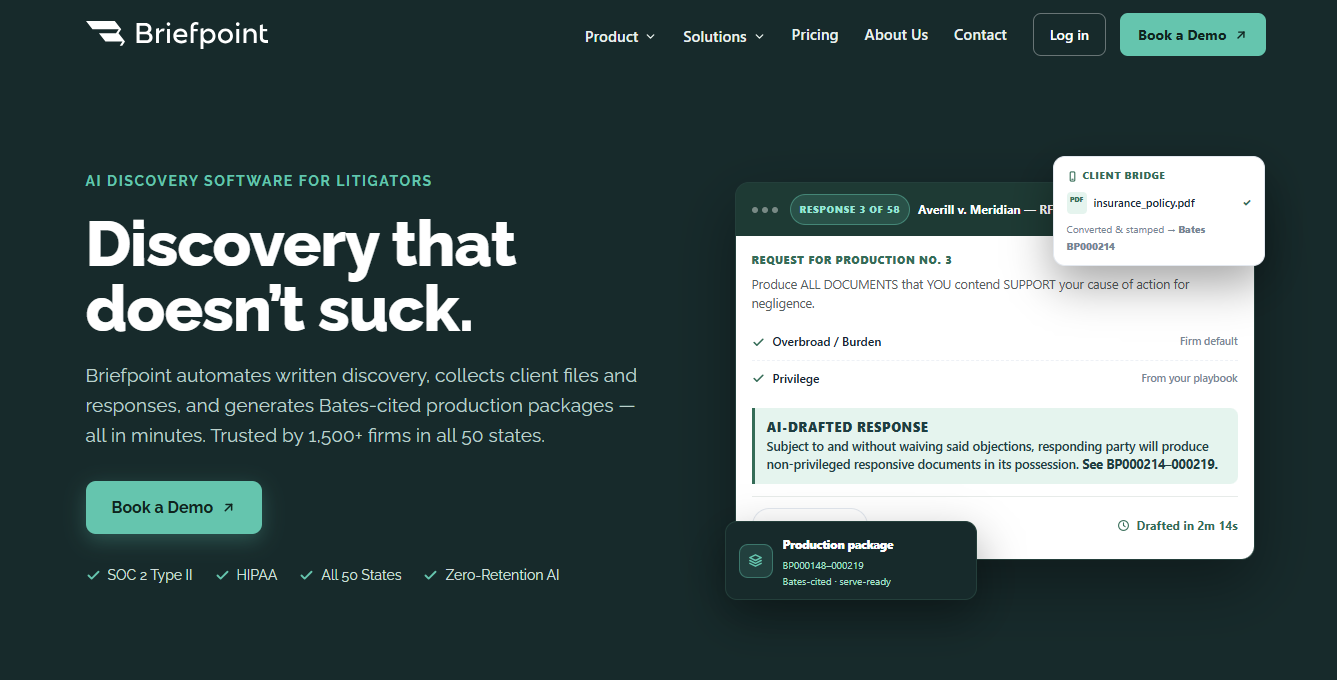
Briefpoint is built specifically for discovery work. It can draft and respond to interrogatories, RFAs, and RFPs, collect client responses through plain English questions, and generate editable Word documents.
Autodoc can identify responsive materials, create Bates-cited responses, and prepare production packages. Discovery Playbooks can apply your preferred objection and response strategy more consistently from one matter to the next.
A powerful AI assistant can be useful throughout trial prep, but Briefpoint gives you a much more focused way to automate discovery work and reduce the hours that go into it.
Ready to spend less time on discovery requests? Schedule your demo today.
