How Legal Document Review Works
How Legal Document Review Works
Legal document review plays a major role in how attorneys understand the material in front of them and decide what needs attention.
The work can be simple for a short document, but larger matters often require much closer document analysis. Context becomes important, especially when one record changes the meaning of another or raises a new issue.
In this guide, we’ll look at how legal document review works, what makes it difficult, and how technology can support legal professionals in this process.
What Is Legal Document Review?
Legal document review is the process of examining documents to determine their relevance, legal significance, accuracy, or potential risk, among many other things.
The exact purpose depends on the legal matter. During the litigation process, document review often involves identifying materials that are responsive to discovery requests and deciding what can be produced to opposing counsel.
For example, contract review may focus on obligations, risk allocation, or provisions that need revision. Due diligence can require a detailed analysis of corporate records before a transaction moves forward.
A legal document review process can involve both physical documents and electronic files. Email, cloud storage records, chat logs, contracts, spreadsheets, and scanned materials may all need review.
Human reviewers still play a central role, but advanced technologies are increasingly part of the process. Natural language processing, machine learning, predictive coding, and other AI tools can help legal teams analyze large volumes of information and prioritize potentially relevant documents.
Attorney review remains important whenever legal interpretation, confidentiality, or privilege is involved.
What Types of Documents Require Legal Review?
Almost any document connected to legal rights, obligations, evidence, or a dispute may need review. Common examples include:
- Contracts and agreements: Lawyers review terms, obligations, deadlines, risk allocation, and provisions that may need negotiation or revision.
- Discovery materials: Legal teams review documents collected during litigation to identify relevant documents, responsive information, and anything requiring privilege review.
- Corporate records: Due diligence and compliance work may involve reviewing governance documents, financial records, internal policies, or transaction materials.
- Emails and messages: Communications can contain important evidence, admissions, timelines, or attorney-client privilege concerns.
- Court and case documents: Pleadings, exhibits, deposition materials, and other records may require review during case preparation or later stages of legal proceedings.
- Scanned and physical documents: Optical character recognition (OCR) can convert scanned materials into searchable text before further analysis.
- Regulatory materials: Legal departments may review records produced in response to an investigation, audit, subpoena, or second request.
What Do Lawyers Look for During Document Review?
Lawyers are rarely reading every document for the same reason. A clear review protocol helps human reviewers know what should be flagged and what can move forward.
Common review criteria include:
- Relevance: Reviewers determine which documents relate to the issues, claims, defenses, or discovery requests involved in the matter.
- Responsiveness: During the discovery process, lawyers identify materials that actually answer or fall within a particular request.
- Privilege: Attorney-client privilege and other protections must be considered before potentially privileged information is disclosed.
- Confidentiality: Sensitive information may require redaction, restricted access, or another form of protection before production.
- Key facts: Reviewers look for dates, communications, events, and other key information that may influence legal strategy.
- Inconsistencies: Conflicting records or information that differs from earlier statements may require further investigation.
- New evidence: Previously unknown documents can change the direction of case preparation and prompt additional legal work.
- Risk: Contract reviews and due diligence may focus heavily on liabilities, unfavorable obligations, or other issues requiring closer attention.
How the Legal Document Review Process Works
A consistent process helps legal teams keep review work organized, particularly when thousands of documents may be involved.
Here is a standard workflow that may serve as inspiration for your own:
1. Define the Scope of the Review
Start by deciding what the review needs to accomplish.
The legal team should identify the relevant issues, document categories, date ranges, and review criteria before reviewers begin reading files.
During litigation, the scope may be based on discovery requests or issues in the pleadings, or a due diligence review could focus on a particular transaction or business risk.
Key decisions at this stage may include:
- Which document types are in scope
- Which date ranges apply
- Who handles privilege calls
- Which issues reviewers should flag
- When a document needs second-level review
Defined roles give quality control teams a clearer baseline and reduce inconsistent review decisions later.
2. Gather and Organize the Documents
Relevant information may come from email accounts, shared drives, cloud storage, mobile devices, physical documents, or internal business systems. Law firms or in-house legal teams may also receive documents from clients, third parties, or another department.
Files should be organized in a way that preserves data integrity and makes them searchable. Metadata can be important, particularly during litigation, so careless file handling can create problems later.
When scanned files are involved, optical character recognition may be used to extract searchable text.
A well-organized collection gives reviewers a much cleaner starting point and makes it easier to identify potentially relevant documents.
3. Review for Key Terms, Risks, and Issues
Reviewers can now begin examining the content itself.
Search terms may help narrow the initial document population, but detailed analysis is usually needed before making final decisions. Human reviewers may look for specific events, people, communications, contractual obligations, or other information relevant to the legal strategy.
Technology-assisted review can help when the collection is very large. Predictive coding and AI-assisted review can prioritize materials that appear most likely to be relevant based on patterns within the documents.
4. Check for Missing or Inconsistent Information
Relevant information does not always appear neatly in one document.
Reviewers may find:
- Gaps in a timeline
- Missing attachments
- Conflicting statements
- References to documents that were never collected
- New evidence that points to another custodian or source
Flagging those issues early helps the legal team decide if it needs to expand data collection, request additional documents, or revisit part of the review.
5. Flag Documents for Further Analysis
Documents that raise legal questions should be separated for closer review.
Privilege is a common reason for escalation. A communication involving an attorney does not automatically qualify as privileged, so qualified attorneys or senior reviewers may need to make the final determination.
Legal teams may also flag documents containing sensitive information, unclear relevance, or evidence that could affect litigation strategy.
A second-level review gives experienced attorneys a chance to resolve difficult calls before the document is produced, relied on in a filing, or used in another legal proceeding.
6. Revise, Redline, or Prepare Responses
Document review often leads directly into another legal task.
For instance, a contract may need redlining after risks are identified. Due diligence findings may need to be summarized for the client. Discovery review may lead to written responses and document production.
At this point, the legal team should connect the findings from review to the work product that comes next.
During discovery, for example, responsive documents may need to be mapped to individual production requests before responses are drafted. Privileged documents should be handled separately according to the applicable rules.
Linking review with the next stage can reduce duplicate manual work.
7. Complete Attorney Review and Approval
Final attorney review remains essential before legal work leaves the firm or legal department.
Senior reviewers can check important privilege decisions, confirm that relevant information has been considered, and verify that the final work aligns with the legal strategy.
Quality control measures can also catch coding mistakes, inconsistent review decisions, or documents that were placed in the wrong category.
Performance monitoring may be useful during larger review projects. Legal teams can track reviewer consistency and identify areas that require additional guidance.
Final approval gives the team a last opportunity to correct human error before documents are produced, filed, shared with a client, or sent to opposing counsel.
Common Challenges in Legal Document Review
Even a well-planned review can become difficult when the matter involves large volumes of information. You might encounter issues like:
- Volume: Reviewing thousands or millions of documents manually can be extremely time-consuming.
- Tight deadlines: Discovery schedules and regulatory requests can leave legal teams with limited time to complete a thorough review.
- Privilege decisions: Privileged information requires careful handling because an incorrect production can create serious consequences.
- Inconsistent reviewers: Different human reviewers may interpret review instructions differently, which makes quality control important.
- Data security: Review platforms may contain confidential and sensitive information, making strong security controls essential.
- Changing evidence: New evidence can require teams to revisit earlier decisions or expand the original review.
- Cost: Large-scale doc review can require contract attorneys, senior reviewers, outside vendors, or additional legal services.
- Geographical barriers: In-house teams and outside counsel may be working from different locations, increasing the importance of secure online collaboration.
What to Look for in Legal Document Review Software
The right legal document review software should fit the scale and purpose of your review rather than add another complicated system to the process.
At the very least, look for the following key features:
- Search and filtering: The review platform should make it easy to narrow large collections using keywords, metadata, date ranges, and other criteria.
- AI-assisted review: AI technology can help prioritize relevant documents and support faster analysis of large data sets.
- Privilege tools: Features for tagging, escalating, and reviewing privileged information can make privilege review easier to control.
- Quality control: Look for tools that support second-level review, audit trails, and other quality control measures.
- Security: Encryption, access controls, and strong data security practices are important whenever confidential information is being stored or reviewed.
- OCR support: Optical character recognition makes scanned and image-based documents searchable.
- Scalability: The software should remain usable when matters involve large volumes of files.
- Workflow flexibility: Different legal cases require different review protocols, so teams should be able to adapt the process rather than force every matter into the same workflow.
How Briefpoint Supports Discovery Document Review
Discovery review often requires attorneys to move from a large collection of case files to the documents that actually respond to individual requests for production.
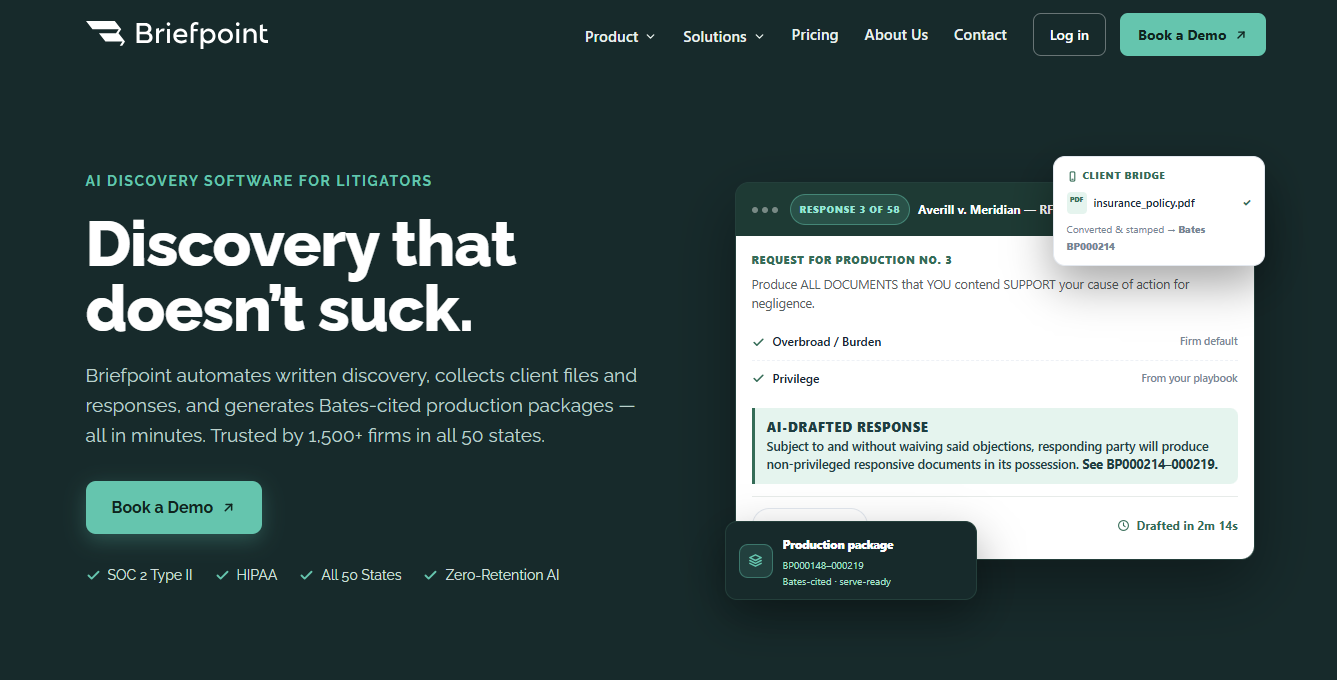
Briefpoint’s Autodoc automates much of that workflow. Firms can upload their requests for production (RFPs) along with production or case files, and the platform searches the documents to identify responsive materials for each request.
It then prepares Word-formatted responses with page-level Bates citations and generates a Bates-numbered production package.
The workflow can remove several manual steps that normally sit between document review and production, including mapping responsive files to individual RFPs and preparing Bates-cited responses.
Briefpoint also gives attorneys review controls before the output is finalized. Client Bridge can collect additional files and answers through a secure client link, while Supplemental Responses help update discovery when new information appears later in the litigation process.
For law firms handling written discovery regularly, connecting document review directly to response drafting and production can make efficient eDiscovery easier to achieve.
