7 Legal AI Workflow Examples You Can Replicate Today
What Are Legal AI Workflows?
Legal AI workflows are structured processes that use artificial intelligence to support specific parts of legal work. The term can cover a wide range of uses, from document drafting and review to discovery, research, intake, or case preparation.
Because the category is so broad, it helps to focus on the structure behind it. Most legal AI workflows follow the same basic idea: information goes into a system, AI performs a defined task, and the output moves to the next stage of the legal process.
For example, a firm might collect information from a client, use AI to turn it into a draft discovery response, and send that draft to an attorney for review. Another workflow might analyze a set of documents and surface information relevant to a particular issue.
The exact steps vary, but the goal is usually similar. Legal workflow automation helps legal teams reduce manual work and move routine tasks forward more efficiently while giving legal professionals control over the final work product.
7 Legal AI Workflow Examples You Can Use at Your Firm Today
You may already have several parts of your day-to-day legal work that are good candidates for AI, even if you have not formally mapped them as workflows yet. We’ve compiled some examples below to show seven practical ways you can start using legal AI in your firm today:
1. Draft Written Discovery Responses
Drafting written discovery responses is exactly the kind of repetitive task where AI can make an immediate difference.
Instead of building every response manually, legal teams can use AI-powered tools to generate a first draft based on the requests, matter information, the firm’s preferred objection language, and other key factors.
A typical workflow might look like:
- Upload or import the discovery requests
- Identify the jurisdiction and matter details
- Apply approved objections and response language
- Generate draft responses
- Review and revise the document in Word
Document automation can cut down the mechanical work involved in document generation while giving legal teams a more consistent starting point. Legal departments and firms can then spend more time reviewing substance and making decisions that require legal judgment.
Briefpoint is an example of an AI-powered tool built specifically for this workflow. It can draft responses to interrogatories, RFAs, and RFPs with objections included, using jurisdiction-specific formatting, and attorneys can review the resulting drafts in Word.
Spend less time drafting discovery responses. See how Briefpoint can help.
2. Summarize Case Files and Key Documents
Legal AI tools can make large files much easier to work through by identifying important facts and turning dense material into a more usable summary.
That capability can be useful in workflows like litigation, due diligence, legal research, document review, and contract review, where lawyers often need to understand a large amount of information before deciding what deserves closer attention.
For example, a litigation team could use AI-powered automation to review a lengthy case file and produce a summary of the main facts, key documents, and relevant issues.
The output can then serve as a starting point for legal review rather than requiring someone to manually reconstruct the story from hundreds of pages.
Moreover, these workflows can help convert information into more structured data, which makes it easier to compare documents or identify recurring issues. Reducing that administrative burden gives lawyers more room to focus on higher-value work that depends on context and legal judgment.
3. Review Contracts and Flag Risky Clauses
Contract review is another workflow where AI can help when legal and compliance teams are dealing with a steady stream of agreements.
Some AI capabilities can support contract analysis by comparing language against predefined rules, approved positions, or playbook standards and highlighting clauses that may need closer review.
For example, an in-house legal team reviewing a new vendor agreement could use AI to compare the contract against its preferred indemnity and termination terms. Clauses that fall outside those standards could be flagged before the lawyer starts a full review.
A contract review workflow might include:
- Clause identification: AI locates provisions such as indemnity, liability, renewal, or termination language.
- Playbook comparison: Contract terms are checked against predefined rules or approved fallback positions.
- Risk flagging: Unusual or potentially unfavorable language is surfaced for attorney review.
- Review prioritization: High-risk provisions can be addressed first, which can be useful for high-volume contract review.
For in-house legal teams using contract lifecycle management software, this type of workflow can make contract review more consistent while reducing the amount of time spent locating issues manually.
4. Draft Routine Legal Documents From Templates
Aside from discovery documents, routine drafting becomes much easier to streamline when a firm already has approved templates in place.
AI can take the information tied to a matter or legal request and use it to populate the right document, cutting down on administrative effort while keeping the firm’s preferred language consistent.
Common examples include:
- Engagement letters
- Demand letters
- Notices
- Standard motions
- Internal legal forms
A workflow might begin with an intake form or matter record, then send the relevant details into a template and produce a draft for review. Once it is approved, the document can be saved in the existing document management system.
Legal operations can use this approach to speed up recurring work and make document creation more consistent. It can also reduce the time spent copying details between systems or rebuilding familiar documents from scratch.
5. Conduct Legal Research and Build Case Summaries
Legal research can take a lot of time when you are working through a broad question or trying to make sense of a long case history.
Legal AI tools can help narrow the field by using natural language processing to understand what you are asking and surface material that is likely to be relevant.
Of course, the benefit is not just speed. A good research workflow can help you pull together key facts, identify useful authorities, and connect new research with institutional knowledge your firm already has, among many other things.
Say you are researching whether a contractual limitation is enforceable under a particular state’s law. You could ask the system a plain-language question, review the cases it surfaces, and use those results to build a case summary that explains the reasoning most relevant to your issue.
From there, you can verify the authorities and dig into the underlying opinions.
6. Automate Client Intake and Matter Information Collection
Client intake is a strong candidate for legal automation because the same information often needs to be collected at the start of every new matter. Law firms can use AI to review submissions, organize client data, and guide each request into the right intake and triage path.
A workflow might handle:
- Intake forms and questionnaires
- Conflict-check details
- Initial matter classification
- Supporting document requests
- Follow-up questions based on missing information
AI can make the process more responsive by adapting questions to what the client has already provided.
A personal injury intake, for example, could trigger follow-up questions about the incident date, treatment records, or insurance information, while a business dispute could collect contract details and key communications.
Cleaner intake data can reduce administrative work later in the legal practice and give attorneys a more complete picture before the first substantive review. Additionally, it can make early client relationships feel more organized because fewer details have to be chased down after the matter is opened.
7. Review Bills and Track Legal Spend
In legal billing software, AI can make legal spend management easier by reviewing invoices at scale and highlighting patterns that would be difficult to catch manually.
In-house teams can use it to compare billing activity against guidelines, surface unusual charges, and get a clearer view of where outside counsel budgets are going.
A typical workflow might include:
- Invoice review: AI checks line items against billing guidelines and flags entries that may need closer review.
- Spend categorization: Charges can be grouped by matter, firm, practice area, or other reporting categories.
- Budget tracking: Current spend can be compared with matter budgets to spot overruns earlier.
- Trend analysis: Historical billing data can reveal recurring cost patterns or shifts in outside counsel usage.
A legal department handling dozens of active matters, for instance, could use AI to identify repeated billing issues across several firms and see which matters are consuming more budget than expected. That gives the department better information for forecasting and future billing discussions.
How to Choose Which Legal AI Workflows to Automate First
You absolutely do not need to automate every part of your legal process at once. A better starting point is to look for work that is repetitive, time-consuming, and structured enough that AI can handle part of it reliably.
A few factors can help you prioritize:
- Volume: Start with tasks that happen often. Automating legal workflows has a bigger payoff when the same process repeats across many matters.
- Time spent: Look for work that absorbs attorney or staff hours but does not always require deep legal judgment.
- Consistency: Processes with clear inputs and predictable outputs are usually easier to automate than highly variable work.
- Integration: Check how well a new tool fits with your existing systems. Workflow automation is much more useful when information can move between tools cleanly.
- Review requirements: Consider how much manual review will still be needed and whether the time savings remain meaningful after that step.
- Resource impact: Prioritize workflows that help you allocate resources more effectively, especially where experienced legal staff is spending too much time on administrative work.
A good tip is to start with one or two high-friction workflows, which makes it easier to measure the impact before expanding automation elsewhere.
What to Look for in Legal AI Workflow Software
The right tools should fit into the way your firm already works and solve a clear problem rather than add another layer of complexity.
As you compare options, focus on how well each platform supports your existing workflows and how much control it gives your team over the process. Consider the following:
Easy Integration With Existing Systems
Legal AI software should work well with the systems you already rely on, including document storage, matter management, email, and billing platforms. Poor integration can create duplicate work and make automation harder to maintain.
Look for software that can pull information from existing systems and return completed work to the right place. Keep in mind that smooth integration becomes particularly important when a workflow touches several stages of a matter or depends on information stored in different tools.
Clear Human Review Controls
Human oversight should be built into the workflow from the beginning. Lawyers need a clear point where they can review AI-generated work and approve the final output.
Good software should make it obvious what the AI produced and what information it relied on. Review controls are particularly important when a workflow involves things like substantive legal analysis, client communications, or documents that will be filed or sent externally.
Flexible Workflow Rules
Your firm may have specific requirements around approvals, assignments, escalation, or document handling. Software with configurable business rules lets you shape automation around those requirements instead of forcing every matter into the same process.
Useful options can include assigning work based on matter type, routing legal intake to the appropriate person, or triggering a review when certain conditions are met. Flexible rules make it easier to adapt the system as your processes change.
Strong Security and Access Controls
Any platform handling legal information needs safeguards that match the sensitivity of the work. For starters, you should review how the provider protects client confidentiality, manages permissions, and controls access to stored information.
Role-based permissions are useful when different users should have access to different matters or documents. You should also understand how data is stored, whether it is used to train models, and what security standards the provider follows.
Tracking and Visibility
Automation works better when you can see where work stands. Features such as deadline tracking, compliance tracking, and status reporting can help prevent tasks from getting buried as matters move forward.
A complete audit trail can be useful as well, particularly when you need to see who reviewed a document, when an approval happened, or how a workflow changed over time. Better visibility can also improve workload distribution by showing where work is building up.
Enough Flexibility to Grow
The software you choose today should still be useful as your firm adds matters or expands automation into new areas. A platform that handles one narrow workflow well may be a good starting point, but it helps to understand what else it can support.
For example, you can look at how easily you can add new workflow steps, users, or practice areas. Growth should not require rebuilding every process from scratch.
Build a Faster Discovery Workflow With Briefpoint
Discovery has plenty of repeatable work, and Briefpoint is built to take much of that work off your plate. The platform can draft responses to interrogatories, RFAs, and RFPs, while Client Bridge helps collect client answers and supporting information.
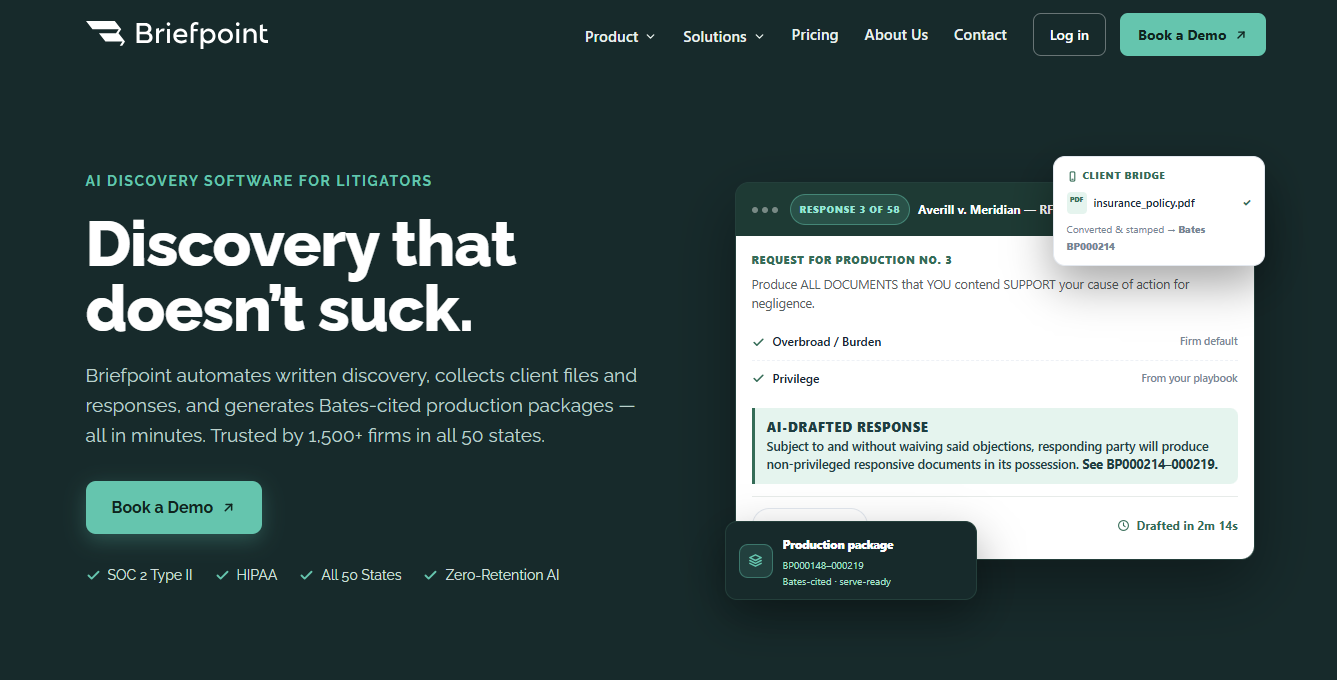
Autodoc takes the workflow further when productions are involved. You can upload the complaint, RFPs, and case files, and Autodoc identifies responsive documents for each request.
It then generates Word responses with page-level Bates citations and prepares a Bates-numbered production package for service.
Briefpoint also supports all 50 states and 98 federal district courts, which can be useful when your practice spans multiple jurisdictions.
With its comprehensive features, Briefpoint easily covers a large portion of the discovery workflow that would otherwise require hours of repetitive preparation.
Book a demo today and explore how much of your discovery process you can automate.
