What Is AI Legal Research & How Do You Use It?
What Is AI for Legal Research?
AI for legal research helps you move through legal questions faster and with more direction. Rather than relying only on exact keywords, you can describe the issue in plain language and get results tied to the facts or jurisdiction you are researching.
Most AI legal research tools use AI technologies like natural language processing and machine learning to interpret your query and sort through legal sources.
Depending on the platform, you may also be able to summarize a long opinion or compare authorities that take different approaches.
You can use the results to narrow your search, spot stronger lines of inquiry, and decide which sources deserve a closer read. That makes AI in legal research useful early in the process, when you are still shaping the issue and trying to understand how courts have handled similar questions.
How Is AI Changing Legal Research?
AI is changing legal research by helping you get to a useful starting point faster. Instead of testing one search phrase after another, you can describe the issue in plain language and refine the results through follow-up questions.
For legal professionals, that changes how the early research process feels and where time gets spent.
- More natural searches: AI systems can interpret full questions, so practicing attorneys do not always need to build complex keyword strings before finding relevant source material.
- Faster case review: AI can pull key points from long opinions and help you decide which authorities deserve a full read.
- Clearer comparisons: Legal teams can compare how courts treat similar issues, which can make conflicting rulings or factual distinctions easier to spot.
- Better research direction: AI usage can reveal related doctrines or alternative arguments that may not have appeared in the first search.
General AI tools may help with brainstorming or organizing ideas, while legal-specific platforms are usually better suited for locating authority and working with verified sources.
As these tools improve, lawyers can spend less time sorting through broad results and more time developing the analysis.
What Can AI Help With During Legal Research?
AI can support several parts of the research process, from finding stronger authorities to making dense source material easier to work through. The sections below look at the most practical ways you can use it during legal research:
Finding Relevant Cases and Authorities
AI can make the legal research process feel much less scattered when your first search brings back too many results. You can describe the issue in plain language, add the key facts, and look for relevant case law tied closely to the question you are researching.
For example, a lawyer reviewing a noncompete dispute could include the jurisdiction, the employee’s role, and the scope of the restriction. A platform like Bloomberg Law can then help surface relevant primary sources and other legal materials that deal with similar facts.
From there, you have a more focused set of authorities to review rather than a long list of loosely related results.
Summarizing Cases and Legal Documents
Long opinions can take time to unpack, particularly when you only need to know whether a case is worth a closer read.
AI software can summarize the central issue, the court’s reasoning, and the outcome so you can understand the decision before working through the full text.
For example, a lawyer reviewing several legal cases on the same procedural question could use AI to pull out how each court applied the rule and which facts shaped the result. The same approach can help with other documents, such as briefs or agency guidance.
AI-assisted legal research can reduce time-consuming tasks during the first pass and help you focus your attention on the most useful sections.
Comparing Multiple Authorities
AI can help you compare several authorities side by side rather than working through each one separately. You can ask it to organize legal information around the issue you care about, such as how different courts define a standard or which facts changed the outcome.
For example, a lawyer researching bad-faith claims could compare decisions from several courts and look for recurring reasoning. AI can help identify patterns in the rulings, point out where the authorities diverge, and make factual distinctions easier to spot.
A structured comparison gives you a clearer view and helps you decide which cases are strongest for your analysis.
Identifying Research Gaps
Research can look complete until you ask what has not been covered yet. AI platforms can help you test the work from that angle by surfacing missing jurisdictions, overlooked exceptions, or questions that still lack direct support.
For instance, you may have several cases explaining the general rule but nothing addressing the exact procedural posture in your matter.
A targeted AI search could reveal that the issue has been treated differently in another line of cases or that newer authority changes the analysis.
Used well, this step helps you catch weak spots before they turn into incorrect information. In the legal field, that can make the difference between a broad summary and research that truly holds up.
How to Use AI for Legal Research
Using AI for legal research usually takes a few rounds rather than one perfect prompt. The steps below show how to shape the question and build toward a useful result:
1. Define the Legal Issue
Before you open an AI tool, get clear on the question you are trying to answer. A vague issue will usually lead to vague results, so narrow it down to the rule, jurisdiction, and facts that could affect the analysis.
For this example, say you are researching whether a court may compel further responses to requests for production after the opposing party gave boilerplate objections and produced only part of the requested material.
That question gives you a useful starting point because it identifies the procedural issue and the conduct in dispute. You can refine it further by adding the jurisdiction, the type of case, or any deadlines tied to the motion.
2. Choose the Right AI Tool
The tool you choose should match the type of research you are doing. General generative AI tools can help you frame the issue or brainstorm search terms, but legal AI platforms are usually better for finding authority tied to a specific jurisdiction.
Look for a few practical features:
- Reliable source access: The platform should connect its answers to cases, rules, or other legal authority you can open and review.
- Jurisdiction filters: You should be able to narrow results to the court system and time period that apply to your issue.
- Useful follow-up tools: Strong platforms let you refine a question, compare cases, or trace how a rule has been applied.
For the legal discovery dispute example, you would want a tool that can search controlling authority on motions to compel and show how courts have treated boilerplate objections.
A general chatbot may help you shape the query, while an AI legal research platform can take you closer to the source material you need.
3. Write a Clear Research Prompt
A strong prompt gives the tool enough context to understand the issue you are researching. Include the jurisdiction, the legal question, and the facts that could affect the result. You can also specify the type of output you want, such as recent cases or a comparison of competing approaches.
In this situation, you might ask:
“Find recent California cases addressing motions to compel further responses to requests for production where the responding party used boilerplate objections and produced only part of the requested material.”
Generative artificial intelligence works better when the request is narrow and concrete. A prompt like “Find cases about discovery objections” leaves too much open, while the more detailed version gives the tool a clearer path into the research.
You can refine the prompt again after reviewing the first set of results.
4. Use the First Answer as a Research Map
Your first answer should point you toward the next round of research and not serve as the finished result. Review it for the legal principles, cases, and search terms that could help you build a clearer path forward.
For the motion to compel issue, your research map might include:
- California rules governing further responses
- Cases addressing boilerplate objections
- Decisions involving partial document production
- Secondary sources explaining the applicable standard
- A research guide for local motion requirements
You can then open the strongest authorities and use what you find to narrow the question further.
5. Review the Original Sources
Once you have a workable list of authorities, open the cases and read the relevant sections yourself.
AI models can help you find possible support, but they cannot replace professional judgment when you are deciding how a court’s reasoning applies to your facts.
For example, pay close attention to the procedural posture, the objections the court considered, and the relief it granted. Check the cited rules as well, then confirm that each case is still good law.
Reading the source directly gives you the context needed to exercise legal judgment and decide which authorities truly support your position.
6. Verify Citations and Quotations
Before using any authority in your legal work, confirm that the citation is accurate and that the source supports the point you plan to make. Open the case, find the quoted language, and read enough surrounding text to understand how the court used it.
Check that the authority comes from the correct jurisdiction and follows the court rules that apply to your filing. You should also compare the AI-generated summary with the original opinion, since small changes in wording can alter the meaning of a legal rule.
Document review at this stage should stay focused on accuracy. If your research includes sensitive information, keep it out of tools that have not been approved for confidential client work.
7. Ask Focused Follow-Up Questions
When you understand the first set of results, use follow-up questions to test the issue from a narrower angle. Good follow-ups can reveal distinctions the initial search missed and help you see how strong your position really is.
You might ask:
- Which cases reached the opposite result?
- How have courts treated partial production?
- What facts led courts to reject boilerplate objections?
- Are there newer cases from the controlling court?
- What exceptions could limit the general rule?
Each question should build on what you already found. The more specific you get, the more useful the next round of research becomes.
8. Turn Research Into a Usable Work Product
Research becomes useful when you shape it into something another lawyer can quickly understand and act on. AI can help organize your findings into a practical format, but the final structure should reflect the needs of the case and the audience reading it.
Common work products include:
- Research memo: Summarize the governing rule, strongest authorities, and any unresolved questions.
- Case comparison chart: Lay out how different courts approached similar facts and where their reasoning diverged.
- Argument outline: Arrange the authorities around the position you plan to advance and the responses you expect from the other side.
- Drafting notes: Pull together quotations, citations, and factual points that may be useful in a motion or brief.
As AI adoption grows in the legal profession, this step can help legal services move from research to drafting with less rework and a clearer record of how the analysis developed.
Risks and Ethical Considerations of AI Legal Research
AI can speed up research, but law firms still need clear rules for how these tools are used. The biggest risks usually come from weak source checking, poor handling of client data, or treating generated output as settled law.
Watch out for:
- Inaccurate results: AI may produce outdated authority, misstate a holding, or create a citation that does not exist. Lawyers should never rely solely on generated answers when preparing legal work.
- Client confidentiality: Entering confidential information into an unapproved platform can expose facts that are protected by professional duties. Firms should limit what users can upload and choose tools with strong data protection standards.
- Data privacy: Providers may store prompts or use submitted material to improve their systems. Review the platform’s retention policies before sharing client data.
- Hidden bias: AI systems may favor commonly cited authorities and overlook less prominent decisions that could change the analysis.
- Professional competence: AI ethics now form part of responsible technology use in legal practice. Ongoing legal education can help lawyers understand what a tool can do and where its limits remain.
Make AI Research Part of a Smarter Legal Practice
AI can help you reach useful authority sooner and bring more structure to the research process. The strongest results still come from using each answer as a lead, refining your questions, and reading the sources that shape the final analysis.
Once the research is complete, the work usually moves into drafting and case preparation. That transition is a natural place to look for further efficiency.
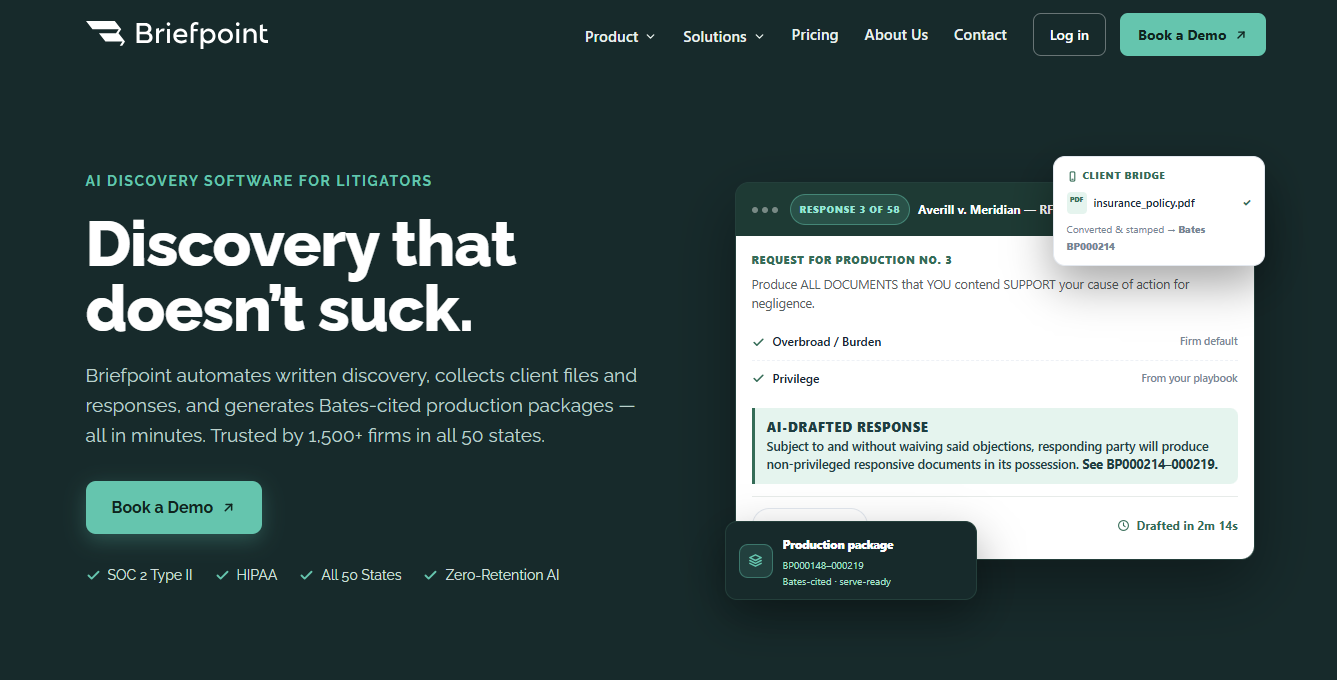
Briefpoint helps litigation teams automate written discovery after the legal and factual direction of a case is clear.
The platform supports both propounding and responding to discovery, so firms can handle more of the process in one place.
You can draft and respond to interrogatories, RFAs, and RFPs, collect client answers through a secure link, and prepare Bates-cited production packages in one platform. Briefpoint also exports editable Word documents to make it easier to review the work and make final changes before service.
Book a demo to see how Briefpoint can reduce the manual work surrounding discovery.
