A Step-by-Step Look at Discovery Drafting
What Is Discovery Drafting?
Litigation moves into the discovery phase once the parties begin formally exchanging information about the case. This is where each side asks for facts, documents, and admissions that may shape how the dispute develops.
Discovery drafting is the process of preparing those written requests and responses.
For example, the plaintiff might send interrogatories asking the defendant to explain key events, while the other side may request records or ask the plaintiff to admit certain facts. Attorneys also draft objections when a request is vague, overly broad, or seeks protected information.
Naturally, the work requires close attention because each response must reflect the facts of the case and follow the applicable court rules. Language pulled from an old template may need substantial revision before it fits the current dispute.
Strong discovery drafting helps you ask clearer questions and provide responses that accurately represent your client’s position.
It can narrow disputed issues, reveal useful evidence, and give both sides a better picture of the case before other steps like depositions, settlement discussions, or trial.
Types of Discovery Documents
Discovery can take several forms depending on what you need to learn or prove. These are some of the most common discovery requests used in civil litigation:
Interrogatories
Interrogatories are written questions that one party sends to another. The receiving party must answer them under oath within the deadline set by law.
They can help you identify witnesses, clarify what allegedly happened, and understand the other side’s version of events (among others). Attorneys often use them to gather basic facts before moving into more detailed discovery.
Common types include:
- Form interrogatories
- Special interrogatories
- Contention interrogatories
- Background questions
- Questions about other persons with relevant knowledge
Requests for Production
Requests for production ask a party to provide documents, electronically stored information, or physical items connected to the dispute. These requests may cover records that support your client’s story or help test claims made by the other side.
Each request should describe what is being sought clearly enough for the receiving party to identify and produce responsive material.
Requests for Admission
Requests for admission ask the other party to admit or deny specific statements. They are often used to confirm facts that should not require further proof and narrow the issues that remain disputed.
A clear answer can save time later in the case. If a party admits a fact, you may not need separate evidence to prove it at trial.
Depositions
Depositions allow counsel to question a party, witness, or expert under oath before trial. The testimony is usually recorded by a court reporter and may be used later to evaluate credibility, prepare motions, or challenge a witness’s account.
A deposition can be helpful when written discovery leaves gaps or when you need to hear the full story in the witness’s own words.
Subpoenas
A subpoena is a formal command requiring a person or organization to appear, provide testimony, or produce documents. Attorneys often use subpoenas to discover information held by someone who is not directly involved in the lawsuit.
The person called may need to attend a deposition, appear in court, or present specific records.
Other Discovery Documents
Other discovery tools may come into play depending on the dispute and the applicable rules. These include:
- Expert disclosures: Identify expert witnesses and summarize the opinions they expect to present.
- Initial disclosures: Provide basic information about witnesses, damages, and documents early in the case.
- Medical examination requests: Ask the court to require an examination when a person’s physical or mental condition is disputed.
- Requests for inspection: Allow a party to inspect property, equipment, or another location connected to the case.
- Supplemental responses: Update earlier answers when new information becomes available.
Common Issues During Discovery Drafting
Discovery drafting can take longer than expected because each request and response needs to be clear, relevant, and tailored to the case. Problems often appear once you begin putting the facts into formal language or responding to what the other side has sent.
Here are the issues that tend to cause the most trouble:
- Requests are too broad: Asking for every possible record may create unnecessary disputes. Narrowing the scope makes requesting documents more practical and easier to defend.
- The wording is unclear: A vague request can leave the receiving party trying to figure out what information you want. Precise language gives them a better ability to respond fully.
- Templates do not fit the case: Older wording may miss an important fact or include language that no longer applies. Attorneys sometimes realize this only after reviewing the full draft.
- Objections lack detail: General discovery objections may not explain the actual issue with the request. A stronger response connects each objection to the wording and applicable rule.
- Facts are incomplete: Drafting attempts may stall when client information is missing or inconsistent. Confirming key details early helps create responses that reflect the record.
- Deadlines are overlooked: Discovery timelines can be strict, and late responses may limit available objections or lead to court involvement.
What the Typical Discovery Drafting Process Looks Like
Discovery drafting usually begins with a close look at the case and what information still needs to be developed. The process then moves through a series of practical steps that help shape the requests or responses before they are served.
Here is what that process commonly looks like:
1. Review the Case and Discovery Needs
The process starts with a careful review of the basics, such as pleadings, available evidence, and perhaps the issues still in dispute. Before drafting anything, you need a clear sense of what the case already shows and where the record still feels incomplete.
This review helps you decide which facts need further support and which claims require closer attention. It can also reveal gaps in your client’s account or inconsistencies that should be addressed before the other side raises them.
At this stage, attorneys often create a working outline of the key issues. That outline gives the writing process some direction and keeps the discovery focused on information that could affect the case.
2. Identify the Information to Request
Once the open issues are clear, the next step is deciding what information could help develop them. Each request should connect to a specific point in the case rather than asking for broad categories with no clear purpose.
The information you need may include:
- Communications related to the dispute
- Financial or business records
- Names of relevant witnesses
- Details supporting a claim or defense
- Documents referenced in the pleadings
- Information about alleged damages
This list can serve as the foundation for your document requests and written questions. It also helps you check that every request has a reason behind it. If you cannot explain how the information could affect the case, the request may need to be revised or removed before drafting begins.
3. Choose the Appropriate Discovery Method
Different discovery tools serve different purposes, so the method you choose should match the information you are trying to obtain.
For example, interrogatories work well when you need written explanations or the identity of people with relevant knowledge. Requests for production are better suited to records and electronically stored information.
Requests for admission can help confirm facts that should not remain disputed. A deposition may be more useful when you need detailed testimony or want to follow up on answers given earlier in written discovery.
You may use several methods during the same case, but each one should have a clear role. Choosing the right format early helps you avoid asking the same question in several ways and keeps the overall discovery plan focused.
4. Draft the Requests or Responses
Now the information gathered earlier becomes a working document. For outgoing discovery, the first draft should turn each issue into a clear request that asks for one identifiable category of information.
For discovery responses, the initial draft should address each request separately and include the facts currently available.
Keep the wording direct and avoid packing several ideas into one paragraph. A request that tries to cover too much can create confusion and make objections more likely. The same applies to responses that rely on vague language rather than a clear answer.
Templates can give the writer a useful starting point, but every section still needs to fit the case.
5. Review Objections and Supporting Details
The review stage is where you test the draft for legal and factual weaknesses. Each objection should have a clear basis and connect to the specific request. Boilerplate language may be easy to add, but it can create problems if the other side challenges the response before a judge.
Supporting details also need close attention. Check that factual answers match the available record, and that document references are accurate. If a response promises production, confirm that the identified materials can actually be produced.
This is also the time to fix unclear wording, repeated requests, or answers that leave too much room for interpretation.
6. Finalize and Serve the Documents
Before service, confirm that the document follows the applicable court rules and any case-specific requirements. Check the caption, numbering, signature block, verification language, and certificate of service.
Remember: Legal document formatting may seem minor, but errors can delay service or require a corrected filing.
The final review should also confirm that every request has a corresponding response and that any attachments are included. If the document will be served electronically, make sure the file opens properly and has a clear name.
Once everything is complete, serve the discovery through the approved method and keep a copy in the matter file. Record the service date as well, since it may affect later deadlines and any motion practice that follows.
What Is Discovery Drafting Software?
Discovery drafting software is a program that helps legal teams prepare, review, and organize written discovery. It can support both outgoing requests and responses, which can then give you a faster way to handle repetitive drafting work while keeping each document tied to the case.
The exact features vary, but common benefits include:
- Automated document creation: The software turns matter details, selected requests, and approved language into a structured draft.
- Request and response analysis: Some platforms review discovery language and suggest relevant objections or identify information needed for a complete answer.
- Template management: Firms can store preferred wording and reuse it while adapting the draft to the current dispute.
- Document review support: The program can help connect responsive files to specific requests and organize supporting citations.
- Consistent formatting: Captions, numbering, definitions, and signature sections can be added in the required format.
Attorneys interested in using this software may worry that automation will replace legal judgment. These tools still require careful review, but they can easily reduce the manual work surrounding discovery and give counsel more time to focus on the substance of each response.
A Faster Path to Review-Ready Discovery
Discovery drafting plays a major role in how a case develops. Clear requests can uncover useful information, while well-prepared responses help protect your client’s position and reduce avoidable disputes.
Even so, a large part of the work happens before an attorney reaches the final review. Requests need to be organized, objections must be matched to the right language, and client answers often have to be collected and added manually.
Briefpoint helps move that process along. You can draft interrogatories, requests for admission, and requests for production using objection-aware language built for your jurisdiction.
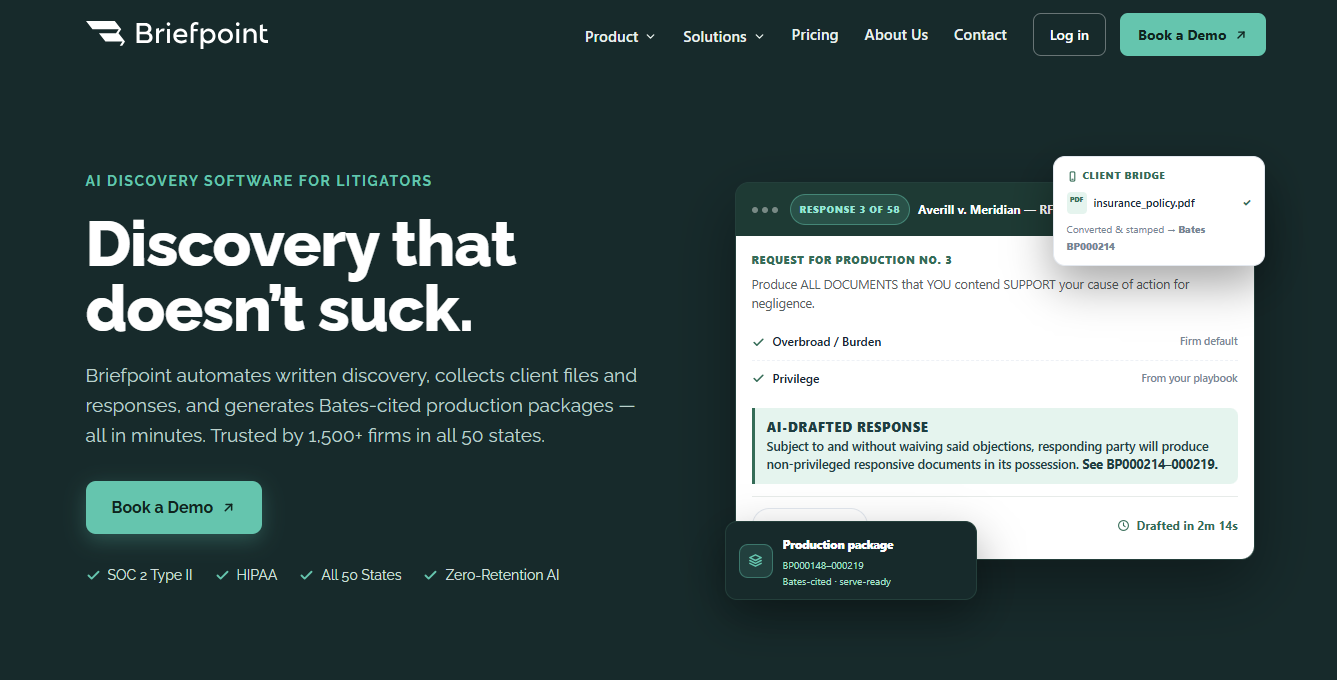
From there, Client Bridge gives clients a secure way to answer questions in plain English or Spanish. Their responses are then mapped back to the relevant discovery requests, which makes attorney review easier.
For document-heavy RFP responses, Autodoc identifies responsive files, creates page-level Bates citations, and prepares a Word-formatted response. It can also generate a Bates-numbered production package while keeping your team in control of the final document set.
Do you want to see how it all works in practice?
