What Is Automated Legal Document Creation?
What Is Automated Legal Document Creation?
Legal work easily and quickly gets repetitive when every new matter brings another round of forms, agreements, and other documents to prepare.
Thomson Reuters reports that lawyers can spend 40% to 60% of their time drafting legal documents and reviewing contracts, leaving less time for higher-value work
Automated legal document creation can cut down a lot of that busywork. With automation, you can move from intake or matter information to a usable document much faster, without relying so heavily on old files or manual copy-and-paste.
For law firms and in-house legal teams, that can mean shorter drafting cycles and less time spent on routine document creation. The bigger question is how the technology actually works, what it can handle, and where it fits best in your existing workflow.
Automated Legal Document Creation Explained
Automated legal document creation is the use of software to generate documents from templates, stored information, user answers, or other structured inputs.
Traditional document automation might take a legal template and populate names, dates, addresses, or matter information automatically. More advanced legal automation software can apply conditional logic, so clauses and sections change according to the information entered.
Picture a typical estate planning intake form. A client answers questions about beneficiaries and property. Document assembly software can use those responses to prepare customized legal documents from approved automated templates instead of requiring someone to copy every detail into Word.
Legal document automation can support document drafting in many practice areas, such as family law or corporate law. It may also connect document creation with client intake, approval processes, electronic signatures, or document management.
However, the level of automation varies widely. Some automation tools create standardized forms, while other legal document automation tools can assist with complex legal documents that require additional review and legal judgment.
How Does Automated Legal Document Creation Work?
Document automation can work through several different technologies. The setup may rely on predefined fields, conditional logic, stored case data, or AI that helps generate larger portions of a document.
Common approaches include:
- Template-based automation: Document templates contain predefined fields that pull information from client data or matter records. A client agreement, for example, might automatically populate the client name, fee terms, and case number.
- Conditional logic: Rules determine which language appears in an automated document. An employment agreement might add a particular provision only when a certain answer is selected.
- Document assembly software: Information gathered through questionnaires or client intake is assembled into one or multiple documents based on predefined rules.
- AI-assisted drafting: AI can interpret source material and assist with automated document drafting when the output cannot be created from fixed fields alone.
- System-connected automation: A seamless integration may pass information between existing systems through native connections or an application programming interface, which can then reduce duplicate data entry.
What Types of Legal Documents Can Be Automated?
Many legal documents contain predictable language or repeat information already stored elsewhere. Those characteristics make them good candidates for automating legal document creation.
Here are examples of legal documents you can automate:
- Client agreements: Information from client intake can flow into engagement letters, fee agreements, and related onboarding documents.
- Contracts: Contract management workflows can generate agreements from approved clauses and business information, then route drafts through an approval process.
- Estate planning documents: Automated questionnaires can populate wills and other estate planning documents based on client responses.
- Court documents: Legal document software can help populate pleadings, forms, and other court documents when the required information follows a defined structure.
- Discovery documents: Specialized software for law firms can assist with interrogatories, requests for admission, requests for production, and responses to incoming discovery.
- Corporate documents: Corporate law practices may automate routine resolutions, notices, and standard agreements from existing company data.
PDF documents and legacy documents can also serve as source material, though automation capabilities vary by platform and file format.
Benefits of Automated Legal Document Creation
Law firm document automation can reduce repetitive drafting tasks and make routine document creation easier to manage.
Some of the notable benefits include:
- Less repetitive work: Automating repetitive tasks cuts down on copying, formatting, and other manual processes that take up time during document preparation.
- Faster document creation: A document automation platform can help you create documents from existing data and approved templates instead of rebuilding each draft manually.
- Fewer avoidable mistakes: Pulling information from stored client or matter data can reduce human error from retyping names, dates, and other details.
- More consistent language: Automated templates make it easier to use approved clauses and formatting from one document to the next.
- More accurate documents: Structured fields and predefined rules can help keep key information consistent throughout a draft, especially when the same data appears in multiple places.
- Better workflow connections: Document automation can connect drafting with systems you already use for document management, approvals, or electronic signatures.
- Easier scaling: Larger law firms or teams handling higher document volume can produce repeatable drafts more efficiently without spending more time drafting documents.
Key Features to Look for in Legal Document Automation Software
The best legal document automation setup depends on your practice areas and the documents you produce most often. Before choosing software, map your current process and identify where repetitive work takes up the most time.
We’ve compiled a few essential features you should consider:
Flexible Templates and Conditional Logic
Your templates should be able to adapt as the document changes. A rigid form can work for simple drafting, but more involved documents often need language to shift based on specific details or the type of agreement being created.
Look for features such as:
- Automated templates
- Reusable clauses
- Variable fields
- Conditional logic
- Branching rules
- Custom sections
- Dynamic questions
Those features make it easier to produce customized legal documents from one repeatable framework rather than editing the same static file over and over.
Integrations With Your Existing Systems
Creating a document is often one step within a larger legal workflow. Look at how the software connects with existing systems such as legal practice management software, contract management tools, or your document management system.
Particularly, Microsoft Word integration can be valuable when lawyers prefer to complete their review and revisions there.
An application programming interface may provide additional flexibility when your legal department has custom technology or specific legal operations requirements.
Review and Approval Controls
Automated workflows still need clear points for human review.
Useful features can include approval routing, permissions, document status tracking, and controls over finalized documents.
Accurate legal documents require more than filling the correct fields. For example, a lawyer may still need to assess legal language, client circumstances, or case strategy before anything is signed or served.
Document Management and Version Control
Document management features help keep generated drafts organized after creation.
Check how the platform names files, stores versions, handles multiple documents, and connects drafts to the correct client or matter. Generally, firms handling a high volume of legal services may need stronger controls than a solo practice preparing a small number of standard forms.
A connection with your existing practice management system can help reduce extra administrative steps.
Automation That Fits Your Legal Work
The right document automation software should fit the work you actually want to automate.
A general document generation tool may work well for routine forms. Specialized legal document automation tools can be more useful when the drafting process depends heavily on legal context.
Before buying a platform, test it against a real workflow. See how it handles document creation, revisions, approvals, and final output. Legal innovation has the greatest practical impact when software reduces work people are currently doing manually.
Bring More Automation Into Discovery With Briefpoint
General document automation can help with many legal practices, but discovery has requirements that standard template software may struggle to handle.
Briefpoint focuses specifically on written discovery. You can use the platform to draft and respond to interrogatories, requests for admission, and requests for production.
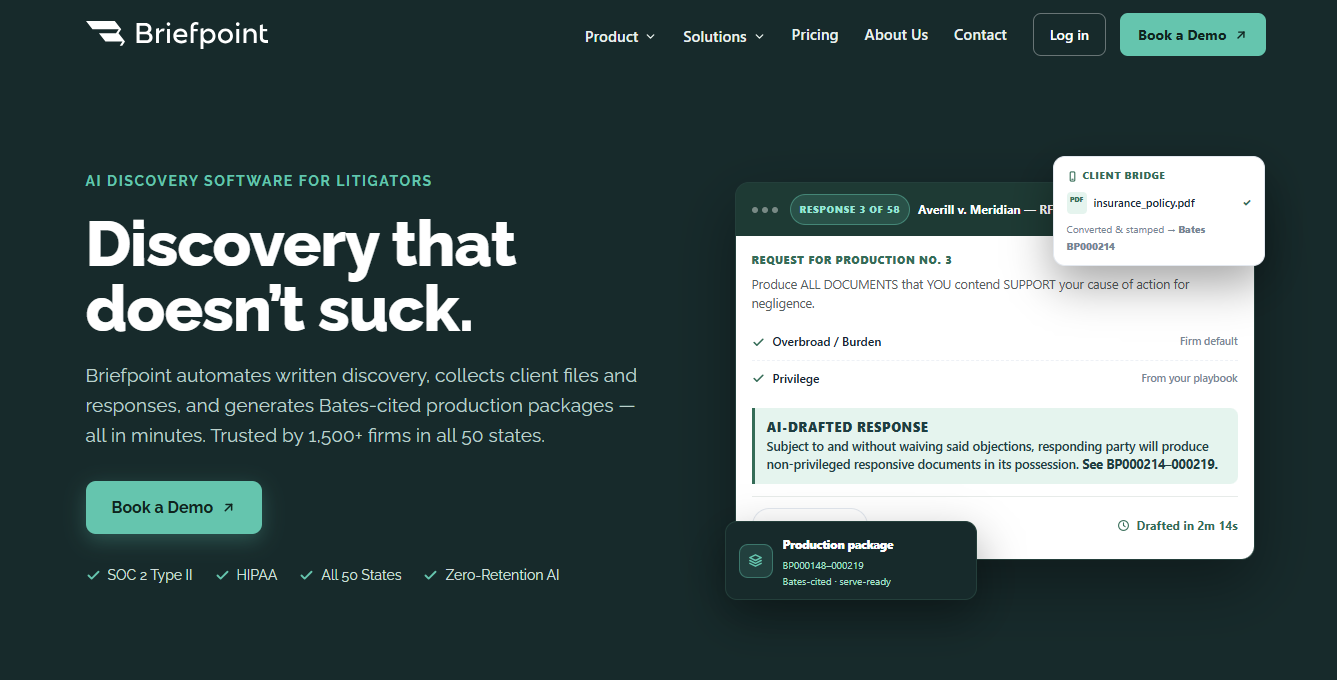
Its Autodoc feature reviews case files, identifies documents responsive to individual RFPs, and prepares Word responses with page-level Bates citations. Briefpoint can generate a Bates-numbered production package alongside the response.
Client Bridge gives clients a secure way to provide answers and upload files, while Supplemental Responses lets you prepare updated discovery responses while preserving earlier versions for reference.
For a practical example, imagine receiving 40 RFPs along with thousands of pages of case files. Rather than reviewing every file manually and mapping documents to each request one at a time, Autodoc can locate responsive material and build editable responses for attorney review.
For law firm operations where discovery consumes significant drafting and review time, Briefpoint offers legal automation built around that specific workflow.
