Objections to Interrogatories: Federal Rules and Examples
Objections to Interrogatories: Federal Rules and Examples
Legal content overseen by Nathan Walter, Esq., attorney licensed in California (State Bar No. 313299).
Under the Federal Rules of Civil Procedure, objections to interrogatories must be served within 30 days after service of the interrogatories unless a stipulation or court order sets a different time, and each ground must be stated with specificity (Rule 33(b)(2) and (b)(4)).
Any part of an interrogatory that is not objected to must still be answered separately, fully and under oath.
This guide covers federal procedure only: the rules, the facts that support each common ground, three invented defense-side examples that pair an objection with an answer, and the mistakes that weaken an objection.
What are objections to interrogatories?
An objection to an interrogatory is a written statement, served with the answers, that the responding party is not fully answering a question for a stated reason such as scope, burden or privilege. A denial responds on the facts; an objection challenges the question or part of it.
Under Rule 33(a)(2), an interrogatory “may relate to any matter that may be inquired into under Rule 26(b),” so most objections come back to the scope and limits in Rule 26(b). Our guides to interrogatories in discovery and federal discovery responses cover the wider process, and our reference on objections across written discovery compares other request types.
This guide is written for defense-side litigators and paralegals responding in employment and premises-liability cases. Briefpoint offers discovery workflows for defense firms.
Federal rules for objections to interrogatories
Deadline, specificity and waiver
Rule 33 sets the response deadline and the standard for objections:
- Deadline: “The responding party must serve its answers and any objections within 30 days after being served with the interrogatories.” A shorter or longer time may be stipulated to under Rule 29 or ordered by the court (Rule 33(b)(2)).
- Specificity and waiver: “The grounds for objecting to an interrogatory must be stated with specificity. Any ground not stated in a timely objection is waived unless the court, for good cause, excuses the failure” (Rule 33(b)(4)).
Answers under oath and separate signatures
Rule 33(b)(3) says each interrogatory must, “to the extent it is not objected to, be answered separately and fully in writing under oath.”
When the responding party is a corporation, partnership, association or governmental agency, the answers are made “by any officer or agent, who must furnish the information available to the party” (Rule 33(b)(1)(B)). The person who makes the answers signs them, and the attorney who objects signs any objections (Rule 33(b)(5)).
Count discrete subparts, not just numbered questions
Unless otherwise stipulated or ordered by the court, a party may serve “no more than 25 written interrogatories, including all discrete subparts.” Leave to serve more may be granted “to the extent consistent with Rule 26(b)(1) and (2)” (Rule 33(a)(1)). The rule text does not define a discrete subpart, and this guide does not propose a test for one.
Common grounds and the facts that support them
None of these entries guarantees that a court will sustain an objection.
Relevance, proportionality and overbreadth
Rule: Rule 26(b)(1) allows discovery of “any nonprivileged matter that is relevant to any party’s claim or defense and proportional to the needs of the case,” considering:
- the importance of the issues at stake in the action;
- the amount in controversy;
- the parties’ relative access to relevant information;
- the parties’ resources;
- the importance of the discovery in resolving the issues; and
- whether the burden or expense of the proposed discovery outweighs its likely benefit.
Facts to state: the claims or defenses at issue, the facility, time period, person or subject the interrogatory reaches, and why that requested information falls outside the relevant and proportional scope of discovery. The words “all” or “every” in a question do not by themselves show overbreadth.
Undue burden and cumulative discovery
Rule: the last factor above weighs burden or expense against likely benefit. Under Rule 26(b)(2)(C), the court, on motion or on its own, “must limit the frequency or extent of discovery” if it determines that:
- the discovery is unreasonably cumulative or duplicative, or can be obtained from some other source that is more convenient, less burdensome, or less expensive;
- the party seeking discovery has had ample opportunity to obtain the information by discovery in the action; or
- the proposed discovery is outside the scope permitted by Rule 26(b)(1).
Facts to state: the records or systems that would have to be searched, the work involved and the limited benefit to the case. A documented burden gives a court something to weigh; the word “burdensome” alone does not. Rule 26(b)(2)(C) states what the court must do, not an exemption from answering.
Unclear terms and disputed premises
Rule: the passages of Rules 33 and 26 quoted in this guide do not set out a separate test for vague or ambiguous questions.
Drafting practice: an answer can identify the unclear term, state the interpretation used and answer on that basis, consistent with Rule 33(b)(3). The same practice applies to a question built on a premise the responding party disputes: the answer can state the dispute and respond within it.
Privilege and work product
Rule: Rule 26(b)(1) reaches only “nonprivileged” matter. Trial-preparation materials are addressed separately in Rule 26(b)(3)(A): “Ordinarily, a party may not discover documents and tangible things that are prepared in anticipation of litigation or for trial by or for another party or its representative.” Subject to Rule 26(b)(4), they may be discovered if they are otherwise discoverable under Rule 26(b)(1) and the requesting party “shows that it has substantial need for the materials to prepare its case and cannot, without undue hardship, obtain their substantial equivalent by other means.” If a court orders discovery of them, it “must protect against disclosure of the mental impressions, conclusions, opinions, or legal theories of a party’s attorney or other representative concerning the litigation” (Rule 26(b)(3)(B)).
The substantial-need exception sits in the trial-preparation provision, and its text does not extend it to every privilege claim. Attorney-client privilege elements are outside this guide.
Facts to state: a party that withholds information on either basis “must: (i) expressly make the claim; and (ii) describe the nature of the documents, communications, or tangible things not produced or disclosed” in a manner that “will enable other parties to assess the claim” without revealing protected information (Rule 26(b)(5)(A)). A privilege log is one way to convey that description; the rule text prescribes no format.
Confidential information and protective orders
Rule: confidentiality is not the same as privilege. Under Rule 26(c)(1), the court “may, for good cause, issue an order to protect a party or person from annoyance, embarrassment, oppression, or undue burden or expense.” Rule 26(c)(1)(G) lists an order “requiring that a trade secret or other confidential research, development, or commercial information not be revealed or be revealed only in a specified way.”
Facts to state: the nature of the information and why unconditional disclosure would cause that harm. A motion for a protective order under Rule 26(c)(1) “must include a certification that the movant has in good faith conferred or attempted to confer with other affected parties in an effort to resolve the dispute without court action.”
Examples of objections to interrogatories
The scenarios and responses below are invented for illustration. They are not court-approved forms, and each depends on its own invented facts.
Narrowing an unrelated time period and location
A former shift supervisor at an employer’s Dayton distribution center sues over his March 31, 2024 termination. The employer operates 40 facilities. Interrogatory No. 6 asks Defendant to identify every employee disciplined at any facility from January 1, 2010 through March 31, 2024, and the reason for each discipline.
Objection: Defendant objects to Interrogatory No. 6 under Rule 26(b)(1) as to facilities other than the Dayton distribution center and as to any period before January 1, 2022. Plaintiff’s claim concerns his termination by the Dayton operations manager. The interrogatory reaches discipline imposed by other managers at 39 other facilities over fourteen years, which is not tied to a pleaded claim or defense and is not proportional to the needs of the case. Defendant is not providing information outside that scope.
Answer: From January 1, 2022 through March 31, 2024, four employees at the Dayton distribution center received discipline, all issued by the Dayton operations manager: Alex Reed and Jordan Lee for attendance, Casey Morgan for a safety violation, and Taylor Brooks for insubordination.
The objection names the claim and the facilities and dates it excludes, so the other side can see what is not being answered, and the answer covers the unobjected portion as Rule 33(b)(3) requires. Whether a court would accept January 1, 2022 as the cutoff depends on the pleadings; the example shows structure, not a safe harbor.
Explaining a disproportionate records inquiry
A customer sues a grocery chain over a fall in one aisle of Store 112 on October 3, 2024. The chain operates 140 stores. Interrogatory No. 9 asks Defendant to identify every wet-floor complaint, incident report and claim at any store from January 1, 2015 through October 3, 2024.
Objection: Defendant objects to Interrogatory No. 9 under Rule 26(b)(1) as to stores other than Store 112 because the burden and expense of the discovery outweigh its likely benefit. Defendant keeps incident reports in store-level logs, and responding for every store would require manual review of logs for 140 stores across the ten calendar years 2015–2024, or 1,400 annual store logs. Plaintiff’s claim concerns one aisle on one date.
Answer: From January 1, 2015 through October 3, 2024, Store 112 received two wet-floor complaints before Plaintiff’s fall: Morgan Ellis’s June 14, 2023 complaint about aisle 4, recorded in incident report 112-2023-0614, and Avery Chen’s January 9, 2024 complaint about aisle 7, recorded in incident report 112-2024-0109. Neither concerned the aisle where Plaintiff fell. On October 3, 2024, Plaintiff reported the fall at issue in this action, and manager Jamie Patel completed the standard incident report for that fall. Apart from those matters, Store 112 had no wet-floor complaints, incident reports or claims during the stated period.
The burden statement identifies the source, the volume and the comparison to the claim. The quantities are hypothetical, and the court decides whether the burden outweighs the benefit.
Separating protected material from discoverable facts
In the same case, Interrogatory No. 12 asks Defendant to describe every investigation of the fall, including the substance of each witness statement and each investigator’s conclusions.
Objection: Defendant objects to Interrogatory No. 12 to the extent it seeks the protected contents of a four-page memorandum dated October 9, 2024, prepared in anticipation of litigation by investigator Riley Park at Defendant’s counsel’s direction. The memorandum summarizes interviews with Store 112 employees Sam Rivera and Drew Quinn and records the investigator’s litigation-related conclusions. Defendant claims trial-preparation protection under Fed. R. Civ. P. 26(b)(3) and provides this description under Rule 26(b)(5)(A). Defendant withholds the memorandum’s protected contents, not the underlying facts about the fall.
Answer: On October 3, 2024, Store 112 manager Jamie Patel inspected the aisle and completed Defendant’s standard incident report. Rivera reported seeing liquid in the aisle shortly before the fall; Quinn reported placing a warning cone after the fall. Patel concluded that the source of the liquid was unknown. On October 9, 2024, Park interviewed Rivera and Quinn at counsel’s direction and prepared the memorandum described above. These were the only investigations.
The objection makes the claim expressly and describes the withheld item without revealing what it says, as Rule 26(b)(5)(A) asks. The example involves trial-preparation material under Rule 26(b)(3), not attorney-client privilege. Whether a document was prepared in anticipation of litigation is a question of its facts.
Mistakes that weaken an interrogatory objection
General reservations instead of request-specific grounds
Rule 33(b)(4) speaks of the grounds for objecting “to an interrogatory,” stated “with specificity.” A paragraph of general objections at the front of a response set does not tie a ground to a particular interrogatory, and a ground not stated in a timely objection is waived unless the court, for good cause, excuses the failure.
Treating contention questions or multiple clauses as automatically improper
Rule 33(a)(2) provides that an interrogatory “is not objectionable merely because it asks for an opinion or contention that relates to fact or the application of law to fact.” The 1970 Advisory Committee Note adds that interrogatories “may not extend to issues of ‘pure law,’ i.e., legal issues unrelated to the facts of the case.” Multiple clauses raise a counting question under Rule 33(a)(1), not a categorical ban on compound questions.
Treating incomplete discovery as an extension
Under Rule 33(a)(2), the court “may order that the interrogatory need not be answered until designated discovery is complete, or until a pretrial conference or some other time.” Incomplete discovery does not itself extend the response deadline; the timing changes through a court order or a stipulation under Rule 29, as Rule 33(b)(2) provides.
For interrogatories touching expert issues, Rule 26(a)(2)(D) states that disclosures are made “at the times and in the sequence that the court orders,” so the court’s expert schedule is the first thing to check. This guide does not cover expert-discovery protections.
State rules
For state-court cases, separate guides cover California interrogatory responses, Texas interrogatory responses, Florida interrogatory responses and New York interrogatory responses. Use the guide for the relevant jurisdiction rather than treating this federal overview as a state-court response guide.
Draft interrogatory responses with Briefpoint
Briefpoint drafts responses and objections to interrogatories, requests for production and requests for admission. Output is editable in Microsoft Word, and attorneys keep final review, so objections and answers can be revised before service. The attorney decides which grounds the facts support, and a draft is not a legal conclusion or a compliance guarantee. Briefpoint supports all 50 states and 98 federal courts. Attorneys still review the draft against the governing rules and the facts of the case.
When an answer or objection turns on identifying documents, Autodoc can support that document work. It finds responsive documents, adds page-level Bates citations and builds a Bates-numbered production package. The response draft remains subject to attorney review.
Book a demo to see how Briefpoint drafts interrogatory responses and objections for defense matters.
See Briefpoint in this short demo:
FAQs About Objections to Interrogatories
What are common objections to interrogatories?
Common grounds include relevance and proportionality under Rule 26(b)(1), undue burden, trial-preparation protection under Rule 26(b)(3) and (b)(5), and confidential information, addressed through a protective order under Rule 26(c)(1). Each ground must be stated with specificity under Rule 33(b)(4), and any part not objected to must be answered under oath.
Can you object to an interrogatory and still answer part of it?
Yes. Rule 33(b)(3) requires each interrogatory, “to the extent it is not objected to,” to be answered separately and fully in writing under oath. An objection to one clause or time period leaves the rest to be answered, and the attorney who objects signs the objection under Rule 33(b)(5).
Are general objections to interrogatories enough?
Rule 33(b)(4) requires the grounds for objecting to an interrogatory to be stated with specificity, and a ground not stated in a timely objection is waived unless the court excuses the failure for good cause. A general statement at the front of the responses does not tie a ground to a particular interrogatory.
Can an interrogatory ask for a legal conclusion?
Sometimes. Under Rule 33(a)(2), an interrogatory is not objectionable merely because it asks for an opinion or contention relating to fact or the application of law to fact. The 1970 Advisory Committee Note says interrogatories may not extend to issues of “pure law,” meaning legal issues unrelated to the case’s facts.
What is a compound interrogatory, and can you object to it?
A compound interrogatory combines several questions under one number. Rule 33(a)(1) limits a party to 25 written interrogatories “including all discrete subparts,” unless stipulated or ordered, and the court may grant leave to serve more. The rule text does not define a discrete subpart or ban compound questions.
The information provided on this website does not, and is not intended to, constitute legal advice; instead, all information, content, and materials available on this site are for general informational purposes only. Information on this website may not constitute the most up-to-date legal or other information. This website contains links to other third-party websites. Such links are only for the convenience of the reader, user or browser. Readers of this website should contact their attorney to obtain advice with respect to any particular legal matter. No reader, user, or browser of this site should act or refrain from acting on the basis of information on this site without first seeking legal advice from counsel in the relevant jurisdiction. Only your individual attorney can provide assurances that the information contained herein – and your interpretation of it – is applicable or appropriate to your particular situation. Use of, and access to, this website or any of the links or resources contained within the site do not create an attorney-client relationship between the reader, user, or browser and website authors, contributors, contributing law firms, or committee members and their respective employers.
READ MOREHow to Evaluate RFP Responses
What Are RFPs and RFP Responses?
In litigation, RFPs are requests for production. They are written discovery requests that ask the other side to produce documents, electronically stored information, or tangible items tied to the case.
That can include emails, contracts, invoices, photos, medical records, internal messages, and other records that matter to the claims or defenses.
An RFP response is the written answer to each request. It tells you if the responding party will produce documents, object to the request, or do both.
A response may say documents will be produced in full, produced in part, or withheld based on objections like relevance, burden, privilege, or scope.
Hence, it helps to start with a clear understanding of both the request and the response. You need to know what was asked for, how the other side answered, and what that answer really means in practice.
Some responses are direct, but others can be vague, heavily qualified, or written in a way that leaves room for dispute.
Since most RFPs are tied to facts that matter later in the case, these responses can shape depositions, motion practice, settlement discussions, and overall case strategy. They also help you evaluate what has been produced and what may still be missing for your clients’ needs.
What Does It Mean to Evaluate an RFP Response?
Evaluating an RFP response means reviewing how well the other side answered your requests, both on paper and in the production itself.
Keep in mind that you are looking at more than whether a response exists. You are checking for different RFP criteria, such as whether the answer is complete, specific, legally sound, and matched to what was actually requested.
That review helps you make informed decisions about what to do next. Maybe the response is solid, and you move on. Maybe it is packed with boilerplate objections, vague wording, or obvious gaps that call for a meet and confer or motion to compel.
The goal is to spot strengths, weaknesses, and anything that could affect the discovery strategy.
Some common RFP evaluation criteria include:
- Completeness
- Specificity
- Relevance
- Objections
- Responsiveness
- Privilege claims
- Timing
- Quality of production
A consistent review process also helps ensure consistency from one request to the next, especially when you are dealing with a long set of responses. That makes it easier to compare answers, track deficiencies, and decide which issues deserve follow-up.
How to Evaluate an RFP Response
Law firms may handle this review a little differently depending on the case, the team, and the stakes involved. Even so, there are a few core things worth checking any time you evaluate an RFP response.
We’ve prepared a step-by-step guide to help you get started:
1. Read the Request and Response Side by Side
Start with the RFP document itself, then read the response right next to it.
Look closely at the wording of the request, including definitions, date ranges, and categories of documents. Then compare that language to the response line by line. You want to see if the answer actually matches the request or shifts it into something smaller and easier to answer.
For example, say a request asks for “all emails, texts, and internal messages between January 1 and June 30 related to the termination of Plaintiff.” The response says the party will produce “non-privileged emails concerning Plaintiff’s separation.”
That answer leaves out texts, internal messages, and the exact date range. It also swaps “termination” for “separation,” which may narrow the scope.
In many firms, this step is part of a broader RFP process handled by attorneys, paralegals, or other evaluation teams, but the common goal is to catch mismatches early.
2. Check for Clear Answers and Specific Objections
Next, look at how directly the other side answered the request. A strong response tells you what will be produced, what is being withheld, and why. In contrast, a weak one hides behind vague language or piles on discovery objections without tying them to the actual request.
You also want to see if the objections are specific. General objections like “overly broad,” “unduly burdensome,” or “not reasonably calculated” do very little on their own.
The response should explain what part of the request creates the problem and how. That level of detail matters for compliance, and it also makes it easier to decide if the objection has any real weight.
A few things to watch for:
- Clear yes or no answers
- Objections tied to the wording of the request
- Partial responses explained clearly
- Vague or boilerplate objections
- Statements that leave production unclear
Plenty of firms have their own drafting habits, but specific objections and direct answers are still closer to industry standards than generic pushback.
If you want a better sense of what weak objections look like, check out our discovery objections cheat sheet.
3. Compare the Response to What Was Produced
Once you read the written response, compare it to the documents that were actually produced.
This is the point where a response that sounded acceptable on paper may start to fall apart. A party may promise responsive documents, then produce only a thin set of records that does not fully match the request.
For example, say the response states that the party will produce communications related to a contract dispute.
When the production arrives, you find a few emails and one attachment, but no drafts, internal messages, or follow-up communications. That gap may tell you the response was narrower than it first appeared, or that the production was incomplete.
This step is vital because written responses can be carefully phrased to craft responses that sound cooperative without giving you much in practice. Looking at the production lets you test the response against the facts.
It also helps you apply clear evaluation criteria in a more useful way, since you are no longer judging the wording alone. You are also judging whether the production actually backs it up.
4. Flag Gaps, Withholding, and Evasive Language
This is the stage where you slow down and look for what the response avoids saying.
Some answers look polished but still leave major questions open. You want to spot missing categories of documents, unclear withholding, and wording that gives the other side room to argue later that they never promised much in the first place.
Pay close attention to phrases that sound responsive but do not actually commit to full production. Also watch for objections followed by partial answers that never explain what was withheld.
Examples include:
- “Responding party will produce responsive, non-privileged documents”
- “Subject to and without waiving these objections, responding party states…”
- “After a reasonable search, no documents are presently known”
- “Defendant will produce documents, if any, in its possession”
- “This request is vague, overbroad, and unduly burdensome”
None of those phrases automatically makes a response deficient, but they should make you pause. They may signal limited production, hidden withholding, or an objection that says very little.
When you flag this language early, it becomes much easier to decide what deserves a follow-up letter, a meet and confer, or a closer review of the production.
5. Decide What Needs Follow-Up
Once you finish reviewing the responses and production, the next question is what actually deserves follow-up.
Of course, not every weak response needs a fight. Some issues are minor, while others can affect depositions, motion practice, expert work, or settlement posture. What you want is to focus on the gaps that matter most to the case.
For example, if the other side objected to a request but still produced the key documents, that issue may not need immediate attention.
On the other hand, if a response promises communications about a termination decision and the production leaves out internal emails, texts, or drafts, that is probably worth raising. The same goes for responses that mention withheld documents without saying what was withheld or why.
This part of the review is also a form of risk management. You are deciding which issues can wait, which ones need a meet and confer, and which may need court involvement if the problem continues.
Plus, it helps the team provide feedback internally before the next submission, especially if discovery deadlines are close or similar issues are showing up in multiple responses.
Make RFP Review Less Tedious With Briefpoint
Reviewing RFP responses often turns into more than reading objections and checking what was produced. You may start with one request, then end up tracing missing documents, comparing qualified answers, and figuring out what still calls for a follow-up.
Briefpoint fits naturally into that workflow. More than 1,500 law firms use it to handle discovery work faster, and it covers more than first-pass drafting.
Autodoc helps turn productions and case files into ready-to-serve discovery responses, which is useful when the volume of documents starts to pile up.
Briefpoint also supports Supplemental Responses, so when new information comes in or an answer needs to be updated, your team can revise without rebuilding everything from scratch.
If you want a better way to handle discovery work from initial responses through later updates, book a demo with Briefpoint.
15 Law Firm Marketing Strategies That Help Firms Grow
MyCase vs. PracticePanther: What Are the Key Differences?
What Is MyCase?
MyCase is a cloud-based legal practice management software that gives you one place to organize your firm’s work. It’s essentially a system that keeps your tasks, contacts, billing, calendar, and legal documents from living in ten different tabs.
It first launched in 2010 and quickly picked up traction with small and midsize firms that wanted something modern but easy to learn.
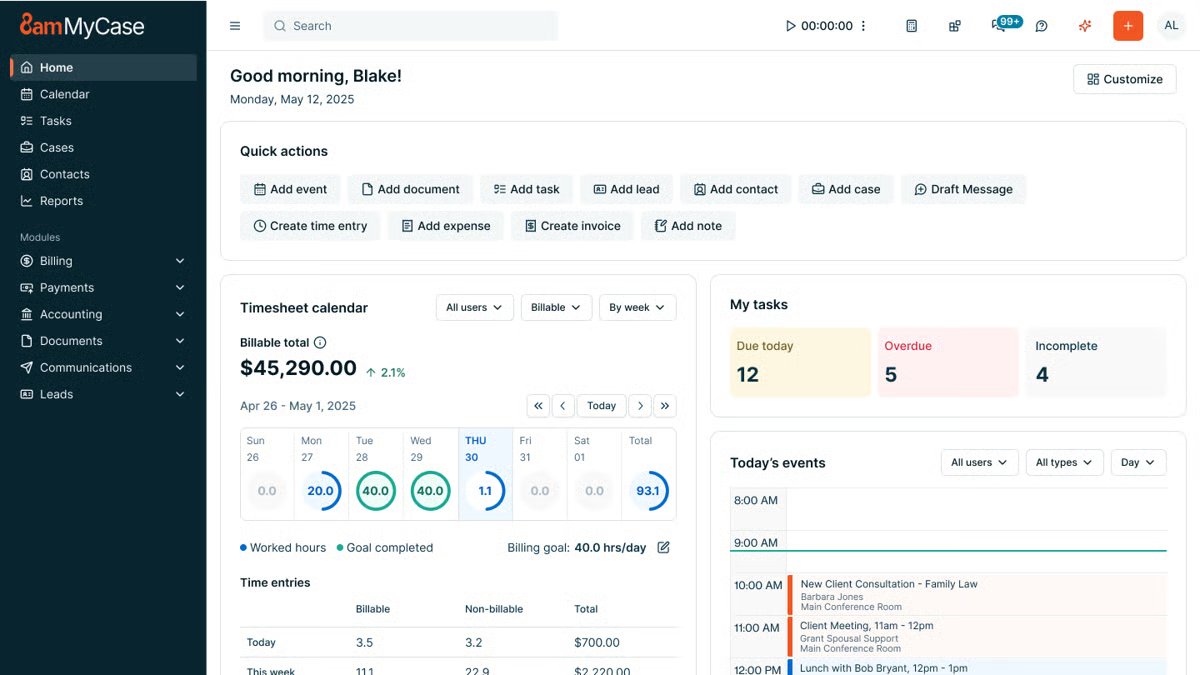
Source: G2
Part of its appeal comes from its straightforward layout. You don’t need a week of training to get comfortable. Most users jump in and start managing matters, sending invoices, or uploading documents without much friction.
Its document management setup is also a big reason people choose it. You can store files, share them with your team, and keep everything tied to the right case.
Something else you might appreciate is how client-friendly it feels. The built-in portal, online payments, and messaging tools help you cut down on emails and long phone chains. Clients get a clearer view of what’s happening, and you spend less time tracking small updates.
Overall, MyCase works well for firms that want an all-in-one platform that keeps everyday tasks moving and brings your documents, communication, and case details into one organized space.
What Is PracticePanther?
PracticePanther is a legal practice management platform built for firms that want a system they can grow into.
You get a cloud-based dashboard that brings your matters, billing, calendar, and communication together, but the real draw is how flexible the software feels once you start using it.
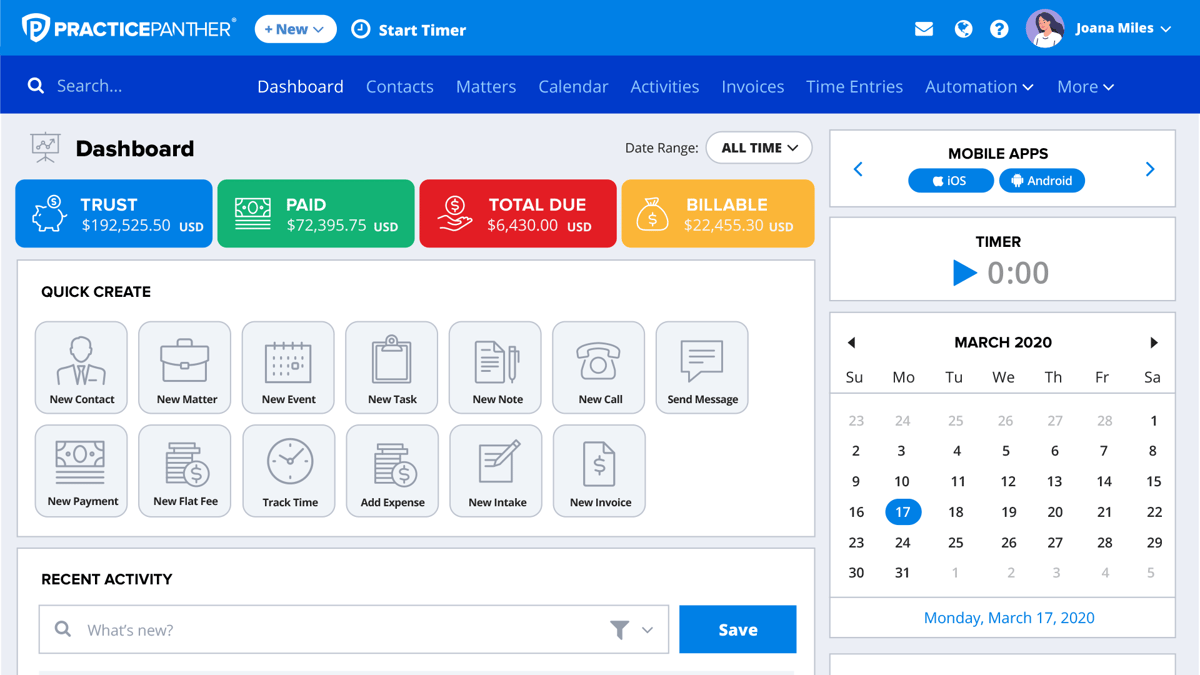
Source: G2
If you’ve ever felt boxed in by rigid legal workflows, this tool tends to be a nice change of pace. You can customize tasks, automate repetitive steps, and shape processes around the way your firm already works.
In other words, it’s designed to support everything from simple daily checklists to more specific tasks that vary from case to case.
Another standout trait is its connection to third-party tools and apps for lawyers. Email, payment processors, document services; PracticePanther plugs into many of the platforms firms already rely on, which keeps transitions smooth and avoids extra busywork.
And because the platform scales well, it fits solo attorneys just as comfortably as expanding teams. You get comprehensive features, plenty of control over how you work, and a structure that adapts as your caseload grows.
MyCase vs. PracticePanther: An In-Depth Comparison
Not sure which tool to choose? This quick comparison gives you a clearer sense of which option fits the way your firm actually works.
Main Purpose
When you look at the core purpose of each platform, the differences become easier to spot.
MyCase simplifies daily work for law firms that want an organized, all-in-one hub. Its goal is to cut back on time-consuming admin tasks and give you a straightforward system for matters, billing, communication, documents, and more.
If you want something that works smoothly as long as you have an internet connection and doesn’t overwhelm your team, MyCase offers a very direct path.
PracticePanther takes a slightly different angle. The platform aims to give firms more control over how they work, offering deeper customization and more flexible workflows.
PracticePanther excels when you want to tailor your processes, connect with third-party tools, and build out legal automations that match your firm’s habits. It also focuses on scalability, so teams with growing caseloads or more complex workflows often appreciate its structure.
When you’re comparing MyCase and PracticePanther, it really comes down to what you value most.
Overall, MyCase offers simplicity and a clean workflow that keeps everything in one place. PracticePanther offers more advanced functionality and the freedom to shape the software around your firm. Both solve everyday challenges, just in different ways.
Key Features
Taking a closer look at the features helps you understand how each platform supports your daily flow and where its strengths differ:
MyCase’s Key Features
- Secure client portal: Clients can view case files, send secure messages, and pay invoices while keeping everything confidential.
- Automated time tracking: Tracks time as you work, so billing and completing invoices feel easier.
- Customizable invoicing: Lets you adjust formats, payment options, and payment history.
- Document solution: Stores case files, supports customizable templates, and connects with Google Drive.
- Google Calendar sync: Keeps deadlines and events aligned across your devices.
- Accounting software: Helps you manage retainers and trust balances accurately.
- Client communications: Offers secure messages and organized updates in one place.
PracticePanther’s Key Features
- Custom fields and custom tags: Lets you tailor matters with details that match your legal workflow.
- Automated time tracking: Captures billable time in the background.
- Customizable templates: Helps you create repeatable documents for recurring or specific tasks.
- Third-party integrations: Works with Google Drive, payment systems, email tools, and other solutions.
- Secure client portal: Gives clients protected access to documents, invoices, and messages.
- Trust accounting: Tracks retainers, payments, and transfers with clear reporting.
- Reporting dashboard: Helps you gain insights into billing performance and law firm productivity.
Who It’s Best For
MyCase usually clicks with lawyers who want something they can get comfortable with right away. If your priority is a clean layout, easy case management, and quick access to the basics, it fits that style well.
Legal professionals who don’t want to spend time configuring every detail tend to appreciate how smoothly it handles law firm communication, scheduling, and billing. It’s especially appealing for small firms or teams that want things organized without juggling extra setup.
PracticePanther leans toward firms that like having more control. If your practice area involves complex steps, custom fields, or a need to connect with a bunch of other tools, the platform gives you that extra flexibility.
Many lawyers choose it because they want something that grows with their client base and adapts as workloads shift. Its advanced features and customization options make it a comfortable match for teams with expanding needs or more structured workflows.
Pricing
Pricing for both platforms depends on the plan you choose and the size of your team, but here’s what you can expect at a high level.
MyCase Pricing
- Basic plan: $49 monthly: Core case management, billing, payments, client messaging, and the secure client portal.
- Pro plan: $99 monthly: Everything in Basic plus advanced reporting and enhanced document management tools.
- Advanced plan: $119 monthly: Adds MyCase Drive, advanced document automation, and expanded analytics.
PracticePanther Pricing
- Solo plan: $59 monthly: Designed for individual attorneys with core case management, billing, and calendar tools.
- Essential plan: $79 monthly: Adds integrations, automated workflows, and more robust document management.
- Business plan: $99 monthly: Includes advanced features like deeper automation, advanced reporting, and more customization options.
Add Briefpoint to Strengthen Your Legal Tech Stack
Choosing between MyCase and PracticePanther comes down to what your firm values. Both tools cover case management, billing, communication, and client-facing features, so you’re already headed in the right direction with either one.
That said, no practice management platform handles everything on its own, especially when you’re dealing with heavy document work.
This is where Briefpoint becomes a smart addition to your legal tech stack. It automates routine litigation drafting, helps you move through legal documents faster, and keeps your work product consistent across matters.
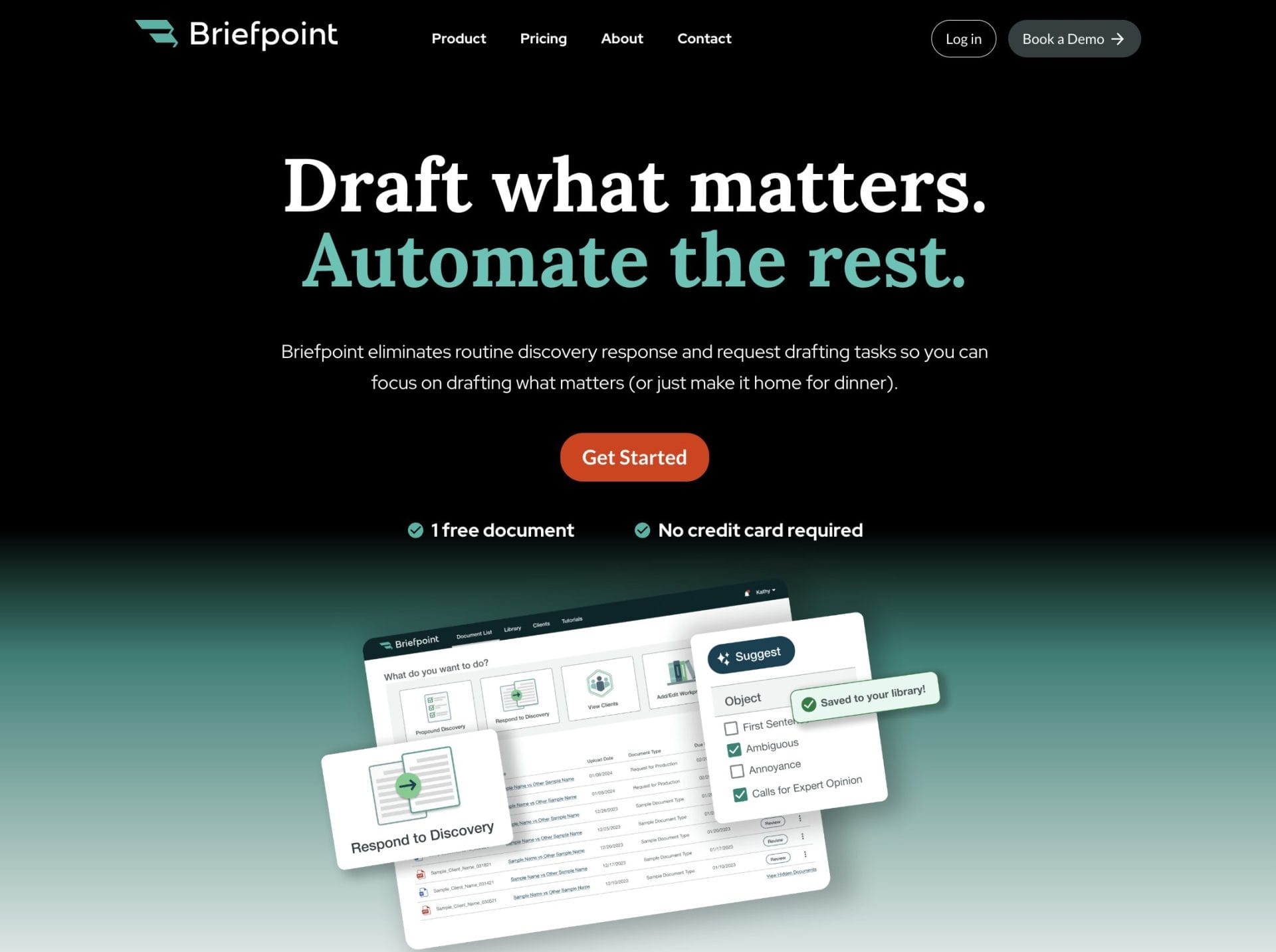
If you’re already using systems like MyCase or PracticePanther, Briefpoint fits right in by handling the pieces those platforms don’t focus on.
You can also take advantage of the Autodoc feature for quick, accurate document assembly when you’re under pressure with multiple deadlines. It generates ready-to-serve discovery responses, complete with Bates numbering and page-level citations, so you’re not piecing things together manually.
The combination saves time and keeps your workflows running smoothly, no matter which practice management system your firm prefers.
Early Case Assessment: eDiscovery Essentials
What Is Early Case Assessment in eDiscovery?
Early case assessment gives you a faster read on the size and direction of a legal matter before the full discovery work begins. You’re taking an early look at potentially relevant data, spotting what’s clearly irrelevant, and getting a sense of the risks, timelines, and costs that might follow.
Law firms and legal teams use this step to avoid surprises and decide how much effort a case may require.
An early case assessment process usually includes gathering a sample of data, running quick searches, and reviewing patterns that hint at what the larger collection will look like.
That early snapshot sets the stage for smarter decisions, whether the goal is negotiating, narrowing the scope, or preparing for deeper review later.
The focus is basically on conducting a comprehensive evaluation before the heavy lifting starts. You get clarity on custodians, data sources, and core issues long before documents pile up.
Why Early Case Assessment Matters
Taking a moment to understand a legal case early helps you step into the rest of the litigation process with fewer surprises.
Legal professionals get a clearer read on how much data they’re facing, what looks useful, and which potential risks might shape strategy later. It sets a more grounded plan before the heavier review work begins.
Here’s how an early look makes a difference:
- Stronger clarity: You get a quick sense of the most relevant data and what can be set aside, which makes the next steps smoother.
- Better forecasting: Understanding how much data needs attention helps you plan timelines and set expectations without guessing.
- Smarter strategy: Early awareness of potential risks gives you room to adjust your approach before things get complicated.
- More focused review: Filtering out obvious irrelevant data at the start keeps the team focused on information that actually supports the legal matter.
- A more defensible approach: Consistent steps, documented searches, and early data analysis help build the most defensible process for the rest of the case.
This kind of early check-in gives you direction and confidence before review work grows in size or cost.
5 Key Components of an Effective ECA Process
A solid early case assessment works best when you break it into a few focused steps. Consider this section as a quick guide you can use to get a cleaner view of your case data before the eDiscovery process grows in size and cost.
1. Identifying Key Custodians and Data Sources
An effective assessment starts with knowing who holds the most critical information. This involves examining key custodians, where their electronically stored information (ESI) lives, and how much of it may matter to the case.
You might look at email accounts, shared drives, chat platforms, and even paper documents if they still play a role.
A few things to confirm early:
- Data locations that truly matter
- Any potential gaps based on job roles
- Sources that might contain relevant documents
Getting this right gives you a complete picture before search terms or a deeper review begins.
2. Collecting a Manageable Sample of Case Data
You don’t need a full collection at this stage; you only need enough to understand patterns.
A small sample of potentially relevant ESI can show you early themes, topics, and data volume without pulling in every file. Many teams use early case assessment software here to review samples quickly, highlight irrelevant data, and spot red flags.
This makes room for quicker, informed decisions before investing in a full review. It also creates an opportunity to confirm which data sources should be prioritized once production planning starts.
3. Conducting Custodian Interviews
Talking directly to the people involved gives you far more context than metadata alone. These conversations help you pinpoint critical information, understand communication habits, and confirm how the parties involved handled files, messages, or other materials.
During interviews, you might explore:
- How information was shared inside and outside the team
- Topics or terms that may guide searches later
- Any unique tools or storage locations that custodians rely on
These insights guide your next moves and reduce the chance of overlooking important sources.
4. Running Early Searches and Filtering
Once you understand where the information lives, quick searches help you narrow the scope. You’re looking for patterns that highlight what’s relevant, what can be pushed aside, and what may require detailed analysis later.
This step often uncovers communication threads, timelines, and early indicators of potential issues with opposing counsel.
A well-planned search also reduces unnecessary review work, which keeps the project lean while maintaining accuracy.
5. Using Reports and Data Visualization Tools
Clear visuals help you understand the story your data tells. Data visualization tools can show communication spikes, custodians with heavy activity, or time periods that warrant closer review.
These reports support informed decisions because you’re not relying solely on text or spreadsheets.
Charts, heat maps, and timelines often reveal patterns that are easy to miss in raw data. This can help you assess risks and decide how to move forward with confidence.
How eDiscovery Software Supports ECA
The right tools make early case assessment feel far more manageable. You’re taking large sets of raw data and turning them into something you can actually understand, which helps you build a clearer case strategy before review work grows.
Early case assessment tools often start by pulling in data from multiple sources, indexing it, and giving you an easy way to search across everything at once. That alone helps you spot crucial data early.
From there, features like filtering, analytics, and reporting help you narrow the focus so you’re not spending time on information that doesn’t support the matter.
Many platforms also offer quick ways to identify responsive documents, surface keywords and communication patterns, and get a sense of who’s involved in conversations that matter.
In other words, you’re basically getting a preview of the story your data tells before you commit to a full document review.
Common features that make this step easier include:
- Fast searching across raw data
- Visual summaries that show patterns or high-activity custodians
- Filtering tools that separate useful information from noise
- Early tagging to help teams stay aligned
All of this gives you the context you need to make smart choices early, reducing unnecessary work and pointing your team toward the areas that deserve attention first.
Benefits of Using ECA Tools
We talked earlier about the value of early case assessment, and the legal software side adds another layer of support.
These tools help you move through the early stages with more clarity, less manual effort, and a better understanding of where the case may be heading.
Here are the core benefits:
- Faster insight: ECA tools help you spot relevant information quickly so you’re not digging through large volumes of data to find what matters.
- Lower project costs: Early filtering and guided searches keep the focus on potentially responsive documents, which leads to meaningful cost savings later in the project.
- Clearer strategy development: Early visibility into key issues gives you what you need to shape a stronger litigation strategy without waiting for full review.
- More accurate conclusions: Better organization and early analysis give you a clearer read on the case, which helps you avoid missteps and premature assumptions.
- Stronger team alignment: Everyone works from the same information to make it easier to stay coordinated as the matter grows in size and complexity.
Early Case Assessment Checklist
A quick checklist gives you a simple way to stay organized as you work through the early steps of a matter. It keeps you focused on the essentials, helps you avoid missing potentially relevant information, and gives everyone involved a clearer view of the available data before deeper review begins.
Here are the core items worth confirming:
- Identify key legal issues and the people most connected to them
- Confirm what collected data you actually have and what’s still missing
- Check all likely locations for potentially relevant information
- Review a small sample to understand the tone, topics, and data review needs
- Talk with custodians to clarify context and storage habits
- Map out the entire dataset so risk managers understand the scope
- Estimate potential costs based on volume, timing, and complexity
- Use eDiscovery tools to organize early findings and highlight patterns
- Flag dates, keywords, and communication threads that need closer attention
- Document early insights so the rest of the matter stays consistent
How Briefpoint Supports Your Early Case Assessment Work
An early case assessment gives you a head start. You’ve already sorted through the noise, spotted key documents, and built a clearer view of the case before the heavy data review begins.
At this point, it’s all about turning those early insights into something you can use without spending significant time on tasks that slow everyone down.
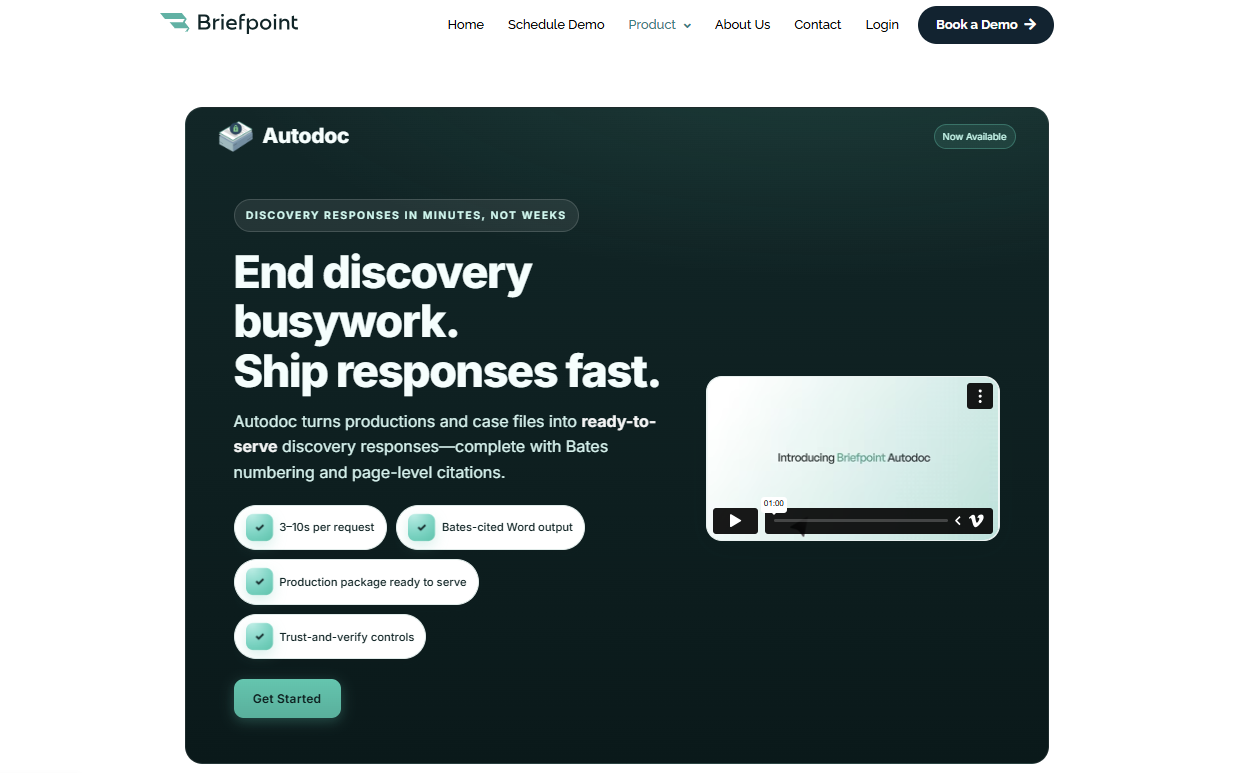
This is where Briefpoint’s Autodoc fits in naturally. Once you understand your available data, Autodoc helps you move from early analysis to finished discovery responses without the usual page-turning.
You upload your files, and the tool finds responsive material, generates Bates-numbered outputs, and packages everything in a format you can serve with confidence. It takes the work that usually drags on for days and turns it into a cost-effective process that feels straightforward.
If you want to see how much time your team can save, you can book a demo and see Autodoc for yourself.
11 eDiscovery Best Practices for Defensible Discovery
1. Define a Clear eDiscovery Strategy and Protocol
A clear eDiscovery strategy gives legal teams a structured approach throughout the entire process. It promotes consistency, reduces confusion, and keeps deadlines on track.
The plan should align with the Electronic Discovery Reference Model (EDRM), which outlines the following stages: identification, preservation, collection, processing, review, and production.
When creating your strategy, remember to:
- Set clear goals for scope, timelines, and team roles.
- Document every step to maintain transparency and defensibility.
- Use standard templates for data requests and productions.
- Define escalation points for handling disputes or technical issues.
- Update the plan regularly as laws, lawyer tools, and data sources change.
A written eDiscovery protocol forms the backbone of every matter. It should describe how data will be preserved, how privilege will be protected, and what file formats will be used for production.
This structure keeps everyone aligned from the start and helps prevent missing data or inconsistent handling later.
2. Involve Legal, IT, and Compliance Teams Early
Legal, IT, and compliance teams each play a unique role in managing electronically stored information (ESI), and early coordination prevents confusion later. When these teams work together from the start, identifying relevant data becomes faster and more accurate.
For example, when litigation is anticipated, the legal team defines the scope of discovery and which custodians may hold relevant ESI.
The IT department then identifies where that data lives (perhaps across cloud storage platforms, email servers, or internal systems) while compliance reviews the process to confirm it aligns with privacy and retention policies.
If these groups don’t align early, data could be lost, duplicated, or mishandled, putting the organization at risk of sanctions or missed deadlines.
Many organizations now rely on eDiscovery tools that let cross-functional teams collaborate in real time, centralizing case data and tracking progress from preservation to production.
A shared platform improves communication, reduces manual work, and keeps every department accountable.
For teams seeking a simpler, faster, and more reliable approach to document preparation during discovery, Briefpoint offers automation that turns complex requests into accurate, court-ready documents in minutes.
3. Identify and Preserve Data Sources Promptly
Quick identification and preservation of electronic data are key steps in the discovery process.
Once litigation is expected, legal teams must act fast to locate and secure relevant data before it’s altered or deleted. Delays can lead to spoliation or incomplete productions, both of which can harm a case.
The first step is mapping data sources, which means creating a clear record of where information is stored and who controls it. Common data sources include:
- Company email systems and archives
- Shared drives and document management tools
- Cloud storage platforms like Google Drive, OneDrive, or Dropbox
- Messaging apps such as Slack or Microsoft Teams
- Employee laptops, phones, or external devices
- Social media posts
Once these sources are identified, data collection should begin under defensible procedures that maintain metadata and prevent modification. Preservation notices must also be issued to custodians responsible for the data, suspending any auto-deletion or retention policies.
Plus, documenting each step of data preservation builds credibility and protects against challenges later in court. A consistent, repeatable approach keeps the process transparent and helps the team handle future matters more efficiently.
4. Use Legal Hold Procedures Effectively
A well-managed legal hold process is one of the most important parts of data preservation during discovery.
When a dispute or investigation is anticipated, legal professionals must suspend routine data deletion policies and preserve all potentially relevant ESI. This step prevents the loss of key evidence and demonstrates good faith compliance with the court.
A legal hold begins with a clear notice sent to custodians. Employees or departments likely to have relevant documents or electronic records. The notice explains what data must be preserved, how it should be handled, and who to contact with questions.
For instance, if a company expects litigation involving employment issues, HR staff and managers may receive a hold instructing them not to delete emails, reports, or internal chat messages tied to the event in question.
Tracking acknowledgments and sending reminders are equally important. Every action, from issuing the notice to releasing the hold, should be logged for transparency.
Many legal teams now use automated legal hold software to monitor compliance and record each step. This level of documentation protects the organization and confirms that data was preserved properly if the process is ever questioned in court.
5. Collect Data in a Defensible and Documented Way
Once a legal hold is in place and data preservation is confirmed, the next phase of the discovery process involves collecting that data for review. This transition is critical because any misstep during collection can damage file integrity or cast doubt on the evidence.
Moreover, data collection is one of the most sensitive parts of legal discovery, and every action must be defensible if challenged in court.
Legal teams should apply consistent procedures that maintain authenticity and retain relevant information exactly as it existed. This includes preserving metadata, timestamps, and detailed records of each activity.
Defensible collection often involves coordination between legal and IT teams. Data must be copied from secure data storage systems using approved forensic tools that prevent alteration.
For example, when collecting data from mobile devices, specialists may extract text messages or attachments in a controlled environment to preserve their original state.
A simple collection record may include:
- The person responsible for the collection and the date completed
- The tools or software used
- The source systems, such as email servers or cloud databases
Documenting every action supports strong information governance and demonstrates accountability. In large legal proceedings, complete records protect the organization from disputes about data handling and show that the collection followed a defensible process.
6. Leverage Advanced Search and Filtering Tools
Advanced search and filtering tools are core features of any modern eDiscovery platform. They allow legal teams to narrow large sets of data into smaller, more focused collections that matter to the case.
As data volumes continue to grow across emails, chat logs, and cloud solutions, these tools make it possible to manage the document review stage with precision and speed.
In the modern litigation process, the biggest eDiscovery challenges often involve identifying what’s relevant among thousands or even millions of files.
Keyword searches, date filters, and metadata queries help locate information quickly, while advanced analytics can detect duplicate files or similar content that might otherwise be reviewed multiple times.
Some systems also let users analyze log files or communication patterns to uncover hidden connections between custodians or data sources.
A strong review process combines these tools with attorney oversight to confirm accuracy and context. Automation alone can’t replace legal judgment, but it can remove the manual burden of sorting irrelevant material.
7. Apply Technology-Assisted Review or AI for Efficiency
Technology-assisted review (TAR) and AI-powered review systems have become standard in modern eDiscovery because they help manage the overwhelming amount of digital data generated in litigation.
Essentially, these technologies speed up the review of emails, documents, and messages while maintaining accuracy and consistency in how relevance and privilege are determined.
- Technology-assisted review: Uses machine learning and predictive coding to identify patterns in previously reviewed data, which allows the system to rank remaining documents by likelihood of relevance.
- Artificial intelligence: Expands on TAR by applying natural language processing and contextual analysis to understand meaning, not just keywords, across large datasets.
In practical terms, TAR and legal AI tools learn from attorney input and apply those lessons to new files, which helps teams prioritize what to review first. This reduces manual workload and accelerates the production of electronically stored information.
When used responsibly, TAR can cut review time by more than half and improve consistency in identifying data produced for disclosure. Combined with human oversight, these tools help legal teams meet discovery deadlines efficiently while keeping the process defensible.
8. Maintain Strong Chain-of-Custody Documentation
A clear chain of custody makes sure that every piece of evidence collected during eDiscovery can be trusted.
More specifically, it records how data moves from collection to review and production, showing that nothing was changed, lost, or mishandled. Strong documentation also supports regulatory compliance, especially in industries where audit trails are required.
To keep all teams on the same page, every handoff should be recorded in a chain-of-custody log. This log tracks:
- The names of key custodians involved in handling or accessing data
- The date and time of each transfer
- The storage location and transfer method used
- Verification notes confirming file integrity
For example, if an outside vendor receives a set of emails for review, the record should show when the transfer occurred, who approved it, and how the files were verified before upload. Each action must be timestamped and supported by documentation.
Maintaining this level of tracking not only protects against disputes but also helps in ensuring compliance with legal discovery standards. Courts expect transparency in how evidence is handled, and a reliable chain of custody provides exactly that.
9. Review and Redact Sensitive Information Carefully
During the review phase of eDiscovery, handling confidential data requires both precision and awareness of privacy laws and eDiscovery rules.
Legal teams must identify and redact sensitive content before further processing or production to avoid exposing personal or privileged material. Failure to do so can lead to sanctions, data breaches, or violations of legal requirements.
Examples of information that should be redacted include:
- Personal identifiers such as Social Security numbers or birth dates
- Financial details like bank account or credit card numbers
- Private communications covered by the attorney–client privilege
- Medical records or health-related data protected under HIPAA
One of the most common eDiscovery challenges is maintaining a balance between transparency and confidentiality. Automated redaction tools can speed up the process, but human review is still necessary to verify accuracy and context.
For instance, a legal AI system might flag names or numbers, but only an attorney can decide if they are relevant or privileged within the legal case.
Careful redaction protects both clients and opposing parties, keeping productions compliant and defensible. Every redaction decision should be logged and stored with a record of who approved it, so there is a clear audit trail for future reference.
10. Track Costs and Vendor Performance Throughout the Process
Monitoring expenses and vendor results is an often-overlooked part of the eDiscovery process, yet it has a direct impact on both budgets and case efficiency.
Each stage of discovery incurs measurable costs tied to storage, software licenses, and professional services. So, keeping a detailed record of these figures helps legal teams forecast spending, justify budgets, and identify where savings are possible in future matters.
For example, a law firm working with multiple vendors might notice that one provider charges significantly higher rates for hosting data but delivers slower turnaround times.
Tracking this performance over several projects makes it easier to decide who offers the best value. Metrics like average processing time, accuracy rates, and responsiveness can help build a clear picture of which partnerships are most effective.
Many firms now use dashboards or litigation management software to centralize cost data, automate invoices, and monitor key metrics in real time.
In other words, treating cost and performance tracking as part of the standard workflow keeps the overall eDiscovery process both predictable and efficient.
11. Regularly Update and Refine eDiscovery Policies and Technology
Finally, every organization should treat its eDiscovery policies as living documents that evolve with new data sources, laws, and legal tech software.
Some areas that should always be reviewed include:
- Backup tapes: Make sure retention schedules reflect current storage limits and recovery options.
- Preservation measures: Reassess how data is secured to avoid accidental loss or overwriting.
- Collecting ESI: Verify that approved tools and methods maintain file integrity and defensibility.
- Producing electronically stored information: Confirm that file formats and transfer protocols meet court and client expectations.
Keeping eDiscovery tools and practices updated not only supports compliance but also reduces manual work. Teams that modernize their approach are better equipped to manage complex matters efficiently.
Autodoc, the newest solution from Briefpoint, takes this a step further. It ends manual discovery work by turning productions and case files into ready-to-serve discovery responses (with Bates numbering and page-level citations) in just seconds.
Book a demo and be among the first to automate their discovery responses.
Briefpoint and the Future of eDiscovery
Strong eDiscovery practices are built through structure, collaboration, and the right technology to keep everything moving smoothly. Each stage of discovery, from locating data to preparing final productions, depends on accuracy and clear communication.
And when teams work within a defined system, discovery becomes less chaotic and more predictable.
Briefpoint helps make that happen. It replaces repetitive manual work with automation that drafts, numbers, and formats discovery responses in just minutes. The result is more time for strategy, stronger client outcomes, and less effort spent on administrative tasks.
If you’re ready to simplify discovery and see what faster, smarter document preparation looks like, book a Briefpoint demo today.