5 Legal Workflow Examples You Can Implement for Maximum Efficiency

What Is a Legal Workflow?
A legal workflow consists of a series of tasks and processes designed to accomplish a particular legal objective or outcome. It serves as the foundational blueprint that directs your team in managing cases, from the initial client intake to the final billing process.
What Is Legal Workflow Automation?
Legal workflow automation is the application of technology to simplify and automate time-consuming tasks within legal processes.
Legal automation technology allows law firms and legal departments to design, execute, and manage legal workflows.
More specifically, incorporating software tools and applications lets legal professionals automate various tasks, such as:
- Document drafting automation
- Client intake processes
- Case management
- Billing and invoicing
- Contract review
- Compliance checks
What Are the Benefits of Legal Workflow Automation?
Automating legal workflows can make life easier for everyone on your legal team in many ways. In turn, a more productive legal department contributes to a better bottom line. Here’s a closer look at how legal workflow automation benefits the legal industry:
Streamlining Operations
Automating the repetitive tasks that bog down your daily operations not only speeds things up but also lets your team focus on more valuable, more complex aspects of legal work.
Reduced Risk of Errors
Automation reduces the likelihood of human error in document creation, data entry, and other processes. By capturing key data points automatically, the system ensures higher accuracy and fewer errors within all files.
Improved Client Satisfaction
Automation can lead to faster response times and more consistent communication with clients. It means modern legal teams are always a step ahead, from seamless onboarding to timely updates, leading to higher satisfaction and retention rates.
Enhanced Collaboration
Legal workflow automation tools often come with features that improve communication and collaboration among team members. Shared access to documents, automated task assignments, and progress tracking help keep everyone aligned and informed.
Cost Savings
Automating legal workflows can result in significant cost savings over time. It takes the manual labor out of many non-billable tasks, allowing you to redirect your team’s efforts to areas that need human insight. In the long run, this strategic allocation of resources pays off.
Scalability
When your workload increases, automated systems can handle the extra demand without needing to proportionally increase your staff. This makes scaling up smoother and more manageable, letting you expand your business without the growing pains.
Data Security and Compliance
Many legal workflow automation tools incorporate advanced security features to protect sensitive information. Plus, by automating processes, you can enforce strict access controls to ensure your operations always line up with strict regulations.
Strategic Insight and Decision Making
Automation tools often include analytics and reporting capabilities, providing law firms with valuable insights into their operations. Using real-time dashboards, you can track workflow efficiency, spot areas for further improvement, and identify new opportunities for automation instantly.
5 Legal Workflow Examples You Can Replicate
You can apply automation to various administrative tasks to improve your overall efficiency and productivity. Below are five actionable legal workflow examples that you can easily emulate to harness the power of automation in your legal practice:
1. Client Intake/Onboarding
Legal teams can apply automation to the client intake and onboarding process to ensure a smooth and professional first impression. You can:
- Use online forms and document management systems to collect client information
- Automatically run conflict checks
- Generate onboarding paperwork
Here’s an example of an automated client intake process:
Step 1: Initial Contact
Clients start by filling out a detailed contact form on your law firm’s website. This form collects preliminary information, such as the client’s name, contact details, and a brief description of their legal issue.
Upon submission, the client immediately receives an automated email acknowledging receipt of their inquiry and outlining the next steps.
Step 2: Conflict Check
The information from the contact form is automatically fed into your firm’s conflict check system. If no conflicts are identified, the process moves to the next step.
If a conflict is found, an automated response informs the client that the firm cannot represent them due to a conflict of interest.
Step 3: Intake Questionnaire
Clients who pass the conflict check receive an email with a link to a more comprehensive intake questionnaire. This questionnaire is designed to gather detailed, relevant data to understand their case.
The questionnaire includes the ability to securely upload relevant documents.
Step 4: Consultation Scheduling
After submitting the questionnaire, clients are directed to an online scheduling tool integrated with the firm’s calendar. They can choose a convenient time for a consultation, either in person or virtually.
Once a consultation is scheduled, both the client and the attorney receive an automated confirmation email with the appointment details and a calendar invite.
Step 5: Onboarding Documents and Agreement
Based on the information provided in the intake questionnaire, the system automatically generates onboarding documents and a customized agreement.
Clients can review and e-sign the agreement and pay the initial retainer fee online through a secure payment gateway.
Step 6: Welcome Package
Upon completion of the onboarding process, clients receive a welcome email. This email includes an introduction to their legal team, what they can expect moving forward, and how to communicate with the firm.
The email also provides login details for a client portal where they can track the progress of their case, communicate with their attorney, and access documents.
Step 7: Internal Notification
Once a new client is successfully onboarded, relevant in-house teams are automatically notified through the firm’s internal communication system. This ensures that everyone involved is up to date and ready to start working on the case.
2. Client Communications
Automating client communications is an excellent approach to upgrading client engagement and satisfaction, ensuring consistent and timely interactions throughout the legal process. Here’s an illustrative process for automating client communications within your law firm:
Step 1: Automated Onboarding Messages
After a client is successfully onboarded, they receive an automated welcome message. This message outlines what they can expect in terms of communication and introduces them to their legal team.
Step 2: Case Updates
Set up a system to send automated updates on case progress at predetermined intervals or after specific milestones are achieved.
Step 3: Appointment and Deadline Reminders
Implement an automated reminder system that notifies clients of upcoming appointments, important dates, and deadlines via email or SMS.
Step 4: Automated Check-Ins
For long-duration cases or for clients with whom you wish to maintain a relationship, set up automated emails or messages that check in on them periodically. These communications can offer assistance, provide relevant legal updates, or share useful client advice.
Step 5: FAQ and Resource Sharing
Automate the distribution of FAQs, guides, and resources relevant to the client’s case or legal needs. This proactive approach can address common questions and concerns, reducing the need for direct inquiries.
Step 6: Billing and Payment Reminders
Automate billing reminders and payment confirmations to streamline the financial interactions with clients. This way, you can ensure transparency and reduce the administrative burden of managing payments.
3. Legal Document Automation
Legal document automation revolves around generative artificial intelligence (AI). This AI-powered subtype of legal tech is designed to automatically draft various legal documents, such as contracts and discovery documents, to cut down the manual processes involved in document generation.
These are the documents that legal professionals usually automate:
Discovery Response and Request Documents
Busy law firms can use generative AI to draft discovery responses and request documents (e.g., requests for production, requests for admission, interrogatories) that would otherwise take hours to make.
Contracts and Agreements
Legal workflow software quickly generates standard contracts, service agreements, lease agreements, non-disclosure agreements (NDAs), employment contracts, and partnership agreements with customized details for each party involved.
Legal Letters and Correspondence
Templates for letters of advice, demand letters, cease and desist letters, and other formal legal communications allow for quick customization for various scenarios.
Court Forms and Pleadings
Certain types of software can automate the inclusion of relevant case and party information in standard forms and pleadings for court filings, including complaints, motions, affidavits, and judgments.
Estate Planning Documents
Legal teams can customize wills, trusts, powers of attorney, and healthcare directives to fit the specific needs and circumstances of the client.
Real Estate Documents
Some legal practice management software can efficiently produce purchase agreements, deeds, closing documents, and landlord-tenant agreements, such as leases and eviction notices.
4. Law Firm Billing
Implementing automation in law firm billing practices can transform the management of financial transactions, improving the efficiency, accuracy, and transparency of billing operations.
Here’s a breakdown of how law firms can automate their billing process:
Step 1: Time Tracking Integration
Implement software that legal teams can use to track their time spent on different cases automatically. This helps ensure accurate billing and minimizes the chance of unbilled work.
Step 2: Generating Invoices
Based on the time tracked and the specific billing arrangements with clients, the system automatically generates detailed invoices for billable hours. These invoices can include descriptions of the services rendered, the time spent, and the applicable rates.
Step 3: Customization and Review
Allow for customization of invoice templates to meet the firm’s branding and clients’ preferences. Before sending, your team can put files through a legal review if necessary, ensuring accuracy and client satisfaction.
Step 4: Electronic Delivery
Use the billing system to email invoices directly to clients, reducing paper waste and speeding up the delivery process. Electronic delivery also makes it easier for clients to review and pay their invoices.
Step 5: Online Payment Options
Integrate online payment solutions that allow clients to pay their invoices via credit card, ACH transfer, or other online payment systems. This convenience can significantly shorten the payment cycle and improve cash flow.
Step 6: Payment Tracking and Reminders
The billing system should automatically track payments received and reconcile them with the corresponding invoices. For overdue invoices, the system can send out automated payment reminders to clients, encouraging timely payments.
Step 7: Financial Reporting
Utilize the billing software to automatically generate financial reports, providing insights into the firm’s financial health, productivity, and outstanding receivables. These reports are essential for effective financial management and planning.
5. Task Management
Workflow automation plays a big role in task management, involving the use of various types of software to streamline the planning, delegation, tracking, and completion of tasks and projects.
This technology helps law firms improve time management and accountability and ensure that critical deadlines are met without overwhelming manual oversight.
Here are several examples of automated processes for task management:
Case Intake and Assignment
A new case is entered into the firm’s case management system through an online form submission by a potential client.
The system automatically performs a conflict check and, if cleared, assigns the case to an attorney based on expertise and current workload. The assigned attorney receives an email notification about the new case.
Initial Review and Client Communication
The assigned attorney marks the case as “reviewed” in the system.
The system automatically generates an introductory email to the client, providing the attorney’s contact information and scheduling a kick-off meeting using a link to the attorney’s calendar.
Document Request and Collection
After the kick-off meeting, the attorney identifies the documents needed from the client.
The system sends an automated email to the client with a secure link to upload the required documents. A follow-up reminder is scheduled if the client does not respond within a specified timeframe.
Task Delegation and Monitoring
Documents are received from the client.
The system creates tasks for document review and analysis, assigning them to appropriate team members. Each team member receives a notification of their assigned tasks with deadlines.
For tricky matters, the software can route tasks to external counsel to assist the internal staff. The system can further track progress and send reminders as deadlines approach, so it’s easier to handle complex workflows without dropping the ball.
Billing and Time Tracking
Tasks related to the case are marked as completed.
The system logs billable hours associated with completed tasks and generates a draft invoice for the attorney’s review. Once approved, the system sends the invoice to the client with payment instructions.
Legal Workflow Automation Software Overview
These examples of legal workflow automation make the benefits of automation clear. Each automated workflow eases the burden on most legal teams, creating more room for more important legal matters and other strategic tasks. The cumulative result? More satisfied clients and increased law firm profitability.
Don’t know what legal workflow automation software to start with? Consider automating the most tedious part of litigation first, the discovery phase.
Briefpoint is a law firm automation tool that offers invaluable litigation support by automating discovery requests and response documents. With Briefpoint, you can save valuable time on these routine contracts and ensure consistency in all your documents, including but not limited to:
- Requests for Production
- Requests for Admission
- Interrogatories
- Bates Citations
- Client Response Collection
Take Advantage of Legal Automation with Briefpoint
Discovery is often one of the most repetitive parts of a legal workflow, which makes it a good place to start when looking for automation opportunities.
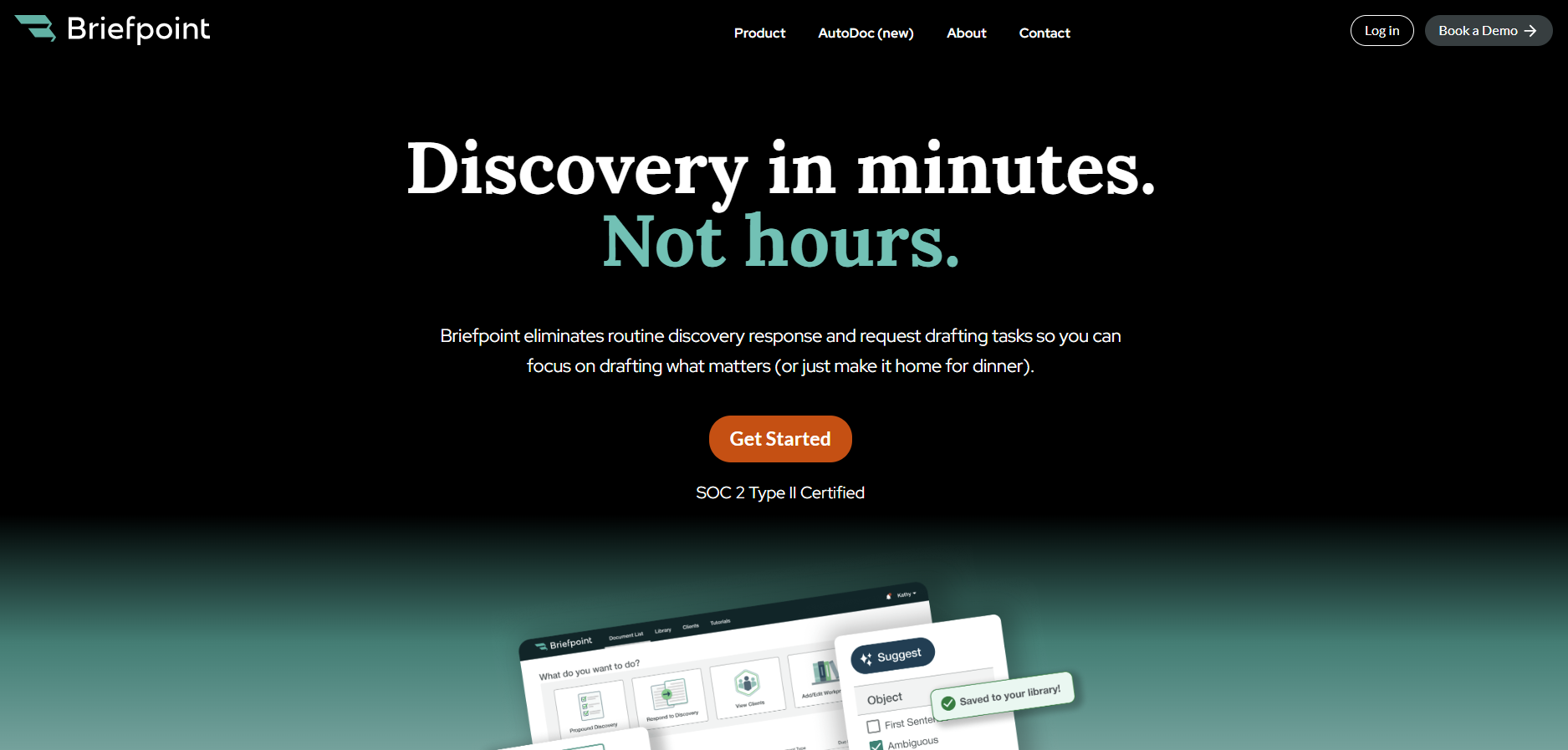
Briefpoint helps law firms automate discovery requests and responses, including requests for production, requests for admission, and interrogatories. Instead of spending hours drafting routine documents from scratch, attorneys can generate editable Word drafts in minutes and focus on higher-value legal work.
The platform also includes Briefpoint Bridge, which streamlines client response collection through a guided portal. Clients can answer questions and upload supporting documents, and their responses flow directly into your discovery drafts.
For document-heavy matters, Autodoc adds another layer of automation. Attorneys can upload complaints, productions, RFPs, and case files, and Autodoc will identify responsive documents, generate Word responses with page-level Bates citations, and create organized production packages.
Whether you’re building a more efficient discovery workflow or looking to reduce manual document work across your practice, Briefpoint helps your team move from request to response faster.
Book a demo and see it firsthand.
Best AI for Legal Documents: Top 7 Tools for 2026
Types of AI Tools for Legal Documents
First things first, let’s talk about the different types of AI tools for legal documents. Keep in mind that not all legal AI tools do the same thing.
Here are the main types of AI tools, per the process they cover:
- Legal document drafting: Creates pleadings, discovery documents, contracts, court filings, and other legal paperwork based on templates and case details. Generally, it expedites the drafting process while maintaining accuracy.
- Contract drafting: These tools help create agreements using legal document templates and user inputs.
- Document review: Speeds up analysis by identifying emerging legal risks, missing clauses, and inconsistencies, similar to how legal professionals review documents.
- Legal research: Finds relevant case law, statutes, and regulations quickly to cut down the time spent on legal research.
- E-signature and contract management: Simplifies contract signing, tracking, and storage to make sure deadlines aren’t missed.
- Litigation support: Assists with case analysis, summarizing legal documents, and predicting case outcomes in litigation workflows.
Top 7 AI Tools for Legal Documents
Below are some of the best AI tools for legal documents:
1. Briefpoint
Briefpoint is an AI-powered discovery platform designed for the part of litigation that tends to consume the most time, which is most often drafting and responding to discovery.
If your work involves propounding discovery requests, reviewing responses, and preparing Bates-numbered productions, Briefpoint brings those steps into one cohesive workflow that matches how discovery actually gets done.
Rather than drafting requests for admission, requests for production, and interrogatories from scratch or spending days organizing productions, you can let Briefpoint handle the repetitive structure while you stay focused on substance and strategy.
The platform applies jurisdiction-ready formatting, standard objections, and properly structured responses, so discovery keeps moving.
If discovery shows up often in your matters, Briefpoint is a game-changer, as it takes hours of repetitive work off your plate and replaces it with a review-first process you can rely on from case to case.
Key Features
- Propound discovery from a complaint: Upload a complaint, and Briefpoint automatically generates tailored interrogatories, RFAs, and RFPs. Each request is written to avoid common drafting issues like ambiguity or assuming facts.
- Automated discovery response drafting: Upload opposing counsel’s discovery requests, and Briefpoint identifies court details, parties, set numbers, and local formatting rules. Responses are structured automatically, with standardized objections applied where appropriate.
- Client response collection in plain English: Briefpoint Bridge converts interrogatories into plain-language questions and sends them to clients through a secure portal. Clients respond directly in their browser, and answers flow back into Word-ready drafts.
- Word-ready documents: All discovery responses export as properly formatted Word documents, complete with captions, numbering, and objections. Final review and edits happen where attorneys already work.
- Autodoc: Autodoc extends Briefpoint’s discovery workflow into document production. Upload RFPs and case files, and Autodoc locates responsive documents for each request and generates written responses with page-level Bates numbering.
- Security and compliance: Briefpoint is SOC-2 certified, encrypts data in transit and at rest, and keeps client data siloed per account. Uploaded materials are never used to train Briefpoint or third-party models.
Pros
- Handles both propounding and responding to discovery
- Produces jurisdiction-ready RFAs, RFPs, and interrogatories
- Cuts discovery drafting and production time from days to minutes
- Generates Bates-cited responses and ready-to-serve productions
- Keeps attorneys in control with Word-first editing and verification
If you want a full tour of Briefpoint, book your free demo today!
2. CoCounsel by Casetext
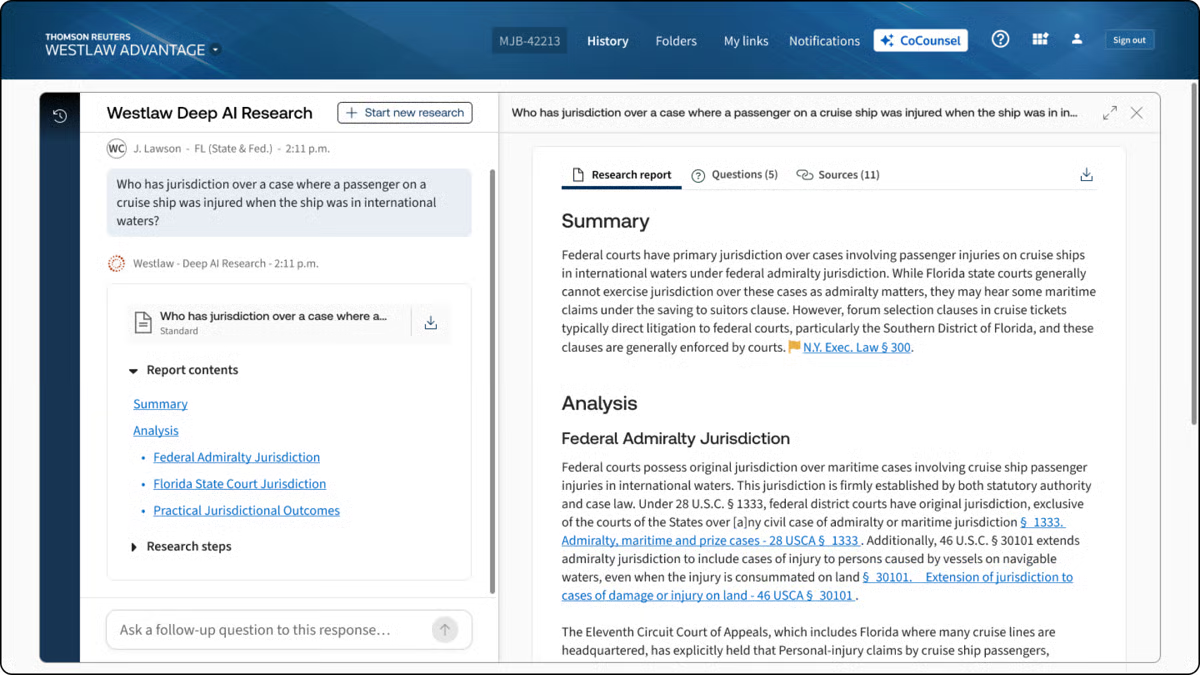
CoCounsel is an AI-powered legal document assistant that helps lawyers with research, contract review, and document analysis.
Developed by Casetext, it automates time-consuming legal tasks that would otherwise require significant manual effort.
Source: G2
With features like document summarization, deposition preparation, and contract analysis, CoCounsel functions as an AI-powered document assistant trained on large language models designed for legal workflows.
It processes full transactional documents, reviews different document versions, and responds to legal questions while staying grounded in the legal context.
Key Features
- Legal research assistance: Quickly finds relevant case materials, law, statutes, and regulations while accounting for legal context and jurisdictional nuance.
- Contract review: Analyzes contracts, flags potential risks, and surfaces issues across full transactional documents.
- Deposition preparation: Helps attorneys organize key points, review testimony, and prepare outlines with less manual effort.
- Legal document summarization: Extracts critical details from lengthy documents and multiple document versions.
- Case analysis: Identifies trends, arguments, supporting evidence, and relevant precedents to support actionable intelligence.
Pros
- Finds case law and statutes faster than manual searches
- Flags risks and missing clauses with AI-powered insights
- Automates repetitive tasks, significantly reducing workload for legal teams
3. ChatGPT
ChatGPT isn’t designed specifically for law firms (or legal practice, for that matter), but many in the legal industry use it as a general-purpose AI for a wide range of legal-adjacent tasks.
From drafting emails and summarizing case law to generating legal arguments and reviewing long documents, it serves as a flexible AI-powered legal assistant.
Source: ChatGPT.com
While it doesn’t replace specialized legal AI tools, lawyers often rely on ChatGPT to answer questions, produce first drafts, brainstorm ideas, and refine legal writing before final review.
Key Features
- Legal writing assistance: Helps draft contracts, emails, and legal memos with clear, structured language suitable for first drafts.
- Document summarization: Condenses case law, statutes, and long legal documents into digestible summaries.
- Legal research support: Helps locate case law, statutes, and legal concepts, though outputs require verification.
- General productivity support: Assists with scheduling, transcription, simple legal services, and other administrative tasks.
Pros
- Useful for research, writing, and general legal-adjacent tasks
- Quickly generates drafts, summaries, and contract reviews
- More accessible than many specialized legal AI apps or tools
- No complex setup or integrations required
4. ContractSafe
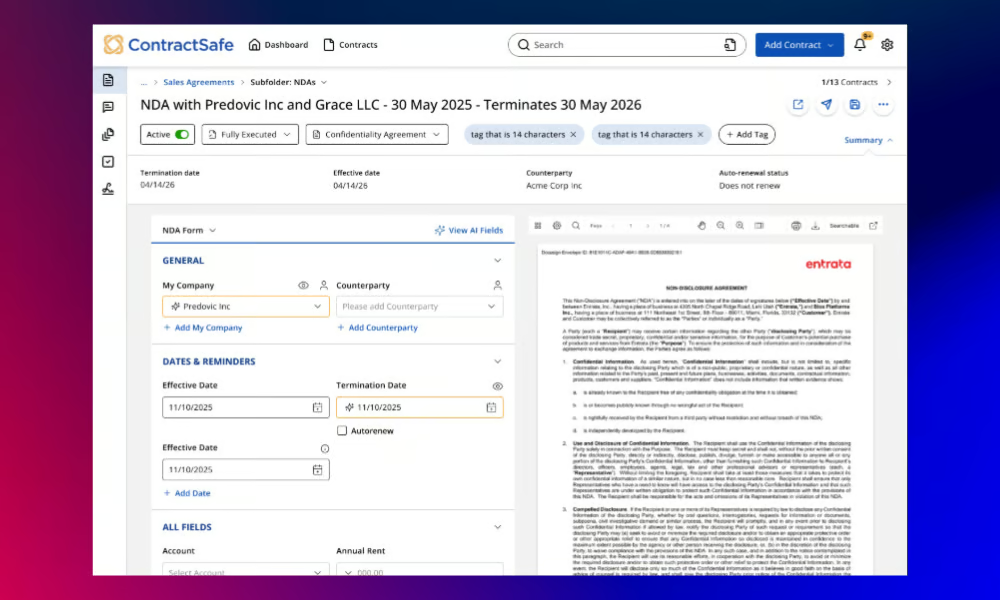
ContractSafe is a contract repository tool that helps teams store, search, and keep track of agreements in one place.
Source: G2
ContractSafe avoids the tediousness of having documents in separate places by giving contracts a single home. You can search documents the same way you would search briefs, pulling up specific clauses, names, or dates in seconds to gain real-time insights into your active legal files.
Behind the scenes, it organizes legal data on a vast database of agreements to help managers make informed decisions regarding active commitments. At the same time, automated reminders help teams stay on top of renewals and obligations, and secure storage keeps sensitive files protected.
It stays focused on organization and tracking rather than drafting or reviewing full contracts. For teams that need clarity around active agreements, deadlines, and responsibilities, ContractSafe offers a straightforward way to keep contract work moving without adding friction.
Key Features
- AI-powered search: Instantly locates contract terms, clauses, and key details within complex documents using simple keyword searches.
- Automated deadline reminders: Send alerts before renewals, expirations, or other important obligations tied to active agreements.
- Secure document storage: Keeps contracts centralized and searchable for faster attorney review.
- User permissions & access control: Controls who can view, edit, or download contracts across teams.
- Integrations with business tools: Connects with CRMs and document management platforms to fit into existing systems.
Pros
- Makes finding contracts quick and easy
- Prevents missed deadlines with automated reminders
- No complex setup or IT support needed
- Supports team collaboration with access controls
5. DocuSign
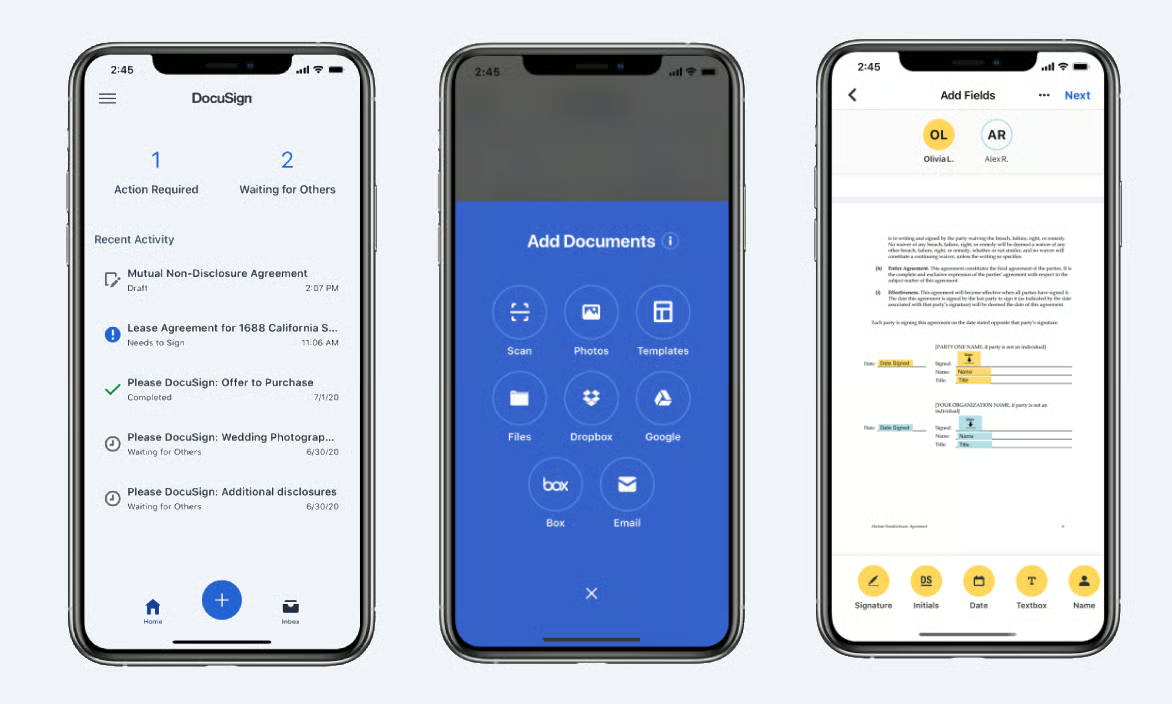
DocuSign makes signing and managing legal documents faster, more secure, and fully digital.
With legally binding e-signatures and automated workflows, it helps businesses and law firms move agreements forward without the friction of printing, scanning, or mailing documents back and forth.
Source: G2
While DocuSign is best known for e-signatures, its platform has expanded to support broader legal document workflow automation used by transactional lawyers and corporate legal departments.
Tools like DocuSign Iris add AI capabilities that assist with due diligence, document review, and data extraction. These features help teams work through agreements more efficiently while staying aligned with client service expectations.
These features support agentic workflows and custom legal workflows that fit into existing processes, making DocuSign a fully integrated option for managing agreements from signature through storage and tracking.
Key Features
- Legally binding e-signatures: Allows users to sign documents securely from anywhere, across devices.
- Automated contract workflows: Supports custom workflows for sending, signing, approving, and finalizing agreements.
- AI-assisted review with Iris: Helps surface key terms and insights during due diligence and contract review.
- Audit trails & compliance tracking: Maintains a detailed activity record to support compliance and internal review.
- Secure cloud storage and integrations: Connects with legal CRM, document management, and legal systems to stay fully integrated.
Pros
- Speeds up contract signing with secure e-signatures
- Supports due diligence and review with AI-assisted tools
- Fits into custom, agentic workflows for different teams
- Accessible across devices for remote and distributed work
6. MyCase
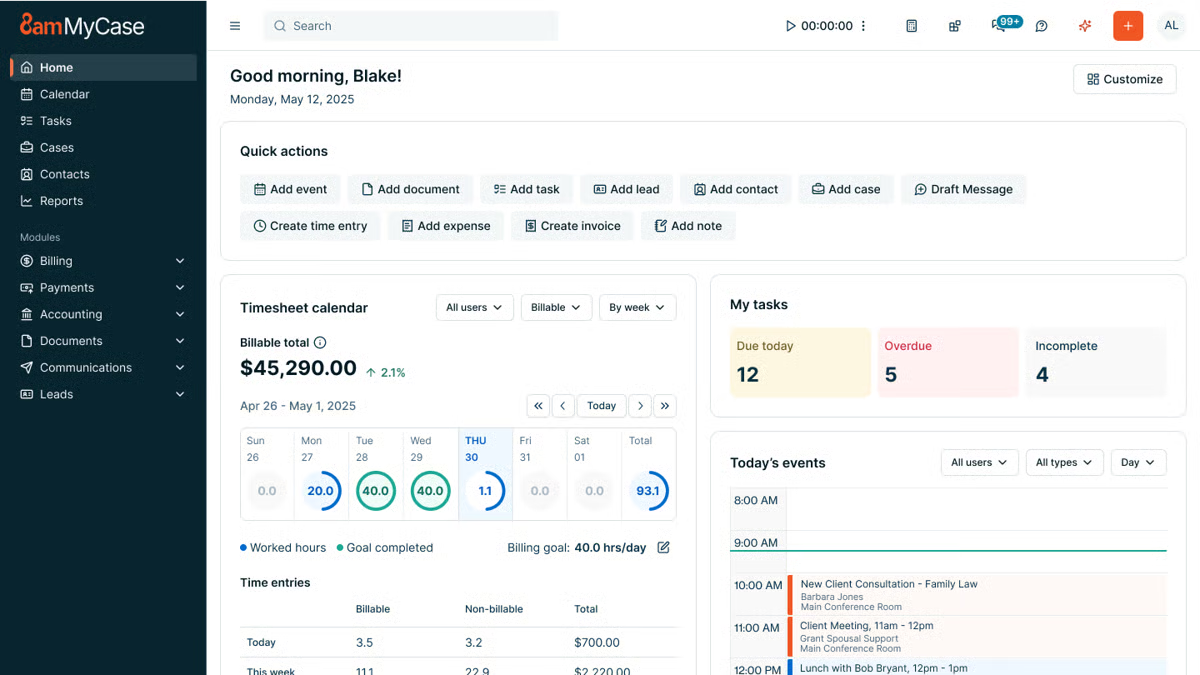
MyCase simplifies document storage with a secure, cloud-based document management system built specifically for law firms.
Source: G2
MyCase helps attorneys store, access, and manage case data in one centralized location to reduce the risk of lost files and version confusion. Documents stay connected to the right matters, clients, and deadlines, which supports consistency and data security across the firm.
While MyCase offers broader practice management tools, its document storage features focus on keeping sensitive client information protected, searchable, and easy to work with, whether files originate in Microsoft Word or are uploaded from other sources.
Having these records organized allows even a junior associate to answer complex questions quickly, which provides partners with real-time insights into active cases.
Overall, the platform is designed to support everyday workflows while helping firms ensure compliance with internal policies and security expectations.
Key Features
- Cloud-based document storage: Keeps legal files organized and accessible from any device.
- Advanced search & tagging: Uses filters and keyword searches to quickly locate legal content tied to specific cases.
- Role-based access control: Manages who can view, edit, or download documents containing sensitive client information.
- Client portal integration: Allows secure document sharing without email attachments.
- Automatic backups & security encryption: Protects case data and supports data security and compliance needs.
Pros
- Keeps all legal documents in one secure location
- Makes it easy to search and retrieve case files
- Allows controlled access for clients and team members
- Provides cloud-based access for remote work
7. Harvey AI
AI models are making legal work faster and more efficient, and Harvey AI is one of the newest tools built specifically for law firms.

Source: Harvey.ai
Designed to assist with legal research, contract review, and document analysis, Harvey AI helps lawyers process large amounts of information quickly while maintaining accuracy.
No type of artificial intelligence can be a total replacement for human legal expertise, of course. Nevertheless, many firms use Harvey AI to speed up repetitive tasks, analyze legal documents, and improve decision-making.
Key Features
- AI-powered legal research: Finds relevant case law, statutes, and legal precedents in seconds.
- Contract analysis & review: Identifies key clauses, missing terms, and potential damages or hidden risks in agreements.
- Litigation support: Assists with drafting briefs and legal arguments and summarizing case details.
- Document summarization: Extracts important points from long legal documents to save time.
- Natural language processing: Understands complex legal language and provides insights based on queries.
Pros
- Speeds up legal research by quickly retrieving relevant cases
- Helps identify risks and missing clauses in contracts
- Reduces the time spent summarizing lengthy legal documents
- Uses advanced AI to interpret legal language accurately
Why Should You Use Legal AI Tools for Legal Documents?
Aside from speeding up work, legal AI software improves accuracy, compliance, and overall efficiency.
Let’s go over why you should have them in the first place.
Speeds Up Document Drafting
Drafting legal documents takes time, but AI makes it a whole lot faster. Instead of starting from scratch every time, lawyers can generate complete, well-structured documents in minutes.
For instance, AI legal drafting tools can pull in key details, suggest relevant clauses, and format everything properly to cut down on repetitive work.
Take Briefpoint, for example. It automates legal drafting by pulling case details and structuring them into polished documents. That means less time spent on manual entry and more time focusing on the actual case.
Book a demo to see it firsthand!
Reduces Human Errors
Small mistakes in legal documents can create big problems. AI helps catch those issues early, before they turn into something you have to fix later.
When legal firms rely heavily on manual processes for writing legal documents, it’s easy to miss details. This happens most often with long agreements, repetitive discovery responses, or documents that go through multiple revisions.
Generative AI technology works like an added review layer. It scans legal information carefully and flags sections that don’t line up.
More specifically, AI can help spot issues like:
- Inconsistent terminology
- Missing key clauses
- Formatting mistakes
- Duplicate or conflicting sections
- Incorrect dates or names
- Ambiguous language
- Non-compliant contract terms
Remember: AI-generated output should always support your judgment, not replace it. The real value is speed and focus. Potential problems surface earlier, so your review time goes toward analysis and strategy rather than tracking down avoidable errors.
Improves Compliance With Legal Standards
Staying compliant in the legal field takes constant attention. Rules change, expectations shift, and even experienced teams can miss details when they’re working through documents quickly.
AI-powered tools help reduce that risk by acting as a steady backstop during review.
Many tools use machine learning trained on legal terminology to spot clauses, language, or structures that may fall outside current standards. They highlight areas worth a closer look, particularly in long contracts or documents that follow similar patterns.
For example, some contract management tools flag terms that don’t align with regulatory requirements or point out language that may need updating based on recent changes. That saves you from having to comb through every page, line by line, just to confirm compliance.
Again, you still stay in control of the final decision, but AI helps surface potential issues earlier.
Saves Costs on Administrative Tasks
Nobody wants to waste time on paperwork, and AI helps cut down on it. By handling routine tasks like legal drafting and data entry, AI lets law firms spend less on admin work and more on what really matters, reducing overhead expenses.
For example, AI can auto-fill forms, generate standard documents from templates, and organize case files without anyone having to do it manually.
That means fewer billable hours lost to repetitive work and more time for legal teams to focus on clients.
Supports Legal Research and Case Preparation
Research can quietly eat up half a day if you let it. Rifling through court documents, cross-checking citations, and making sure you’re not missing a key case takes real time.
Luckily, AI tools can easily shorten that process. Many use generative AI layered over large legal databases to sort through thousands of cases and regulations quickly. In the legal sector, that means less manual searching.
Picture this: you’re drafting a motion to compel and need recent decisions from a specific court that deal with a narrow procedural issue. An AI research tool can filter by jurisdiction, pull similar fact patterns, and return a short list of relevant cases with clear summaries.
Some platforms also include litigation analytics, which can give you insight into how certain judges have ruled in comparable situations.
All that changes how you prepare. You’re still responsible for checking the authority and shaping the argument, but you begin with organized results rather than a blank search bar.
The tool works like a focused personal assistant for research, gathering and sorting information so you can concentrate on analysis and positioning.
Keeps Documents Organized and Accessible
As matters grow, so does the paper trail. But without structure, even simple tasks like locating the latest draft or confirming a renewal date can slow everything down.
AI solutions help keep legal files organized by sorting, categorizing, and tracking documents automatically. Contracts, pleadings, and internal records stay connected to the right matter, client, or deadline, which makes retrieval much easier.
Many platforms also support document and contract analysis, so you’re not just storing files. You’re able to search inside them and surface key details in seconds.
An AI-powered organization often includes:
- Smart tagging based on keywords, client names, dates, or contract terms
- Full-text search across large volumes of documents
- Automated deadline and renewal reminders
- Version tracking to reduce confusion over edits
- Access controls that support data privacy and protect sensitive information
When documents are structured and searchable with AI software, your team spends less time hunting for files and more time acting on them. That clarity can create a real competitive edge, especially in fast-moving practices where quick access to information makes a difference.
Automate Your Biggest Bottleneck With Briefpoint
Discovery work tends to be the slowest, most repetitive part of litigation. Tedious tasks like drafting requests, organizing responses, and double-checking formatting can quietly consume days that could be spent on higher-value legal work.
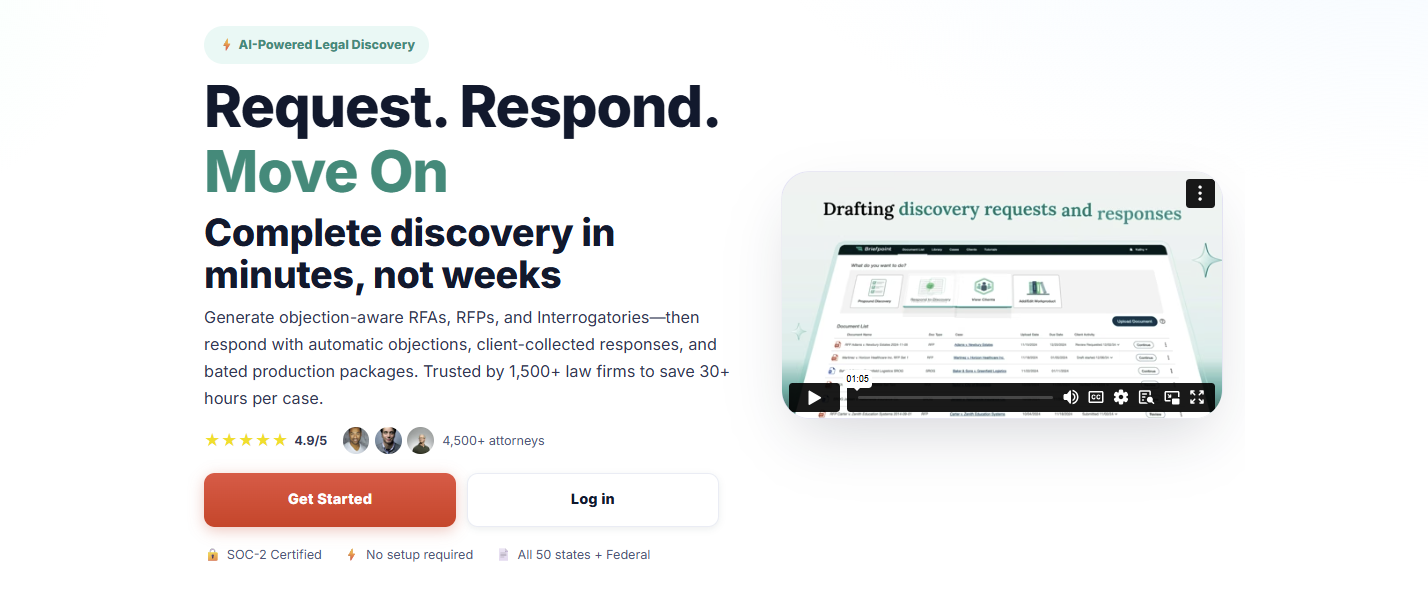
Briefpoint is an AI-powered tool that targets the bottleneck directly. It handles the repetitive structure and formatting of discovery while keeping attorneys firmly in control of review and strategy. Everything stays in Word, so the process feels familiar and easy to verify.
Autodoc extends that workflow into document production. It connects requests for production to the actual case files, identifies responsive documents, and generates written responses with page-level Bates numbering.
All of these capabilities mean less time matching documents to requests and fewer manual steps before serving a production.
8 Ways to Optimize Your Litigation Workflow

What Are the Biggest Litigation Bottlenecks Legal Teams Face?
If you’re managing a litigation process, you probably know the frustration of slowdowns that seem to pop up everywhere. Before we dive into fixes, let’s take a clear-eyed look at what’s really clogging your legal workflows.
Here are some of the most common culprits:
- Manual processes: Filing, sorting, and tracking paperwork by hand wastes time and increases the risk of human error. Every extra hour spent on admin work is time you’re not spending on strategy, client service, or case analysis.
- Discovery delays: Discovery shouldn’t feel like digging through a haystack. Yet, without the right legal technology, searching for key information or drafting discovery documents can turn into a tedious, drawn-out process that delays your entire workflow.
- Communication gaps: Missed messages, unclear updates, or siloed conversations? These gaps can lead to real consequences like missed deadlines, rework, and lost trust with clients. Effective communication is a core part of client satisfaction, and it’s often overlooked.
- Outdated methods: Relying on paper files, spreadsheets, or outdated systems slows down collaboration and makes finding information harder.
- Overburdened staff: When your team is buried in repetitive administrative work, they face intense daily pressure and have less time for high-impact legal tasks. That bottleneck adds up, hurting both your efficiency and client satisfaction.
These issues don’t just slow things down. They also create stress, frustration, and even client dissatisfaction.
The good news? Once you pinpoint these roadblocks, you’ll be in a stronger position to streamline tasks, strengthen communication, and adopt legal technology that truly supports your practice.
How to Maximize Your Litigation Workflow
Now that we have a clearer picture of the common roadblocks, it’s time to focus on how you can clear them and set your legal workflows up for long-term success.
Let’s walk through a few smart ways to tighten up your workflow, cut down on human error, and bring your legal technology up to speed.
1. Identify the Worst Roadblocks in Your Legal Workflow Automation
As mentioned, it’s important to figure out where your workflow gets stuck before you look for solutions.
Let’s say your firm still uses paper files. Sound familiar? Every time you need something, you’re digging through endless stacks of folders and wasting time that could be spent elsewhere.
Or take the discovery phase, as it’s one of the most time-consuming parts of the litigation workflow. Drafting similar documents over and over manually can eat up hours and leave room for mistakes.
Communication is another common issue. Imagine a client sends over crucial updates, but not everyone on the team gets the memo. Suddenly, deadlines are missed, and everything feels chaotic when trying to share updates with the other party. These communication breakdowns can also create issues when coordinating filings, responses, or document exchanges with the opposing party.
Then there’s the workload. Staff members are often juggling important casework with routine tasks like scheduling and data entry. For example, a paralegal might spend more time managing calendars than actually contributing to the case, which is why most people find manual workflows so frustrating.
Identifying these problem areas makes it easier to take action. The next challenge is finding the best ways to resolve them.
2. Use Legal Practice Management Software
Legal practice management software simplifies your legal workflow by consolidating essential tasks into one platform. Rather than using multiple tools or relying on outdated methods, you can manage everything more efficiently and focus on more value-adding work.
These tools are designed to handle a variety of tasks, including:
- Tracking case deadlines and tasks
- Managing client communication and case files
- Automating legal billing and invoicing processes
- Generating reports to monitor performance
- Storing and sharing documents securely
- Handling document review
The software’s centralized approach eliminates the back-and-forth between systems to save you time and reduce errors. Having all your data in one place gives your team a clear view of every active case.
For example, it’s easier to keep track of deadlines with built-in calendars and task lists. Features like automated billing also make invoicing quicker and more accurate, helping you get paid faster.
Collaboration becomes seamless, too. Whether you’re sharing updates with your team or accessing files remotely, everything is organized and easily accessible.
Many platforms also integrate with tools you already use, like email or cloud storage, which helps organize your workflow even further.
3. Automate Discovery Document Drafting
Drafting discovery documents is a tedious and time-intensive task for legal teams, but legal document automation tools like Briefpoint can make the process faster and more efficient.
Here’s how it works: You start by uploading your discovery request to Briefpoint. Its AI jumps in by scanning and pulling key details like the court name, case number, parties involved, and even the type of request. It also applies local formatting rules automatically to save you the hassle of doing it manually.
Once that’s done, the system creates a draft with the basics already filled out, including captions and routine information. From there, you can add objections or responses with just a few clicks, personalizing each request as needed.
When everything looks good, you can download the document, open it in Word, and make any final tweaks before filing.
Briefpoint can handle requests for production, requests for admission, and interrogatories, and it supports discovery work in all 50 U.S. states, D.C., and all 98 federal district courts. Trusted by 1,500 law firms, it helps you save up to 30 hours per case and generate up to 70 discovery requests in under 3 minutes.
4. Digitize As Much As You Can
Relying on paper files creates more headaches than it solves. Whether you’re handling a legal dispute or managing filings in district court, digitizing your workflow saves time and minimizes stress, especially when every minute counts.
Essentially, a strong legal workflow management system helps you work smarter and serve clients better. Here’s how going digital supports smoother workflow management:
- Relevant document access: Instead of sorting through paper files, you can gain access to the documents you need in seconds. This makes reviewing documents and responding to client needs much easier.
- Smoother collaboration: With digital files, your entire team can access and update the same documents in real time. This means no more version control headaches or wasted time on non-billable tasks.
- Streamlined client intake: Digital tools simplify the client intake process, which helps you gather information faster and kick off matters for the plaintiff without unnecessary back-and-forth.
- Centralized legal workflow management software: Using purpose-built legal workflow management software keeps everything organized.
- Future-ready federal court filings: As district courts continue moving toward electronic filings, having a digitized system ensures you stay compliant and competitive.
5. Offer Self-Service Options
Not every question needs a direct call or email. By offering self-service options like a knowledge base or blog, you give clients easy access to information while freeing up your team’s time.
These resources can be especially useful for answering common questions about topics like alternative dispute resolution, navigating the court system, or understanding civil procedure.
A well-organized knowledge base provides quick explanations of legal processes, which helps save clients from waiting for responses. For example, they could look up how arbitration works or what to expect during a civil procedure hearing.
Blogs, on the other hand, allow you to share insights on broader topics, like preparing for a district court appearance, handling settlement negotiations, or tips for managing legal disputes.
Aside from helping clients, these tools position your firm as knowledgeable and proactive. They can also cut down on repetitive inquiries so your team can focus on more pressing tasks.
6. Consider Outsourcing Administrative Tasks
Administrative tasks can pile up quickly and leave your team stretched thin. Outsourcing some of these responsibilities is a smart way to free up time and focus on core work like medical malpractice cases, civil litigation, or resolving disputes.
Reducing administrative work also gives attorneys more time to focus on client matters and productive billable hours.
Here are some common tasks you can outsource:
- Preparing defendant answers and other routine legal documents
- Managing data entry for civil litigation and criminal cases
- Scheduling meetings and managing calendars
- Organizing discovery files
- Handling client communication for non-urgent inquiries
For example, using a virtual legal assistant or legal outsourcing service can reduce workloads, lower administrative costs, and improve efficiency while making sure all tasks are handled properly.
7. Invest in a Good CRM Software
Client relationship management (CRM) software is a practical tool for organizing client information, managing interactions, and tracking case details. A well-chosen CRM keeps your team efficient while improving the overall client experience.
These platforms centralize important data such as contact information, case histories, and communication logs.
With everything in one place, finding the details you need becomes much easier. Setting reminders, tracking deadlines, and monitoring case progress also become seamless, reducing the risk of overlooked tasks in a complex lawsuit.
Integrations with tools like email and document systems further untangle your workflows. Many CRM solutions also include legal automation features, which help with tasks like sending client updates or creating detailed progress reports to better manage customer demands.
A reliable CRM sets you up for better communication, improved legal task management, and smoother operations. It’s a great investment, especially for many firms that use these systems to deliver exceptional service to their clients.
8. Switch to Legal Research Tools
If you’re still relying on traditional legal research methods, you’re probably spending more time than you need to and adding unnecessary administrative burdens to your legal workflows.
In contrast, shifting to automated systems and modern legal research tools transforms this formal proceeding into something faster, more precise, and far less tedious.
Faster research can be especially valuable when preparing arguments for a summary judgment motion or evaluating a case strategy.
By using research platforms built for law firms, you free up time for strategic tasks like case analysis and trial preparation. Here’s what modern legal research tools bring to your workflow:
- Advanced search capabilities: Cut through irrelevant results with tools that filter by jurisdiction, statute, case law, or topic, so you get exactly what you need without endless searching.
- Built-in citation analysis: Make sure every case you reference is valid and up-to-date, reducing the risk of relying on outdated information.
- Access to comprehensive legal databases: Whether you need federal regulations or state-specific laws, these tools keep everything in one place for easy access.
- Efficiency for large law firms and growing teams: Automated workflow features help scale research processes without overloading your staff.
These platforms can also help attorneys locate authorities and precedents needed for pre-trial motions without spending hours searching through multiple sources.
Pairing legal research tools with legal workflow automation software helps streamline the formal research process while keeping your team focused on high-impact, strategic tasks.
Overall, it’s a smart way to replace manual work with automated workflow systems that maximize both efficiency and the quality of your work.
Briefpoint Is the First Step to Upgrading Your Litigation Workflow
Improving your litigation workflow doesn’t have to feel like a huge challenge. While this isn’t an exhaustive list, it’s a great place to start. Tackling workflow clogs, digitizing processes, and using the right tools can make a big difference in how smoothly things run.
When it comes to simplifying repetitive tasks like drafting discovery documents, Briefpoint is an excellent choice. Its AI-powered system gives attorneys and law teams the ability to save time, reduce errors, and keep everything organized.
From requests for production to interrogatories, it handles a wide range of discovery documents with ease.
For document-heavy matters, Autodoc can identify responsive documents, generate Bates-cited responses, and create organized production packages from your case files and productions.
If you’re looking to make your workflow more efficient, schedule a demo with Briefpoint today and see how it can support your practice.
Interrogatories Example and Common Types
What Are Interrogatories?
Interrogatories are written questions that the other side sends during the discovery process of a lawsuit. If you are the answering party, you have to respond in writing and do so carefully, since your answers can heavily influence how the case moves forward.
These written questions usually ask for facts tied to the dispute, such as:
- What happened
- Who was involved
- What injuries or losses are being claimed
- What facts support a claim or defense
In other words, they give the other party a way to learn your position before depositions or trial prep begin. They also give attorneys a chance to spot weak points, missing facts, or statements that may need follow-up later.
And since the answers become part of the case record, they need to be accurate, clear, and carefully worded.
What Does a Sample Interrogatory Look Like?
An interrogatory usually looks like a numbered written question followed by a space for the response. It is often included in a formal discovery document that one side will serve on the other.
For example, in a personal injury case, the plaintiff might send the defendant an interrogatory like this:
Interrogatory No. 3:
State all facts that support your contention that you were not negligent in the incident described in the complaint.
The response might look like this:
Response to Interrogatory No. 3:
Responding party states that the traffic signal was green at the time of entry into the intersection, that plaintiff entered against a red light, and that responding party exercised reasonable care at all relevant times. Investigation is ongoing, and responding party reserves the right to supplement this response.
This is the basic format. You get a numbered request, then a written answer or objection beneath it. Some responses also include objections before the answer.
Common Types of Interrogatories
Interrogatories can cover a lot of ground, but most of them fall into a few familiar categories. Here are five interrogatories common in the discovery process:
Background Interrogatories
Background interrogatories focus on basic information tied to the people, entities, and events in the case. They usually come early in discovery because the asking party wants a clearer picture of who is involved before moving into more detailed issues.
These questions often ask the opposing party to identify names, addresses, job titles, relationships, and other starting-point details. They can also ask about insurance, business roles, or the location of relevant resources and records.
Common examples include requests to identify:
- Full legal name
- Home or business address
- Date of birth
- Employer
- Job title
- Relationship to other parties
- Insurance coverage
- Business affiliations
- People with knowledge of the facts
- Locations of relevant documents
Fact-Based Interrogatories
Fact-based interrogatories focus on the facts behind a claim or defense.
They ask you to spell out what happened, who was involved, and what information supports your position. These questions help the other side test your proof, narrow disputes, and see how well your allegations are defined.
You will see them in many case types, including car accident claims, contract disputes, and medical malpractice cases. A question may ask for the facts supporting a denial of liability. Another may ask a party to explain what happened before, during, and after the event in dispute.
In a medical malpractice case, for example, one interrogatory might ask what conduct allegedly caused the injury and what facts help prove that claim.
Common examples include:
- Facts supporting each claim
- Facts supporting each defense
- Date, time, and place of the incident
- Actions taken before or after the event
- Names of people involved
- Facts supporting denial of liability
- Facts supporting causation
- Facts supporting claimed damages
Damages Interrogatories
Damages interrogatories focus on what a party says they lost and what they want to recover. If the case includes a demand for compensation, these questions push that claim into specifics. They ask for:
- Actual amounts
- Supporting facts
- The basis for each category of loss
These interrogatories may cover things like medical bills, missed work, property damage, future care, or emotional distress. They may also ask about insurance proceeds, reimbursements, settlements, or any other payment already made.
That gives the other side a clearer view of the damages claim and what documents or testimony may support it.
Typical requests include:
- Total amount of damages claimed
- Itemized medical expenses
- Lost wages
- Loss of earning capacity
- Property damage
- Repair costs
- Out-of-pocket expenses
- Future medical costs
- Emotional distress damages
- Date and amount of each payment received
- Insurance payments
- Documents supporting damages
Witness Interrogatories
Witness interrogatories are used to find out who may have information that could affect the case. Witnesses can include eyewitnesses, treating providers, company employees, investigators, or expert witnesses.
In some cases, the response may also need to identify people who gave statements or people with knowledge that could link a party to a key event, document, or defense.
These questions usually ask for names, contact details, and a short summary of what each person is believed to know. Once those details are disclosed, they can help the other side decide who they want to interview, depose, or otherwise obtain information from later.
If a response leaves out key witness details, the requesting party may try to compel a fuller answer.
You may also see questions aimed at who is responsible for keeping witness statements, recordings, or related records. Questions like these can become important before a hearing, during motion practice, or while preparing for trial.
Document-Related Interrogatories
Document-related interrogatories deal with the paper trail behind the case. Essentially, they are used to pin down what records exist, what they relate to, who has them, and how they support a claim or defense.
If documents are central to the dispute, this section of discovery can tell you a lot about what each side plans to rely on.
These interrogatories can be especially useful after an initial exchange of records leaves gaps or raises follow-up questions. For instance, a lawyer may use special interrogatories to ask for narrower details, or send a later set after production turns up new information.
Plus, document-related interrogatories can help narrow disputes over missing records, vague references, or claims that collection would create too much burden.
Some document-related interrogatories ask for details like these:
- Identify all documents that support your claims: State what records back up the factual or legal positions being asserted.
- Identify all communications about the incident: Cover emails, letters, text messages, memos, or other written exchanges.
- State who has custody of relevant documents: Clarify who holds the records and where they are kept.
- Identify documents tied to damages: Point to bills, invoices, estimates, receipts, or payment records.
- Describe any documents withheld: Show what was not produced and why.
How to Write Strong Interrogatory Responses
At the very least, a strong interrogatory response needs to be clear, accurate, and focused. These four steps can help you get there:
1. Read Each Question Carefully
Read the interrogatory slowly and break it into parts before you answer. Look for dates, names, time periods, definitions, and any wording that may limit or expand what one party is asking.
Another important step is to compare the question to the complaint, answer, and any other discovery already filed in the case. Doing so can help you catch wording that seems harmless at first but could box you into an incomplete or inconsistent response.
As you review it, make a note of anything vague, too broad, or built on an assumption that may need a discovery objection or a qualified answer.
2. Answer Only What the Question Asks
Keep your answer tied to the exact question and no more. If a request asks for a date, give the date. If it asks for facts supporting one allegation, respond to that allegation rather than giving a full case narrative.
Being concise helps keep the response complete without giving away additional information that the other side did not ask for.
This practice also helps when a question feels overly broad. In a limited civil case, for example, a party may still send a request that reaches farther than it should. A careful answer stays within the actual wording of the interrogatory and avoids filling gaps that the other side left open.
For instance, if the interrogatory asks you to identify the date of the incident, a focused response would state the date of the incident. It would not also volunteer a full description of the event, list witnesses, and summarize medical treatment unless the question asked for that too.
3. Check the Facts Before You Respond
Before you serve anything, make sure the facts line up with the records, the pleadings, and your client’s position.
Interrogatory answers are usually given under oath, so accuracy matters from the very start. A rushed answer can create problems later if it conflicts with documents, deposition testimony, or another response.
You also need to check the applicable rules before finalizing anything. Some objections are permitted, some answers need verification, and some responses may need to mention an agreement to produce more information later. You usually cannot simply refuse to answer without a valid basis.
Remember: If you are drafting interrogatory responses, take time to confirm names, dates, timelines, and supporting facts before anything goes out. That extra review can save you from corrections, disputes, or credibility issues later.
4. Use Objections Carefully and Clearly
Objections can protect your client, but they need to be specific and grounded.
A vague objection often creates more trouble than it solves. If a question is unclear, overly broad, seeks privileged material, or goes beyond what is allowed, say so plainly and explain the issue in a way that fits the request.
It also helps to know what type of discovery you are dealing with. Form interrogatories tend to follow standard language, while a custom or final set may raise narrower disputes.
Sometimes, you may also need to look at local rules on how many questions can be served or how discovery differs from requests for admissions.
After service, a weak objection can invite a meet-and-confer letter or a motion to compel. In contrast, a careful one gives notice of the problem while preserving your position.
This discovery objection cheat sheet can be a valuable resource when preparing these responses.
Briefpoint Can Speed Up Interrogatory Drafting
Reviewing a few sample interrogatories can help you understand the format, but real drafting still takes time. You still need to sort through facts, shape objections, keep responses consistent, and review supporting pages before anything goes out.
Briefpoint is an AI-powered tool that can cut down much of that workload. It supports interrogatories, RFAs, and RFPs, and it can generate objection-aware drafts much faster than starting from a blank page.
Its AutoDoc workflow also turns productions and case files into ready-to-serve responses with Bates citations and page-level citations, which is especially useful when the record is large or multiple other attorneys need to review the same set.
Briefpoint is used by 1,500+ law firms nationwide, and its platform has generated 637,000+ objections used by litigators.
If interrogatories are eating up too much time in your practice, it’s a clear sign that you need Briefpoint to help you draft faster and move discovery forward with less manual work.
Legal Billing Software: What You Need to Know (+ 7 Best Options)
What Is Legal Billing Software?
Legal billing software helps manage billing, payments, trust accounts, and other parts of law firm financial management in one system.
Here are some things it can help you do:
- Track billable time: Record hours and tasks accurately, so your bills reflect the work completed and less time goes unbilled.
- Create professional invoices: Put together clear, client-ready bills with detailed entries, rates, and expenses tied to the right matter.
- Manage trust accounts: Keep client funds separate from operating funds and maintain cleaner records for compliance purposes.
- Handle expense management: Track filing fees, court costs, expert fees, and other matter-related expenses.
- Process payments: Accept online payments, reduce delays, and make it easier for clients to pay outstanding balances.
- Manage invoices: Review sent bills, monitor unpaid amounts, and keep billing activity organized in one place.
- Use batch billing: Generate multiple invoices at once to save time when your firm handles a large volume of matters.
- Support e-billing: Work with clients that require electronic billing formats and more structured submission processes.
- Review performance: Monitor collections, outstanding balances, and your firm’s financial performance more closely.
How Does It Differ From Regular Accounting Software?
Legal billing software is tailored specifically to the unique needs of law firms, while regular accounting software is more general and designed for businesses across various industries.
One major difference is time tracking. Legal billing software lets you track billable and non-billable hours accurately, which helps make sure your invoices reflect the work done for each client. This is something standard accounting software typically doesn’t offer.
Another key feature is trust accounting, which is critical for law firms to manage client trust funds and comply with legal regulations. Generic accounting tools usually aren’t equipped to handle this.
Additionally, legal billing software provides specialized reports, such as case-specific cost breakdowns and client expense summaries, which go beyond the standard financial reports found in regular tools.
Many legal billing platforms also integrate with case management systems to organize workflows in a way that generic software often can’t. These differences make legal billing software a much better choice for law firms.
Why Do Law Firms Need Legal Billing Software?
Legal billing software is essential for law firms aiming to stay organized, save time, and improve accuracy. Here’s why it’s worth the investment:
Accurate Billing
Tracking every billable minute manually can easily make room for error. For one, it’s easy to miss a few minutes here and there, and those small errors can add up to big losses over time. Plus, mistakes in the legal billing process can lead to client disputes, which can affect your bottom line overall.
Legal billing software takes the kinks out of the process. It tracks your time automatically, so you know exactly how many hours you’ve worked and can create accurate, detailed invoices.
For example, if you switch between different tasks throughout the day, the software can capture that time as you work, so those smaller tasks do not get left off the bill.
Clients appreciate clear, transparent billing, and you’ll avoid awkward conversations about charges that don’t add up. On top of that, you’ll get paid for every minute of the work you’ve done.
Time Savings
Billing can eat up more time than it seems like it should because it’s not only the invoice itself. It’s the time entries, the expenses, the follow-up, and all the manual data entry that pile up around the process.
Legal billing software solutions help cut that down. When you can track time and expenses in one place, there’s less catching up later and less time spent piecing everything together at the end of the month. A lot of the work that usually slows billing down becomes easier to manage.
That makes the entire billing cycle less of a drain on your day. You spend less time on billing admin and more time on actual legal work.
Better Cash Flow
Legal billing software can help your firm get paid faster by making the payment process easier to manage for both your team and your clients. Here are a few ways it helps:
- Automated reminders: The software sends reminders to clients automatically, which helps reduce delays.
- Online payment options: Clients can pay instantly through secure online portals, making the process faster and more convenient.
- Fewer overdue invoices: With clear invoices and easy payment methods, clients are less likely to miss deadlines.
- Faster invoice generation: Bills can go out sooner, which means less delay between finishing the work and requesting payment.
- Automated billing workflows: Recurring tasks like reminders, payment tracking, and follow-up take less manual effort.
- Custom payment plans: Some tools let firms offer structured payment options, which can help clients stay current on what they owe.
- Better billing data: You can review invoice status, payment activity, and outstanding balances without looking through separate records.
- Fewer billing errors: Cleaner records can reduce mistakes that slow down approvals or create billing disputes.
- Batch sending: Some platforms let you send multiple invoices at once, which helps keep billing on schedule.
Trust Account Management
Trust accounting has to be precise. Your firm needs to keep client funds separate from operating funds, record every deposit and withdrawal correctly, apply transactions to the right matter, and maintain a clear ledger for each client.
For modern law firms, that level of recordkeeping is hard to manage in the legal industry when too much of it depends on manual updates.
Legal billing software helps keep those requirements easier to manage. It gives your team one place to track trust activity, review balances, and keep records organized.
A lot of tools help with tasks like these:
- Separate trust and operating accounts
- Record deposits and withdrawals
- Match transactions to the correct matter
- Maintain client trust ledgers
- Review balances more easily
- Reduce commingling issues
- Support compliance recordkeeping
Detailed Reporting
Legal billing software takes the guesswork out of understanding your firm’s financial health by providing detailed reports.
These reports give you a clear breakdown of data like case expenses, client payments, and outstanding balances, all in one place. Instead of sifting through spreadsheets or scattered data, you can access organized insights with just a few clicks.
Whether you’re checking which clients have unpaid invoices or planning budgets, these reports make it easy to see where things stand. The ability to quickly pull up accurate financial information saves time and helps you make better decisions for your firm.
Our Top 7 Picks for Legal Billing Software
Choosing the right legal billing software can make a big difference in how efficiently your firm operates. With so many options available, it’s important to find a tool that fits your specific needs. Below, we’ve highlighted some of the best legal billing software options.
1. Clio
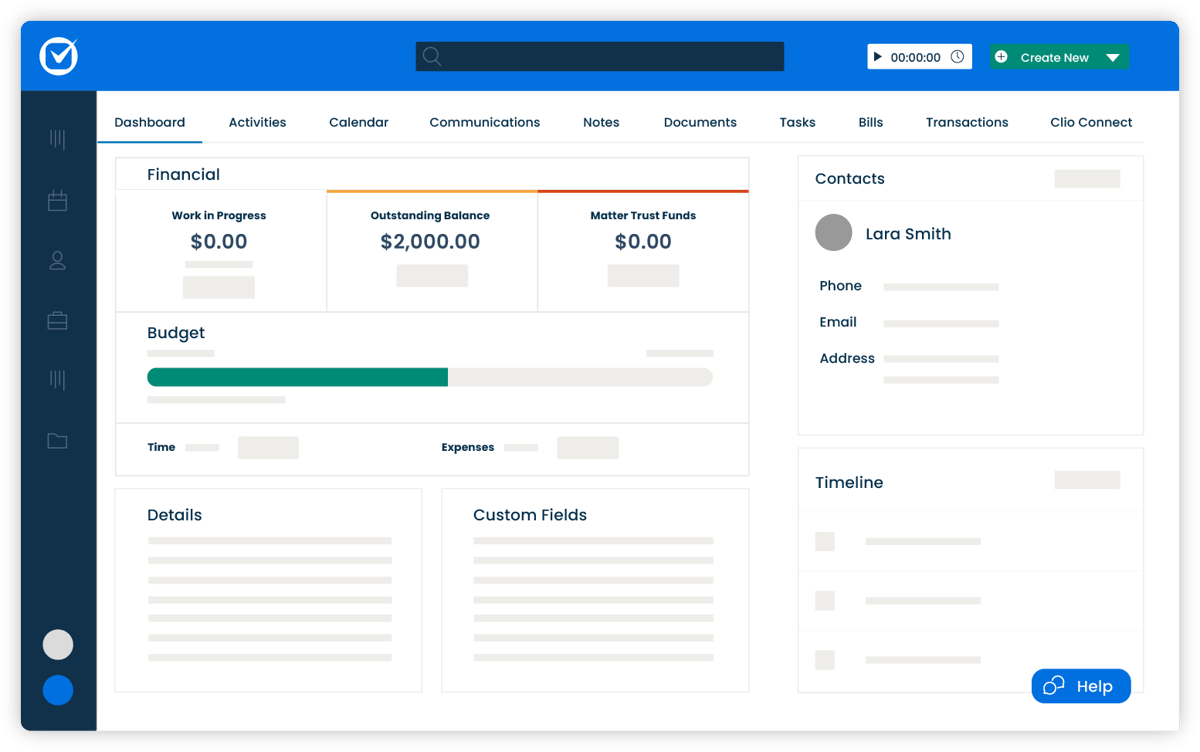
Clio is a versatile legal practice management platform that offers tools for case management, document organization, client communication, and more.
While it’s not primarily a billing software, Clio includes great billing features designed to simplify invoicing, time tracking, and trust account management.
Source: G2
Key Features
- Time tracking and billing: Track billable hours precisely and generate detailed invoices tailored to your clients.
- Customizable invoice templates: Create professional, branded invoices that reflect your firm’s style and include all necessary details.
- Secure client portal access: Provide clients with a secure space to view invoices, share documents, and communicate directly with your firm.
- Trust accounting management: Keep client funds compliant and organized with tools to separate trust and operating accounts.
- Integration with popular tools: Sync with QuickBooks, Google Workspace, Zoom, and more to optimize your workflows.
Pros
- Easy to use, even for those new to legal billing software
- Excellent customer support for troubleshooting and setup
Pricing
Clio offers plans starting at $59 per user per month, which include a basic legal billing system with time tracking and client billing.
2. TimeSolv
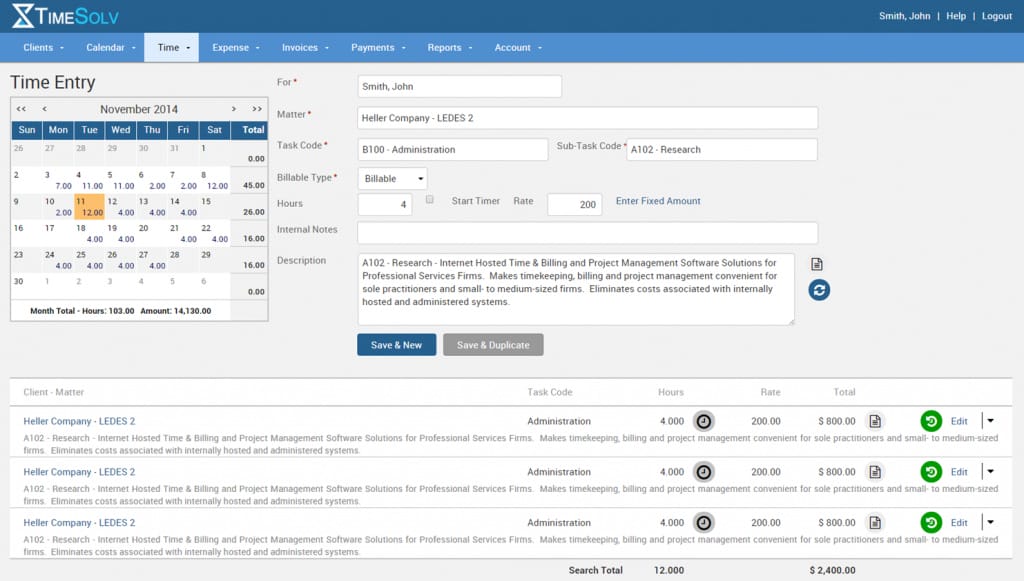
TimeSolv is online legal billing software designed to help law firms easily manage their billing processes. This billing solution is particularly well-suited for smaller firms and solo practitioners as it balances affordability and functionality.
Source: G2
Key Features
- Cloud-based access: Work from anywhere with secure access to time tracking, billing, and client data, whether on a computer or mobile device.
- Advanced time tracking: Log billable and non-billable hours accurately with built-in timers and manual entry options.
- Split billing: Easily divide invoices between multiple clients or matters, which can make complex billing scenarios hassle-free.
- Trust accounting tools: Track client trust funds with tools to maintain compliance and keep funds organized separately from operating accounts.
- Detailed reporting: Generate reports on billing, payments, and firm performance to get a clear picture of your financial health.
Pros
- Affordable for smaller firms and solo attorneys
- Offers strong data security features
Pricing
TimeSolv’s pricing starts at $40 per user per month for TimeSolv Pro. The starting plan includes time tracking, billing, expense tracking, unlimited clients, and secure document storage.
3. Lawpay
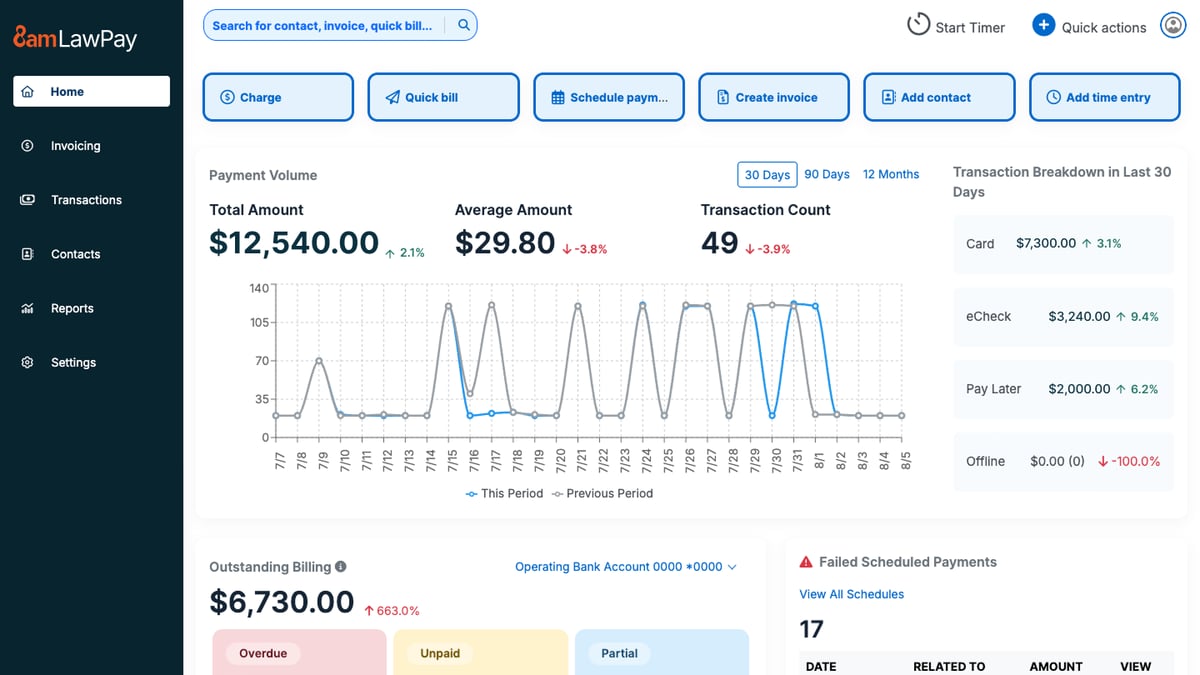
Lawpay is a payment processing solution built specifically for law firms and focuses on making transactions easy and compliant.
It’s not complete legal office billing software, but it works seamlessly alongside your existing tools to simplify payment collection and trust accounting.
Source: G2
Key Features
- Secure payment processing: Accept credit card payments, ACH transfers, and eChecks, all while making sure client funds are handled securely.
- Trust account compliance: Automatically separates earned and unearned funds to help you meet trust accounting requirements without the risk of commingling.
- Customizable payment pages: Create branded payment pages for your website to provide a professional and convenient experience for clients.
- Recurring payment options: Set up recurring billing for ongoing matters, which reduces administrative tasks.
- Detailed transaction reporting: Track all payments and deposits in real time so it’s easier to manage finances and maintain accurate records.
Pros
- Simplifies trust accounting for compliance
- Easy to set up and use for legal professionals
Pricing
Lawpay’s monthly pricing is a flat fee of $19 per month, including features like trust account protection, unlimited users, and customizable website payment pages. There is also custom pricing for specialized plans.
4. Smokeball
Smokeball is a cloud-based legal practice management software that offers tools for billing, case management, and document automation.
While it’s known for its comprehensive features, its billing functionality stands out with automatic time tracking and pre-built templates.

Source: G2
Key Features
- Automatic time tracking: Captures all billable and non-billable hours without requiring manual input.
- Pre-built invoice templates: Create detailed and professional invoices quickly, with options to include time entries, expenses, and case-specific details.
- Case and matter management: Organize all case-related files, deadlines, and communications in one centralized platform.
- Document automation: Generate legal documents quickly with pre-built templates tailored for various practice areas.
- Trust accounting management: Easily handle client trust funds with tools designed to ensure compliance and accuracy.
Pros
- Great for small teams needing simple but powerful tools
- Intuitive interface that’s easy to navigate
Pricing
Smokeball’s pricing is not currently publicly available.
5. FreshBooks
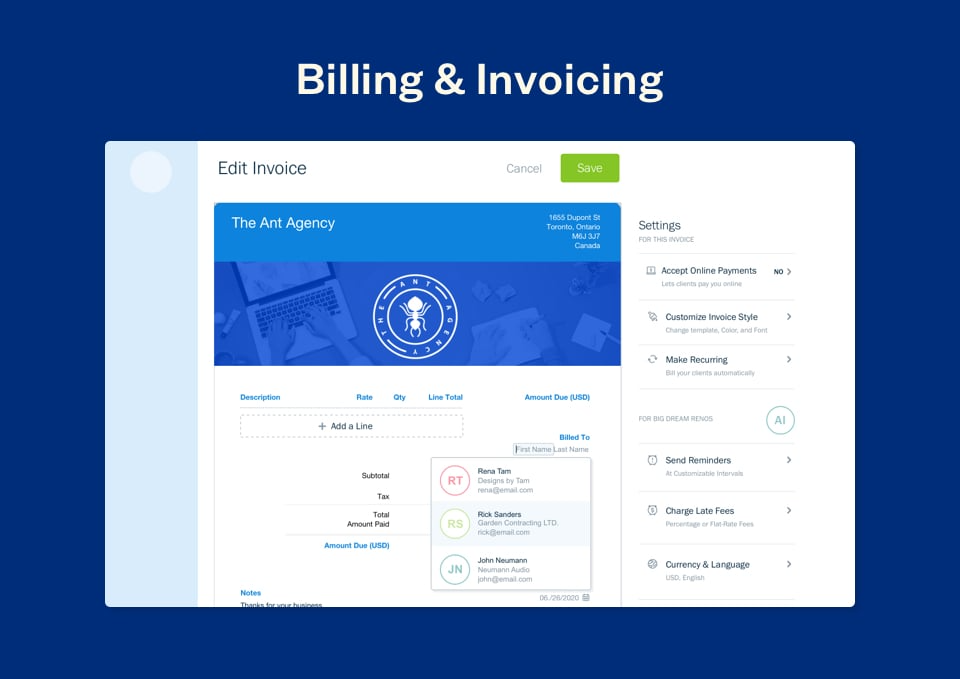
FreshBooks is a popular accounting and invoicing platform ideal for solo attorneys and small law firms.
It’s not designed exclusively for legal professionals, but its intuitive interface and billing features make it a great option for those who need simple, straightforward tools for managing invoices, payments, and expenses.
Source: G2
Key Features
- Expense tracking: Easily log billable hours and categorize firm expenses to keep your finances organized and track costs against budgets.
- Automated invoice reminders: Send friendly reminders to clients automatically to help you get timely payments without the need for manual follow-ups.
- Multi-currency and multi-language support: Perfect for firms with international clients because it offers flexibility in billing for different currencies and languages.
- Secure online payment options: Accept payments via credit cards, ACH transfers, or payment gateways, which makes it easy and convenient for clients to pay invoices.
- Detailed financial reporting: Provides insights into income, expenses, profit margins, and outstanding balances.
Pros
- Easy to use, even for those without accounting experience
- Affordable pricing plans for solo practitioners
Pricing
FreshBooks starts at $6.90 per month, offering a budget-friendly solution for small firms or solo attorneys looking for essential billing and invoicing features like expense tracking and invoices.
6. PointOne
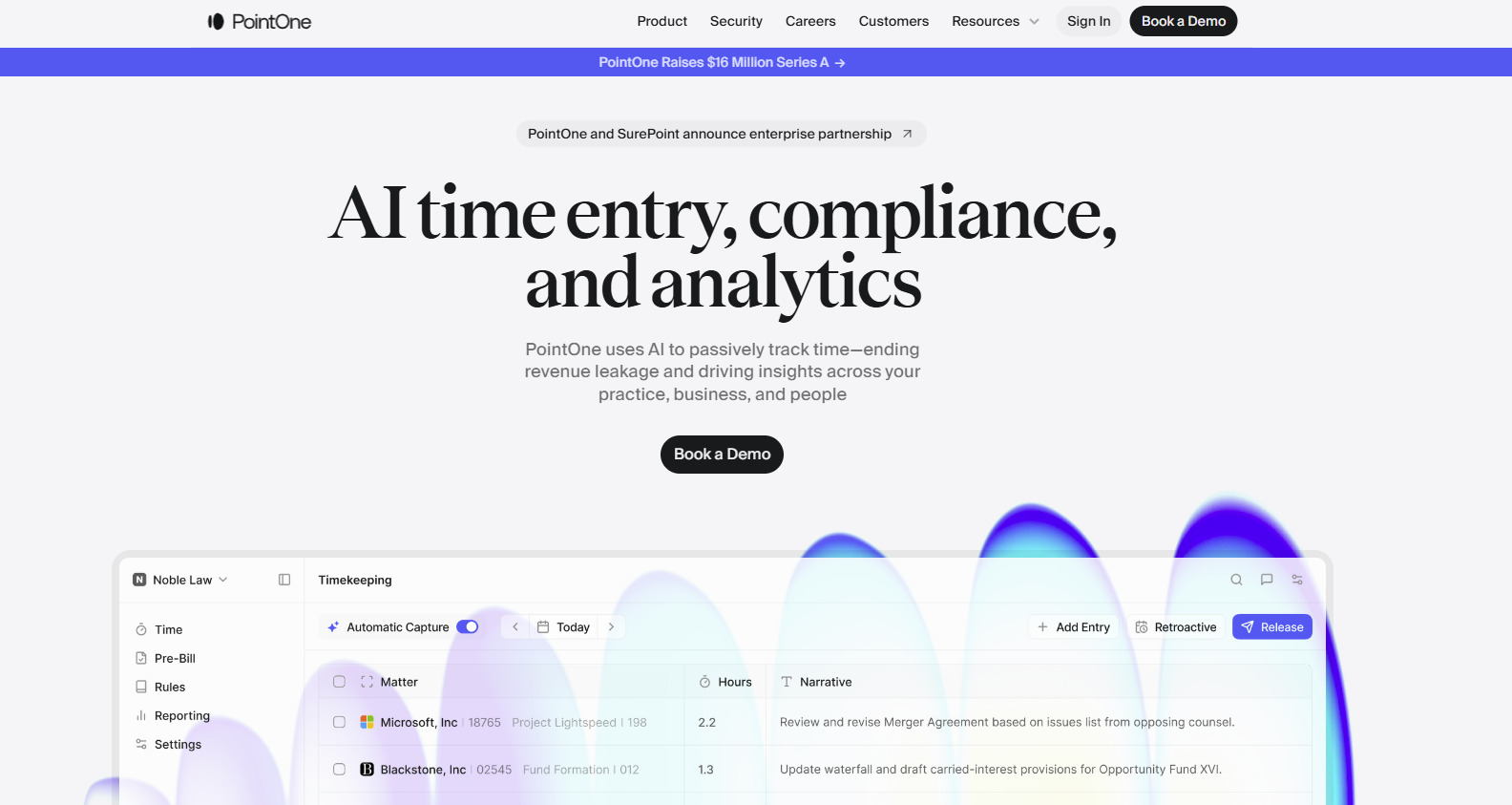
PointOne is an AI-driven platform that automates timekeeping and billing for law firms. Its goal is to optimize efficiency and profitability by reducing administrative burdens and ensuring accurate time capture.
Source: Pointone.com
Key Features
- Automated time tracking: PointOne passively records all work activities, which helps reduce administrative tasks.
- AI-powered pre-bill review: The platform uses artificial intelligence to review pre-bills, suggesting edits to improve bill quality and compliance with client guidelines.
- Integration: PointOne integrates with existing billing software and practice management systems.
- Real-time collaboration: The platform offers features that allow team members to collaborate on billing matters for better alignment and transparency within the firm.
Pros
- Automates time capture, ensuring all billable activities are recorded
- AI-driven reviews help produce precise and compliant bills
- Frees up time by automating timekeeping and billing processes
Pricing
PointOne currently does not have its pricing publicly listed.
7. Billables AI
Billables AI helps lawyers keep up with timekeeping without having to stop and log everything by hand. It tracks work in the background and turns that activity into billable entries with the client, matter, and narrative details already filled in.

Source: Billables.ai
This platform can help when timekeeping tends to happen after the fact. With more of the activity captured as you work, there is less to piece together later and less reliance on memory when reviewing entries.
Key Features
- Automated timekeeping: Tracks workflows automatically while you work and generates billable activity reports.
- AI-generated time entries: Creates entries with clients, matters, and narrative descriptions included.
- Adaptive billing support: Learns from usage over time so the dashboard better matches how you bill.
- User-controlled review: Let users edit or delete billable records before anything is exported or shared.
- Workflow integrations: Connects with tools like email, calendar, docs, calls, Microsoft 365, Teams, Adobe, Chrome, Edge, and Zoom.
Pros
- Helps capture work that often gets missed in manual timekeeping
- Gives lawyers more control over reviewing and editing entries before export
- Strong integration focus for day-to-day legal workflows
- Reduces administrative workload surrounding billing
Pricing
Billables AI does not list public pricing on its website.
How to Choose the Right Legal Billing Software For Your Team
Looking at a list of popular tools can help you narrow things down, but that only tells you so much. Legal billing has its own demands, so the better question is whether a platform fits the way your team bills.
Here are a few things worth checking:
- Customizable billing templates: Your bills should be easy to format around your rates, time entries, and client expectations.
- Client management: It helps when client details, matter information, and payment records are easy to pull up during billing.
- Embedded payment links: Giving clients a direct way to pay from the invoice can make collections a little less drawn out and help improve cash flow.
- Billing history: A full record of invoices, payments, credits, and edits makes it easier to review past activity.
- Document management: Some teams need billing to connect closely with matter files, supporting records, or shared documents.
- Everyday workflow: The system should make billing easier to keep up with and not add more steps to it.
Automate Parts of Your Discovery Process With Briefpoint
Legal billing software helps your firm handle invoices and payments, but it does not do much for the discovery work that takes up so much time behind the scenes.
Briefpoint focuses on that part of the process. It helps with drafting discovery requests and responses, and Autodoc helps move that work into cleaner production-ready documents with Bates stamps and cited materials when needed.
That matters even more once a case starts to shift. Discovery responses rarely stay frozen. New facts come in, answers need updates, and your team ends up revisiting the same sets again.
Briefpoint now supports Supplemental Responses inside the same workflow, so you can create updates for RFPs, RFAs, and interrogatories while keeping prior answers intact and easy to reference.
If client input changes, Bridge can pull that into the process without forcing your team to manage everything outside the platform.
For firms dealing with ongoing discovery across multiple rounds, this can make the work easier to track and easier to update without losing the thread of what came before.
Want to see how it works?
Schedule a demo here and discover how Briefpoint can help your firm work smarter.
Will AI Replace Lawyers? The Future of Legal AI
How Legal Professionals Are Using AI Today
The way people are using AI right now feels pretty practical. It’s showing up most in tasks that take time, involve a lot of reading, or call for a solid first draft before a lawyer steps in to review and refine it.
According to the Thomson Reuters survey, among legal professionals currently using AI tools:
- 77% use it for document review
- 74% use it for legal research
- 74% use it to summarize legal documents
- 59% use it to draft briefs or memos
That tells you a lot about where AI fits. It’s helping legal professionals get through the kind of work that can pile up easily and quickly, especially when there are large sets of legal documents to review or due diligence tasks that need careful attention.
At the same time, none of this takes legal training out of the picture. AI can support legal knowledge work, but lawyers still need to review the output, catch weak spots, and make sure the final result lines up with the facts and the law. More on this later.
What Are AI-Powered Legal Tools?
Legal AI tools are software platforms that use artificial intelligence to take on time-consuming tasks, like the ones mentioned before.
These tools can also help with traditionally tedious tasks like:
- Document automation
- Electronic discovery
- Legal research
- Contract work
- Case pattern recognition
- Compliance checks
- Discovery drafting
- Workflow automation
Most of these systems rely on large language models (LLMs), machine learning (ML), and other data-driven methods to process information at a speed humans can’t match. For example, they can pull out key points, surface relevant documents, and spot patterns across large sets of files.
Advantages of Integrating AI into Legal Workflows
AI legal technology brings a range of practical benefits to everyday legal work, which ultimately gives human attorneys more time and space for strategic thinking and the parts of a case that require experience and judgment.
Here are some of the advantages many law firms see:
- Law firm productivity and efficiency: AI handles repetitive tasks to allow lawyers to focus on strategy, client communication, and complex legal matters.
- Cost reduction: Automating routine administrative work can lower operational costs and help teams use their time more intentionally.
- Fewer human errors: AI law firm tools manage large data sets with consistency to reduce mistakes in documents, timelines, and investigatory work.
- Better information access: AI can surface relevant documents, key terms, and patterns much faster than manual review, which can improve overall legal assistance and help solve more legal challenges.
- Improved turnaround times: Tasks that once took hours can be completed in minutes.
- More consistent workflows: Standardized outputs help teams maintain quality and keep cases moving, even during busy periods.
Potential Risks of Employing AI in Legal Practice
It’s just as important to talk about the drawbacks and limitations of legal AI tools as it is to highlight their benefits. Even with strong capabilities, AI’s ability to support legal work still depends heavily on human judgment and oversight.
Some of the key risks include:
- Data security: Relying on digital platforms introduces vulnerabilities, especially when sensitive client information is involved. Law firms must stay alert to cybersecurity threats and maintain strong protections as the technology evolves.
- Ethical concerns: Questions around confidentiality, privacy, and the lawyer-client relationship remain front and center. AI can process information quickly, but it can’t navigate the human elements of trust or context, which is why human oversight retains the final say.
- Dependence on technology: If teams lean too heavily on legal automation, core skills can weaken over time. AI should assist the work, not replace the professional judgment required for complex decisions.
- Factual accuracy and bias: AI systems can produce confident but incorrect outputs or mirror biases found in training data. Without careful review, errors can slip into important legal documents.
Despite a rapidly evolving legal landscape, these risks remind firms that AI works best as a tool that supports, but never replaces, skilled practitioners.
Will AI Replace Lawyers?
We raised this question at the start, and it’s worth taking a closer look now that we’ve covered both the benefits and the risks of using AI in legal work.
So here’s the big question in plain terms: Will AI actually replace lawyers?
We know that AI can handle a lot of routine tasks, but its strengths stay squarely in the technical side of the job. It doesn’t understand legal principles the way trained lawyers do, and it can’t do human things like:
- Apply judgment
- Weigh competing interests
- Navigate sensitive client situations
- Deliver client service
- Exercise ethical reasoning
- Give client counsel
- Tailor advice to the facts
In other words, the practice of law often depends on interpreting gray areas, building trust, and making decisions that blend logic with human insight. That’s not something software can step into.
So, while AI changes how legal work gets done, it doesn’t replace the need for human lawyers. It offers support, speeds up repetitive tasks, and gives attorneys more room to focus on strategy and client needs.
Why AI Will Not Replace Lawyers
Since we’ve now looked at the broader question, it’s time to break down the specific reasons AI won’t replace lawyers.
There are just some jobs AI cannot and should not take over, and the law falls squarely into that category. The practice of law is built on human expertise, professional conduct, and judgment shaped through years of education, real cases, and work with clients.
Here are some key areas where AI falls short:
Complex Reasoning and Judgment
AI can review legal documents, analyze patterns, and pull out useful information, but it still cannot understand context or apply legal principles the way an experienced lawyer can.
Lawyers draw on legal training, case law, and real-world experience to interpret gray areas, deal with conflicting precedents, and form legal opinions that fit the facts in front of them.
Judgment matters in ways software cannot replicate. Even as AI becomes more useful in legal work, it does not eliminate lawyers because it cannot think through nuance, responsibility, and consequence the way people can.
Emotional Intelligence
Clients often need more than information. They need reassurance, clarity, and someone who understands the human side of their situation. That is especially true in legal contexts where people may be dealing with stress, uncertainty, or life-changing decisions.
For example, a client going through a divorce or facing a wrongful termination claim may not only want answers. They may also need calm guidance, honest client counsel, and a lawyer who knows how to explain the next step with care.
Empathy, communication, and trust-building are essential in the legal field, and they sit well outside AI’s capabilities.
Adaptability
Legal matters tend to shift quickly. Facts change, negotiations evolve, and unexpected issues surface without warning. Lawyers adapt on the fly and adjust strategy based on judgment and experience. AI can support the process, but it can’t handle that level of flexibility.
For example, a case may look straightforward at first, then take a turn after a witness changes their statement, new records come to light, or a late ruling from a court affects the next step. A lawyer can adjust legal representation based on those changes and respond in real time.
The same goes for larger shifts in the law. When a Supreme Court decision changes the legal landscape, lawyers have to interpret what that ruling means for current matters, future arguments, and client strategy.
Ethical Responsibility and Accountability
Lawyers are still the ones who answer for the work. Even if AI helps draft legal language or sort information, it cannot take on professional responsibility.
Legal work involves duties tied to judgment, disclosure, and client protection. A lawyer has to decide what is sound, what needs revision, and what should never move forward. AI focuses on generating a response. It does not understand professional duty or the weight attached to a legal decision.
That also affects the conversation around access to justice. AI may help more people get quicker access to information, which can be useful. But when a legal issue carries real consequences, someone still has to make the call and stand behind it.
Integrating Artificial Intelligence Into the Practice of Law
For law firms and professionals, the key is not to resist AI but to embrace it strategically. Integration can take several forms:
Augmentation
In most firms, AI-powered tools fit best as extra support. They help legal teams get through the parts of the legal process that tend to eat up time.
The real value shows up in the day-to-day tasks you already know well. For instance, AI can scan long contracts, organize discovery documents, draft simple sections of a document, or highlight language that might need your attention.
That leaves you with more room to focus on strategy, client guidance, and the legal issues that call for real judgment.
Education and Training
As AI becomes a bigger part of legal work, it helps to make sure you and your team feel confident using these tools. Understanding how generative AI works, how it relies on training data, and where it needs human judgment makes everyday use much smoother.
Most firms find it useful to offer practical, hands-on learning, such as:
- Short workshops that walk you through AI chatbots and legal drafting tools
- Clear guides on how generative AI processes information
- Training for young lawyers and law students preparing to enter AI-ready workplaces
- Regular refreshers when new features or tools roll out
Keep in mind that the goal is to help you get comfortable with what these tools do well and where they need your supervision. When you know how to review AI output, ask the right questions, and apply your legal expertise on top of it, the tools become genuinely useful.
Strong training makes AI adoption feel less like a leap and more like a natural part of your legal workflows.
Ethical Guidelines
Using AI in legal practice brings real advantages, but it also introduces important questions you can’t afford to ignore.
Anytime an AI model touches client data or influences part of your workflow, you’re operating within the ethical standards that keep the legal system trustworthy.
Clear guidelines help your legal operations stay aligned with privacy rules, professional responsibility, and the expectations clients have when they seek legal services.
Many firms look to well-known frameworks like the OECD AI Principles or the NIST AI Risk Management Framework as a starting point. You don’t have to follow them word-for-word, but they offer helpful guidance on fairness, transparency, and accountability.
When building or updating your own guidelines, it’s worth covering areas such as:
- Client confidentiality and data handling: How the AI model stores and processes sensitive information.
- Accuracy and verification: A requirement that humans review AI-generated content before it’s used in any legal matter.
- Bias and fairness: Steps for monitoring and reducing unfair outcomes in search, drafting, or analysis.
- Transparency with clients: When and how you disclose that AI tools are being used as part of your legal services.
Clear ethical standards give your team confidence and protect both you and your clients as AI tools become more common in everyday legal work.
The Practical Value Briefpoint Brings to Your Cases
AI can be helpful in legal practice, but the real value shows up when a tool cuts out the busywork without disrupting the way your team already operates.
Briefpoint focuses on that goal by giving litigation teams a faster, more reliable way to handle discovery from start to finish.
Briefpoint helps you propound and respond to discovery in minutes. Autodoc moves things even faster by turning your productions and case files into ready-to-serve discovery responses.
You upload the complaint, the RFPs, and the materials. Autodoc finds the responsive documents, prepares a Word response with objections, answers, and Bates citations, and builds a complete production package that is ready to serve.
Firms using Autodoc routinely save 30–40 hours per matter because they skip the slowest steps of discovery. No setup is required, and nothing you upload is used to train any model.
You keep full control, and you get consistent, defensible documents while freeing lawyers from non-billable work.
If your team wants a faster and more predictable way to handle discovery, Briefpoint is built for exactly that kind of everyday workload.
Interrogatories vs. Deposition: What Sets Them Apart
What Are Interrogatories?
Interrogatories are written questions one side sends to the other during the discovery process. The other side has to answer them in writing and under oath, which means those answers become part of the formal record in the case.
You’ll usually see them early in the discovery phase, when both sides are trying to pin down the facts, understand each other’s position, and get a clearer sense of what the case involves. They can ask about key elements like:
- People
- Events
- Damages
- Documents
- The basis for certain claims and defenses
Compared with a deposition, interrogatories give the other side time to prepare careful written responses. That can make them useful for getting straightforward background information, even if they are not always the best tool for digging deeper.
In many legal proceedings, they are one of the first steps toward building stronger interrogatory responses and a more organized case strategy.
What Is a Deposition?
A deposition is a formal interview that takes place outside the courtroom during discovery. One attorney asks questions, the witness answers under oath, and a court reporter records everything. This oral examination gives both sides a chance to explore the facts in real time.
Unlike interrogatories, oral depositions allow follow-up questions on the spot. They are useful when you need to test someone’s memory, clarify vague statements, or gather essential information that may not come out fully in written answers.
The back-and-forth can also lead to more candid answers, especially when a witness has to respond immediately.
A written deposition also exists, but it is much less common. In most cases, when people talk about a deposition, they mean live questioning with attorneys present.
Interrogatories vs. Deposition: What Are the Key Differences
Interrogatories and depositions both help you gather information during discovery, but they do it in very different ways.
Here’s how they compare:
Format
The format is one of the biggest differences between the two.
With interrogatories, the other party sends a list of written questions, and the responding party answers them in writing.
The process usually gives your side time to review the questions, gather facts, and craft answers carefully before serving them. When answering interrogatories, attorneys often help shape the wording, raise discovery objections, and make sure the responses line up with the case strategy.
A deposition works very differently. It usually happens in person, though remote depositions are common as well.
A lawyer asks questions out loud, and the witness answers in real time under oath. That answer becomes sworn testimony, and a court official, such as a court reporter, creates the record.
The difference in format can shape the entire exchange. Interrogatories are slower and more controlled. Depositions are more immediate, which leaves less room to pause and refine an answer. Both still have to follow the same basic legal standards that govern discovery.
Flexibility
With written interrogatories, one party sends a fixed set of questions, and the other side responds in writing. If an answer feels vague or incomplete, you usually cannot push further in that same moment. You may need another round of discovery to clear things up, which can slow things down.
A deposition is much more flexible. You can ask deposition questions in real time, follow up right away, and change direction based on what the witness says.
That makes it easier to dig into unclear statements, test someone’s version of events, and uncover relevant information that may not show up in a carefully prepared written response.
You also get a verbatim transcript of the exchange, which can be useful later if the witness changes their story or gives a different version of the facts. So, the live back-and-forth gives depositions an edge when you need detail or a better sense of how someone responds under pressure.
Time and Cost
Interrogatories usually take less time and cost less than a deposition. In many cases, drafting and answering one set may take a few attorney hours, though bigger cases can take longer.
For a simple estimate, firms may spend a few hundred to a few thousand dollars on a set of interrogatories, depending on how many questions are involved and how much review the answers need.
Depositions usually require more time and a bigger budget. A single deposition can involve several hours of prep, a half day or a full day of questioning, and additional time to review the transcript later.
Court reporter fees, transcript costs, attorney prep, and attendance all add up. A straightforward deposition may cost a few thousand dollars, while longer or more complex depositions can climb well beyond that.
Interrogatories work well when you want basic facts at a lower cost. Depositions make more sense when the case calls for deeper answers, follow-up questions, or testimony you may want to use later.
Depth of Information
Interrogatories and depositions can both uncover useful facts, but they usually give you different levels of detail.
Interrogatories generally offer a more limited view. The questions are submitted in writing, and the answers are usually reviewed carefully before they are served.
You might get solid background facts on relevant topics, such as the names of witnesses, the date of an incident, the injuries being claimed, or the documents a party plans to rely on.
For example, one answer may identify everyone present at a car accident or list the medical providers involved after the crash.
Depositions usually go further. Lawyers can ask follow-up questions right away, press for clarification, and explore weak spots in a witness’s answer. That ability gives opposing sides a chance to hear how a person explains events in real time.
For example, a witness may list a conversation in an interrogatory response, but during a deposition, the lawyer can ask what was said, who was in the room, how certain the witness is, and why the story changed.
Who Responds
The answer depends on which discovery tool you’re using.
With interrogatories, the responding party is usually one of the parties in the case. In most situations, you are asking a plaintiff or defendant to provide written answers under oath.
For instance, in a business dispute, a company may answer through a representative with access to the necessary information. The same general rule applies under civil procedure in many jurisdictions.
With depositions, the pool is much wider. Depositions and interrogatories serve different purposes, so the people involved can look very different, too. A deposition can be taken from someone directly involved in the lawsuit or from someone who simply has useful testimony.
Examples of who may respond:
- Plaintiff
- Defendant
- Corporate representative
- Eyewitness
- Treating physician
- Expert witness
- Investigating officer
- Employee with relevant knowledge
In a civil trial, for example, depositions often help you hear directly from the people who may later testify.
Interrogatories are narrower and usually stay with the parties themselves. Because the rules can vary, many firms rely on experienced attorneys to decide who to question and which tool makes the most sense.
When Should You Use Interrogatories?
Interrogatories are a good fit when you want written answers from the opposing party early in civil litigation. They can help you pin down basic facts, narrow the disputed issues, and build a clearer record before moving on to depositions or other discovery.
Here are some common situations where interrogatories make sense:
- Early case investigation: Interrogatories can help you determine what the other side is claiming, denying, or relying on at the start of the case.
- Basic factual information: They work well for getting names, dates, documents, damages, and other core details in writing.
- Issue narrowing: Written answers can show which facts are actually disputed and which points may not need as much attention later.
- Case strategy and planning: A smart strategic use of interrogatories can help you spot weak points, test legal theories, and prepare for the next stage of discovery.
- Budget-conscious discovery: Interrogatories usually cost less than depositions, so they are often a practical first step when you need useful information without a larger expense.
When Should You Use a Deposition?
A deposition makes sense when written discovery will not give you enough detail. For instance, live questioning can help you dig deeper and gather comprehensive information that may be harder to get through interrogatories alone.
A deposition is usually needed in these situations:
- Credibility is a major issue: A deposition lets you hear how a witness answers under pressure, which can reveal hesitation, inconsistency, or uncertainty in a way written answers cannot.
- Follow-up questions will likely matter: Interrogatories may produce careful or thoughtful responses, but a deposition gives you room to press for clarification right away.
- Witness demeanor could affect the case: Tone, pause, confidence, and body language can shape how testimony comes across, especially when the facts are disputed.
- You need testimony tied closely to the evidence: Depositions are useful when you want a witness to explain documents, timelines, photos, emails, or other evidence in detail.
- You may need stronger testimony for later use: Under the Federal Rules, deposition testimony can play an important role in motion practice, impeachment, or preserving testimony for a subsequent deposition or trial strategy.
What Civil Procedure Says About Interrogatories and Depositions
The Federal Rules of Civil Procedure place both interrogatories and depositions within the broader discovery process.
Rule 26 sets the general scope of discovery, Rule 33 covers interrogatories to parties, and Rule 30 covers depositions by oral examination.
A few points make the structure easier to follow:
- Rule 26: Sets the overall scope and limits of discovery, including relevance and proportionality.
- Rule 33: Covers interrogatories, which are written questions served on parties and answered in writing under oath.
- Rule 30: Covers depositions by oral examination, where a witness gives live, sworn testimony and an officer records the answers verbatim.
The federal rules also set default limits on each tool:
- Interrogatories: Usually capped at 25, including discrete subparts, unless the court orders otherwise.
- Depositions: Usually capped at 10 per side, with a default limit of 1 day of 7 hours for each deposition, unless the court changes that limit.
Take note that this is just a general overview rather than a one-size-fits-all rule for every case. State civil procedure rules can differ, sometimes in significant ways, so you should treat this section as a federal baseline.
How Briefpoint Helps With Interrogatories and Discovery Drafting
Interrogatories offer a useful way to gather facts, but drafting responses, reviewing objections, and matching answers to relevant documents can get time-consuming.
Briefpoint is built for that part of litigation work. It helps law firms draft discovery requests and responses for interrogatories, RFAs, and RFPs much faster, with objection-aware drafting and workflows built for civil cases.
Autodoc adds another layer when document-heavy discovery is involved.
You can upload the complaint, RFPs, and case files, then use AutoDoc to find responsive materials, organize them, and generate a Bates-numbered production with a Word response that includes page-level Bates citations. That can save a huge amount of manual review and drafting time.
Briefpoint also supports Supplemental Responses, so you can create updated responses for interrogatories, RFAs, and RFPs while keeping earlier answers intact and easy to reference.
Want to see all these features in action?
21 Must-Have Apps for Lawyers in 2026
What Are Legal Apps?
Every industry has its core tools. Designers rely on creative software. Accountants use financial platforms. Sales teams live inside CRMs. Lawyers have their own category of apps built around the structure and pressure of legal work.
Legal apps are software tools shaped by how a law practice actually operates. They account for deadlines that carry real consequences, detailed documentation requirements, and the need for organized task management under constant time constraints.
While many industries focus on speed and volume, legal work demands accuracy, traceability, and controlled workflows.
As mentioned, some legal apps are purpose-built for firms. Others come from broader productivity categories and adapt well to legal environments.
What separates them from generic business tools is how they support work productivity without disrupting professional standards or compliance needs.
How Can These Apps Benefit Law Firms and Legal Professionals?
You already know where most of your time goes. It’s not always the hard legal questions. Often, it’s the follow-ups, the tracking, and the small administrative tasks that sit between you and the actual work.
Legal apps are there to help clean that up. Essentially, they give your day more structure, so you’re not relying on memory or scattered systems to keep things moving.
When work is organized properly, you don’t have to think twice about what’s next or where something lives.
Here’s what that can look like:
- Fewer administrative tasks: Routine steps take less effort, which frees up mental space.
- Better control over important documents: Files stay connected to the right matters and are easier to locate.
- Real-time collaboration: Your team sees updates as they happen and stays aligned.
- Clearer coordination in larger firms: Responsibilities and workloads are more visible.
- Artificial intelligence support: Legal drafting and review move faster while you stay in charge.
- Stronger work productivity overall: Less friction means more consistent progress.
21 Best Apps For Lawyers
There are tons of tools out there, but not all of them are built with lawyers in mind. We’ve rounded up some of the most useful apps (both legal-specific and general productivity tools) that actually make a difference in your day-to-day work:
1. Briefpoint

Discovery has a way of taking over your calendar. One large set of RFPs can eat up days, especially when court dates are tight, and your team is already stretched. Briefpoint was built for that exact pressure in the legal world.
It’s an AI-powered discovery platform that helps you propound and respond to requests for production, requests for admission, and interrogatories in a fraction of the usual time.
With its Autodoc feature, you can upload a complaint, RFPs, and production files, then generate captioned Word responses with page-level Bates citations in minutes. What used to take 30–40 hours can now take minutes.
Briefpoint works for both small firms and larger litigation teams. The user-friendly interface means there’s no heavy setup, and it integrates with tools like Clio, Smokeball, and MyCase. It’s SOC 2 Type II certified, HIPAA compliant, and available in all 50 states and federal courts.
More than 1,500 law firms use Briefpoint, with an average 4.9 satisfaction rating. Plus, attorneys regularly report saving 30+ hours per case.
Key Features
- Propound discovery from complaints: Generate up to 70 targeted, objection-aware requests in minutes.
- AI-assisted response drafting: Apply consistent objections and draft answers quickly.
- Autodoc production packages: Create Bates-numbered productions with cited Word responses.
- Client response collection portal: Send plain-English questions and receive Word-ready drafts.
- Security and compliance: SOC 2 certified, HIPAA compliant, encrypted data.
Want to learn how Briefpoint can fit into your workflow? Book a demo today!
2. Evernote
Evernote is a simple note-taking app that helps you keep everything in one place, such as case notes, client information, meeting summaries, to-do lists, and even voice memos.
You can tag, search, and organize your notes into notebooks, which helps make it easy to find what you need fast.

Source: Evernote.com
Key Features
- Cross-device syncing: Access your notes from desktop, tablet, or phone without losing updates.
- Flexible note formats: Create text notes, attach images, or record audio in one place.
- Organized notebooks and tags: Sort information in a way that fits your workflow.
- Powerful search: Quickly locate saved notes using keywords and filters.
3. Clio
Clio is a case management platform designed specifically for the legal world. It brings your files, legal billing, scheduling, and client communication into one system so your practice runs with fewer moving parts.
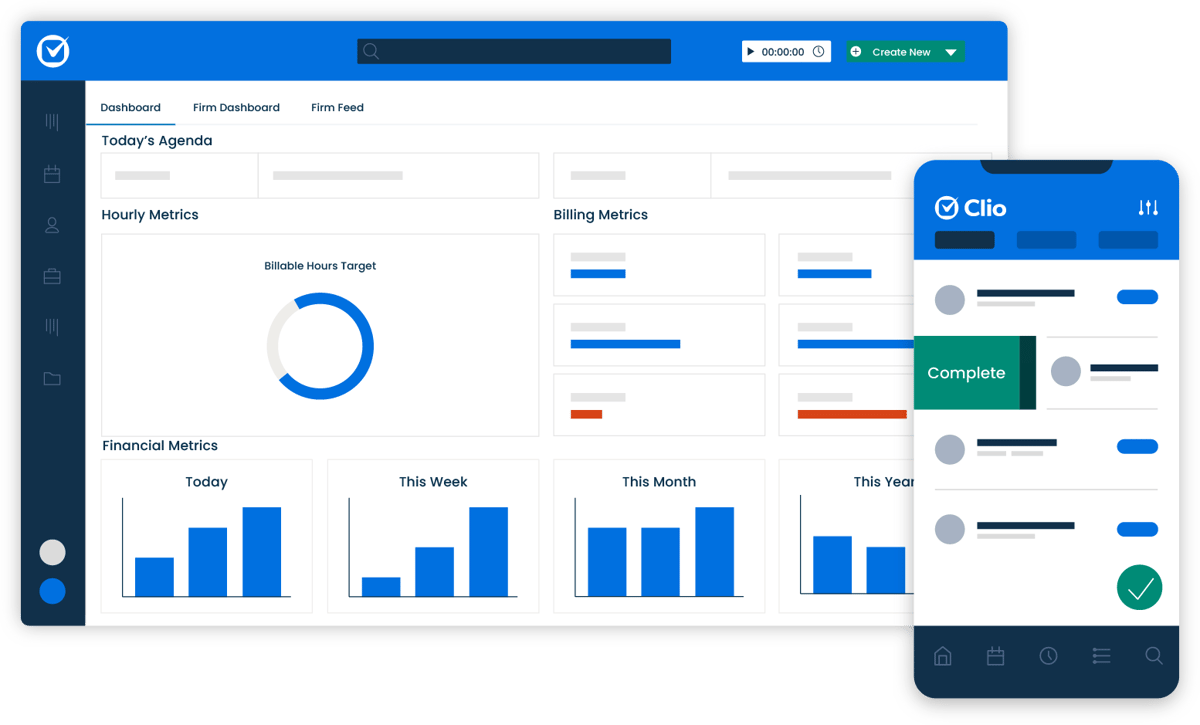
Source: G2
It works well for solo attorneys and growing firms alike, especially if you want clearer visibility into deadlines, workloads, and client messages without relying on disconnected tools.
Its built-in calendar app, billing tools, and matter tracking features help boost productivity by keeping everything tied to the right case.
Key Features
- Centralized case management: Organize matters, contacts, and documents from a single dashboard.
- Integrated calendar app: Track court dates, meetings, and deadlines alongside your cases.
- Billing and time tracking: Log hours and generate invoices directly within the platform.
- Secure client portal: Share files and client messages in a protected environment.
- Wide integrations: Connect with tools like Outlook, Zoom, and Dropbox for smoother workflows.
4. OneDrive
OneDrive is Microsoft’s cloud solution and a practical choice for lawyers who already work inside the Microsoft ecosystem.
It keeps case files and other files stored in one secure location while allowing you to open, edit, and share the same document without worrying about version confusion.
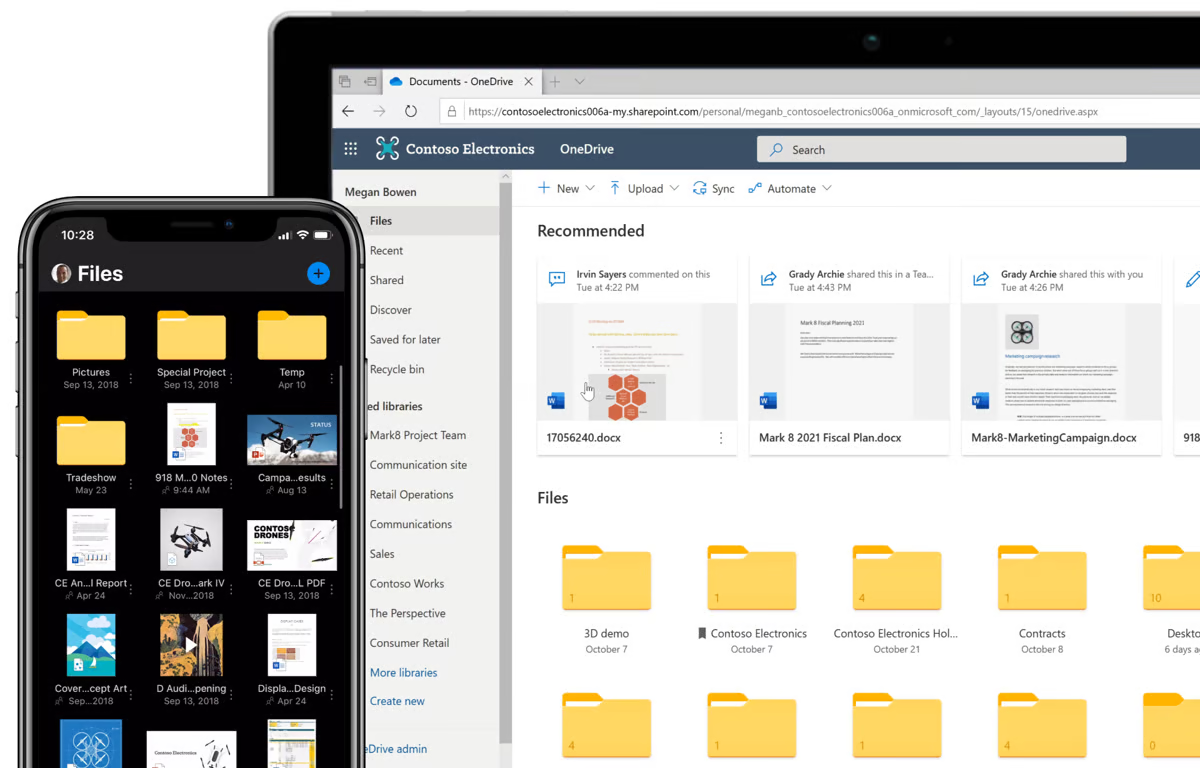
Source: G2
Because it connects directly with Word, Excel, and Outlook, your files stay synced automatically. That makes it easier to collaborate, store drafts, and keep everything backed up. There’s also a free plan available, which can work well for smaller practices getting started.
Key Features
- Cloud storage with automatic syncing: Keep case files and other files updated across devices.
- Real-time access to the same document: Collaborate without creating duplicate versions.
- Microsoft Office integration: Open and edit files directly in Word, Excel, and Outlook.
- Flexible sharing controls: Grant access to clients or colleagues with permission settings.
- Cross-device availability: Access files from desktop, tablet, or mobile phones.
5. Google Docs
Google Docs is a simplistic tool, but that’s part of what makes it so useful. It’s quick to open, easy to use, and perfect for drafting documents with other lawyers or clients. You can leave comments, track changes, and never worry about hitting “save.”
Source: Docs.Google.com
Key Features
- Real-time editing and collaboration: Work on the same document simultaneously with comments and suggestions.
- Automatic saving to Google Drive: Changes are saved instantly without manual backups.
- Flexible sharing controls: Set viewing, commenting, or editing permissions for each user.
- Cross-device access: Open and edit documents from desktop, tablet, or mobile devices.
6. Clockify
Clockify is a simple time-tracking app that helps you log billable hours without much setup. It’s great for solo lawyers or small teams who want something quick and easy. You can track time by client, case, or task and generate clean reports when it’s time to bill.
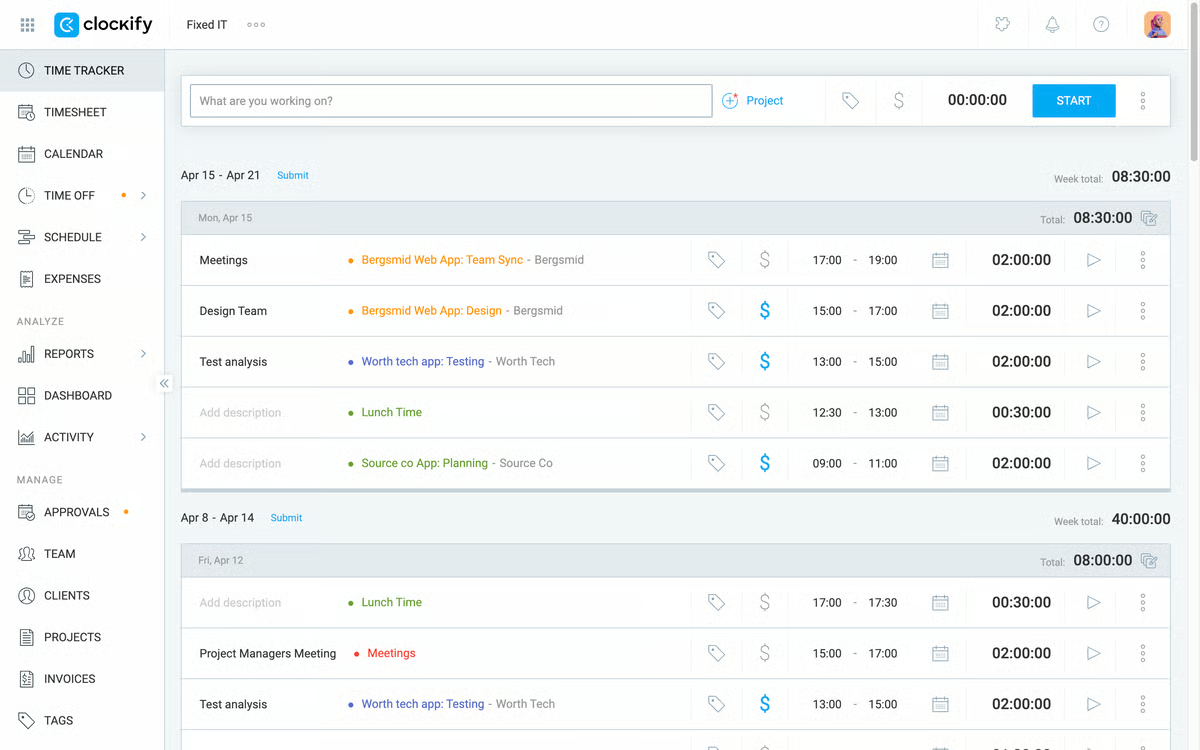
Source: G2
That said, it may be too simple for larger law firms that need more advanced billing features or deep integrations.
Key Features
- One-click timer and manual entry: Start tracking instantly or log hours after the fact.
- Client and case tagging: Assign time entries to specific matters or tasks.
- Detailed reporting tools: Generate summaries for billing and internal review.
- Multi-platform access: Use on web, desktop, or mobile devices.
7. Adobe Reader
Adobe Reader is a must-have since many legal documents come in PDF form. It allows quick viewing, highlighting, commenting, and signing without printing anything.
Source: G2
Legal professionals can easily review and send legal documents while keeping everything digital and organized.
Key Features
- PDF viewing and annotation: Highlight, comment, and mark up documents directly within the file.
- Form filling and e-signatures: Complete and sign PDF forms without printing.
- Cross-device compatibility: Access and review files on desktop or mobile.
- Adobe ecosystem integration: Connect with other Adobe tools for editing and document workflows.
8. Grammarly
Grammarly helps catch grammar errors, awkward phrasing, and tone issues before anything is sent out. In the legal industry, clear writing matters, and this tool makes it easier to get things right the first time.
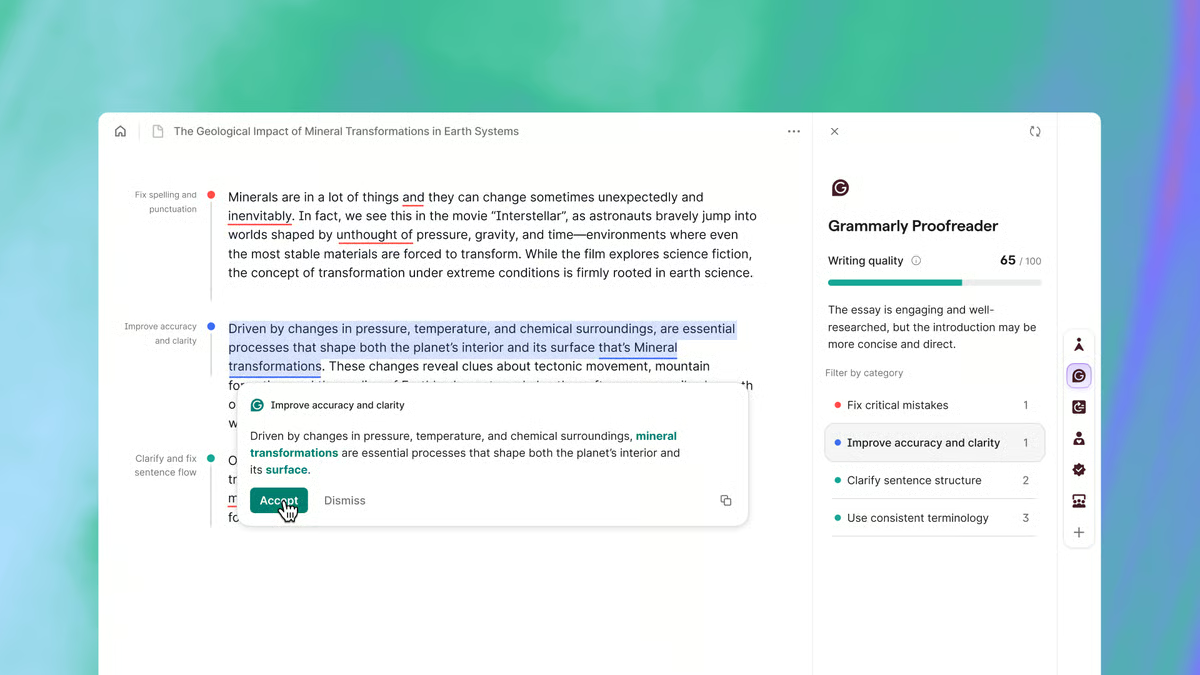
Source: G2
Plus, it works in email, documents, and even web browsers, which helps improve productivity across the board.
Key Features
- Real-time grammar and spell check: Identify errors as you write.
- Tone and clarity feedback: Adjust phrasing to match a professional voice.
- Cross-platform support: Works in Google Docs, email, and browser-based tools.
- Custom writing settings: Set preferences for formal or firm-specific standards.
9. Dropbox
Dropbox is a reliable file storage app widely used in the legal profession for sharing and organizing documents. It offers free storage to get started and makes accessing files from any device simple.

Source: G2
It integrates smoothly with common workplace tools, so it can fit into your existing setup without requiring major changes.
Key Features
- Cloud storage with device syncing: Keep files updated across desktop, mobile, and web.
- Secure file sharing: Control access with customizable permission settings.
- App integrations: Connect with tools like Slack, Zoom, and Microsoft Office.
- Anywhere access: Open and manage documents from multiple devices.
10. Zapier
Zapier is a great tool for busy lawyers who want to cut down on repetitive tasks. It connects different apps and lets them work together automatically.
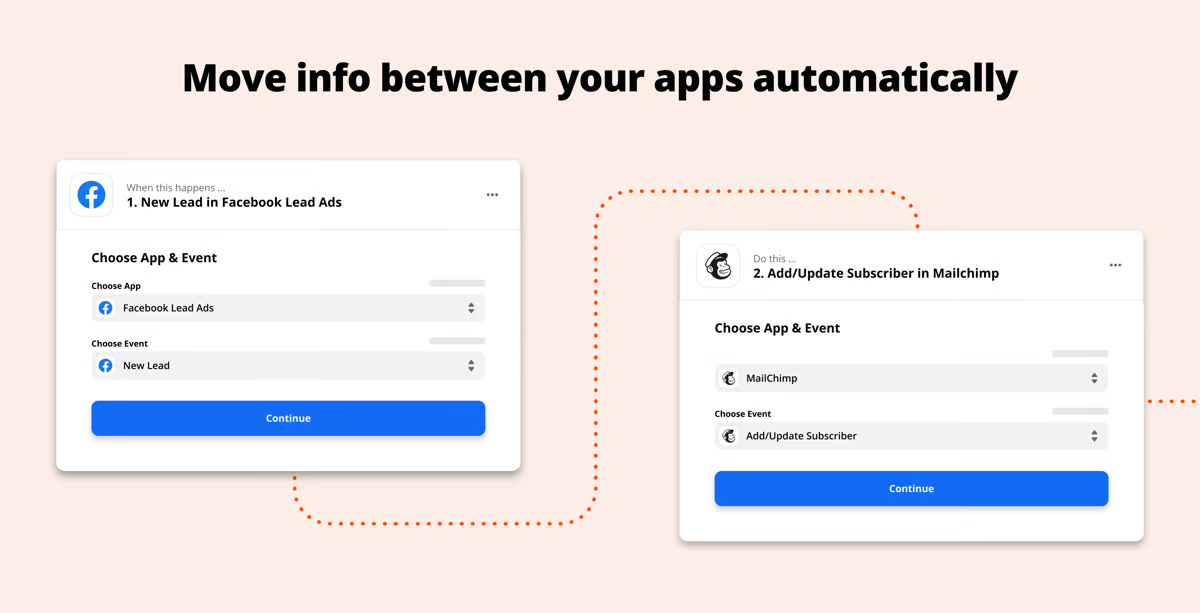
Source: G2
For example, you can set it up so that every time you receive a signed document in Dropbox, it gets copied to a case folder in Google Drive, and you get an email alert without doing anything manually.
By setting up these “Zaps” (which are basically if-this-then-that rules), you can streamline legal workflows and save a lot of time. It also works with thousands of apps, so chances are it fits right into how you already work.
Key Features
- App-to-app automation: Connect tools like Gmail, Google Docs, Clio, and Dropbox to run tasks automatically.
- No-code setup: Create workflows using simple trigger-and-action rules.
- Custom workflow rules: Automate document routing, alerts, and status updates.
- Wide app compatibility: Integrates with thousands of business and productivity platforms.
11. Slack
Slack is a messaging app that helps legal teams communicate quickly and easily. You can set up channels for different cases or departments and keep all your conversations organized. It’s easy to share files, ask quick questions, and get real-time updates.

Source: G2
Key Features
- Channel-based messaging: Organize conversations by case, team, or topic.
- Direct messaging: Communicate privately with colleagues when needed.
- Searchable message history: Quickly find past discussions and shared files.
- Cross-device access: Use on desktop and mobile without losing updates.
- App integrations: Connect with tools like Google Drive, Zoom, and Calendly.
12. QuickBooks Online
QuickBooks Online is a cloud-based accounting platform that many law firms use to manage their finances in one place.

Source: G2
It covers billing, expense tracking, reporting, and payment processing without requiring a complicated setup. The layout has a simple interface, which makes it easier to navigate even if accounting isn’t your focus.
It works well for solo attorneys and small to mid-sized firms that want clearer visibility into revenue, outstanding invoices, and overall cash flow. You can attach detailed notes to transactions, categorize expenses, and connect your bank accounts for automatic updates.
Key Features
- Invoicing and online payments: Send invoices and accept online payments directly from clients.
- Integrated payment processing: Manage credit card and ACH transactions within the platform.
- Time tracking tools: Log billable hours and convert them into invoices.
- Expense tracking with detailed notes: Attach receipts and add context to each transaction.
- Set reminders: Automate payment reminders to reduce follow-ups.
- Mobile access and digital wallet support: Monitor finances and track payments on the go.
13. Toggl Track
Toggl Track is a time-tracking app built for professionals who want clarity without a complicated setup.
It’s especially helpful if you’re balancing multiple clients, matters, or internal tasks and want a cleaner picture of how your hours break down.
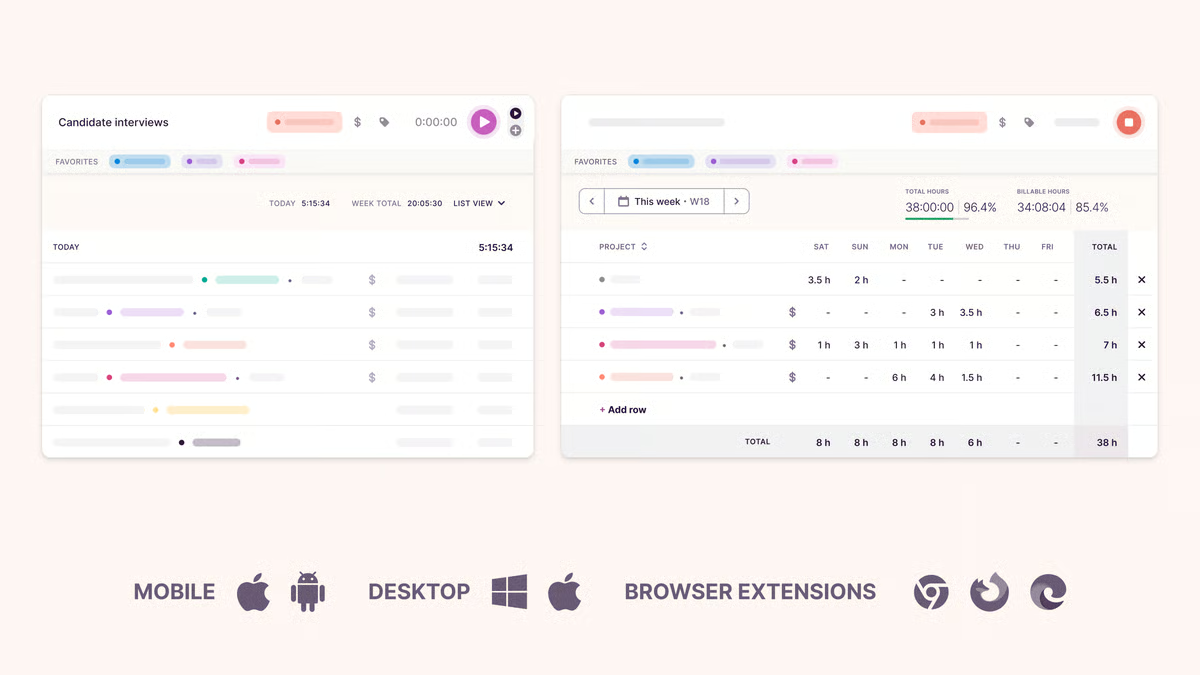
Source: G2
The layout is also straightforward, so logging time doesn’t feel like another chore at the end of the day.
Key Features
- One-click timers and manual entry: Start tracking instantly or log time after completing a task.
- Client and matter tagging: Assign hours to specific cases or projects for better organization.
- Clear reporting tools: Generate easy-to-read summaries of billable and non-billable time.
- Multi-platform support: Available on desktop, mobile, and browser extensions.
14. Zoom
Zoom has become a standard meeting platform for many professionals, including those in the legal world.
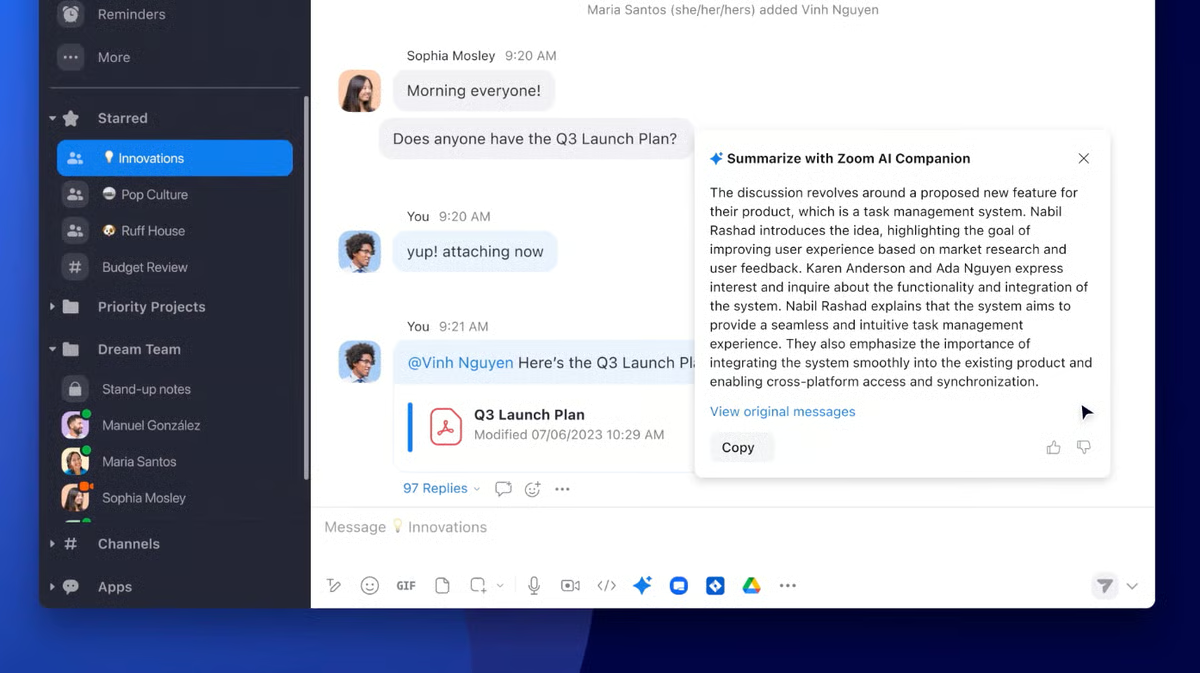
Source: G2
It supports virtual client meetings, internal team discussions, and remote appearances when needed. The setup is straightforward, and joining a meeting typically takes only a link and a few clicks.
It works reliably across devices, which makes it practical for firms coordinating across offices or time zones.
Key Features
- High-quality video and audio: Stable calls for client meetings and team discussions.
- Built-in scheduling tools: Coordinate meetings with calendar and time zone support.
- Screen sharing and recording: Present documents and save sessions when needed.
- Cross-platform access: Available on desktop and mobile devices.
15. Otter.ai
Otter.ai is a transcription tool that turns spoken conversations into searchable text. It’s useful for lawyers who want a written record of meetings, phone calls, or other audio recordings without taking manual notes the entire time.
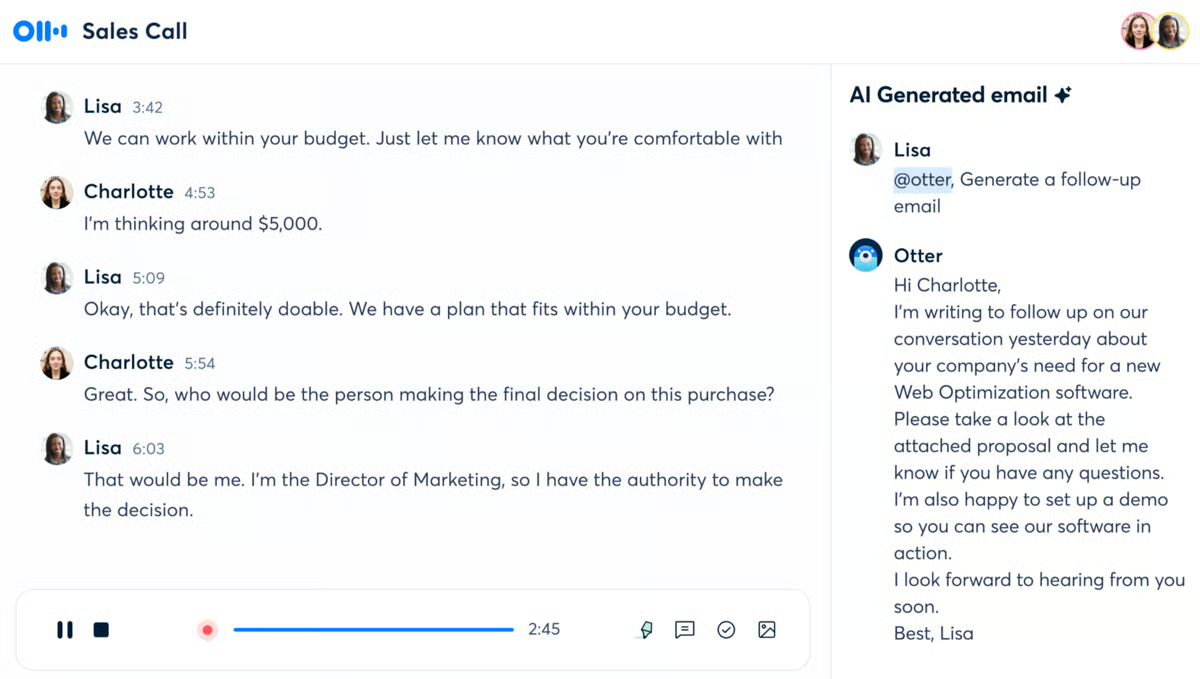
Source: G2
You can record directly inside the app or upload existing audio files, and the transcript appears within minutes. The interface is straightforward, which makes it extremely easy to review conversations, highlight key sections, and share notes with your team.
It works well for internal meetings, client discussions, and strategy sessions where capturing details matters.
Many users consider it a great app for organizing spoken information in a way that’s actually usable later.
Key Features
- Automatic transcription: Convert phone calls and audio recordings into searchable text.
- Live recording and uploads: Record in-app or import existing audio files.
- Searchable transcripts: Find keywords quickly within long conversations.
- Collaboration tools: Highlight, comment, and share transcripts with your team.
- Cross-device access: Use on desktop or mobile devices.
16. Feedly
Feedly is a smart news reader that helps lawyers stay updated on legal trends, case law, and industry news, all in one place. You can follow blogs, court updates, news sites, and even YouTube channels, then read them in a clean, organized feed.
Source: Feedly.com
It’s a great way to cut down on time spent checking multiple websites. Feedly also lets you group your sources into categories, so you can quickly scan updates on specific topics like litigation, privacy law, or tech news whenever you have a free minute.
Key Features
- Custom news feeds: Follow legal blogs, court updates, and industry sources in one place.
- Organized categories: Group content by topic for easier scanning.
- Clean reading interface: View articles in a distraction-free layout.
- Web and mobile access: Check updates from desktop or mobile devices.
- Sharing and saving tools: Send articles to your team or bookmark for later reference.
17. LastPass
LastPass is a secure password manager that helps legal professionals keep their login information safe and organized.
Source: G2
Instead of writing down passwords or reusing the same ones, you can store them all in one secure vault. Just remember one master password, and LastPass handles the rest.
It’s a smart way to protect sensitive client data and save time when jumping between tools.
Key Features
- Secure password vault: Store and autofill login credentials across websites and apps.
- Password generator: Create strong, unique passwords for each account.
- Secure sharing options: Share credentials safely within your team.
- Cross-platform support: Works on browsers, desktop applications, and mobile devices.
18. Calendly
Calendly takes the back-and-forth out of scheduling by letting others book time with you based on your availability. It’s a good app for lawyers managing client meetings, and it’s also a good tool for law students coordinating study groups or interviews.
Source: G2
The app works smoothly on desktop, iOS, and Android devices, which makes it easy to manage your schedule from anywhere.
Key Features
- Self-service scheduling: Allow clients and colleagues to book meetings based on your availability.
- Automated reminders: Send calendar invites and email confirmations automatically.
- Calendar integrations: Sync with Google Calendar, Outlook, and Zoom.
- Cross-device access: Manage bookings on desktop, iOS, and Android devices.
19. Asana
Asana is a task and project management app that helps law firms organize work and keep track of who is responsible for what. It allows you to break cases into smaller steps, assign tasks, and monitor deadlines in one shared space.
Source: G2
Key Features
- Custom workflows: Create task lists and timelines tailored to each matter.
- Task assignment and deadlines: Assign responsibilities, add notes, and set due dates.
- Multiple project views: Track progress using boards, calendars, or list views.
- Cross-platform access: Stay updated on desktop and mobile devices.
20. ChatGPT
ChatGPT is an AI app that can help with writing, research, brainstorming, and even reviewing legal language.
While it’s not designed specifically for legal professionals, many lawyers use it to speed up routine tasks like drafting emails, rewording documents, or summarizing long content. It can be a handy assistant as long as it’s used with care.

Source: ChatGPT.com
An internet connection is required to use it, and it’s best treated as a support tool, not a replacement for legal judgment.
Key Features
- Content drafting and editing: Generate, rephrase, and summarize written material.
- Question answering: Provide explanations and quick research support.
- Brainstorming assistance: Help outline ideas or refine arguments.
- Web and mobile access: Available through browser and mobile apps.
21. Google Calendar
Google Calendar is one of the favorite apps lawyers rely on to keep deadlines, meetings, and court dates organized in one place. It offers a simple way to schedule appointments, block focused work time, and avoid double-booking.

Source: Indeed.com
Because it connects easily with email and other productivity tools, creating a calendar event often takes just a click. You can also share calendars with colleagues or assistants, which makes coordination smoother inside growing firms.
Key Features
- Quick event creation: Add a calendar event directly from email or within the app.
- Easy scheduling: Schedule appointments with built-in availability visibility.
- Shared calendar access: Share calendars with team members for better coordination.
- Cross-platform support: Use on desktop, mobile, and tablet devices.
Start Automating Your Discovery Documents Today
The point of this article was simple: lawyers don’t need to do everything the hard way.
With the right apps, staying organized, saving time, and keeping your practice running smoothly is actually possible. From note-taking to time tracking to team communication, there’s a tool that fits the way you work.
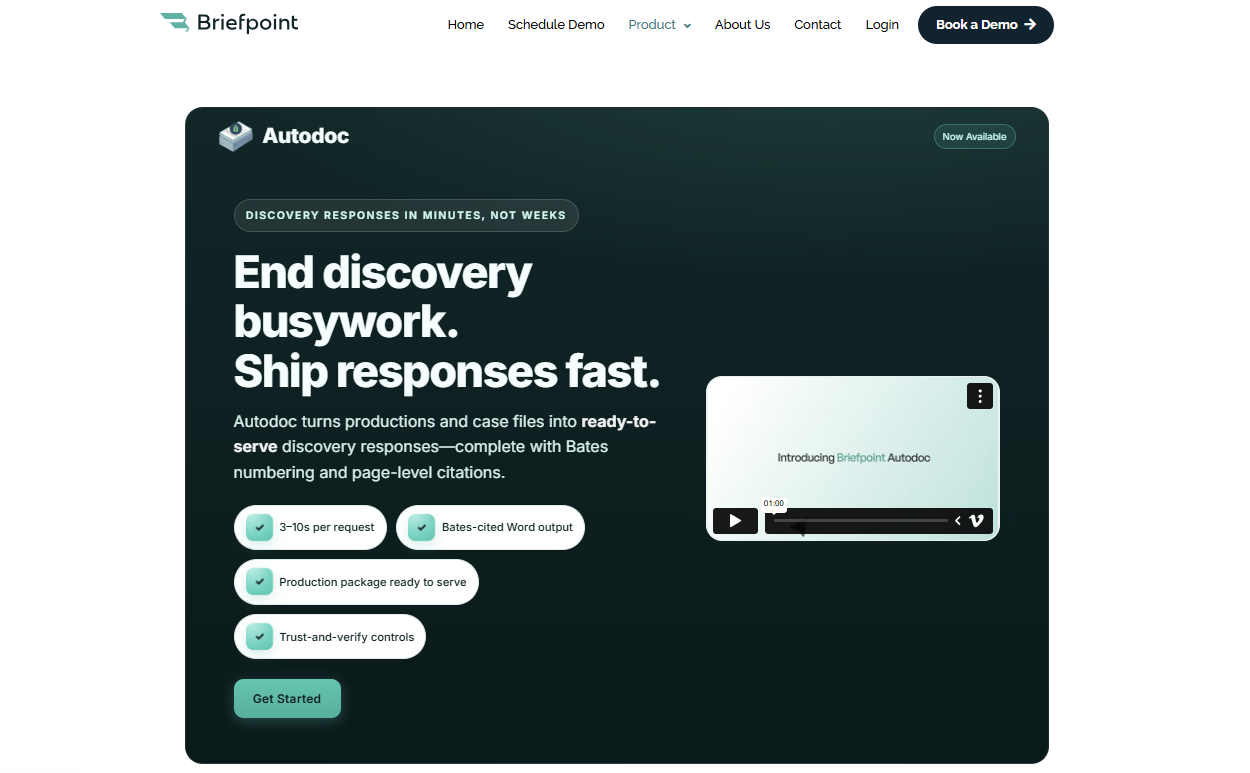
But if there’s one task that still eats up too much of your day, it’s drafting discovery documents.
Briefpoint can make a real difference. It’s built specifically for lawyers who want to cut hours of drafting down to just minutes without sacrificing quality or control.
If you’re ready to spend less time formatting and more time lawyering, give Briefpoint a try.
Overview of Interrogatories in Discovery (2026 Full Guide)

Interrogatories play a key role in legal cases. Their main purpose is to help attorneys gather critical information from the opposing party.
However, drafting them effectively isn’t always straightforward.
Asking the right questions requires a full understanding of the case, careful wording, and a strategic approach. At the same time, legal professionals must balance cooperation with protecting privileged information, all while keeping costs and billable hours in check.
It’s a delicate process, and mistakes can lead to wasted time, incomplete responses, or unnecessary disputes.
We created this guide to break down the essentials of crafting strong interrogatories that drive cases forward. You’ll learn how to gather and share key details while avoiding common pitfalls that complicate litigation.
Understand the Purpose of Your Interrogatories
Before drafting your questions, take a step back and clarify what you’re trying to accomplish. The stronger your strategy, the more useful the responses will be.
Are you gathering facts, identifying legal arguments, or uncovering key documents? Knowing your goals upfront will help you craft more precise and effective interrogatories.
Interrogatories often serve multiple purposes, so it’s important to be strategic in how you frame them. Here are some common objectives:
- Gather factual details: Ask for specifics about the case, such as the parties involved, potential damages, and the events leading up to the dispute. If the party served is a public or private corporation, you may also want details about company policies, employees involved, or internal records.
- Obtain key documents: Request financial records, written witness statements, police reports, or any other discovery documents that could be relevant. This can help clarify the timeline of events and provide supporting evidence.
- Clarify legal arguments: Identify the statutes, case law, or legal theories the other party intends to rely on. This insight can help you anticipate their strategy and prepare counterarguments.
- Identify witnesses: Find out who was present at key moments and whether they can provide testimony. Their statements could shape the direction of the case.
Before you serve interrogatories, make sure each question has a clear purpose. Well-crafted interrogatories improve your chances of getting meaningful responses while keeping the process efficient and focused.
Learn to Respond Effectively to Interrogatories
For the answering party, interrogatory responses are rarely simple. Each answer becomes part of the record, and once it’s served, it can shape depositions, motions, and trial strategy.
That’s why the responding party needs more than surface-level accuracy. You have to fully understand what the propounding party is actually asking and why.
Start with the intent behind the question. Is the party making the request trying to pin down a timeline? Lock in a damages theory? Identify witnesses for later depositions?
Your response should address the question directly without volunteering extra material that expands the scope of the discovery process.
Keep a few principles in mind:
- Rely on documented facts rather than memory or assumptions.
- Answer only what is asked and avoid broad narrative responses.
- Object when appropriate if a request is vague, irrelevant, or unduly burdensome.
- Consider producing business records if they contain the responsive information.
For example, if the propounding party asks you to “describe all communications related to the contract,” that may be overly broad. A targeted discovery objection, combined with reference to identified emails or contract files, can protect your client while still providing a proper response.
Draft Interrogatories Strategically
Drafting interrogatory questions takes planning. In most cases, you’ll send interrogatories early in the discovery process to seek information that shapes depositions, document requests, and case strategy.
Since a party may serve more than one set (subject to applicable rule limits), each interrogatory asks something that should move the case forward.
Keep these principles in mind:
- Ask specific questions: Avoid vague written questions that invite objections. Tailor form interrogatories to your facts so the responding party can clearly determine what is being requested.
- Build in sequence: Structure interrogatory questions so one leads to the next. A logical order makes it harder to dodge key facts and helps you identify gaps that call for additional information.
- Focus on what’s missing: Use interrogatories to seek information not found in produced documents or prior disclosures.
- Stay factual: Don’t draft an interrogatory that asks for legal conclusions. Stick to facts that can be verified and answered separately.
- Watch the rule limits: Federal and state rules often cap how many interrogatories a party may serve. Be deliberate, especially if you anticipate serving more than one set.
Deal With Objections and Motions Effectively
Interrogatories don’t always go smoothly. Even if you follow best practices, objections and motions are common (sometimes as delay tactics). Whether you’re handling a car accident case or a complex corporate dispute, knowing how to push back effectively can keep things moving.
Start by reviewing objections carefully. Are they valid, or is the opposing side just trying to stall? In federal courts, objections must be backed by law, not just broad claims of over-generality.
If their reasoning is weak, push back and demand answers. If necessary, file a motion to compel the opposing party to respond.
If an interrogator asks you to disclose privileged information, especially in cases involving a governmental agency, consider seeking a protective order. Courts may allow you to limit disclosure to protect sensitive details.
When you serve answers, make sure they address all relevant questions while avoiding unnecessary disclosures.
Legal AI tools like Briefpoint can help by identifying baseless objections, drafting responses, and managing legal correspondence efficiently.
Sample Interrogatory Questions
Interrogatory questions vary depending on the type of lawsuit, the court, and the claims at issue.
In personal injury claims, for example, both the plaintiff and defendant use written questions to lock down facts that may later shape admissible evidence in circuit court.
Here are common examples used in civil procedure:
- Identify witnesses: “Identify all persons with knowledge of the incident described in the complaint.” This helps determine who may testify and what evidence might surface later.
- Describe the event: “State in detail how the accident occurred, including date, time, and location.” A clear narrative answer can expose inconsistencies or confirm key facts.
- Explain damages: “Itemize all injuries and medical treatment you claim resulted from the incident.” In personal injury claims, this clarifies the scope of alleged harm.
- Identify documents: “Identify all documents supporting your defenses in this lawsuit.” This connects written responses to potential exhibits.
- Update prior statements: “State whether any prior response is no longer true and explain why.” This preserves accuracy and prevents shifting positions later.
Make Interrogatories Less of a Hassle With Briefpoint
Written interrogatories have a way of expanding. What starts as a standard set can turn into pages of definitions, objections, document mapping, and formatting clean-up. Add a few burdensome interrogatories to the mix, and your week disappears into review and revision.
Briefpoint was designed for that exact reality.
If you’re propounding discovery, you can upload a complaint and generate jurisdiction-ready interrogatories, requests for admission, and requests for production in minutes.
The requests are structured, clearly defined, and formatted correctly from the start, so you’re not fixing numbering or rewriting compound questions at midnight.
If you’re responding, the workflow is just as direct. Upload the written interrogatories, add objections and answers with AI assistance, and export a Word document that’s ready to review and serve.
Autodoc changes the production side of the equation. Drop in your RFPs and case files, and it:
- Finds responsive documents
- Drafts captioned responses with page-level Bates citations
- Packages a production set ready to go
You still control every edit. You still make the legal calls. The repetitive mechanics around discovery simply stop eating 30 to 40 hours per matter.
Discovery Objections Cheat Sheets: Full Guide
What Are Common Objections to Discovery Requests?
There are many possible objections that can apply in discovery, depending on the request and the rules in play. That said, some objections come up far more often than others.
We’ve broken down some of the most common discovery objections and when they typically apply:
1. Relevance
A relevance objection applies when a discovery request seeks information that has no meaningful connection to the claims or defenses in the case. Even though discovery is broad, it is not unlimited, and the information sought must still relate to the issues actually being litigated.
Courts generally give legal professionals some flexibility during discovery, but they also expect requests to remain within reasonable bounds.
If a party intends to obtain information tied to events, documents, or topics that fall outside the relevant time frame or subject matter, objections apply to keep discovery focused.
It’s important to explain why the request is irrelevant rather than relying on a bare objection. Judges look for context, especially when evaluating whether the request has any potential value to the case.
Example: “Objection. The requested documents concern events that occurred outside the relevant time frame and have no bearing on the issues in dispute.”
A strong relevance objection clearly links the objection to the scope of the case while still complying with discovery obligations where appropriate, such as producing responsive material that does fall within a reasonable and relevant scope.
2. Overbroad and Unduly Burdensome
An objection for being overbroad and unduly burdensome applies when a discovery request is poorly defined, asks for an excessive volume of material, or would require a disproportionate amount of time and effort to answer.
Courts allow wide-ranging discovery in both federal and state courts, but they still expect requests to be reasonable and tied to the proportionality standard. Problems arise when a request lacks limits on time, subject matter, or scope.
For example, demands for “all documents” without context can force a party to review years of files, many of which have little relevance. In those situations, the burden of responding may outweigh any likely benefit.
Judges want more than a conclusory objection. Simply stating that a request is “too broad” is rarely enough. Courts expect an explanation showing why compliance would be unreasonable and how the request could be narrowed.
Example: “Defendant objects to this request as overbroad and unduly burdensome because it seeks all documents related to any insurance policy issued over a ten-year period, without limiting the request to the policy at issue or the relevant time frame.”
If only part of a request creates a problem, courts expect a targeted response. Producing what falls within a reasonable scope while objecting to the rest shows good faith and often helps avoid unnecessary disputes.
3. Privileged Information
An objection based on privileged information is used when a discovery request seeks materials protected by the attorney-client privilege, work product doctrine, or other applicable legal protections.
However, these objections need to be specific. You can’t just claim privilege without explaining why the information is protected. If you withhold documents, you’ll likely need to provide a privilege log listing what’s being withheld and why.
Example: “Objection. This request seeks information protected by the attorney-client privilege and is therefore not subject to disclosure.”
If only part of the response is privileged, courts expect you to produce the non-privileged portions while redacting the protected content.
Keeping a detailed privilege log can help avoid challenges and show that you’re withholding information for a valid reason, not just to block discovery.
4. Vague or Ambiguous
A vague or ambiguous objection comes up when a discovery request is worded in a way that makes it hard to tell what the other side is actually asking for.
If key terms are unclear or the request can be read multiple ways, responding becomes guesswork rather than a meaningful exchange of relevant information.
Courts generally expect parties to act reasonably. When a request is unclear but fixable, asking for clarification often makes more sense than refusing to respond outright. That approach keeps discovery moving while protecting you from overproducing or missing something important.
This type of objection often applies when requests involve things like:
- Broad or undefined references to communications or documents
- Requests for electronically stored information without limits on time, format, or source
- Vague demands for tangible things without explaining what categories are included
Example: “Objection. This request is vague and ambiguous because it fails to define ‘relevant communications,’ making it unclear what information is being sought.”
Addressing vagueness early helps avoid disputes later and makes it easier to provide a response that aligns with the actual scope of the case.
5. Confidential or Private Information
An objection based on confidential or private information applies when a discovery request seeks sensitive business data, personal records, or other legally protected material.
Although courts permit broad discovery, they also expect parties to take reasonable steps to safeguard information that should not be freely disclosed.
This often comes up when a request seeks materials within a party’s possession, custody, or control that include trade secrets, financial records, medical information, or proprietary processes.
Even if the information could be relevant or reasonably calculated to lead to admissible evidence, courts still balance that interest against privacy and confidentiality concerns.
However, simply labeling information as “confidential” is not enough to block production. If the material is relevant, a court may allow disclosure subject to limits, such as a protective order that controls who can access the information and how it can be used.
Example: “Objection. This request seeks confidential business records containing proprietary information not subject to unrestricted disclosure.”
Rather than refusing outright, discussing safeguards or narrowing the request with opposing counsel often resolves the issue more efficiently and reduces the likelihood of court involvement.
6. Already Available
Courts generally don’t require a party to produce materials that the other side can easily obtain on their own, especially if they’re public records, already in possession of the requesting party, or available from a third-party source.
This objection applies when the requesting party has equal access to the documents or data they’re asking for.
Examples: “Objection. The requested documents are equally available to the requesting party through publicly accessible records.”
If the request involves public or easily accessible records, you can reference where the party can obtain them rather than producing the documents yourself.
7. Calls for a Legal Conclusion
A discovery request asks, “Do you admit that the defendant was negligent in causing the accident?”
This type of question isn’t just seeking facts. It’s also asking for a legal analysis that only a judge or jury can decide.
Discovery is meant to gather factual information, not force a party to make legal conclusions. When a request crosses that line, it’s most likely appropriate to object.
Examples: “Objection. This request calls for a legal conclusion and is therefore improper under the rules of discovery.”
8. Compound Request
An objection to compound requests or compound questions is appropriate when a discovery request combines multiple inquiries into one, which makes it difficult to determine exactly what’s being asked.
Requests should be clear and specific, but when a single request covers multiple topics, timeframes, or document categories, it can create confusion or require separate responses.
Examples: “Objection. This request is compound, as it includes multiple separate inquiries that should be broken down into distinct requests.”
When a request includes both clear and unreasonable parts, responding to what makes sense while objecting to the rest is usually the best approach.
9. Calls for Speculation
Speculative questions in discovery are improper because they require a party to guess rather than provide factual information. Requests that ask how someone might have acted under different circumstances or what another person was thinking go beyond what discovery allows.
Courts expect responses to be based on personal knowledge or available admissible evidence instead of assumptions.
Example: “Objection. The question asks the responding party to predict actions or thoughts of another individual, which is not proper for discovery.”
If part of the request can be answered with known facts, it’s best to respond to that portion while objecting to the speculative parts. Courts typically reject blanket refusals if any part of the request is reasonable.
10. Calls for an Expert Opinion
Requests that demand technical analysis, medical evaluations, or legal interpretations often fall outside the scope of standard discovery responses.
If a question requires specialized knowledge that only a qualified expert can provide, an objection may be warranted.
Example: “Objection. This request calls for an expert opinion, which the responding party is not qualified to provide.”
If the responding party has relevant expertise, the court may still require an answer. However, if the request truly requires expert input, the appropriate response is to object and refer the matter to expert witnesses designated in the case.
11. Work Product Doctrine
A work product objection applies when a discovery request seeks materials prepared in anticipation of litigation, such as attorney notes, internal analyses, legal strategy, or case evaluations.
Under federal law, these materials are protected to prevent one party from gaining insight into how the other prepared its case.
In federal court, work product protection can apply even when the materials are not covered by the attorney-client privilege. Courts often look at the parties’ relative access to the underlying information.
If the requesting party can obtain the same facts on its own, there is usually little justification for forcing disclosure of work product.
Not all work product is treated the same. Factual work product may be discoverable in limited circumstances, while opinion work product, including mental impressions and legal theories, receives stronger protection.
There is also a real risk of waiving the protection if materials are shared carelessly or disclosed beyond the scope of the litigation.
Example: “Objection. This request seeks documents prepared in anticipation of litigation and is protected under the work product doctrine pursuant to federal law.”
Clear objections and careful handling of protected materials help preserve the work product protection throughout discovery.
Try Briefpoint for Faster, More Accurate Discovery Responses
Discovery objections are part of the job, but the process around drafting and responding often takes more time than it should.
Between reviewing productions, matching documents to requests, and making sure objections are clear and defensible, it’s easy for discovery work to take over your schedule.
That’s where Briefpoint can change how this work feels day to day.
Features like Autodoc live inside Briefpoint and handle much of the mechanical side of discovery responses. That includes finding responsive documents, applying Bates numbers, and generating Word-ready drafts you can review and edit.
When the busywork fades into the background, it’s easier to focus on substance, strategy, and accuracy. Discovery still requires judgment, but it doesn’t have to consume weeks of your time to get there.
Book a demo today and see how Briefpoint can change your entire workflow.