5 Best Accounting Software For Small Law Firms (A 2026 Guide)

What is Law Firm Accounting Software?
Law firms don’t just need accounting software—they need tools built for the way legal finances work. Between managing trust accounts and staying compliant with industry regulations, standard bookkeeping software doesn’t always cut it.
Legal accounting software helps firms handle client funds properly, generate accurate invoices, and keep financial records organized without extra manual work. Many tools also integrate with case and law practice management software, making it easier to connect billing with legal work.
The key difference? It’s designed to keep law firms compliant and efficient. With built-in trust accounting, expense tracking, and reporting tools, it reduces the risk of errors and helps firms stay on top of their finances without getting lost in spreadsheets.
What Do Small Law Firms Have to Consider When Choosing Accounting Software?
Small law firms have different accounting needs than large firms. You don’t have a full finance team handling the books, so the software you choose has to be practical, compliant, and easy to use. Here’s what to consider:
- Trust accounting compliance – You’re responsible for client funds, and trust accounting mistakes can lead to serious issues. The software should properly track, separate, and reconcile trust accounts.
- Billing & invoicing – If your system doesn’t make it easy to log billable hours and send invoices, you could be leaving money on the table. Look for automated invoicing and payment tracking.
- Cost & scalability – Budgets are tight, and you don’t want to overpay for features you won’t use. But as your firm grows, you’ll need software that can keep up.
- Integration with legal tools – If your accounting software doesn’t sync with your case management system, you’ll spend extra time on manual data entry.
- User-friendliness – You don’t have time to struggle with complex software. A clean, intuitive interface is key.
- Reliable support – When problems arise, fast and knowledgeable customer service makes all the difference.
What Are The Biggest Benefits of Using Legal Accounting Software?
Do you ever feel like managing your firm’s finances takes up more time than actual legal work? Tracking billable hours, handling trust accounts, and chasing down invoices can be overwhelming—especially if you’re relying on spreadsheets or generic accounting tools.
The right legal accounting software keeps everything in check and helps your firm run more smoothly. Here’s how:
Trust Accounting Without the Headaches
Handling client trust accounts isn’t just another task on your to-do list—it’s a responsibility you can’t afford to get wrong. A single mistake can lead to compliance issues, penalties, or even worse.
A good legal accounting software solution takes the guesswork out of trust accounting by automatically keeping client funds separate, tracking every transaction, and generating audit-ready reports.
This means no more manual spreadsheets or worrying about whether your records are accurate. With clear trust ledgers and built-in safeguards, you can stay compliant and focus on your legal work instead of stressing over financial details.
Easier Billing and Faster Payments
Getting paid shouldn’t be a struggle. If you’re still manually tracking hours, creating invoices from scratch, and following up on late payments, you’re spending way too much time on admin work.
Legal accounting software makes billing easier by:
- Automatically logging billable hours
- Generating invoices
- Sending payment reminders
Clients can pay online without hassle, and this means fewer delays and keeping your cash flow steady. Instead of chasing payments or dealing with messy records, you’ll have a system that keeps everything organized.
Fewer Manual Errors
Ever caught a mistake in your books and thought, How did that even happen?
Maybe a decimal was off, a duplicate entry slipped in, or a trust account transaction didn’t balance. Manual data entry makes errors almost inevitable—and fixing them takes time you don’t have.
Legal accounting software helps prevent these slip-ups by automating calculations, tracking every transaction, and flagging inconsistencies before they turn into real problems. So, instead of double-checking numbers and fixing avoidable mistakes, you get clean, accurate records from the start.
Better Cash Flow Management
Late payments and untracked expenses can throw off your firm’s finances fast. If cash flow is unpredictable, it’s harder to plan for growth, cover expenses, or even pay yourself consistently.
The right legal billing software gives you real-time visibility into where your money is coming from—and where it’s going—so you can stay ahead of financial issues before they become bigger problems.
Here’s how it helps:
- Track unpaid invoices – See outstanding balances at a glance and send automated reminders to speed up payments.
- Monitor firm expenses – Keep an eye on operational costs so nothing eats into your profits unnoticed.
- Plan ahead with better forecasting – With real-time financial data, you can make informed decisions about hiring, investments, and budgeting.
- Avoid cash flow surprises – No more guessing whether your firm’s financial performance is enough to cover upcoming expenses.
Seamless Integration with Case Management
Tired of entering the same data twice? Manually linking invoices to cases? Jumping between systems just to get a clear financial picture? That’s the problem when accounting and case management don’t work together.
Good legal accounting software connects with your case management system and keeps financial records aligned with client work automatically. No more double data entry, missing transactions, or wasted time fixing errors.
With everything in sync, billing runs smoother, financial reporting capabilities improve, and client management stays organized. Rather than wrestling with spreadsheets, you get a clear, accurate view of your firm’s finances—without the extra hassle.
Less Time Spent on Admin Work
Nobody starts a law firm because they love bookkeeping. But if you’re spending more time tracking expenses and preparing tax reports than actually practicing law, something’s got to change.
Legal accounting software takes those tedious tasks off your plate. It automatically tracks expenses, syncs with your bank for easy reconciliations, and organizes tax records without the last-minute scramble (and that’s just the tip of the iceberg).
Instead of drowning in spreadsheets or trying to fix accounting mistakes at the end of the month, you can focus on your clients and casework.
Best Accounting Software For Small Law Firm Operations
Now that we’ve covered the key benefits, it’s time to look at the best options. Not all accounting tools are designed for law firms, and choosing the wrong one can lead to compliance issues and extra admin work.
Let’s break down the top accounting software for small law firms and what makes them worth considering.
1. QuickBooks
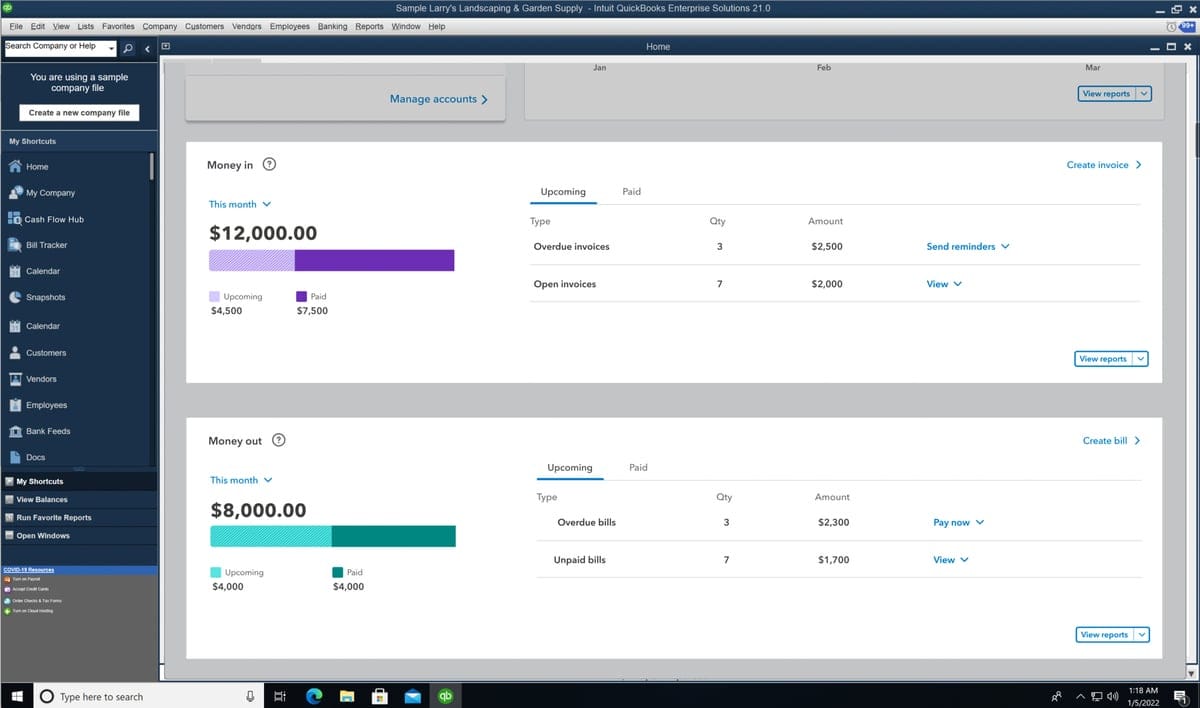
QuickBooks is one of the most widely used accounting tools for small businesses, and law firms are no exception. With options like QuickBooks Online, QuickBooks Desktop, and QuickBooks Desktop Pro, firms can choose a plan that fits their needs.
Source: G2
While it’s not built specifically for legal professionals, it offers powerful financial management features and integrates with legal software like Clio and LeanLaw.
Whether you need cloud-based access, advanced reporting, or simple bookkeeping, QuickBooks has a version that can handle your firm’s accounting needs.
Best Features
- Customizable invoicing: Create and send professional invoices, track payments, and accept online payments.
- Expense tracking: Automatically categorize expenses and reconcile bank transactions.
- Trust accounting support: Integrate with LeanLaw or Clio to properly manage client trust funds.
- Financial reporting: Generate profit and loss statements, balance sheets, and tax reports.
- Legal software integration: Sync with Clio, LeanLaw, and other law firm tools for seamless accounting.
Pros
- Easy to use and widely recognized
- Strong reporting and financial tracking
- Syncs with banks, payroll, and law firm tools
- Multiple versions available for different business needs
- Cloud-based access for remote accounting
- Scalable plans for growing firms
Pricing
The starting price for QuickBooks is €9.50 for the Simple Start plan. It comes with basic accounting essentials, such as invoices, receipt capture, income and expenses, and more. For teams, the Essentials Plan starts at €13.50, coming with more features and three user spots.
2. Clio Accounting
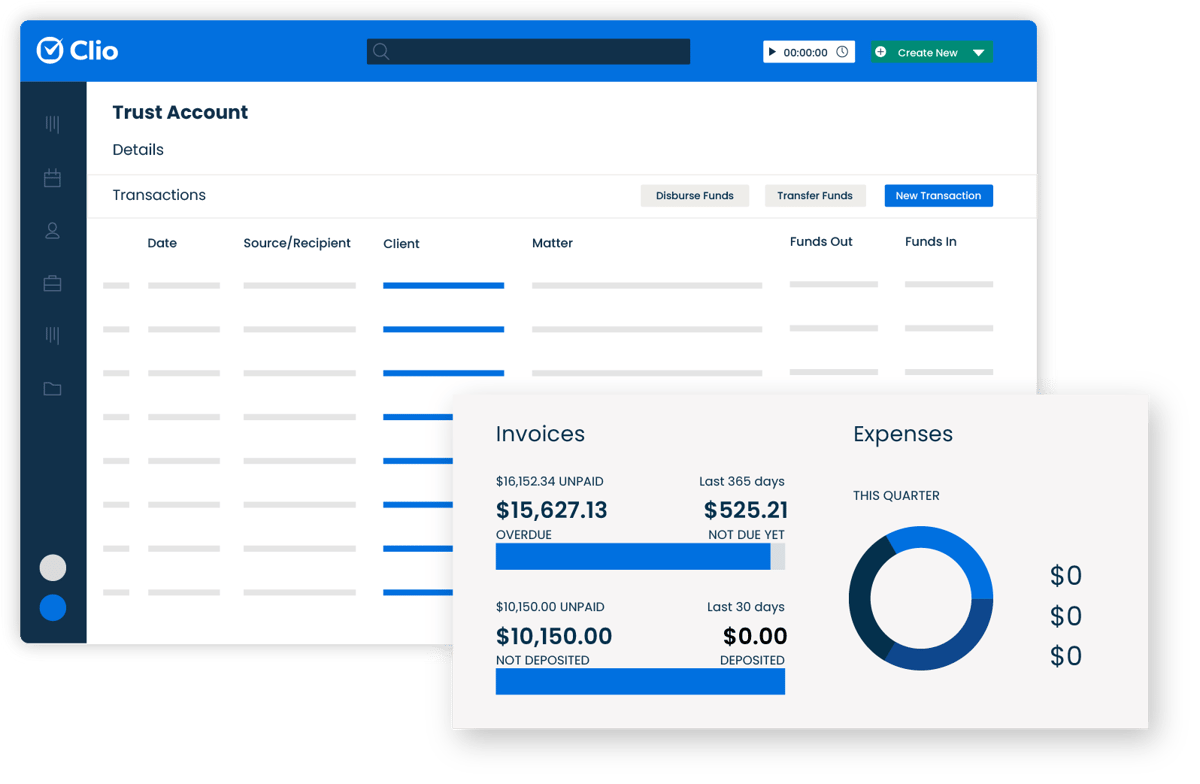
Clio Accounting is designed specifically for law firms, which makes it easier to manage trust accounting, billing, and financial reporting while staying compliant.
Source: G2
As part of the Clio ecosystem, it integrates with Clio Manage, allowing firms to track billable hours, generate invoices, and handle trust accounts all in one place.
Unlike general accounting software, Clio Accounting is built with legal professionals in mind. This can help reduce the risk of compliance issues and manual errors.
Best Features
- Trust accounting compliance: Keeps client funds separate and generates reports to meet legal industry regulations.
- Automated invoicing: Create and send professional invoices with built-in time tracking.
- Payment processing: Accept online payments through Clio Payments, reducing delays.
- Expense tracking: Log and categorize firm and client expenses effortlessly.
- Easy integration with Clio Manage: Syncs billing and accounting data with your case management system.
Pros
- Built specifically for law firms
- Strong trust accounting features
- Fully integrates with Clio’s legal management tools
- Cloud-based access for anytime, anywhere financial management
- Automated reminders help reduce late payments
- Reduces manual data entry by syncing with case files
Pricing
Clio Accounting is an optional add-on, available for the Essentials Plan and up. The starting price for the Essentials Plan is $89 per user per month.
3. LeanLaw
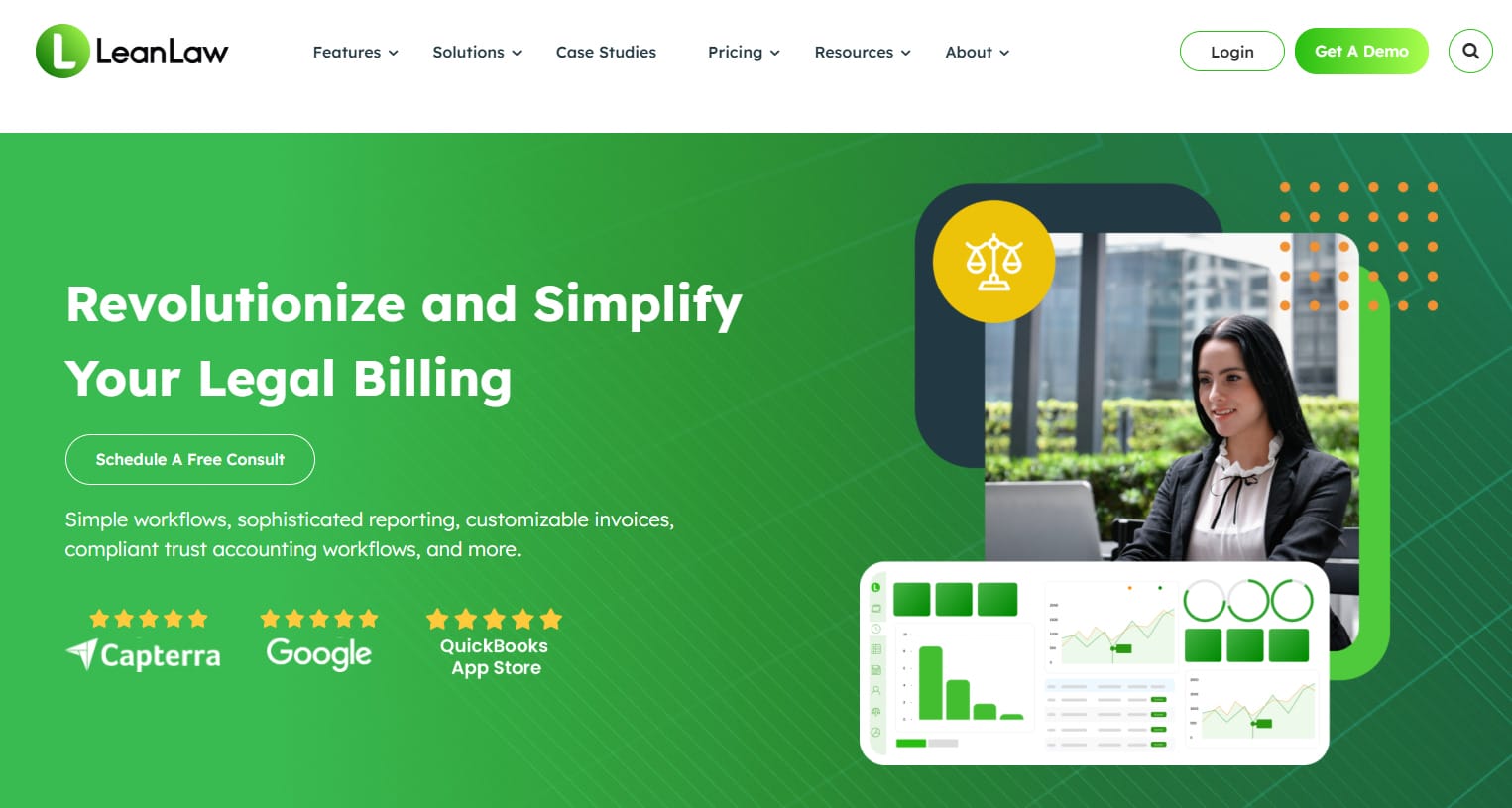
LeanLaw is built specifically for law firms that want seamless integration with QuickBooks while maintaining compliance with legal accounting rules.
Source: LeanLaw.co
It simplifies trust accounting, time tracking, and billing, making it a great choice for firms that rely on QuickBooks but need legal-specific features. With an easy-to-use interface and strong financial reporting, LeanLaw helps small law firms manage their books without extra complexity.
Best Features
- Deep QuickBooks integration: Syncs directly with QuickBooks Online for smooth accounting workflows.
- Trust accounting compliance: Helps keep client funds separate and generates audit-ready reports.
- Time tracking & invoicing: Logs billable hours and turns them into invoices with a single click.
- LEDES billing support: Exports invoices in LEDES format for firms working with corporate clients.
- Expense tracking: Categorizes and assigns firm and client-related expenses easily.
Pros
- Designed specifically for law firms
- One of the best QuickBooks integrations available
- Simple and intuitive interface
- Helps prevent trust accounting errors
- Customizable reports for better financial insights
- Reduces manual data entry for time tracking and billing
Pricing
LeanLaw’s pricing starts at $45 per user per month for the Core Plan, which comes with features like time tracking, electronic payments, and invoicing.
4. FreshBooks
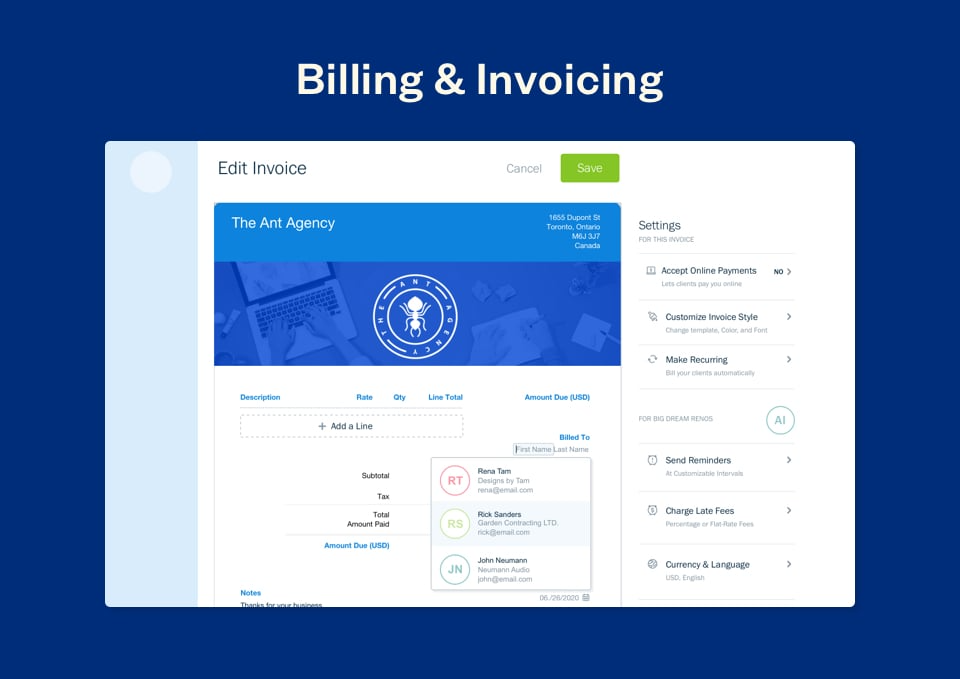
FreshBooks is a simple and user-friendly accounting solution for solo attorneys and small law firms that need straightforward invoicing, expense tracking, and timekeeping.
Source: G2
Although it’s not built specifically for law firms, its easy-to-use interface and automation features make financial management less time-consuming. It’s a good option for firms that don’t require complex trust accounting but need an efficient way to handle billing and expenses.
Best Features
- Automated invoicing: Create, send, and track invoices with built-in reminders for late payments.
- Time tracking: Log billable hours and convert them into invoices with one click.
- Expense management: Automatically track and categorize expenses for easier reporting.
- Online payments: Accept credit card and ACH payments directly through FreshBooks.
- Financial reporting: Generate profit and loss statements, expense summaries, and tax reports.
Pros
- Clean, easy-to-use interface
- Great for solo attorneys and small firms
- Automates invoicing and payment reminders
- Mobile-friendly for on-the-go access
- Affordable pricing compared to other options
Pricing
Plans start at $6.30 for the Lite plan, which allows users to send invoices to five clients, track expenses and other basic accounting work. More robust features are available in higher-tier plans, starting at $11.40 per month for the Plus plan.
5. Xero
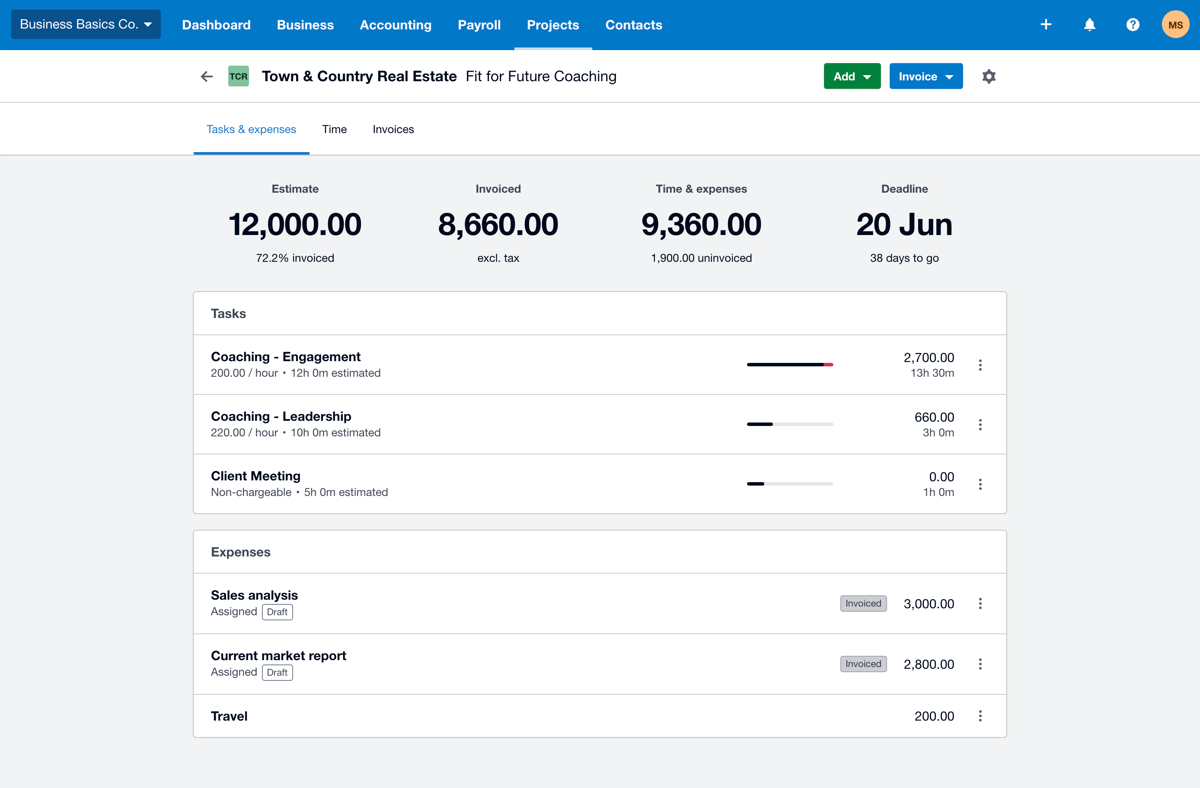
Xero is designed for small businesses but offers key features that work well for law firms, including automated bank reconciliation, invoicing, and expense tracking.
Source: G2
With real-time financial insights and multi-user access, Xero helps firms stay on top of cash flow without getting bogged down in spreadsheets. Plus, it integrates with legal practice management tools, which makes it easier to keep billing and accounting connected.
Best Features
- Bank reconciliation: Syncs with your bank to automatically track and match transactions.
- Customizable invoicing: Create and send branded invoices with automated payment reminders.
- Expense tracking: Categorizes and manages firm-related expenses for better financial oversight.
- Multi-user access: Allows accountants, bookkeepers, and partners to collaborate in real time.
- Financial reporting: Provides insights into cash flow, outstanding invoices, and overall firm performance.
Pros
- Affordable compared to other accounting tools
- Cloud-based for easy access from any device
- Integrates with legal management software like Clio
- User-friendly dashboard with real-time financial insights
- Strong security features to protect financial data
- Scalable for growing firms
Pricing
Xero’s Starter Plan costs $29 per month, which lets users send quotes and up to 20 invoices, enter five bills, reconcile bank transactions, and record bills and receipts.
Want to Beef Up Your Law Firm’s Cash Flow? Try Briefpoint
Keeping your firm’s finances in order isn’t just about choosing the right accounting software—it’s also about making the most of your time. Even the best accounting tools can’t fix cash flow problems caused by hours of unpaid admin work.
Briefpoint helps by automating legal drafting and generating discovery documents in minutes. This way, you can cut down the time spent on repetitive tasks and actually focus on billable work.
More billable hours mean more money in your bank accounts and keeping your firm financially stable. Instead of getting buried in paperwork, you’ll spend more time on high-value tasks that bring in revenue.
Want to see how much time—and money—you could be saving? Book your Briefpoint demo today.
Save Thousands Every Year With Briefpoint
Discovery responses cost firms $23,240, per year, per attorney. $23,240 estimate assumes an associate attorney salary of $150,000 (including benefits – or $83 an hour), 20 cases per year/per associate, 4 discovery sets per case, 30 questions per set, 3.5 hours spent responding to each set, and 1800 hours of billable hours per year.
Book a demo and save on these costs with Briefpoint.
Will AI Replace Paralegals?

Overview of Paralegal Work
Paralegals play a key role in law firms, handling legal work that helps attorneys focus on bigger tasks. They aren’t lawyers, but they assist with research, document preparation, and case management. Their work keeps legal cases moving smoothly and makes sure everything is properly organized.
Here are some of the main tasks paralegals handle:
- Basic legal research
- Drafting legal documents
- Case management
- Discovery
- Client communication
- Court filings
Paralegals work closely with attorneys but can’t provide legal advice or represent clients in court. Their job is to handle the behind-the-scenes work that keeps cases running efficiently.
With AI and automation tools becoming more common, paralegals now have tech-driven solutions to speed up some of these tasks.
But even with AI handling routine work, law firms still rely on paralegals for accuracy, critical thinking, and legal expertise.
How Is AI Changing How Paralegals Work?
With legal AI tools, paralegals can work more efficiently and spend less time on manual processes. Here’s a closer look at how AI impacts different paralegal work areas.
Speeding Up Legal Research
Traditional legal research takes time. Before AI, paralegals and other legal professionals had to sift through case law, statutes, and regulations manually.
AI-powered research tools can scan vast databases in seconds, identifying relevant cases and summarizing key points. This reduces the hours spent searching for information, which allows paralegals to focus on analyzing results rather than just finding them.
However, AI doesn’t replace legal judgment—paralegals still need to verify findings, assess relevance, and apply legal reasoning. AI is a tool that speeds up the process, but it’s not a substitute for human expertise.
Automating Document Drafting
AI is making document creation easier by generating standard legal documents based on templates. Paralegals no longer have to draft routine contracts, NDAs, or discovery responses from scratch.
Instead, AI can pre-fill key sections, format documents properly, and suggest clauses based on previous cases. This saves time and reduces the risk of missing important details.
While AI-generated drafts still need review and customization, automation significantly cuts down on repetitive work. Paralegals can spend less time formatting and more time making sure documents meet legal standards.
Improving Discovery
Sorting through thousands of legal documents used to be a tedious process, requiring paralegals to review and categorize every file manually.
AI now makes e-discovery faster by automatically identifying relevant documents, flagging key terms, and organizing data sets. This means less time spent on document review and more focus on case strategy.
AI can also detect patterns and highlight inconsistencies, making it easier to spot critical information. However, paralegals are still needed to verify AI’s selections and make sure nothing important is overlooked.
Optimizing Contract Review
AI-powered contract analysis tools help paralegals quickly identify risks, missing clauses, and inconsistencies.
Instead of reading through pages of legal text, they can rely on AI to highlight key areas for review. This reduces the chances of errors and speeds up contract analysis.
AI can also compare contracts against past agreements for better consistency and compliance with legal requirements. While AI can flag issues, it doesn’t replace a paralegal’s judgment in negotiating terms or understanding context.
Reducing Administrative Work
AI also helps with scheduling, file management, and other administrative tasks that used to take up a large portion of a paralegal’s time.
Automated case management tools organize legal files, track deadlines, and even generate reminders for upcoming tasks. Some AI-driven chatbots can handle routine client inquiries, freeing up paralegals to focus on legal work.
While AI can reduce the workload, the legal industry still relies on paralegals to manage client interactions and oversee case details.
AI Won’t Replace Paralegals Completely
AI is making legal work faster, but it’s not kicking paralegals out of the picture. Sure, it can handle tasks like document drafting, legal research, and e-discovery, but there’s a lot it just can’t do. Paralegals bring human judgment, attention to detail, and critical thinking—things AI still struggles with.
Think of it this way: Legal work isn’t just about pulling up laws and filling in templates. It’s about understanding context, spotting risks, and knowing when something doesn’t look right.
Then there’s the human side of things. Clients don’t want to talk to a chatbot when they have legal concerns. They want a real person who listens, asks the right questions, and explains things clearly.
AI can scan contracts for missing clauses but won’t negotiate terms or pick up on subtle legal nuances like a trained paralegal. As many legal professionals know, legal issues aren’t always straightforward. Every case is different, and sometimes, you just need a human to figure things out.
Instead of replacing paralegals, AI is becoming another tool in their arsenal. The ones who learn how to use it will have an edge, working smarter and faster. Law firms aren’t getting rid of paralegals—they’re just giving them better tech to work with.
So, What Does the Future Look Like for Paralegals?
AI is definitely transforming the legal profession, and entry-level paralegals will probably feel it the most.
A lot of the routine tasks—like document review, legal research, and basic contract drafting—are now automated. Law firms looking to cut costs might lean on AI for these instead of hiring as many junior paralegals.
But, that doesn’t mean human paralegals are going away. The role is just changing. Firms still need experienced paralegals to manage AI tools, double-check AI-generated documents, and handle complex legal work.

Things like spotting legal risks, communicating with clients, and making judgment calls? AI isn’t taking over those anytime soon.
Paralegals who learn how to work with AI will have an edge. Instead of getting buried in repetitive tasks, they’ll have more time for legal analysis, case strategy, and working directly with attorneys.
AI might handle the grunt work, but law firms will always need sharp, adaptable paralegals who know how to put the pieces together.
How Can Paralegals Future-Proof Themselves?
The presence of AI doesn’t mean paralegals have to take the back seat. The ones who adapt will be even more valuable.
Instead of worrying about AI taking over, here’s how paralegals can stay ahead and build a long-lasting career:
- Master AI-powered legal tools – Learn how to use AI for research, document automation, and contract review. The more comfortable you are with legal tech, the more indispensable you become.
- Sharpen your legal instincts – AI can find information, but it can’t apply legal reasoning the way a trained professional can. Being able to spot risks, interpret laws, and think strategically will set you apart.
- Be the bridge between tech and people – Lawyers and clients will still need someone who can explain complex legal matters in simple terms. Strong communication skills will always be in demand.
- Keep up with industry changes – AI and legal tech evolve fast. Staying informed on the latest developments ensures you don’t get left behind.
- Specialize in high-value areas – AI handles routine work, but paralegals with expertise in corporate law, compliance, or litigation support will always have opportunities.
Help Your Paralegals Work Efficiently With Briefpoint
Paralegals handle a lot of essential but time-consuming work. While AI tools can speed up certain tasks, legal teams still need a solution that balances efficiency with accuracy.
Briefpoint makes that possible by automating discovery responses, reducing manual drafting, and formatting documents instantly.
With Briefpoint, firms don’t have to choose between speed and precision. It gets rid of repetitive work without sacrificing quality, so your paralegals can focus on more important tasks. Instead of spending hours drafting responses, they can review and finalize documents in minutes.
See the difference for yourself. Schedule a demo today to test Briefpoint in action.
Automation Translates to Real Savings
Discovery responses cost firms $23,240, per year, per attorney. $23,240 estimate assumes an associate attorney salary of $150,000 (including benefits – or $83 an hour), 20 cases per year/per associate, 4 discovery sets per case, 30 questions per set, 3.5 hours spent responding to each set, and 1800 hours of billable hours per year.
Book a demo and save on these costs with Briefpoint.
What Is an AI Legal Discovery Process?

What Are the Biggest Challenges in Manual Discovery?
Manual discovery often means sifting through massive amounts of data to find what’s relevant to a case. It’s a necessary step in the legal industry, but it’s not without its challenges—it can slow things down, lead to errors, and drive up costs.
More specifically, the manual discovery phase is:
- Too time-consuming: Legal professionals must sift through thousands, sometimes millions, of documents, emails, digital evidence, and other data forms to collect relevant information. This process can take weeks or months, which can delay case timelines and consume valuable resources.
- Excessively costly: Given its labor-intensive nature, manual discovery can be incredibly expensive. The more time legal teams spend on discovery, the higher the billable hours, which increases clients’ legal fees.
- Prone to human error: Even the most detail-oriented legal professionals can get fatigued, which makes it easy to miss key details or misinterpret information when sorting through endless documents.
- Lacking standardization: Manual discovery methods differ from firm to firm, leading to inconsistencies in how data is collected, reviewed, and presented. Without a clear approach, important details can be handled differently—or even missed entirely—depending on who’s reviewing the information.
- Physically and mentally taxing: The sheer volume of work involved in manual discovery can lead to burnout among legal teams. The stress of meeting tight deadlines and the monotonous nature of the work can have a huge impact on their well-being and, in turn, job performance.
How Can AI and Machine Learning Improve Legal Discovery?
The main goal of AI-powered legal discovery is to take over the most tedious tasks and reduce (if not eliminate) the challenges mentioned above. But what does this mean exactly?
Here are the best ways law firms can apply artificial intelligence in legal discovery work:
Automated Document Review
AI-powered document review takes the grunt work out of sifting through massive amounts of data. Instead of spending hours (or days) manually reviewing documents, automation quickly picks up on patterns, keywords, and key details—way faster and more accurately than humans can.
It’s not just about speed, though. AI helps catch inconsistencies, flag important connections, and reduce the risk of missing something crucial. That means legal teams can spend less time buried in paperwork and more time focusing on strategy.
Discovery Document Generation
Creating discovery documents – like discovery requests and, even more so, discovery responses – can take hours when done manually, which can negatively affect a legal team’s productivity.
Legal AI tools help minimize this hurdle by using artificial intelligence, machine learning, and Natural Language Processing (NLP) to draft documents in seconds instead of hours.
Document generation tools like Briefpoint automatically generate discovery documents based on standard templates. Afterward, you can easily customize these documents based on the specifics of the case and put the finishing touches on Word.
It’s easy, intuitive, and takes up much less time than manual document creation.
Faster Legal Research
AI tools take legal research to the next level by quickly scanning massive legal databases, statutes, case laws, and precedents to identify data that are most relevant to a case.
That means lawyers get instant access to key information, which cuts down the time spent searching through documents and strengthening their arguments.
These tools do more than speed things up. They improve accuracy, analyzing electronic data with precision to make sure no critical detail is overlooked. Legal teams can move forward knowing their case strategy is backed by thorough, well-researched information.
Regulatory Compliance
Keeping up with the constant change of regulations and compliance requirements is a daunting task for most legal professionals. AI and ML models can monitor regulatory updates in real time and make sure law firms remain compliant with current laws and regulations.
This is particularly beneficial for firms dealing with cross-border cases or operating in multiple jurisdictions, where regulatory compliance is complex and always evolving.
What Does an AI-Powered Discovery Process Mean for Law Firms?
Integrating AI into the legal profession clears the way for many advantages. From better productivity to maximizing your bottom line, here are some of the ways AI can take the discovery phase to the next level:
Better Efficiency and Time Management
AI and machine learning algorithms automate the most time-consuming parts of discovery, such as sifting through massive volumes of documents, identifying relevant data, and drafting discovery documents.
Less time spent on these tedious tasks allows lawyers to focus on more strategic aspects of their cases, such as formulating arguments and engaging with clients.
In other words, AI gives attorneys more time to work on higher-value tasks that are more important for the outcome of the case.
Additionally, efficient legal workflows go hand in hand with improved work-life balance for legal teams. This is an important aspect that many gloss over, but when people have a better relationship with work, they tend to be more productive, consistent, and satisfied with their jobs.
Improved Consistency and Accuracy Across Legal Documents
AI technologies can maintain a high level of consistency and accuracy across all legal documents generated during the discovery process.
Unlike humans, who may accidentally introduce errors or inconsistencies into their work, AI systems follow programmed rules so that every document adheres to the same standards and formats.
Uniformity and accuracy are a must in legal proceedings. The quality and reliability of documentation can significantly impact case outcomes, and having problematic documents can waste even more time and money for both clients and legal teams.

Law Firm Profitability
What is the point of introducing AI tech to the legal profession? We already know that the direct benefits are better efficiency, consistency, and accuracy. However, it all boils down to increasing law firm profitability.
Automating repetitive and mundane tasks reduces the billable hours typically required. Cost savings for clients means better competitiveness for the law firm, which can lead to more referrals.
More importantly, efficient operations allow firms to handle a heavier caseload without the need to expand the team. This can lead to better profit margins, career development for current employees, and higher chances of business expansion in the future.
Tech-Informed Law Firms
With more and more law firms shifting to electronic discovery, staying up-to-date with legal software has become a necessity in recent years.
Today’s law firms may have a hard time keeping up with the competition if they don’t adapt to legal trends, and we can only expect these technologies to evolve even further down the line.
Best AI-Driven Discovery Tools of 2025
Now that we’ve established the advantages of AI and machine learning in the discovery process, it’s time to talk about the best tools that let you access these benefits.
Here are some of the top AI-powered technologies that can help make discovery easier, faster, and more valuable:
1. Briefpoint
Briefpoint is a powerful tool that uses generative AI to draft discovery responses and request documents. Manually creating these documents can take hours, if not days, which is a huge bottleneck that can increase litigation costs.
With Briefpoint, however, you can generate content within minutes.
The documents Briefpoint can draft include but are not limited to:
- Requests for Admission
- Requests for Production
- Interrogatories
Using this discovery tool is simple. You just have to upload your discovery request, add objections or responses, and finish up on Microsoft Word. Briefpoint takes care of the nitty gritty in between with data-driven accuracy and precision.
Plus, there’s a built-in feature called Bridge, which makes collecting client responses much faster and easier. Bridge lets you translate interrogatories into plain, easy-to-understand language and send them to your client.
Once your client responds, Bridge will automatically plug their answers into your document. That means no more back-and-forth emailing!
Book a demo today to test Briefpoint’s full capabilities!
2. Logikcull
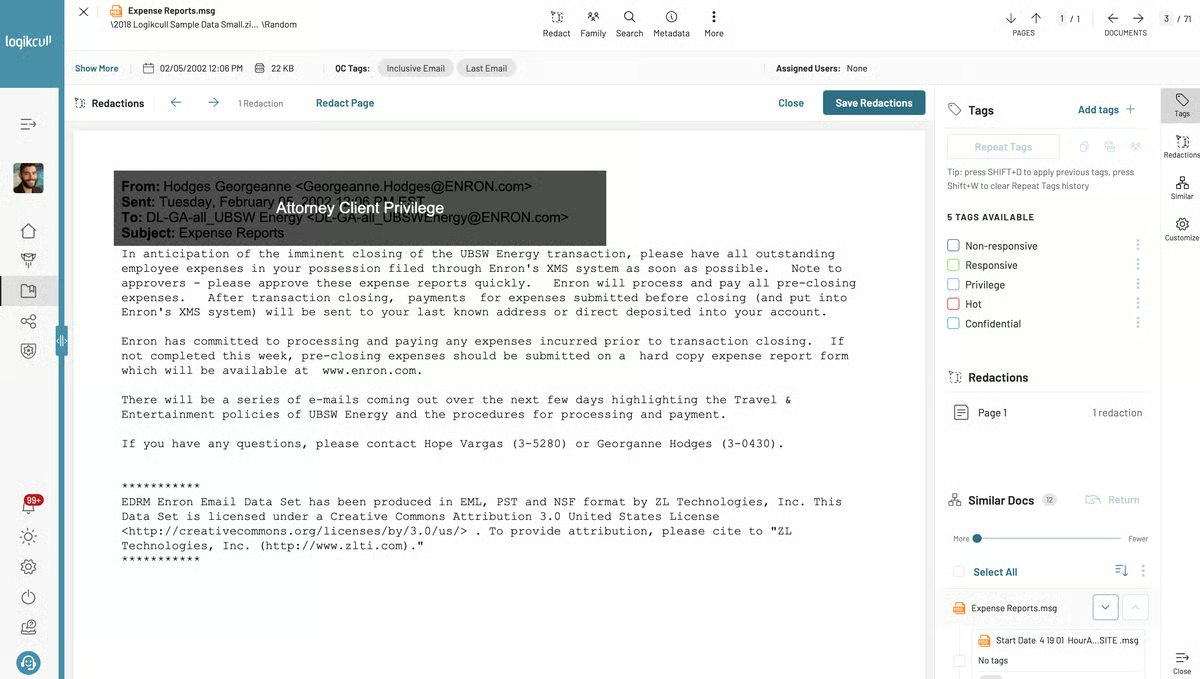
Logikcull simplifies the discovery process with its intuitive, cloud-based platform that automates data processing, document review, and case preparation.
Source: G2
Its artificial intelligence system speeds up the discovery process by automatically categorizing and reviewing electronically stored information. As a result, law firms can spend less time on manual document review and save money on data storage.
3. Luminance
Luminance uses proprietary machine learning algorithms to provide a detailed analysis of legal documents at speeds no human could match.

Source: Luminance.com
It is particularly effective in due diligence and contract analysis and can identify anomalies and patterns that might indicate risk or require further investigation.
Luminance’s AI understands language and document structure in a way that mimics human cognitive processes but with the ability to process information on a much larger scale.
Maximize Your Bottom Line With an Automated Discovery Process
Automating legal discovery starts a domino effect in your law firm. First, you upgrade your efficiency, which leads to better productivity and time management.
In turn, you’ll have more positive case outcomes and get more referrals from satisfied clients. At the end of the chain is a more competitive law firm and a superior bottom line.
With automation, your team can focus on high-value legal work instead of getting bogged down in tedious document reviews. So, are you ready to make the shift?
Get rid of the burden of creating discovery documents by hand. If you want to start optimizing your discovery process with state-of-the-art AI, book your free demo today!
Slash Hours From the Discovery Phase With Briefpoint
Discovery responses cost firms $23,240, per year, per attorney. $23,240 estimate assumes an associate attorney salary of $150,000 (including benefits – or $83 an hour), 20 cases per year/per associate, 4 discovery sets per case, 30 questions per set, 3.5 hours spent responding to each set, and 1800 hours of billable hours per year.
Book a demo and save on these costs with Briefpoint.
How Can Law Firms Use AI in Litigation?
Legal work takes time—lots of it. Attorneys spend hours on research, discovery, and drafting documents, and the workload never really slows down. But AI is changing the game to make litigation faster and a lot less tedious.
From automating routine tasks to pulling up relevant case law in seconds, AI is helping law firms work smarter. It’s improving accuracy, cutting costs, and freeing up time for the legal work that actually matters—strategy, client advocacy, and winning cases.
So, how does AI fit into litigation? What are the real benefits and the potential drawbacks? And what does this mean for the future of the legal profession?
This guide covers everything you need to know—from how law firms are using AI to how tools like Briefpoint are saving attorneys hours on discovery responses. Whether you’re already experimenting with AI or just curious about what’s next, this breakdown will give you a clear picture of AI’s role in modern litigation.

The Applications of AI in Litigation
Legal work is getting a boost from AI. Litigation is faster, more streamlined, and a lot less tedious, thanks to AI. Lawyers can now focus on the important parts of their job. Here’s how it’s being used in litigation today.
1. eDiscovery
Discovery is one of the most time-consuming parts of litigation. Finding the right stuff in a sea of emails, contracts, and case files takes forever. Lawyers and their assistants can spend weeks on this alone.
AI-powered eDiscovery tools take the heavy lifting off legal teams by scanning massive amounts of data in minutes.
Think of it like this: people reviewing things manually miss things. These tools, using machine learning, are much better at finding patterns, spotting errors, and highlighting important details. They’re much more accurate.
Instead of digging through endless documents, attorneys get a prioritized list of the most relevant files, making it easier to focus on building their case.
Besides saving you time, AI helps prevent those annoying little mistakes we all make sometimes. Overlooking evidence weakens any argument. But AI catches everything to minimize that problem.
With tighter deadlines and increasing data volumes in litigation, AI-driven eDiscovery helps firms stay ahead without getting buried in paperwork.
2. Legal Research
Finding the right case law, statutes, and legal precedents takes up a significant portion of an attorney’s time. Research platforms using AI speed things up; they quickly find the right cases and give you the main legal points.
Instead of manually combing through databases, lawyers can rely on AI to surface the most applicable rulings in seconds.
A few platforms offer case comparisons to show where arguments might fall short. Attorneys use this to make their strategies sharper.
Less time researching means more time crafting winning arguments for your clients.
3. Drafting Legal Documents
Legal document drafting is another area where AI is making a difference. Whether it’s responding to discovery requests, preparing contracts, or reviewing your legal writing, AI-powered tools automate much of the process with generative AI and large language models.
Generative AI tools generate templates based on past cases and legal best practices. Imagine trying to build a house without a blueprint. These tools are like that blueprint, making sure everything is done correctly and nothing is forgotten.
Essentially, using AI for writing is great for saving time; it handles a lot of the grunt work, but human review is still necessary.
A great example of this is Briefpoint, an AI-driven platform designed to handle discovery responses efficiently. Instead of spending hours drafting responses manually, attorneys can use Briefpoint to generate high-quality, customized discovery documents in minutes.
The tool automates formatting, inserts relevant objections, and structures responses based on legal standards—saving firms time and reducing errors.
By integrating AI-powered tools like Briefpoint, attorneys can focus more on case strategy and client advocacy rather than getting bogged down by repetitive paperwork.
4. Case Strategy and Predictions
One of AI’s most powerful applications in litigation is predictive analytics.
Using past cases and their results, AI can figure out the probable outcome of a new case. It does this by also looking at settlement patterns. Better decisions about settling versus trial are easier for attorneys with this information.
Some AI tools even assess the strengths and weaknesses of different legal arguments so lawyers can fine-tune their approach. While AI can’t guarantee an outcome, it provides valuable insights that help firms manage risk and develop stronger case strategies.

5. Compliance and Risk Management
AI is also playing a key role in regulatory compliance. Law firms dealing with highly regulated industries—such as finance, healthcare, and corporate law—use AI to review contracts and agreements for compliance risks.
Legal issues? These tools will flag them. Need contract revisions? They’ll suggest them. Want to compare your new contract to past agreements? These tools make it easy to achieve better consistency.
Firms can sidestep costly legal battles by automating compliance checks; this helps prevent missing important requirements.
6. Contract Review and Analysis
Reviewing contracts manually can take hours, especially for firms handling large volumes of agreements.
Contracts get a speed boost from AI; it spots inconsistencies, missing pieces, and possible problems. It can also compare agreements against previous versions to highlight any changes that may impact legal standing.
AI-powered contract analysis tools don’t just speed up reviews—they improve accuracy by catching details that a human reviewer might overlook.
This is particularly useful for transactional law, mergers and acquisitions, and employment agreements, where small errors can lead to significant legal consequences.
7. Client Communication and Chatbots
While AI won’t replace direct client interactions, it can make communication more efficient. Some law firms use AI-powered chatbots to handle routine inquiries, schedule consultations, and provide basic legal information. Lawyers gain extra time; clients get quicker responses.
Chatbots can’t offer legal advice, but they can assist with initial intake, document collection, and FAQs. Clients can access law firms more easily, and it doesn’t mean more work for the firms.
8. Fraud Detection and Investigations
Finding fraud and misconduct is easier with AI, mainly because it’s really good at picking up patterns in huge data sets.
Law firms and corporate legal departments use AI to analyze financial records, contracts, and communications for suspicious activity. Spotting possible fraud is easier for legal teams thanks to these tools, which identify irregularities. Investigations become more efficient as a result.
AI is particularly useful in white-collar crime cases, regulatory investigations, and corporate compliance audits, where finding key evidence quickly can make a significant difference.
What Are The Benefits of Adopting AI Into Your Practice?
AI isn’t just about speeding up processes—it brings real, measurable advantages to law firms. By handling repetitive legal tasks, improving accuracy, and reducing costs, AI allows attorneys to focus on strategy, client relationships, and complex work.
Here’s how integrating AI into your practice can make a difference.
Faster, More Efficient Workflows
Legal work comes with a ton of paperwork, research, and repetitive tasks, especially during litigation. AI takes a lot of that off an attorney’s plate by speeding up processes like document review and case research.
For example, generative AI models and natural language processing (NLP) can help you draft documents in minutes instead of the hours (or days) it would usually take.
So, instead of spending eternity digging through discovery documents or searching for relevant case law, AI can pull up what’s needed in minutes. That means lawyers can focus more on case strategy and less on tedious admin work.
Cost Savings
Law firms run on billable hours, but not all billable work adds real value.
Automating routine tasks like legal research and document creation with AI offers substantial cost reductions. This efficiency boost translates directly to the bottom line for businesses. For example, a law firm could reduce its administrative costs by 15% or more.
Take Briefpoint, for example—it slashes the time attorneys spend drafting discovery responses, saving firms around $20,477 per year, per attorney. That’s money that can be reinvested into client service, firm growth, or even taking on more cases without overloading the team.
Improved Accuracy and Reduced Errors
Even the best attorneys can miss small details when reviewing stacks of documents. AI provides an extra layer of accuracy by flagging inconsistencies, spotting missing clauses in contracts, and identifying compliance risks before they become problems.
It won’t replace human judgment, but it can help make sure nothing slips through the cracks. With AI handling the heavy lifting, legal teams can be more confident that their research and filings are rock-solid.
Better Decision-Making
By analyzing past rulings, settlement trends, and even judge behavior, AI can predict case outcomes with surprising accuracy. Before court or settlement talks, this gives lawyers a much better idea of their likelihood of success.
High-stakes litigation? Forget relying solely on intuition. Data-driven strategies provide a powerful competitive edge.
More Time for High-Value Work
Legal work isn’t just about filing motions and drafting contracts—client relationships and courtroom strategy matter just as much. AI helps attorneys shift their focus from repetitive admin tasks to the work that truly moves the needle.
Because AI now does the legwork of research, document preparation, and compliance reviews, lawyers have more time for the things that really matter: building winning cases, negotiating fair settlements, and providing expert advice to their clients.
This means better representation for everyone.
Better Client Service
Clients want quick answers and timely updates, and AI helps law firms deliver just that. Chatbots and virtual assistants can handle basic client inquiries, schedule meetings, and even help with initial case intake.
AI-powered document automation tools also speed up response times, so clients aren’t left waiting on paperwork. Ultimately, this results in a more seamless experience for clients and less back-and-forth for attorneys.
Scalability for Law Firms
Growing a law firm takes more than just adding new attorneys—it requires efficient processes. AI makes it easier for firms to scale without hiring an army of associates.
Smaller businesses can handle a bigger caseload by automating their busywork. This prevents them from becoming overloaded.
It’s a win-win: Smaller legal practices can compete with larger ones by providing excellent service at a reasonable cost. This means clients get quality representation without the hefty price tag.
Are There Any Limitations or Drawbacks to AI-Powered Litigation?
AI is a powerful tool, but it’s not perfect.
One of the biggest concerns is that AI lacks human judgment. While it can analyze documents, predict case outcomes, and automate research, it doesn’t understand legal nuances the way a trained attorney does. Complex cases require strategic thinking, negotiation skills, and ethical considerations that AI simply can’t handle.
Bias is another issue. AI learns from the past. So, if past court cases showed bias, the AI might repeat those same mistakes. Attorneys must check AI suggestions; otherwise, predictions and recommendations might be biased.
There’s also the matter of cost and implementation. While AI can save money in the long run, high-quality legal AI tools require upfront investment and ongoing training. Firms must integrate these tools into their workflow and make sure staff knows how to use them effectively.
Don’t forget the laws and the moral side of things. These are critical considerations. Legal work from AI needs a lawyer’s check to make sure it’s right and follows all the rules.
Courts may also challenge AI-generated filings or arguments, making it clear that while AI can assist in litigation, it won’t be replacing attorneys anytime soon.
What Does AI Mean For the Future of the Legal Profession?
The legal field is changing thanks to AI, and it’s happening faster than most people thought. When OpenAI first released ChatGPT, most law firms weren’t paying much attention.
A survey from Thomson Reuters found that only 3% of attorneys and law firm staff were actually using AI, and 60% had no plans to adopt it. Even firms that were considering AI were hesitant to implement it in real legal work.
Less than a year later, the landscape had completely shifted. A follow-up survey of top U.S. law firms revealed that AI was already making an impact.
While many firms initially limited its use to internal tasks that didn’t involve client data, nearly half of the Am Law 100 firms had started actively using AI for legal research, business operations, and case strategy.
This rapid adoption shows that AI isn’t just a passing trend for the legal industry—it’s a fundamental shift in how legal work gets done. While AI won’t replace attorneys, firms that embrace it will be better positioned to stay competitive, improve efficiency, and provide faster, more accurate legal services.
Your Discovery Process Doesn’t Have to Be a Drag
Here’s a clear fact—litigation comes with a lot of tedious work. You didn’t become a lawyer to spend hours drafting discovery responses or digging through endless case files. And this is exactly why AI is becoming more and more of a necessity for legal professionals these days.
Adopting AI is all about giving you the tools to work faster and more efficiently. The firms that embrace AI aren’t drowning in paperwork. They’re focusing on case strategy, client advocacy, and winning.
If you’re tired of spending hours on discovery drafting, Briefpoint makes it simple. Generate structured, professional responses in minutes instead of wasting valuable time on formatting and repetitive edits. More efficiency means more time for legal work that actually matters!
See what it can do for your legal practice—schedule a Briefpoint demo today.
Make Your Litigation Workflows More Value-Adding
Discovery responses cost firms $23,240, per year, per attorney. $23,240 estimate assumes an associate attorney salary of $150,000 (including benefits – or $83 an hour), 20 cases per year/per associate, 4 discovery sets per case, 30 questions per set, 3.5 hours spent responding to each set, and 1800 hours of billable hours per year.
Book a demo and save on these costs with Briefpoint.
5 Best Legal Tech For Litigation (2026’s Top Options)

Types of Legal Technologies for Litigation
The legal tech industry solves hundreds of problems for law firms, which span across multiple aspects of the legal profession, including litigation.
Here are types of legal tech that are particularly useful for law firms that focus on litigation, as well as arbitration or mediation:
- Discovery document generation: AI-powered tools like Briefpoint.ai automate discovery request and response drafting, which mostly eliminates the need for manual document creation and reduces hours of work to minutes.
- Case management software: Centralizes case files, deadlines, communications, and tasks to help litigation teams stay organized and make sure nothing is overlooked.
- Legal research platforms: AI-driven databases streamline legal research, offering quick access to case law, statutes, regulations, and predictive insights.
- Communication and collaboration tools: Secure messaging, video conferencing, and collaboration features make way for seamless interaction among legal teams, clients, and stakeholders.
- Trial presentation software: Supports real-time display of evidence, including documents, videos, and audio, to help attorneys present compelling arguments in court.
- Litigation analytics: Analyzes past rulings, judge decisions, and litigation trends to provide data-driven insights that strengthen case strategy.
How Can Legal Tech Help Litigation?
The legal industry is becoming more and more accepting of technology as it continues to evolve–and for all the right reasons. From a wider point of view, legal technology makes workflows easier, faster, and overall more efficient.
But if we look closer, the benefits of legal technology for litigation are clearer:
Maximizing Operational Efficiency
Legal technology introduces automation in various facets of litigation, including document management, billing, and case tracking.
This automation reduces the time legal professionals spend on administrative tasks, which allows them to allocate more resources toward critical thinking and case strategy development.
The result? Law firms and legal departments can handle cases more effectively, reduce delays, and improve the overall quality of their legal services.
Improving Accuracy and Risk Mitigation
Legal tech tools minimize the potential for human error by reducing the reliance on manual processes.
Automated document generation, for example, helps maintain consistency and accuracy in legal filings. In turn, this reduces the risk of mistakes that could lead to delays or negative legal outcomes.
Plus, litigation analytics can help identify potential risks and outcomes based on historical data, which allows for better-informed decision-making.
Refining Discovery and Evidence Management
Automated discovery tools are designed to handle vast amounts of electronic data and allow legal teams to efficiently identify, collect, and analyze relevant information.
This feature is an absolute must in a digital age where evidence often resides in electronic formats. Advanced search algorithms and analytics can uncover crucial pieces of evidence that might be overlooked manually, which can offer a strategic advantage in litigation.
Reducing Costs
While the initial investment in legal tech may be significant, the long-term savings are substantial. Law firms can reduce overhead costs just by simply automating routine tasks and improving efficiency.
Additionally, the precision and speed of legal tech tools can decrease the duration of litigation, which further cuts down expenses that often come with prolonged or delayed cases.
Upgrading Client Satisfaction
When you consider the benefits of legal technology, you can see that using legal technology contributes to higher levels of client satisfaction.
Clients benefit from quicker responses, more transparent communication, and potentially faster resolutions to their cases. More importantly, the ability to provide detailed insights and data-driven strategies can reinforce clients’ confidence in their legal representation.
Increasing Law Firm Profitability
Positive case outcomes almost always result in better law firm profitability, and that’s what both lawyers and clients want. Software solutions can increase the chances of a positive verdict via better legal research, stronger evidence, or even the absence of errors.
In turn, lawyers get their win, and happy clients are likely to bring in more potential clients to the law firm through word-of-mouth. Either way, the winning law firm will see a positive effect on their bottom line.

Best Legal Tech Litigation Tools Every Law Firm Should Have
While legal tech, in general, can yield positive results for a law firm, not all legal tech products are made equal. Legal practitioners still have to be selective when choosing the right stack of tools, especially when it comes to something as crucial as litigation.
Here’s a list of some of the best litigation tools to help you narrow down your search:
1. Briefpoint.ai
Briefpoint.ai is a discovery document automation tool that helps legal professionals generate responses and outgoing sets for Requests for Production, Requests for Admission, and Interrogatories.
Instead of manually drafting discovery documents—a process that can take hours or even days—Briefpoint’s AI-powered system simplifies the workflow, reducing effort while maintaining accuracy.
With a simple three-step process, users can upload a discovery request, select objections and responses, and generate a formatted document that’s ready to finalize in Word.
It’s designed to cut down on repetitive tasks, improve efficiency, and minimize errors in discovery document preparation.
Best Features
- Automated discovery responses: Uses AI to extract details from discovery requests and generate responses in minutes.
- Built-in formatting compliance: Identifies court names and applies local formatting rules automatically.
- Smart objection selection: Lets users choose from pre-set objections, which makes it incredibly easier to respond to requests efficiently.
- Word document export: Provides a structured, mostly completed document that can be finalized in Word.
- Briefpoint Bridge: Helps you translate interrogatories into plain English, collect responses from clients, and plug in their answers into your legal documents.
Pros
- Saves significant time on discovery document preparation
- Reduces manual data entry and copy-pasting
- Ensures proper formatting based on court requirements
- AI-assisted response generation minimizes errors
- Intuitive interface with minimal learning curve
- Allows document downloads at any stage of the process
2. Clio
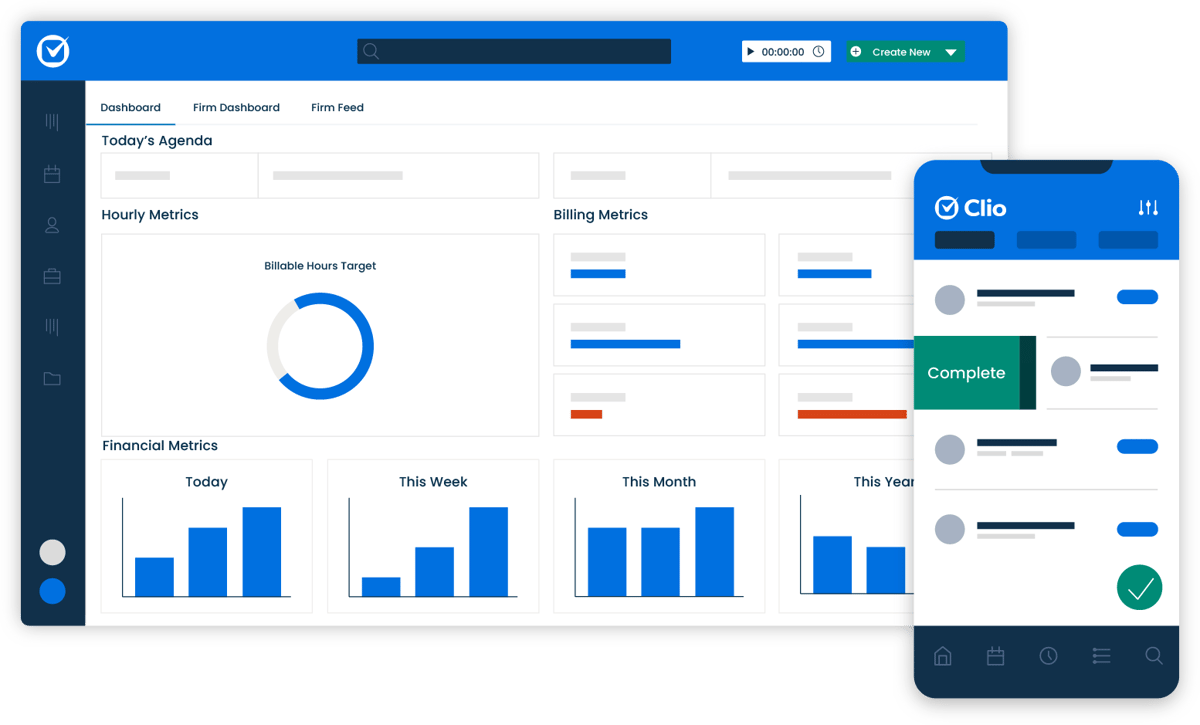
Clio is always going to be the go-to for case and practice management. It offers features that cover everything from document management and time tracking to billing and client communication.
Source: G2
Plus, everything is on a cloud-based system, which allows easy access to case files and information from anywhere.
Best Features
- Case and document management: Stores case files, emails, and client communications in a centralized platform.
- Billing and invoicing: Automates time tracking, invoice creation, and online payments to simplify financial management.
- Client intake and CRM tools: Helps law firms manage leads, onboard clients, and maintain relationships.
- Cloud-based access: Enables remote work with secure access from any device.
- Extensive integrations – Connects with legal research tools, accounting software, and other third-party applications.
Pros
- Comprehensive case and client management features
- User-friendly interface with easy navigation
- Secure cloud storage with access from anywhere
- Customizable workflows and task automation
Cons
- Higher pricing compared to some alternatives
- Learning curve for advanced features
- Some features may require third-party integrations for full functionality
3. Lex Machina
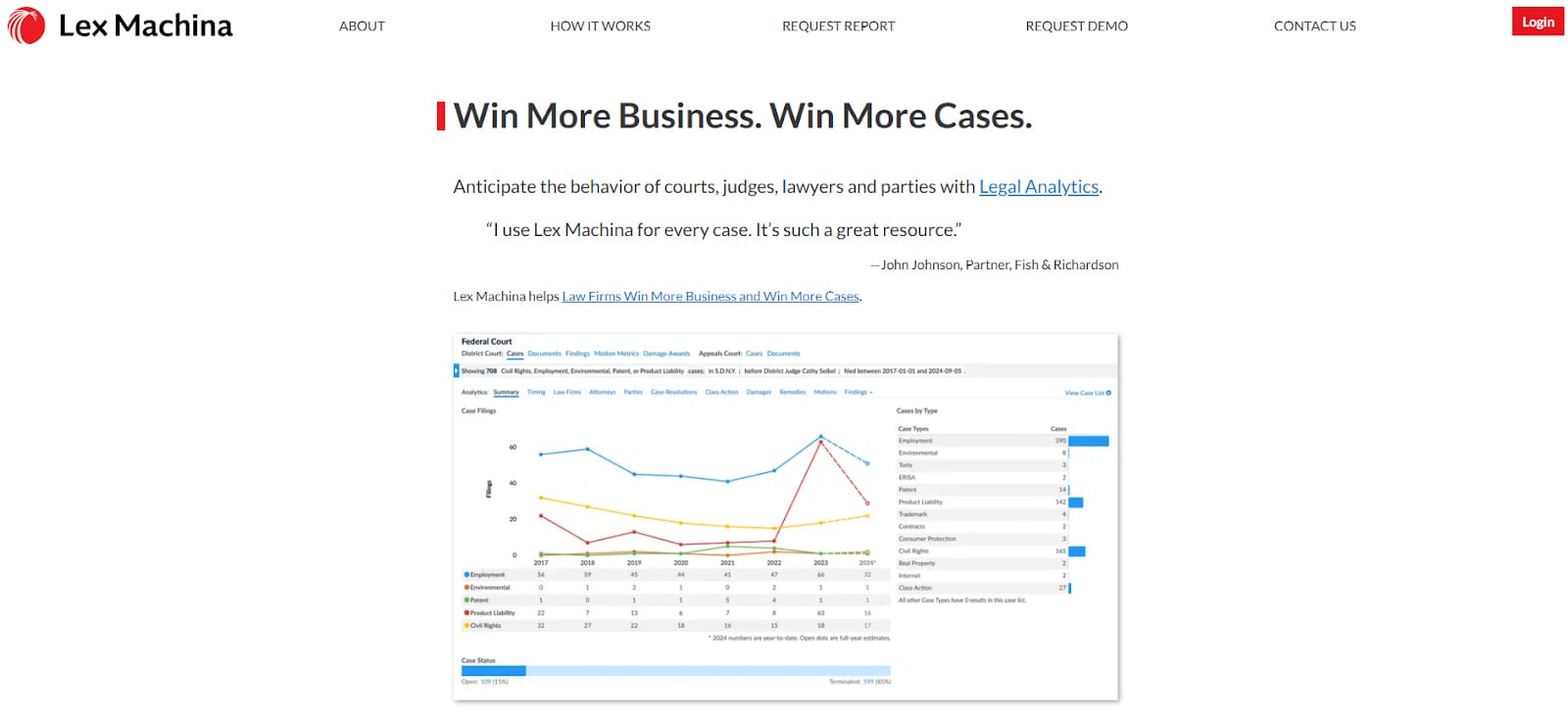
Lex Machina is known for transforming raw legal data into strategic insights. This platform mines litigation data from a vast array of sources and applies sophisticated analytics to unearth patterns and trends that are not immediately apparent.
Source: LexMachina.com
By offering a detailed examination of judges’ rulings, litigation histories, and even the tactics employed by opposing counsel, Lex Machina gives legal professionals a deeper understanding of the legal battlefield.
Best Features
- Judge and court analytics: Tracks judge tendencies, ruling patterns, and case outcomes.
- Opposing counsel insights: Analyzes law firms and attorneys to predict litigation strategies.
- Case outcome predictions: Uses historical data to estimate the likelihood of success.
- Practice area-specific data: Provides tailored analytics for different legal specialties.
- Customizable reports: Generates visual reports for presentations and case evaluations.
Pros
- Saves time on legal research with automated data analysis
- Provides transparency on judge and attorney behavior
- Covers a wide range of practice areas
- User-friendly dashboards with clear visualizations
Cons
- Expensive compared to standard legal research tools
- Requires training to maximize its features
- Data is limited to available court records
4. MyCase
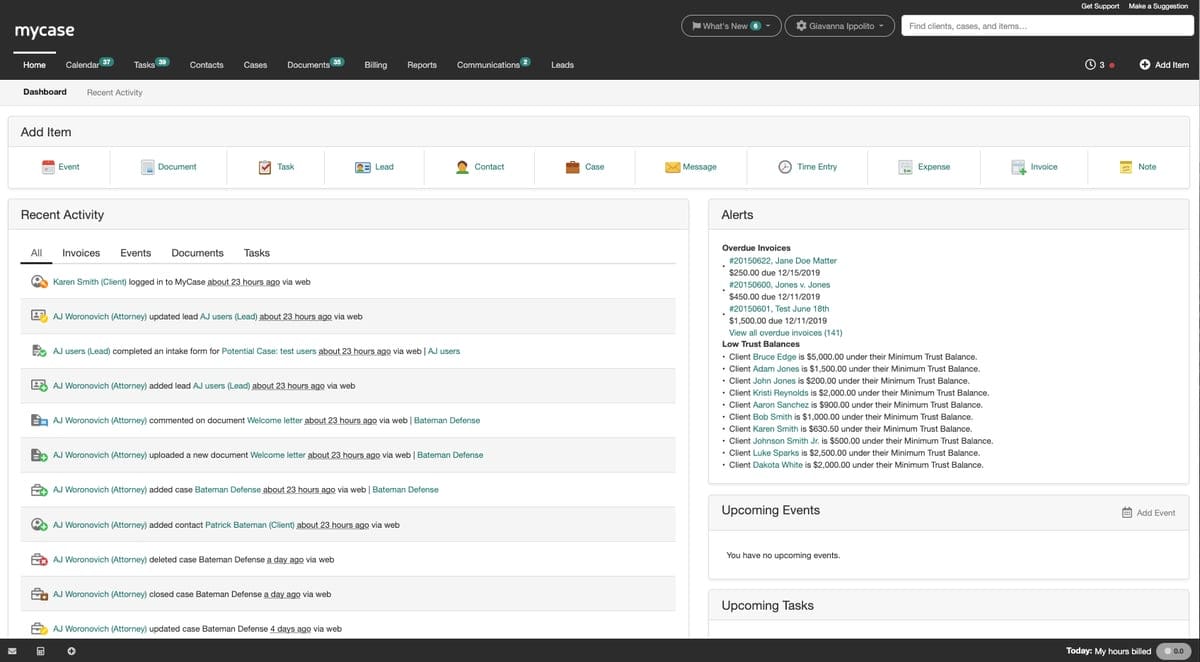
MyCase bridges the communication gap between lawyers and their clients and fosters an environment of trust and transparency.
Source: G2
One of the standout features of MyCase is the ability for clients to have real-time access to their case files and information. This means that at any moment, they can log in to the portal to review documents, see the latest updates, and track the progress of their case.
Such access demystifies the legal process for clients and helps them feel more involved and informed about the proceedings of their cases.
Best Features
- Case and document management: Organizes case files, emails, and client records in a single dashboard.
- Built-in billing and payments: Supports online payments, time tracking, and automated invoicing.
- Client communication portal: Provides a secure space for messaging, document sharing, and updates.
- Task and workflow automation: Helps organize and speed up repetitive administrative tasks.
- Mobile app: Allows attorneys to manage cases and communicate with clients on the go.
Pros
- Intuitive and user-friendly interface
- Secure cloud-based access from any device
- Integrated payment processing with online billing
- Organizes client communication with a dedicated portal
Cons
- Limited customization for reports and workflows
- Some integrations require additional setup
- Mobile app has fewer features than the desktop version
5. LawPay
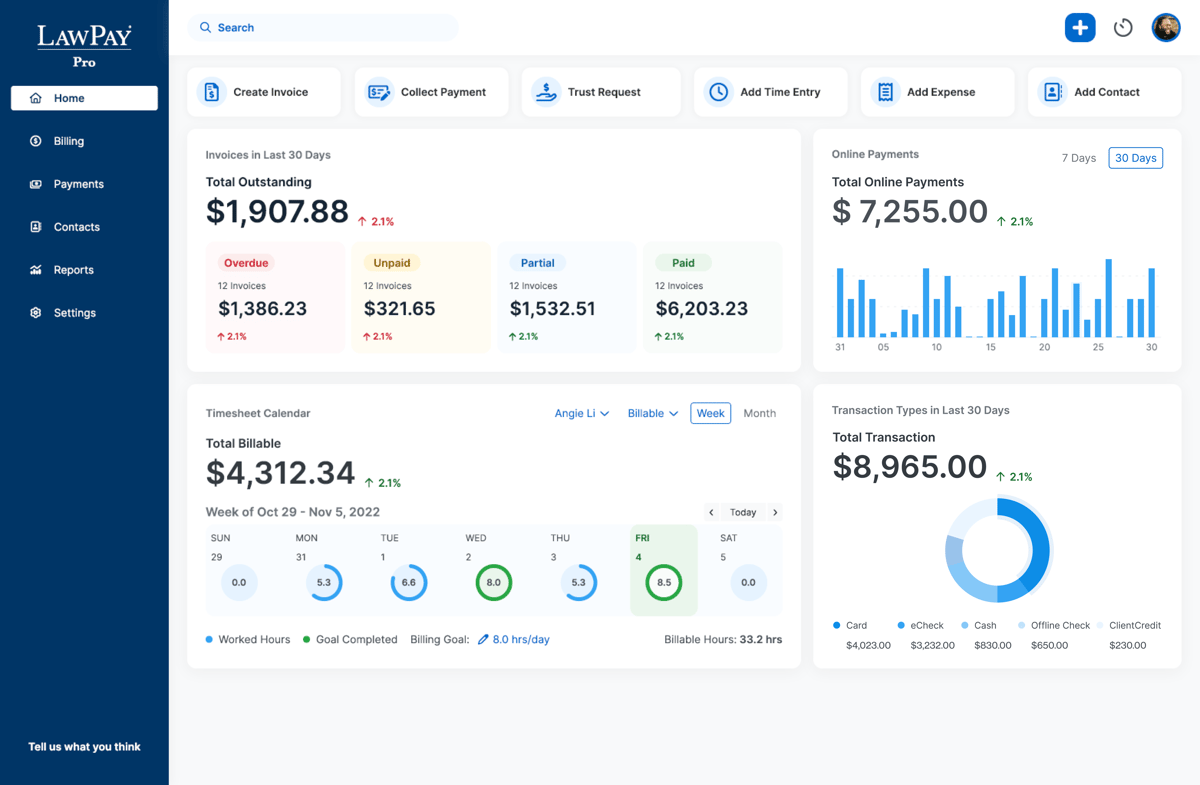
LawPay is a legal payment processing platform designed to help law firms securely accept online payments while staying compliant with ABA and IOLTA regulations.
Source: G2
For litigation lawyers, it simplifies tracking billable hours by integrating with time-tracking and invoicing tools. Ultimately, it helps maintain accurate client billing.
Best Features
- Trust accounting compliance: Keeps client funds separate and ensures IOLTA and ABA compliance.
- Multiple payment options: Accepts credit cards, debit cards, and eChecks.
- Secure online payments: Provides a client-facing payment portal for easy transactions.
- Integration with legal software: Connects with Clio, MyCase, and other practice management tools.
- Recurring and scheduled payments: Automates billing for retainers and ongoing client payments.
Pros
- Helps litigation lawyers track all billable hours efficiently
- Maintains trust accounting compliance
- Easy-to-use client payment portal
- Integrates with major legal management platforms
Cons
- Processing fees may be higher than general payment processors
- Limited features beyond payment processing
- No built-in invoicing (relies on integrations)
Best Practices for Using Legal Technology
Implementing litigation technology effectively goes beyond selecting the right tools; to truly enhance the practice of law, you also need a strategic approach to integration, usage, and ongoing management.
Here are some best practices for law firms looking to make the most of legal technology:
Prioritize Training and Education
Just having the right legal tech isn’t enough—everyone on your team needs to know how to use it effectively. A solid training plan helps legal professionals get up to speed quickly so they’re not wasting time figuring things out on their own.
Start with a structured onboarding process that walks users through essential features and workflows. But don’t stop there—ongoing education is just as important. For example, you can:
- Host live training sessions
- Provide on-demand tutorials
- Set up refresher courses
- Create a knowledge base
- Encourage peer learning
The more comfortable they are with the tools, the more efficiently they can get work done.
Implement Strong Security Measures
Law firms handle sensitive client data every day, so security has to be a top priority. Encryption keeps documents and communications safe, while regular software updates help close security gaps that hackers might exploit.
It’s also a good idea to run periodic security audits to catch vulnerabilities before they become a problem. Adding multi-factor authentication (MFA) and role-based access controls can further limit who gets access to what.
Security isn’t a one-and-done task—ongoing training helps staff spot phishing attempts, use secure networks, and follow cybersecurity best practices.
Focus on Client Data Protection
Keeping client data safe is non-negotiable in legal practice. That means using encrypted emails, secure client portals, and other protected channels instead of standard messaging apps.
Staff should also be trained on confidentiality protocols to prevent accidental data leaks. And when adopting new legal tech, make sure it meets security standards like GDPR or ABA guidelines.
Regular data backups and a solid disaster recovery plan help make sure client information stays protected, even if a cyberattack or system failure occurs.
Embrace Flexibility and Scalability
Legal technology is always evolving, so law firms need tools that can grow with them. Choosing flexible and scalable solutions makes sure that as needs change—whether due to firm expansion, new regulations, or emerging tech—there’s no disruption to daily operations.
Cloud-based and modular platforms make it easier to integrate new features without overhauling existing systems. It’s also worth keeping up with legal tech news to find new opportunities to upgrade your litigation workflows.
Optimize for Collaboration and Accessibility
Legal work often requires teamwork, and the right technology should make that easier, not harder. Cloud-based tools allow staff to access case files, documents, and communications from anywhere, whether they’re in court, at the office, or working remotely.
Cross-device compatibility provides a seamless experience, keeping lawyers, paralegals, and clients connected and productive no matter where they are
Monitor and Analyze Technology Performance
Investing in legal technology is only worth it if it actually improves efficiency. Firms should routinely track how these tools impact productivity, case outcomes, and overall workflow.
Regular assessments help determine whether a tool is meeting expectations or if adjustments—such as training, upgrades, or replacements—are needed to maximize its value.

Incorporating Technology in Your Practice Doesn’t Have to Be Difficult
The legal world is always rife with competition, and that won’t change any time soon. Stay ahead of your competitors by integrating new systems into your practice areas, starting with automation tools that can make work easier.
Use the power of artificial intelligence to get rid of the bottlenecks in litigation. With Briefpoint, you can take out hours upon hours of work spent on just drafting discovery documents. Save your brain power for more value-adding tasks and let Briefpoint do the work.
Automate Your Discovery Phase With Briefpoint
Discovery responses cost firms $23,240, per year, per attorney. $23,240 estimate assumes an associate attorney salary of $150,000 (including benefits – or $83 an hour), 20 cases per year/per associate, 4 discovery sets per case, 30 questions per set, 3.5 hours spent responding to each set, and 1800 hours of billable hours per year.
Book a demo and save on these costs with Briefpoint.
Top 5 Legal Workflow Management Software

By leveraging advanced AI and machine learning, Briefpoint automates the preparation of discovery documents, which allows legal professionals to focus on higher-value work instead of getting bogged down by repetitive administrative tasks.
It handles everything from scanning documents for key information to generating properly formatted responses that comply with local court rules.
Whether you’re a solo practitioner or part of a busy legal team, Briefpoint is a must-have for efficiency and accuracy in discovery-related workflows.
Best Features
Automated document drafting: Upload discovery requests, and Briefpoint’s AI extracts key details like court names, case numbers, and request types.
Objection management: Easily add objections to requests or interrogatories with a simple click.
Customizable formatting: The system applies local court formatting rules for professional results.
Integration with Word: Download partially completed briefs, ready to be finalized in Word.
Broad court compatibility: Supports discovery requests across all U.S. state courts.
Pros
Drastically reduces the time spent on drafting discovery documents
Improves accuracy by automating repetitive tasks prone to human error
Offers a simple, user-friendly interface that’s easy to learn
Ensures compliance with local court rules by applying proper formatting
Supports collaboration by allowing team members to review and adjust drafts
Compatible with all U.S. state courts, making it versatile for legal teams nationwide
2. Clio
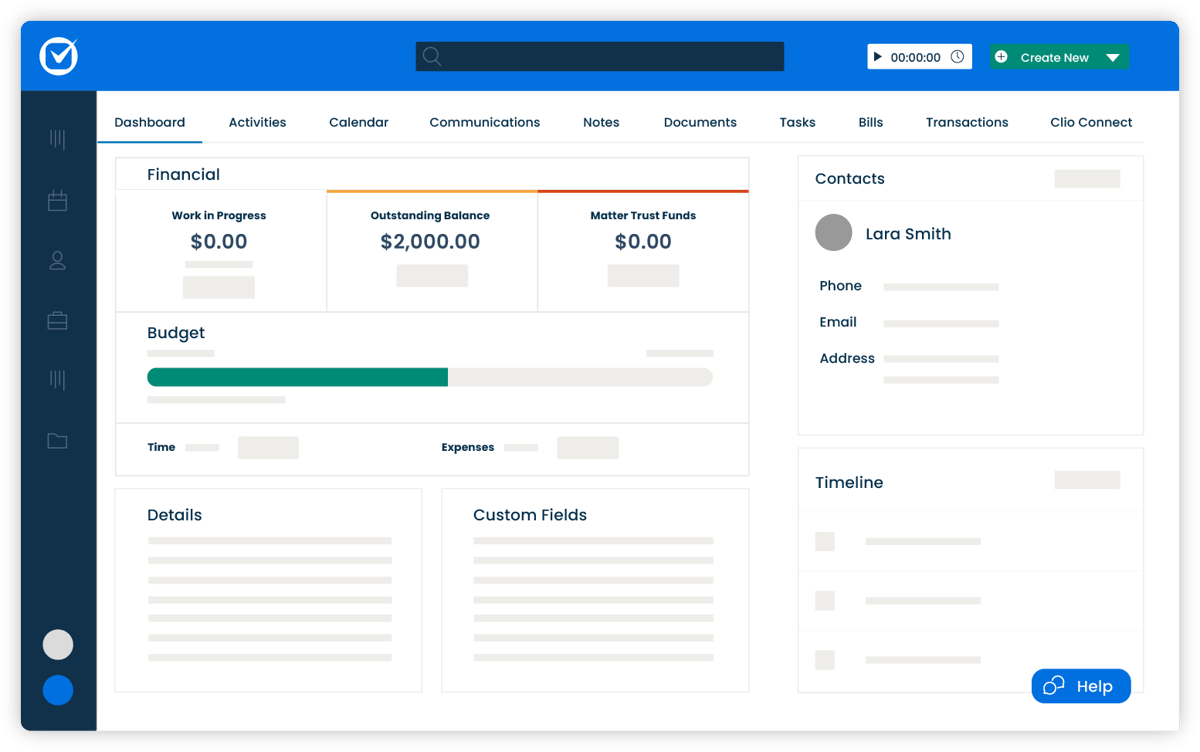
Clio is an all-in-one legal workflow management solution designed to simplify operations for law firms of any size. It provides everything you need for case management, billing, and client communication, all within a single, easy-to-use platform.
Source: G2
With extensive integration options and a focus on efficiency, Clio helps legal professionals manage tasks like client intake, time tracking, and payment processing while staying organized and compliant.
Best Features
- Comprehensive case management: Track all client and case details, deadlines, and communications in one place.
- Billing and payments: Generate invoices and accept payments directly through the platform.
- Client intake management: Simplify onboarding with customizable intake forms and workflows.
- Over 200 integrations: Works seamlessly with tools like Google Workspace, Microsoft 365, and QuickBooks.
- Mobile app: Manage your practice on the go with Clio’s fully featured mobile app.
Pros
- Scales well for firms of all sizes
- Strong integration capabilities for better functionality
- User-friendly design simplifies complex tasks
- Offers detailed reporting for better insights
- Mobile app mirrors desktop features for flexibility
Cons
- Higher pricing can be a barrier for smaller firms
- Some users may find the feature set overwhelming initially
- Advanced features may require additional setup time
Pricing
Clio offers multiple pricing tiers starting at $49 per user per month. The most basic plan offers calendar management, online payment options, and time tracking. Higher-tier plans unlock advanced features such as client intake automation and enhanced reporting.
3. MyCase
MyCase is an all-in-one legal management platform designed to simplify case management, billing, and client communication.

Source: G2
It’s tailored for small to mid-sized law firms and provides an intuitive interface that makes tracking tasks, managing deadlines, and handling invoicing more efficient.
Best Features
- Integrated time tracking and invoicing: Manage billable hours and generate invoices directly within the platform.
- Secure client communication: Use encrypted client portals to share updates, documents, and messages.
- Deadline and task management: Keep track of all important dates and to-dos to stay organized.
- Document management: Store, organize, and access all case-related files in one central location.
- Mobile app support: Manage your practice on the go with MyCase’s mobile-friendly features.
Pros
- Combines case management and billing in one platform
- Offers secure client communication with encrypted portals for better client satisfaction
- Easy-to-navigate interface, even for less tech-savvy users
- Includes mobile access for on-the-go management
Cons
- Limited customization for advanced reporting
- Some features may feel basic for larger firms
- Mobile app lacks some advanced functionalities
Pricing
MyCase pricing starts at $49 per user per month for the Basic plan. It includes core features like task management, a client portal, and expense tracking.
4. Smokeball
Smokeball is a cloud-based legal practice management software built to improve efficiency for small law firms. It offers automatic time tracking, document automation, and daily task management features to help lawyers and staff stay organized and productive.

Source: Smokeball.com
With a user-friendly interface and frequent updates, Smokeball caters to firms looking for an efficient way to manage their daily operations without unnecessary complications.
Best Features
- Automatic time tracking: Keeps track of your work hours without requiring manual entry, ensuring accurate billing.
- Document automation: Simplifies the creation of legal documents using pre-built templates.
- Daily digest: A feature that provides an overview of deadlines, tasks, and appointments to keep you on track.
- Client and matter management: Centralized storage for client information and case files.
- Email and calendar integration: Syncs seamlessly with Outlook to keep communication and scheduling in one place.
Pros
- Saves time with automatic time tracking
- Excellent document automation features for faster drafting
- Intuitive and easy-to-learn interface
- Frequent updates make sure the software stays current
- Strong customer support
Cons
- Higher price point compared to some competitors
- Limited customization options for larger firms
- Some advanced features may have a learning curve
Pricing
Smokeball plans are currently not available for public viewing.
5. Checkbox
Checkbox is a no-code platform built to help legal teams automate repetitive workflows and create customized solutions for their unique needs.
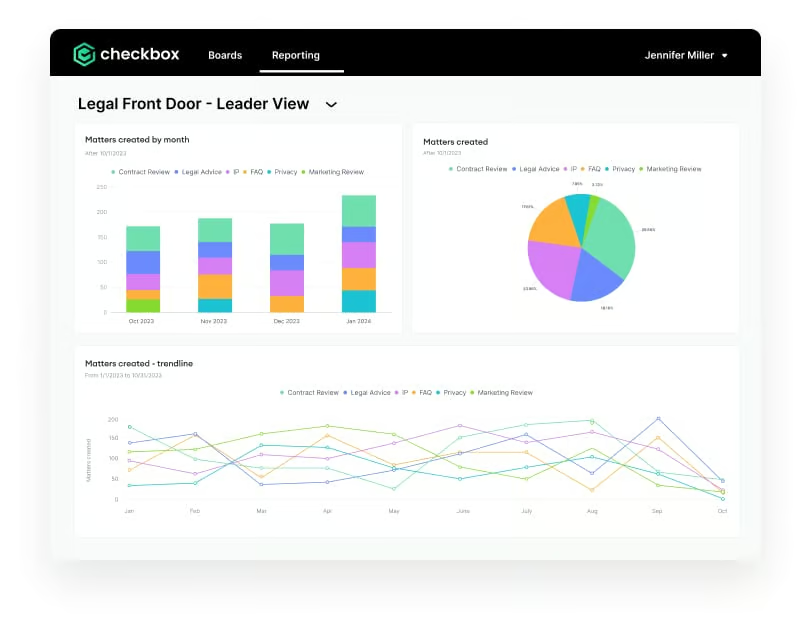
Source: G2
Designed for efficiency and flexibility, Checkbox allows users to build digital workflows, automate compliance tasks, and create self-service portals without requiring technical expertise. It’s particularly well-suited for law firms handling high volumes of routine tasks or processes.
Best Features
- Drag-and-drop workflow builder: Easily design workflows without coding skills.
- Pre-built templates: Get started quickly with customizable templates for legal workflows.
- Self-service portals: Create portals for clients or internal teams to streamline task management.
- Integration options: Connect with tools like Outlook, Google Workspace, and more.
- Scalability: Adaptable for firms of various sizes and industries.
Pros
- User-friendly interface makes automation accessible
- Ideal for compliance-heavy processes
- Highly customizable to suit specific legal needs
- Enables faster service delivery with client portals
- Supports integrations to connect with existing tools
Cons
- Best suited for teams with clear workflow requirements
- Limited analytics and reporting capabilities
- Advanced features may require some initial setup
Pricing
Checkbox has no direct pricing on its website.
Briefpoint Automates The Most Tedious Part of Your Workflow
Legal workflow software has the power to redefine how your firm operates, turning time-consuming processes into seamless tasks.
Tools like Briefpoint stand out by addressing specific challenges, like automating discovery responses, saving valuable hours, and reducing stress for legal professionals.
Why spend countless hours on repetitive tasks when Briefpoint can handle them with precision and speed? Save time, cut down on errors, and focus on delivering outstanding service to your clients. Don’t just manage your workload—transform it.
Schedule a free demo with Briefpoint today and see how it can revolutionize your workflow.
Get Unlimited Savings With Document Automation
Discovery responses cost firms $23,240, per year, per attorney. $23,240 estimate assumes an associate attorney salary of $150,000 (including benefits – or $83 an hour), 20 cases per year/per associate, 4 discovery sets per case, 30 questions per set, 3.5 hours spent responding to each set, and 1800 hours of billable hours per year.
Book a demo and save on these costs with Briefpoint.
Legal AI: Applications & Benefits in 2026

What Is Legal AI?
Legal AI is a technology that uses artificial intelligence to make legal work faster and more efficient. It handles tasks like reviewing contracts, analyzing documents, performing research, and automating processes like drafting agreements or answering client questions.
Natural language processing (NLP) and machine learning allow it to understand legal text, extract key details, flag risks, and predict case outcomes.
How Do Law Firms Use Artificial Intelligence?
AI technology is taking over numerous professional sectors, including business, finance, real estate, and healthcare. The legal industry was quite slower to adopt this type of tech in comparison, but there’s no denying that AI has become a must-have tool for legal professionals.
How did AI make its way into legal departments, an industry that abides by tradition? Here’s a look at some important areas where AI is making a big difference:
1. Document Drafting
Traditionally, creating standard legal documents like contracts, agreements, and wills was a meticulous and time-consuming task that required a lot of attention to detail to make sure everything was accurate and compliant. But now, AI has made this process much more efficient.
Legal AI tools can automate the creation of these standard documents by analyzing large datasets and identifying relevant clauses. A specific type of AI common in document automation and drafting is generative AI.
Generative AI tools draft complex legal documents by generating text that meets the necessary requirements. For example, if a lawyer needs a discovery response document with particular objections, generative AI tools like Briefpoint can produce a draft that includes all the necessary legal language and clauses.

2. Data Synthesis and Document Analysis
In legal work, sorting through piles of documents and data is a given, but it’s also one of the more time-consuming parts of the job. AI is stepping in to simplify this hefty task.
By using AI tools, lawyers can automate the process of organizing and analyzing vast amounts of legal data, from client communications to detailed case histories.
These tools quickly sift through information, extract the necessary details, and present them in a way that’s easy to understand. This speeds up the entire process and reduces the chance of human error.
The result? Legal teams get the insights they need faster, which, in turn, makes it simpler to build cases or advise clients.
3. Legal Research
Legal research is essential for any law practice, as lawyers need to sift through vast amounts of statutes, case law, and legal writings to support their arguments or provide advice. Traditionally, this task has been incredibly time-consuming and sometimes error-prone.
However, large language models (LLMs) and other AI tools are changing the game by speeding up the process and increasing efficiency.
These tools use advanced algorithms, machine learning, and other large language models to comb through extensive legal databases quickly. They can accurately identify relevant cases, laws, and articles much faster than manual methods (way faster than a human can).
This efficiency saves time and helps lawyers build stronger cases by reducing the risk of missing crucial information.
With AI, even smaller law firms or solo practitioners can access comprehensive research quickly, which can help them gain a competitive advantage over larger firms with more resources.
4. Predictive Analysis
Predictive analysis in the legal world means using AI to predict the outcomes of legal cases before they wrap up. This tech dives into heaps of data—from past court decisions to detailed legal precedents—to empower legal professionals to make sound predictions.
This kind of insight can make or break a court victory. For example, it helps lawyers figure out the best strategies for their cases, like whether to settle early or push through to trial based on the predicted outcomes.
But it’s not just about strategizing. Predictive analysis is also great for risk assessment. Law firms use this legal tech to check out the risks of taking on new cases. They can spot potential problems before they blow up, saving everyone a lot of time and money by avoiding drawn-out legal battles.
Clients get a lot from this, too. They receive advice backed by solid data, which can help them make well-informed decisions about their legal issues.
5. Client Communications
Effective communication with clients is an absolute must in the legal profession, but keeping up can be quite a task, especially for busy lawyers. AI is changing how law firms manage this by automating routine interactions and helping maintain consistent, timely communication.
AI tools, such as chatbots and virtual legal assistants, can handle tasks like:
- Answering common inquiries from clients
- Scheduling appointments
- Sending updates about case progress
These tools work around the clock to make sure that clients receive quick responses, which boosts their satisfaction and trust in the legal services provided.
Plus, these AI systems can personalize communications based on client data to make interactions feel more tailored and attentive. For a law firm, this means less time spent on routine tasks and more time available for the complex aspects of their cases.
6. Contract Management
AI models can quickly scan contracts to pinpoint unusual clauses or potential risks. As a result, they speed up the review process and help make sure that everything is up to par legally and aligned with business goals.
When drafting contracts, AI can offer the right language and clauses based on a huge database of existing contracts. AI also helps keep track of active contracts, sending alerts about compliance issues, renewals, or any deviations from the terms.
Such oversight helps prevent problems down the line and makes sure contracts are managed properly.

Stop Spending Hours on Discovery Documents and Let Briefpoint Help
Drafting discovery responses and request documents is by far one of the most tedious parts of the discovery process. What about your legal strategy? The client meetings you have to attend? The other piles of paperwork on your desk?
Sure, you can pile this task on your legal assistant, but that doesn’t solve the overarching problem. Drafting legal documents simply takes up too much time.
Briefpoint.ai gives you an easy solution. With our generative AI, you can draft sets of and responses to:
- Requests for Production
- Requests for Admission
- Interrogatories
- Notice of Depositions
- And more
And all it takes is just a few minutes. No more spending hours preparing this tedious (yet necessary) paperwork. All you have to do is upload your document, add objections and responses, and finish your draft in Word. Briefpoint takes care of the rest.
With Briefpoint’s built-in feature Bridge, this platform also makes collecting client responses easy. Bridge lets you select specific interrogatories, translate them into plain English, and send them to your client. Once your client responds, Bridge will help you put their responses in your document within minutes.
Book a demo today and see how it all works!
Invest in a Generative AI Tool That Can Save You Thousands
Discovery responses cost firms $23,240, per year, per attorney. $23,240 estimate assumes an associate attorney salary of $150,000 (including benefits – or $83 an hour), 20 cases per year/per associate, 4 discovery sets per case, 30 questions per set, 3.5 hours spent responding to each set, and 1800 hours of billable hours per year.
Book a demo and save on these costs with Briefpoint.
The Best Document Automation Software Features To Look For

What is Document Automation Software?
Document automation software is designed to take repetitive tasks off your plate, like drafting contracts or inputting client details. By automating these processes, it makes sure your documents are accurate, consistent, and ready in less time.
Whether you’re managing contracts or legal paperwork, this tool helps reduce errors and frees up your time for higher-value work. It’s a practical solution for professionals like lawyers and paralegals who want to simplify document management without sacrificing quality.
Standalone Document Automation Software vs. Built-In Document Automation Features
Choosing between standalone document automation software and built-in document automation features can be a bit of a puzzle.
Standalone software is dedicated solely to automating your document processes, offering robust, specialized tools that handle everything from template creation to advanced data merging.
It’s a powerful option for firms that need comprehensive automation capabilities and want to make sure every document is spot-on.
On the other hand, built-in document automation features are part of larger software suites that include various other functionalities.
These features might not be as powerful or customizable as standalone options, but they can be incredibly convenient if you’re already using the parent software. Plus, they can integrate into your existing workflow, so it’s easier to manage all your tasks from a single platform.
In a nutshell, if you need extensive, specialized automation, standalone software is the way to go. If convenience and integration with your current tools are your top priorities, built-in features could be the perfect fit.
Document Automation Features to Look For
When selecting document automation software, you need to prioritize features that will seriously optimize your productivity and precision.
Here’s a comprehensive guide to the must-have features in document automation tools:
1. Template Management
Document automation software gets a whole lot more efficient when you have template management on your side to let you generate documents with ease. Good document management software will have:
- Pre-built templates: Save time with a library of ready-to-use document templates for various document types, all customizable to fit your needs.
- Template creation: User-friendly, drag-and-drop tools let you design your own templates from scratch. Build custom details by adding placeholders, dynamic fields, and conditional logic to craft documents that truly speak to each individual.
Template management also offers collaboration and version control:
- Collaborative editing: Multiple users can work on templates at the same time, which keeps everything up-to-date and in line with company standards.
- Version control: Track changes and go back to previous versions if needed, so your templates are always accurate and reliable.
Good template management cuts down the time and effort needed to produce professional documents.
When everything is in sync, document processes hum along smoothly and foster a significant jump in efficiency and productivity.
2. Data Integration
Document automation software helps keep your critical data organized by integrating disparate systems and applications. This helps make sure data flows smoothly, which cuts down on manual entry and minimizes errors.
For instance, integrating with Customer Relationship Management (CRM) systems like Salesforce or HubSpot lets you pull customer data directly into your documents.
By generating personalized contracts, proposals, and reports on the fly, you can say goodbye to tedious data entry and enjoy automated document workflows that hum along with precision.
Beyond CRMs, connecting with Enterprise Resource Planning (ERP) systems allows for automatically including financial data, inventory details, and other essential business info into relevant documents.
This makes sure your documents always reflect the latest business data, helping you make more informed decisions.
Plus, having robust API support means you can set up custom connections with various software applications. This flexibility lets you tailor your document workflows to fit your specific needs and make sure everything runs more smoothly and efficiently.
3. Workflow Automation
Automating your workflow with document automation software makes your processes smoother, faster, and hassle-free.
More specifically, it helps automate repetitive tasks and ensures that documents move smoothly through various stages of creation, review, and approval.
Key components of workflow automation include:
- Conditional logic: You can set up custom rules that trigger document creation based on your specific requirements. For example:
- Populate certain fields or sections of a document when specific conditions are met.
- Automatically select templates or content based on user input or data changes.
- Approval workflows: This feature lets you set up multi-step approval processes, which makes sure that each document is reviewed and approved by the necessary parties before it’s finalized. Benefits include:
- Double-checking every detail to make sure everything meets the highest standards
- Streamlining the approval process with automated alerts and notifications.
- Notifications and alerts: Keep everyone in the loop with reminders of pending approvals or actions needed so everything runs smoothly. This enhances accountability and ensures timely processing.
Document automation software eliminates the tedium of manual document handling and erases hours of repetitive tasks from your schedule. What’s left is a clutter-free work environment and more of your most valuable resource: time.
Plus, automating routine tasks gives you more time to focus on strategic work, which helps increase productivity and improve the overall quality of your document management.
4. Collaboration Tools
Collaboration tools in document automation software are a must-have for teams working together. They make it incredibly easy for everyone to stay on the same page and get things done efficiently. One of the best features is real-time editing.
This means multiple people can work on the same document simultaneously and see changes instantly. There are no more endless email chains or waiting for someone to finish their part.
Another handy feature is the ability to leave comments and annotations right on the document. Clear guidance means everyone’s on the same page, and it’s obvious what needs a refresh or a boost.
Plus, version control is another must-have. With this feature, you’ve got a safety net—you can track changes and bounce back to earlier versions if necessary, so your document stays flawless and current.
5. eSignature Integration
Faster document turnaround times rely on seamless eSignature integration. With built-in eSignature capabilities, you can add legally binding electronic signatures to your documents without leaving the platform. You’ll save time, slash paperwork, and breeze through the signing process.
Popular eSignature tools like DocuSign and Adobe Sign are often supported by the software, which makes it easy to integrate your favorite signing tools. You get to stick with the eSignature service you love, plus enjoy a smooth ride with your document workflows.
eSignature integration reduces security risks, shielding documents from tampering and cyber threats. Electronic signatures are often more secure than traditional paper ones because they come with encryption and authentication features.
6. Document Security
Safeguarding sensitive information is a top priority in document automation software—after all, your data needs to be locked down tight.
When it comes to keeping confidential files confidential, encryption is the fortified wall that stands between them and would-be hackers. With end-to-end encryption, your documents are secure both in transit and at rest, meaning they’re protected whether they’re being sent over the internet or stored in the cloud.
Access controls are another important feature. Role-based access allows you to specify who can view, edit, or share documents, greatly minimizing the risk of data breaches and unintended exposure.
You can set permissions based on user roles so that each team member only has access to the information they need.
Audit trails provide an added layer of security and accountability. Everything that happens to a document is tracked in these detailed logs – the editing, the creating, and the sharing.
Regulatory compliance and monitoring are much easier thanks to this transparent system that lays out who did what and when in plain sight. If any unauthorized activity occurs, it can be quickly identified and addressed.

The Benefits of Document Automation for Law Firms
A document automation tool has become the ultimate necessity for any modern law firm. Here’s why:
Increased Time Efficiency
Automating repetitive tasks like drafting contracts or filling in client details frees up a lot of time. And in the law industry, time literally translates into money.
Automated document generation lets legal professionals focus on more complex, value-added tasks instead of getting bogged down by routine paperwork.
In other words, speeding up document creation helps legal teams use their time more efficiently.
Improved Consistency and Accuracy
Document automation platforms help make sure every document follows the same format and contains accurate information.
Cleaning up errors and giving your documents a sharp, put-together look is a piece of cake with this approach.
Think of consistent formatting and language as the unsung heroes of document creation – they’re the details that set a company apart from its competitors and establish a sense of credibility.
Better Cost-Efficiency
Imagine the cost benefits of offloading document creation duties from staff members. Law firms can do just that by going digital. Fewer errors mean less time and money spent on corrections.
By switching to automated document processes, companies can free up valuable resources and potentially trim their staffing needs.
Improved Client Satisfaction
Faster turnaround times for documents make clients happier. When clients receive accurate documents on time, their trust in your firm’s capabilities grows exponentially.
For any business, there’s no better calling card than a satisfied client; they’ll come back for more and sing your praises to others.
Better Security and Compliance
Document automation software often comes with built-in security features that protect sensitive information. Safeguarding your clients’ data is essential for building loyal partnerships; confidentiality is paramount in this process.
Cutting-edge defenses, including rock-solid encryption and precision access controls, fend off cyber threats and data smugglers to safeguard your complex documents from prying eyes.
Automation helps make sure all documents adhere to the latest legal standards and regulations. One wrongly checked box can lead to a world of legal woes, but this preventative measure clears the path.
How to Choose the Perfect Document Automation Solution for Your Law Firm
To eliminate inefficiencies and catapult your law firm to the next level, you need a document automation solution specifically tailored to your needs.
By doing so, you’ll be able to clock faster turnaround times, diminish errors, and consistently impress clients with top-tier service. Here’s a guide to help you make the best choice:
Identify Your Needs
Start by figuring out what your law firm really needs. Then, take a hard look at your current workflows—can automation help with pesky tasks like document creation, review, and management?
Identify the types of documents you deal with most often, such as contracts, pleadings, or correspondence, to make sure the solution can handle them.
Also, consider which existing systems, like case management or CRM software, the document automation tool needs to integrate with for smooth data flow and efficiency.
Key Features to Look For
When selecting a document automation solution, ask yourself: which features will tangibly improve our firm’s workflow and free up more time for high-leverage activities?
Look for solid template management with pre-built templates and easy customization options. Make sure the solution supports data integration with your existing systems to organize data transfer and cut down on manual entry.
Automating tasks is a top priority, so make sure to look for features that can handle document creation, get approvals, and send out notifications – all without you having to lift a finger.
Evaluate Usability
Usability is crucial when choosing a document automation solution. The software should have a user-friendly interface that’s easy for everyone on your team to use.
Check the availability of training resources and customer support to ensure a smooth transition and ongoing assistance.
Life’s unpredictable, and your work style should be, too. To give your team the flexibility they need, ensure that your solution can keep up with mobile access.
Consider Scalability
When selecting a document automation solution, consider your firm’s future growth. Choose software that can scale with your firm and handle increasing document volumes and additional users as needed.
Find software that’s adaptable and can be upgraded with new features as your needs shift. This way, you can rest assured it’ll stay relevant and meet your changing requirements.
Cost-Benefit Analysis
Conduct a cost-benefit analysis to determine the best solution for your budget. Compare the costs of different solutions and consider the potential return on investment through improved efficiency, reduced errors, and improved client satisfaction.
Make sure the benefits outweigh the costs to get the most value from your document automation software.
Trial and Feedback
Take advantage of free trials and demos to test out different document automation solutions. Put the software to the test in your setting, and you’ll see exactly how it can be applied to solve real problems and streamline processes.
During the trial, gather honest insights from your team—it’s the best way to determine if the solution has everyone’s best interests at heart. You’ll be empowered to make smart calls that resonate throughout your organization.

Choosing the right document automation solution is a must for maximizing your law firm’s efficiency and productivity. Briefpoint.ai offers legal pros a personalized toolkit, specifically crafted to help firms like yours excel.
Here are the key reasons why Briefpoint is the best document automation software:
- User-friendly interface: Briefpoint features an intuitive and easy-to-use design that requires minimal training. This allows your staff to focus more on their legal work rather than struggling with complex software.
- Advanced document automation: The platform excels in streamlining the creation, review, and management of legal documents. With an exhaustive collection of templates at your fingertips, manual data entry becomes a thing of the past, replaced by accuracy and professionalism.
- Robust security measures: Security is a top priority with Briefpoint, which is why we offer end-to-end encryption to protect your documents, automatic backups, payment security, and other tight measures.
- Scalability and support: Briefpoint is designed to grow with your law firm, handling increasing document volumes and additional users seamlessly. Exceptional customer support, including training resources and a dedicated support team, makes sure that you always have the help you need.
- Easier response collection: Briefpoint Bridge is a built-in feature that lets you translate interrogatories into easy-to-understand language, send them to your client, and plug in their responses directly into your draft.
How to Use Briefpoint
Using Briefpoint is straightforward and efficient, thanks to its advanced machine learning and AI capabilities. Here’s a step-by-step guide to help you get started:
Step 1: Upload Your Discovery Request
Begin by uploading your discovery request document to Briefpoint. The platform’s machine-learning AI system will immediately start scanning and extracting information from your document. This includes:
- Court name: Automatically applies local formatting rules.
- Case number: Extracts and inputs the case number.
- Parties: Identifies and records the involved parties.
- Request type: Recognizes whether it’s an RFA, RFP, Interrogatory, or Form Interrogatory.
- Set number: Extracts the set number and much more.
Step 2: Briefpoint’s AI Suggests and Writes Objections
Once the AI system has created a caption and filled out some of the routine data within your brief, including the requests or interrogatories, you can let Briefpoint handle the objections.
Simply click “Suggest,” and Briefpoint’s patented AI system chooses and writes the appropriate objections to each of your opposing counsels’ requests. This streamlined process helps you efficiently complete your responses with minimal manual effort.
Step 3: Open in Word
At any point during the process, you can download your document and open it in Word. This allows you to finish any remaining details on your computer. You’ll receive a properly formatted, mostly-completed brief that’s ready for final touches or even for filing.
Unlimited Savings With the Right Document Automation System
Discovery responses cost firms $23,240, per year, per attorney. $23,240 estimate assumes an associate attorney salary of $150,000 (including benefits – or $83 an hour), 20 cases per year/per associate, 4 discovery sets per case, 30 questions per set, 3.5 hours spent responding to each set, and 1800 hours of billable hours per year.
Book a demo and save on these costs with Briefpoint.
AI in Law Firms: How Is It Being Used Today?

What Is Artificial Intelligence (AI)?
AI development is all about teaching machines to think and learn, just like humans do. So, instead of just following instructions, AI can understand language, recognize things, make decisions, and even get better at legal practice over time.
In the legal field, generative AI is one of the best tools legal professionals can have. For example, AI tools like Briefpoint automate the preparation of discovery responses and request documents.
How Is AI Being Used in the Legal Field?
AI offers a multitude of benefits for the legal industry, including the power to automate routine tasks and analyze large volumes of data. Here are some of the legal tasks AI can streamline:
1. Document Review
AI is making document review faster, easier, and less stressful for legal teams. Instead of spending hours combing through piles of paperwork, AI uses natural language processing (NLP) to quickly analyze and sort documents.
It can pull out important details, flag inconsistencies, and even spot risks in contracts—all in a fraction of the time it would take a person.
This is extremely helpful in areas like litigation and due diligence, where there’s a ton of paperwork and tight deadlines. AI doesn’t just save time; it also reduces errors and helps legal professionals focus on more complex, strategic work.

2. Document Automation
Generative AI tools like Briefpoint make document drafting much easier for legal professionals. These tools can quickly create standard legal documents, saving litigators tons of time and effort. This process, known as document automation, takes the repetitive work out of the equation.
Lawyers can focus on more complex, strategic work while leaving routine drafting to AI. For law firms managing tight deadlines and heavy workloads, document automation is quickly becoming an essential part of modern legal practice.
For instance, Briefpoint lets you draft discovery requests and responses within minutes instead of hours. The process is simple:
- Upload your discovery request
- Add objections and responses to your request
- Download your draft in Word and add the finishing touches
Briefpoint takes care of everything in between, such as filling out routine information. It also comes with Bridge, a built-in feature that lets you select interrogatories, send them to your client in plain English, and then plug their responses back into your draft.
3. Litigation Analysis
AI tools are helping lawyers analyze litigation more effectively by using data from past cases. These tools can identify patterns, predict outcomes, and assess the strengths and weaknesses of a case based on available legal context.
They provide valuable insights that help legal professionals make well-informed decisions and craft stronger strategies.
With this kind of analysis, lawyers can better understand how similar cases have been handled, anticipate potential challenges, and give clients more accurate advice. It’s a practical way to save time and improve the quality of legal work, especially for firms handling complex or high-stakes cases.
4. Legal Research
AI is making legal research faster, easier, and much more efficient. Legal research platforms like Casetext and Bloomberg Law are designed to sift through massive legal databases to find the most relevant cases, statutes, and precedents in no time.
Instead of spending hours digging through books or online archives, lawyers can just type in questions in plain language, and the AI delivers accurate results.
What’s more, these tools help uncover hidden connections and make sure no critical details are missed. They’re also constantly updated so that lawyers can stay on top of the latest laws and rulings without extra effort.

5. Contract Analysis
AI tools are changing the way lawyers handle contracts, which helps make the review and analysis process faster and more reliable.
These tools can quickly scan contracts to detect risks, highlight key terms, and check for compliance with regulations. They’re especially handy for large-scale projects like corporate transactions or mergers, where accuracy and speed are critical.
Advanced tools like Kira Systems and LawGeex can even flag problematic clauses and suggest edits to help legal teams make informed decisions without spending hours on manual review. This not only reduces errors but also frees up time for more strategic tasks.
For law firms and corporate legal teams, AI-powered contract analysis tools are becoming essential, allowing them to handle high volumes of contracts efficiently while minimizing risks.
6. Client Services
AI is changing the way law firms connect with clients, making interactions faster, more efficient, and easier to manage.
Chatbots and virtual assistants can handle basic questions, schedule appointments, and even provide updates on case progress, all while being available 24/7. This means clients get the help they need without waiting.
These tools are also great for client intake, helping collect essential client data, automating documentation, and simplifying onboarding. For example, AI can analyze the information provided by clients to identify their legal needs or pair them with the right lawyer.
Routine tasks no longer need to take up valuable time, allowing law firms to focus on building stronger client relationships and delivering better outcomes. Whether answering common questions or guiding clients through their legal journey, AI makes the entire process smoother and more client-friendly.
7. Administrative Tasks
AI is simplifying the behind-the-scenes work that keeps law firms running. Managing schedules, tracking deadlines, and organizing files can take up valuable time, but AI tools handle these tasks seamlessly.
Billing and invoicing are also easier with AI, as it automates time tracking, generates invoices, and keeps billing accurate. For document management, AI helps organize and store files in a way that makes them quick to find when needed.
These tools lighten the load for legal teams and free up time for higher-priority work. Whether keeping calendars in order or making billing a breeze, AI handles the details so firms can operate more efficiently.
Here are some examples of tasks AI can handle for you:
- Keeping calendars and schedules organized
- Sorting and storing legal documents
- Automating invoicing and time tracking
- Monitoring deadlines and reminders
- Managing routine client follow-ups

What Are the Benefits of Using AI in Law Firms?
From case analysis to litigation, AI can augment and improve almost all parts of the legal process. Below are the potential benefits an AI tool can provide for the legal industry:
- Better accuracy: AI minimizes human errors in document analysis and legal research, which allows for more consistent documents and reduces problems arising from inaccuracies.
- Cost reduction: By automating routine tasks, machine learning AI can lower operational costs.
- Mass data capture: AI’s ability to analyze large datasets can uncover trends and patterns, providing valuable insights for case strategy and legal advice in most legal departments. Pairing this feature with generative AI can also help increase the accuracy of legal drafting.
- Improved drafting and workflow efficiency: AI improves legal drafting by identifying inconsistencies, suggesting improvements, and automating repetitive tasks. Combining AI-driven data capture with generative AI tools leads to higher-quality documents and faster turnaround times.
- Better client services: AI-powered tools help make client communication easy, which leads to faster responses and personalized services. Clients benefit from quicker updates, improved case insights, and a more seamless overall experience.
Lawyers vs Artificial Intelligence
AI can handle a lot of tasks that used to take up lawyers’ time, like reviewing documents, analyzing legal data, or even drafting contracts.
But when it comes to things like nuanced judgment, ethical decision-making, and persuasive courtroom arguments, AI doesn’t hold a candle to the skills of a good lawyer.
The strength of AI lies in its ability to process massive amounts of information quickly and accurately, but it can’t think critically or understand the human side of legal work. Lawyers bring empathy, creativity, and strategic thinking to the table—qualities that machines simply can’t replicate.
Instead of viewing AI as a replacement, it’s better to see it as a tool that improves what lawyers can do. By taking care of repetitive or time-consuming tasks, AI frees up lawyers to focus on the big-picture aspects of their work.
In the end, the combination of skilled lawyers and smart AI tools is the real innovation. AI isn’t here to replace lawyers—it’s here to make their jobs easier and more impactful.

What Does AI Integration Look Like for You?
Integrating AI into the legal field isn’t just about adding a new tool—it’s about changing the way work gets done to make things faster, easier, and more efficient.
For law firms, it means less time spent on repetitive tasks and more time to focus on the work that matters most.
Briefpoint makes this process simple by offering AI tools that are easy to use and fit right into your existing workflows. Here’s what AI integration can look like:
- Saving time: Automate tasks like drafting legal briefs, reviewing contracts, or managing client intake so that you can focus on bigger priorities.
- Improving accuracy: Let AI handle the details, reducing errors in research, document analysis, and compliance checks.
- Getting better insights: Use AI to analyze data, uncover patterns, and create stronger case strategies.
- Smoother workflows: AI tools work alongside your existing processes to make everything run more efficiently.
- Helping clients faster: Provide quicker responses and updates, improving the overall client experience.
With tools like Briefpoint, integrating AI doesn’t have to be complicated. It’s about making your workday easier and more productive, so you can focus on delivering great results.
Savings of Implementing Briefpoint Into Your Firm
Discovery responses cost firms $23,240, per year, per attorney. $23,240 estimate assumes an associate attorney salary of $150,000 (including benefits – or $83 an hour), 20 cases per year/per associate, 4 discovery sets per case, 30 questions per set, 3.5 hours spent responding to each set, and 1800 hours of billable hours per year.
Book a demo and save on these costs with Briefpoint.
What Are the Top HotDocs Alternatives in 2024? (7 Options)

What Is HotDocs?
HotDocs is a document automation tool that helps businesses create complex documents quickly and accurately. Imagine being able to generate contracts, forms, and agreements with just a few clicks instead of spending hours drafting each one by hand.
That’s what HotDocs does—it turns your repetitive document creation tasks into a more efficient process.
Here’s how it works: You start with templates, which are pre-designed documents that you can customize. You input your data once, and HotDocs takes care of the rest, filling in the details and making sure everything is correct.
This process saves a ton of time and reduces the risk of errors, which is especially important in fields like law, finance, and real estate, where precision is non-negotiable.
Why Should You Consider a HotDocs Alternative?
While HotDocs is a powerful tool for document automation, it might not be the perfect fit for everyone. Here’s why you might want to explore some alternative tools to create documents, especially legal documents:
Cost Considerations
Let’s face it: HotDocs can be pricey, especially for small businesses or startups watching their budgets. The high cost can be a big barrier.
Many alternatives offer more flexible and affordable pricing plans or even free versions, which can help you save money without sacrificing functionality.
User Interface and Ease of Use
HotDocs packs a lot of power, but its interface can feel like a maze. If you spend too much time figuring out how to use it, that’s a problem.
Many alternatives have simpler, more intuitive interfaces that make getting started and training your team easier. Imagine reducing the time you spend trying to learn the software!
Integration With Other Tools
Good document automation should work seamlessly with the tools you already use. While HotDocs integrates with many systems, it might miss some key ones you rely on.
Some alternatives offer better compatibility and more extensive integration options for a smoother legal workflow. Think of it as finding a tool that fits perfectly into your existing setup without any hassle.
Scalability for Different Business Sizes
HotDocs is great for handling complex needs, but it might be too much if you’re a smaller operation. Alternatively, it might not be flexible enough if you’re a larger business needing extensive customization.
Alternatives often provide scalable solutions that grow with your business, which gives you just the right amount of power and flexibility.
Better Collaboration Features
In today’s collaborative work environment, having the right features to work together is a must. While HotDocs is good, some alternatives shine brighter with real-time editing, team workflows, and sharing options that increase productivity and teamwork.
Customization and Flexibility
Every business is unique, and your document automation tool should be too. Some HotDocs alternatives offer greater customization options, which allow you to tailor the software to fit your needs. This means you can mold the tool to your workflow rather than the other way around.
Plus, you need a tool with legal document templates that fits your area of expertise. For example, if you want a tool to speed up your discovery process, something like Briefpoint.ai is designed specifically for discovery requests and response documents.
7 Best HotDocs Alternatives You Need to Try
What if Hotdocs isn’t serving your needs as well as it should? Well, it might be time to find a document generation solution that fits perfectly in your tool stack.
We’ve compiled some of the best document automation tools that could deliver a significantly better experience for your law firm:
1. Briefpoint
Briefpoint.ai is an AI-powered document automation tool designed to simplify the process of creating legal documents, particularly discovery request and response documents. These include but are not limited to:
- Requests for admission
- Requests for production
- Interrogatories
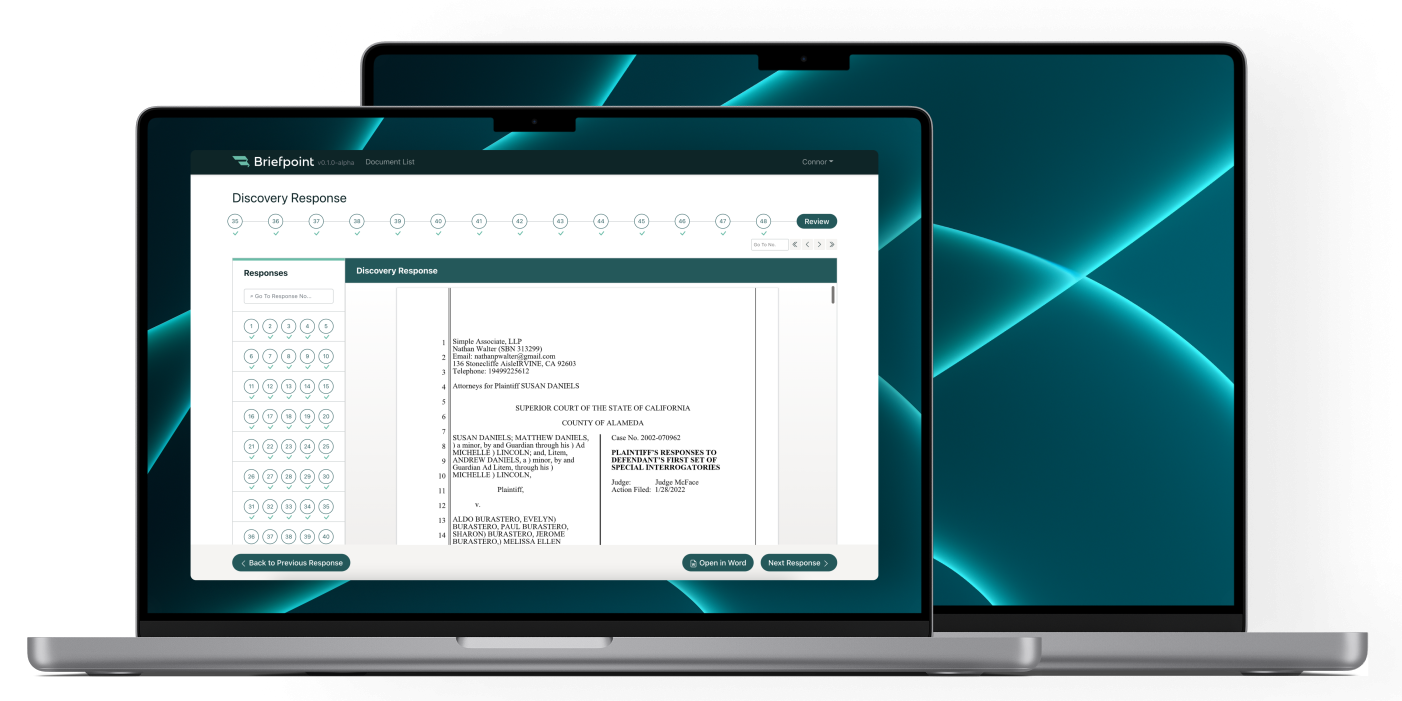
Briefpoint uses a combination of natural language processing and large language models to understand and generate documents based on user uploads, which makes it a perfect fit for lawyers and legal professionals who need to create complex documents at a rapid-fire pace.
Most importantly, the process is extremely simple. You upload the opposing counsel’s discovery request, and Briefpoint’s machine-learning AI system will instantly scan and extract as much information as it can.
Then, the AI will fill out the routine data in your response document and automatically suggest objections to the requests. Briefpoint also has a built-in feature called Bridge, which makes it easy to collect client responses and plug them into your draft.
Finally, you can export your document to Word and put the finishing touches there. The whole process can take as little as a few minutes, compared to hours, if you were to create a whole document manually.
Key Features
- AI-driven document generation
- Template management
- Integration with legal databases
- Customizable clauses and terms
- Supports Word documents
Pros
- Easy to use: The intuitive interface makes it simple for users to get started without extensive training.
- AI-driven: Automates complex legal document creation and minimizes errors from manual data entry.
- Affordable: Offers competitive pricing plans accessible for small to large firms.
2. Legito
Legito is a versatile document automation platform that simplifies the management of different document types. It features automated workflows, customizable templates, legally binding e-signatures, and seamless integration with CRM and ERP systems.
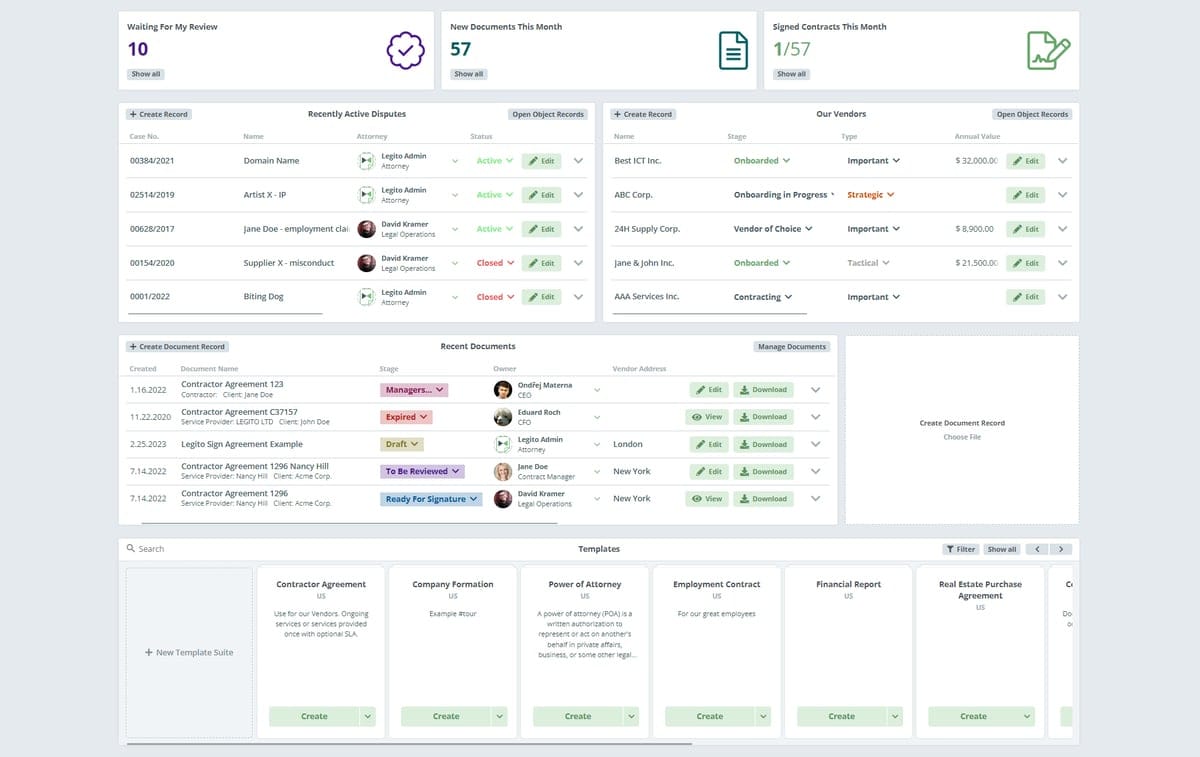
Image sources: G2
For legal professionals, Legito automates the creation of contracts, agreements, and other traditional documents, which cuts down on manual work and produces fewer errors. The interactive templates help ensure compliance and easy customization.
Plus, its document lifecycle management tracks status, manages revisions, and maintains compliance to help save time and increase accuracy.
Key Features
- No-code automation platform
- Interactive templates
- Document lifecycle management
- Integration with CRM and ERP systems
- Legally binding e-signatures
Pros
- Versatile: Supports a wide variety of document types and industries.
- Feature-rich: Includes powerful automation, templates, and e-signatures.
- Collaboration: Excellent tools for team collaboration and real-time editing.
Cons
- Overkill for small businesses: Might offer more features than small businesses need.
- Learning curve: Takes time to learn all the features and fully take advantage of them.
3. Knackly
Knackly lets you simplify document creation with user-friendly templates, easy data importing/exporting, and smart conditional logic. It also integrates well with practice management software, a primary reason why it’s a complete solution for legal document needs.
Image sources SaaS Hub
This tool automates legal document generation to help you save time and increase the consistency among your documents. Users create templates with placeholders for variable data, which can be manually entered or imported.
The tool uses conditional logic to tailor document content based on specific criteria for accuracy and customization. Once data is input, Knackly merges it with the templates to generate complete documents.
Additionally, its intuitive user interface means anyone can use it, while features like conditional logic help make sure documents are accurate and compliant.
Key Features
- Template-based document automation
- Integration with practice management software
- Data importing and exporting
- Conditional logic
Pros
- User-friendly: Designed to be easy to use, even for those who aren’t tech-savvy.
- Efficient template management: Simplifies the creation and management of document templates.
- Affordable: Competitively priced, it’s accessible for small to medium-sized businesses.
Cons
- Primarily for legal use: Best suited for legal documents, which might limit its appeal to other industries with very different business processes.
- Limited integrations: It may not integrate with all the software tools a business uses.
4. DocuGenerate
DocuGenerate is an intuitive document automation tool that makes creating and managing documents straightforward and efficient. It offers features like data merging, conditional logic, and support for various file formats.
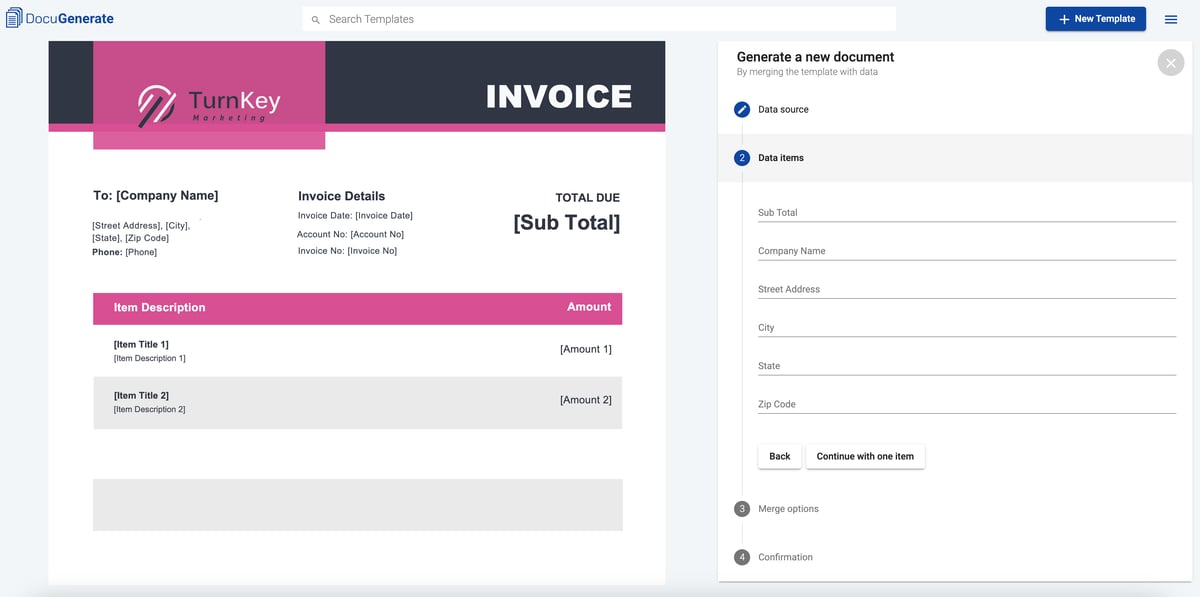
Image sources: G2
With easy integration into cloud storage, it also provides flexibility and ease of access no matter where your team members are.
How does it work? DocuGenerate automates document creation by allowing users to create templates with fields for data merging. Then, users input data, and the tool fills in the templates accordingly with conditional logic to guarantee accuracy and customization.
Key Features
- Data merging
- Conditional logic
- Multiple file format support
- Integration with cloud storage
Pros
- Flexible pricing: Offers a range of pricing options, including a free tier.
- Easy integration: Works well with various cloud storage and other business tools.
- User-friendly: Simple interface that makes document automation accessible to everyone.
Cons
- Advanced features need configuration: Some of the more advanced features might require additional setup.
- Limited advanced functions: Might not have all the advanced capabilities that larger businesses need.
5. PandaDoc
Next up is PandaDoc, a document assembly tool that allows users to create documents using customizable templates, which can be easily edited and personalized. You can add and sign documents electronically and collaborate with team members in real time.
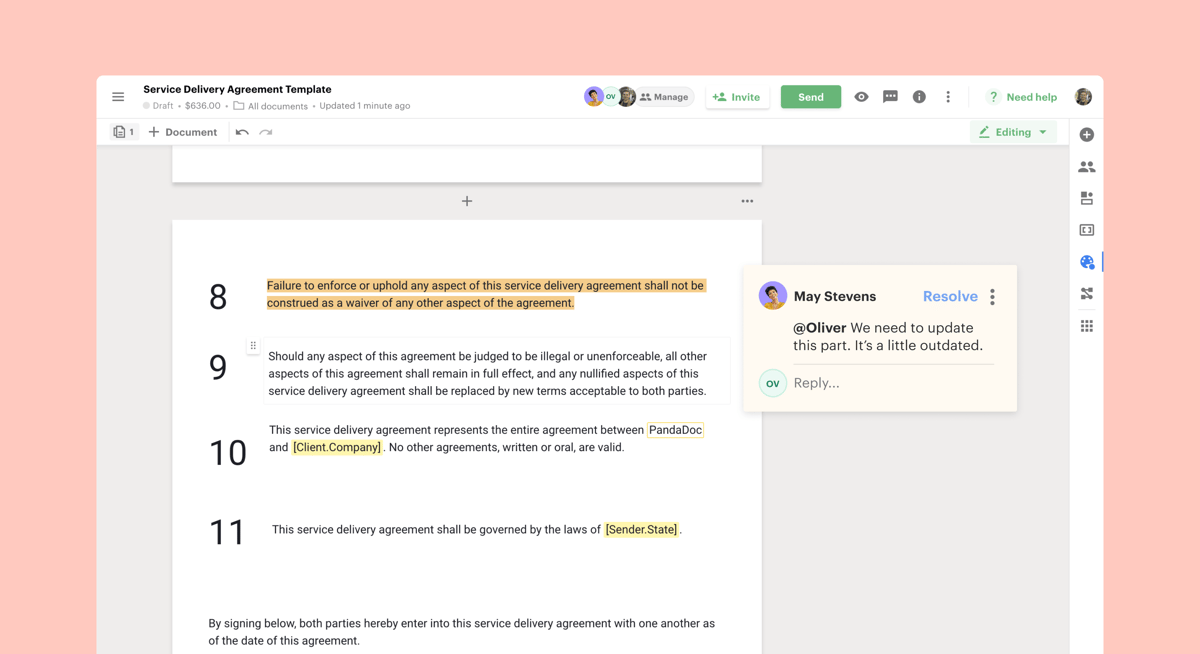
Image sources: G2
At the same time, the platform tracks document progress and provides analytics on document interactions so that you stay informed about how documents are being used.
Key Features
- E-signatures
- Document templates
- Real-time collaboration
- Analytics and tracking
Pros
- Lots of features: From e-signatures to analytics, PandaDoc covers a lot of ground.
- Excellent collaboration tools: Great for teams needing to work together on documents.
- Free plan available: Offers a free tier for businesses to try before committing.
Cons
- Can be pricey: The more advanced features come with higher costs.
- Occasional bugs: Some users report occasional issues and bugs.
6. Juro
Juro is a contract automation platform designed to simplify the management of legal agreements. It allows users to create and manage contracts using easy-to-customize templates. To further simplify the contract lifecycle, you can add e-signatures and automate workflows.
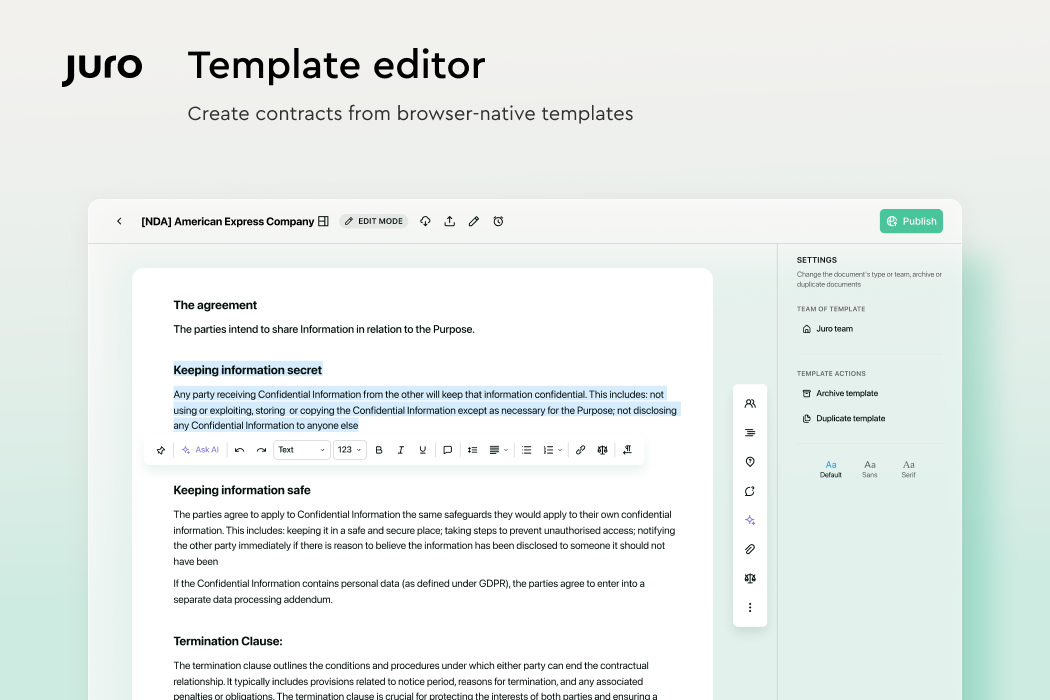
Image sources: G2
Juro is perfect for legal professionals who handle a high volume of contracts. It reduces manual work, minimizes errors, and speeds up the contract management process—all making it a useful tool for improving efficiency and productivity.
Key Features
- Contract automation
- E-signatures
- Customizable contract templates
- Workflow management
Pros
- Specialized for contracts: Perfect for businesses that need to manage contracts efficiently.
- Intuitive interface: Easy to use, with a clean and simple design.
- Good customer support: Responsive support to help with any issues.
Cons
- Limited to contracts: Best suited for contract-related documents, which might not cover all needs.
- Higher pricing for advanced plans: The more advanced features can get expensive.
7. Proposify
Proposify is a document generation and management solution specifically for business proposals. It allows users to create professional proposals using customizable templates tailored to specific needs. This can help sales teams looking to speed up their proposal process.

Image sources: G2
Key Features
- Proposal templates
- E-signatures
- Detailed analytics
- Team collaboration
Pros
- Suitable for sales proposals: Tailored for creating and managing proposals, focusing on the sales process.
- Detailed analytics: Provides insights into how proposals are viewed and interacted with.
- Collaborative features: Great for teams, with real-time collaboration tools.
Cons
- Limited to proposals: Primarily designed for proposals, which might not meet all document needs.
- Can be too focused: Some users might find it too specialized and lacking in broader document automation features.
Why Briefpoint Is the Best HotDocs Alternative
Looking for the best alternative to HotDocs? You’re just in the right place.
Briefpoint will transform your discovery process with its AI-driven tech, which speeds up and simplifies document creation—less fuss, and fewer mistakes. It’s incredibly user-friendly, so you can hit the ground running without navigating through complicated setups.
Plus, it’s tailored for legal professionals so that all your documents meet compliance standards without extra hassle. And if you ever get stuck, their customer support is just a quick call or click away.
Book a demo today and see the difference.
Why Choose Briefpoint?
Discovery responses cost firms $23,240, per year, per attorney. $23,240 estimate assumes an associate attorney salary of $150,000 (including benefits – or $83 an hour), 20 cases per year/per associate, 4 discovery sets per case, 30 questions per set, 3.5 hours spent responding to each set, and 1800 hours of billable hours per year.
Book a demo and save on these costs with Briefpoint.