A Step-by-Step Look at Discovery Drafting
What Is Discovery Drafting?
Litigation moves into the discovery phase once the parties begin formally exchanging information about the case. This is where each side asks for facts, documents, and admissions that may shape how the dispute develops.
Discovery drafting is the process of preparing those written requests and responses.
For example, the plaintiff might send interrogatories asking the defendant to explain key events, while the other side may request records or ask the plaintiff to admit certain facts. Attorneys also draft objections when a request is vague, overly broad, or seeks protected information.
Naturally, the work requires close attention because each response must reflect the facts of the case and follow the applicable court rules. Language pulled from an old template may need substantial revision before it fits the current dispute.
Strong discovery drafting helps you ask clearer questions and provide responses that accurately represent your client’s position.
It can narrow disputed issues, reveal useful evidence, and give both sides a better picture of the case before other steps like depositions, settlement discussions, or trial.
Types of Discovery Documents
Discovery can take several forms depending on what you need to learn or prove. These are some of the most common discovery requests used in civil litigation:
Interrogatories
Interrogatories are written questions that one party sends to another. The receiving party must answer them under oath within the deadline set by law.
They can help you identify witnesses, clarify what allegedly happened, and understand the other side’s version of events (among others). Attorneys often use them to gather basic facts before moving into more detailed discovery.
Common types include:
- Form interrogatories
- Special interrogatories
- Contention interrogatories
- Background questions
- Questions about other persons with relevant knowledge
Requests for Production
Requests for production ask a party to provide documents, electronically stored information, or physical items connected to the dispute. These requests may cover records that support your client’s story or help test claims made by the other side.
Each request should describe what is being sought clearly enough for the receiving party to identify and produce responsive material.
Requests for Admission
Requests for admission ask the other party to admit or deny specific statements. They are often used to confirm facts that should not require further proof and narrow the issues that remain disputed.
A clear answer can save time later in the case. If a party admits a fact, you may not need separate evidence to prove it at trial.
Depositions
Depositions allow counsel to question a party, witness, or expert under oath before trial. The testimony is usually recorded by a court reporter and may be used later to evaluate credibility, prepare motions, or challenge a witness’s account.
A deposition can be helpful when written discovery leaves gaps or when you need to hear the full story in the witness’s own words.
Subpoenas
A subpoena is a formal command requiring a person or organization to appear, provide testimony, or produce documents. Attorneys often use subpoenas to discover information held by someone who is not directly involved in the lawsuit.
The person called may need to attend a deposition, appear in court, or present specific records.
Other Discovery Documents
Other discovery tools may come into play depending on the dispute and the applicable rules. These include:
- Expert disclosures: Identify expert witnesses and summarize the opinions they expect to present.
- Initial disclosures: Provide basic information about witnesses, damages, and documents early in the case.
- Medical examination requests: Ask the court to require an examination when a person’s physical or mental condition is disputed.
- Requests for inspection: Allow a party to inspect property, equipment, or another location connected to the case.
- Supplemental responses: Update earlier answers when new information becomes available.
Common Issues During Discovery Drafting
Discovery drafting can take longer than expected because each request and response needs to be clear, relevant, and tailored to the case. Problems often appear once you begin putting the facts into formal language or responding to what the other side has sent.
Here are the issues that tend to cause the most trouble:
- Requests are too broad: Asking for every possible record may create unnecessary disputes. Narrowing the scope makes requesting documents more practical and easier to defend.
- The wording is unclear: A vague request can leave the receiving party trying to figure out what information you want. Precise language gives them a better ability to respond fully.
- Templates do not fit the case: Older wording may miss an important fact or include language that no longer applies. Attorneys sometimes realize this only after reviewing the full draft.
- Objections lack detail: General discovery objections may not explain the actual issue with the request. A stronger response connects each objection to the wording and applicable rule.
- Facts are incomplete: Drafting attempts may stall when client information is missing or inconsistent. Confirming key details early helps create responses that reflect the record.
- Deadlines are overlooked: Discovery timelines can be strict, and late responses may limit available objections or lead to court involvement.
What the Typical Discovery Drafting Process Looks Like
Discovery drafting usually begins with a close look at the case and what information still needs to be developed. The process then moves through a series of practical steps that help shape the requests or responses before they are served.
Here is what that process commonly looks like:
1. Review the Case and Discovery Needs
The process starts with a careful review of the basics, such as pleadings, available evidence, and perhaps the issues still in dispute. Before drafting anything, you need a clear sense of what the case already shows and where the record still feels incomplete.
This review helps you decide which facts need further support and which claims require closer attention. It can also reveal gaps in your client’s account or inconsistencies that should be addressed before the other side raises them.
At this stage, attorneys often create a working outline of the key issues. That outline gives the writing process some direction and keeps the discovery focused on information that could affect the case.
2. Identify the Information to Request
Once the open issues are clear, the next step is deciding what information could help develop them. Each request should connect to a specific point in the case rather than asking for broad categories with no clear purpose.
The information you need may include:
- Communications related to the dispute
- Financial or business records
- Names of relevant witnesses
- Details supporting a claim or defense
- Documents referenced in the pleadings
- Information about alleged damages
This list can serve as the foundation for your document requests and written questions. It also helps you check that every request has a reason behind it. If you cannot explain how the information could affect the case, the request may need to be revised or removed before drafting begins.
3. Choose the Appropriate Discovery Method
Different discovery tools serve different purposes, so the method you choose should match the information you are trying to obtain.
For example, interrogatories work well when you need written explanations or the identity of people with relevant knowledge. Requests for production are better suited to records and electronically stored information.
Requests for admission can help confirm facts that should not remain disputed. A deposition may be more useful when you need detailed testimony or want to follow up on answers given earlier in written discovery.
You may use several methods during the same case, but each one should have a clear role. Choosing the right format early helps you avoid asking the same question in several ways and keeps the overall discovery plan focused.
4. Draft the Requests or Responses
Now the information gathered earlier becomes a working document. For outgoing discovery, the first draft should turn each issue into a clear request that asks for one identifiable category of information.
For discovery responses, the initial draft should address each request separately and include the facts currently available.
Keep the wording direct and avoid packing several ideas into one paragraph. A request that tries to cover too much can create confusion and make objections more likely. The same applies to responses that rely on vague language rather than a clear answer.
Templates can give the writer a useful starting point, but every section still needs to fit the case.
5. Review Objections and Supporting Details
The review stage is where you test the draft for legal and factual weaknesses. Each objection should have a clear basis and connect to the specific request. Boilerplate language may be easy to add, but it can create problems if the other side challenges the response before a judge.
Supporting details also need close attention. Check that factual answers match the available record, and that document references are accurate. If a response promises production, confirm that the identified materials can actually be produced.
This is also the time to fix unclear wording, repeated requests, or answers that leave too much room for interpretation.
6. Finalize and Serve the Documents
Before service, confirm that the document follows the applicable court rules and any case-specific requirements. Check the caption, numbering, signature block, verification language, and certificate of service.
Remember: Legal document formatting may seem minor, but errors can delay service or require a corrected filing.
The final review should also confirm that every request has a corresponding response and that any attachments are included. If the document will be served electronically, make sure the file opens properly and has a clear name.
Once everything is complete, serve the discovery through the approved method and keep a copy in the matter file. Record the service date as well, since it may affect later deadlines and any motion practice that follows.
What Is Discovery Drafting Software?
Discovery drafting software is a program that helps legal teams prepare, review, and organize written discovery. It can support both outgoing requests and responses, which can then give you a faster way to handle repetitive drafting work while keeping each document tied to the case.
The exact features vary, but common benefits include:
- Automated document creation: The software turns matter details, selected requests, and approved language into a structured draft.
- Request and response analysis: Some platforms review discovery language and suggest relevant objections or identify information needed for a complete answer.
- Template management: Firms can store preferred wording and reuse it while adapting the draft to the current dispute.
- Document review support: The program can help connect responsive files to specific requests and organize supporting citations.
- Consistent formatting: Captions, numbering, definitions, and signature sections can be added in the required format.
Attorneys interested in using this software may worry that automation will replace legal judgment. These tools still require careful review, but they can easily reduce the manual work surrounding discovery and give counsel more time to focus on the substance of each response.
A Faster Path to Review-Ready Discovery
Discovery drafting plays a major role in how a case develops. Clear requests can uncover useful information, while well-prepared responses help protect your client’s position and reduce avoidable disputes.
Even so, a large part of the work happens before an attorney reaches the final review. Requests need to be organized, objections must be matched to the right language, and client answers often have to be collected and added manually.
Briefpoint helps move that process along. You can draft interrogatories, requests for admission, and requests for production using objection-aware language built for your jurisdiction.
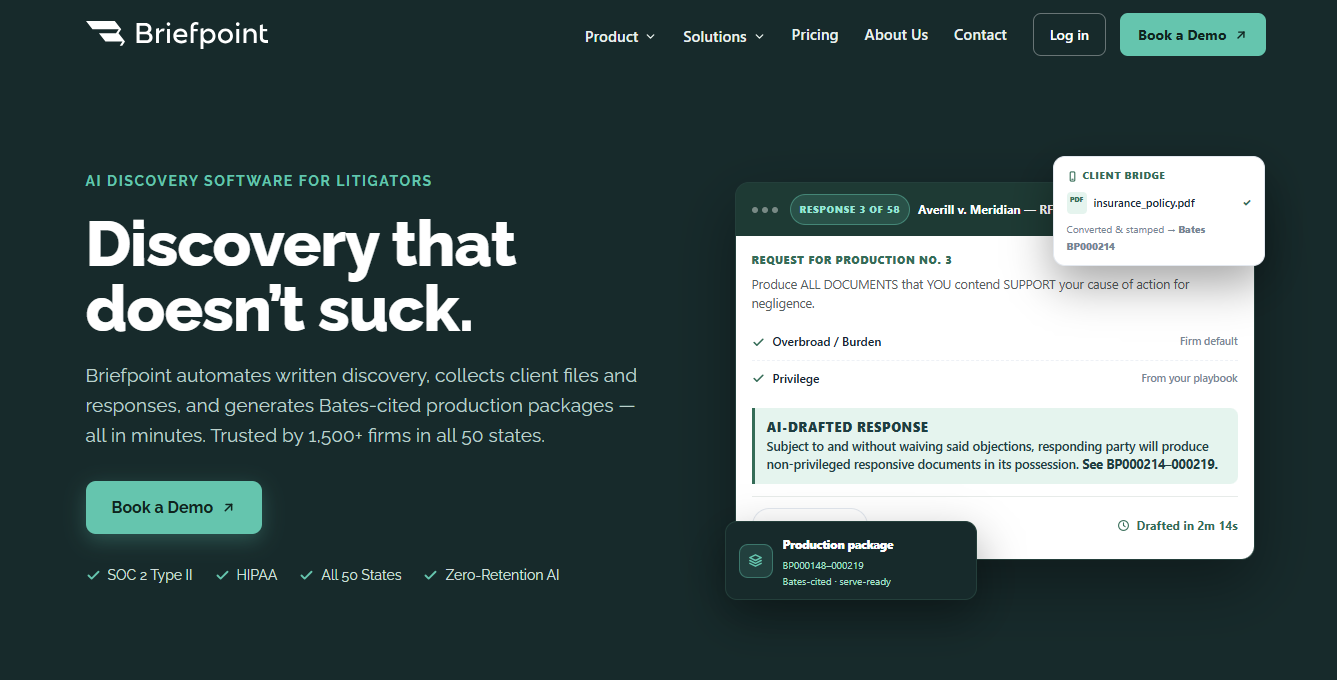
From there, Client Bridge gives clients a secure way to answer questions in plain English or Spanish. Their responses are then mapped back to the relevant discovery requests, which makes attorney review easier.
For document-heavy RFP responses, Autodoc identifies responsive files, creates page-level Bates citations, and prepares a Word-formatted response. It can also generate a Bates-numbered production package while keeping your team in control of the final document set.
Do you want to see how it all works in practice?
5 Tools to Add to Your Legal Tech Stack in 2026
What Is a Legal Tech Stack?
A legal tech stack is the collection of software your firm or legal department uses to handle day-to-day work. It may include tools for case management, legal research, billing, client intake, document drafting, and other parts of the legal workflow.
The right setup looks different for every organization. For example, a litigation firm may place discovery automation and document review near the top of its list, while a transactional practice may prioritize contract tools.
Priorities can also vary between practice areas, firm sizes, and in-house legal departments.
Your tech stack should reflect how your team actually works. Useful legal software should reduce repetitive tasks, support smoother handoffs, and fit into the systems you already rely on.
Of course, adding more legal technology does not automatically create a better workflow, so each tool should solve a clear problem and earn its place in the stack.
5 Software Options You Can Add to Your Legal Tech Stack
Here are five software options that cover different parts of a modern legal workflow, from discovery to accounting. Each one can strengthen a specific part of your legal tech stack, depending on where your team needs the most support:
1. Briefpoint for Discovery Automation
Briefpoint is a discovery automation platform built for litigation teams that want to spend less time drafting and reviewing written discovery.
You can use it to prepare interrogatories, requests for admission, and requests for production, then generate objection-aware responses for incoming requests.
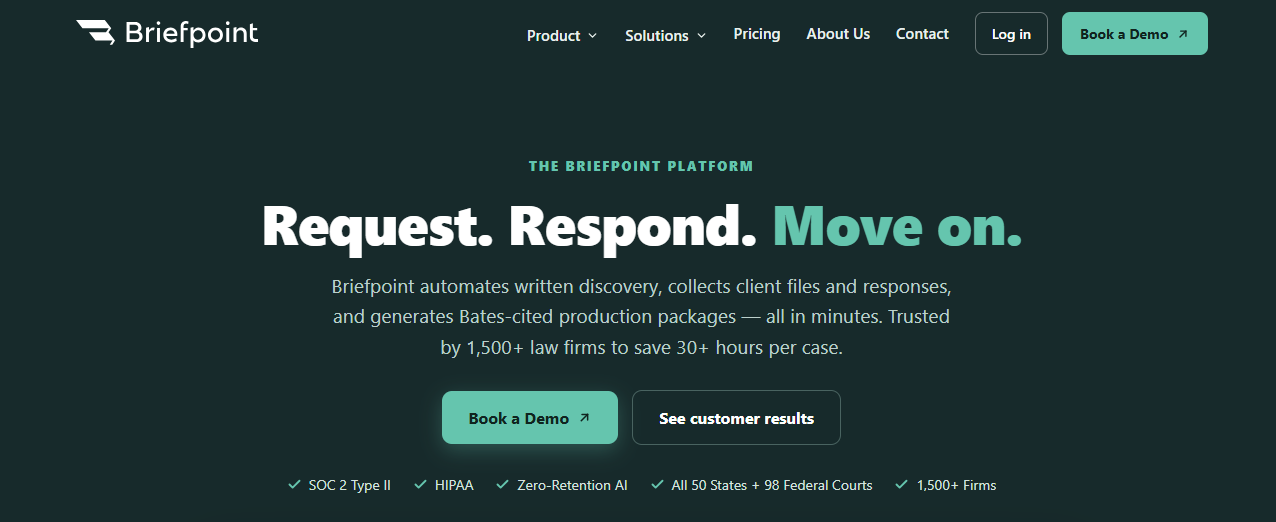
The platform also helps you collect client information through a secure link. Clients can answer questions and upload files from a phone or computer, and those responses are added to the correct draft.
For document-heavy requests for production, Briefpoint can identify responsive files, add page-level Bates citations, and prepare a Bates-numbered production package.
The time saved can help lawyers increase efficiency and focus more of their attention on legal strategy, case preparation, and client communication.
Best Features
- Discovery request drafting: Generate interrogatories, RFAs, and RFPs from the complaint and case details.
- Objection-aware responses: Prepare draft answers and objections for attorney review.
- Client Bridge: Collect client answers and documents through a secure, mobile-friendly link.
- Autodoc: Review uploaded files, identify responsive documents, and connect them to the relevant production requests.
- Bates-cited responses: Create Word-formatted drafts with page-level citations.
- Production packages: Prepare organized, Bates-numbered files for service.
- Jurisdictional support: Draft discovery documents for all 50 states and federal district courts.
2. Clio for Practice Management
Clio is cloud-based law practice management software that brings your firm’s daily operations into one central system. You can manage matters, track time, prepare bills, organize calendars, and keep client information connected to the correct case.
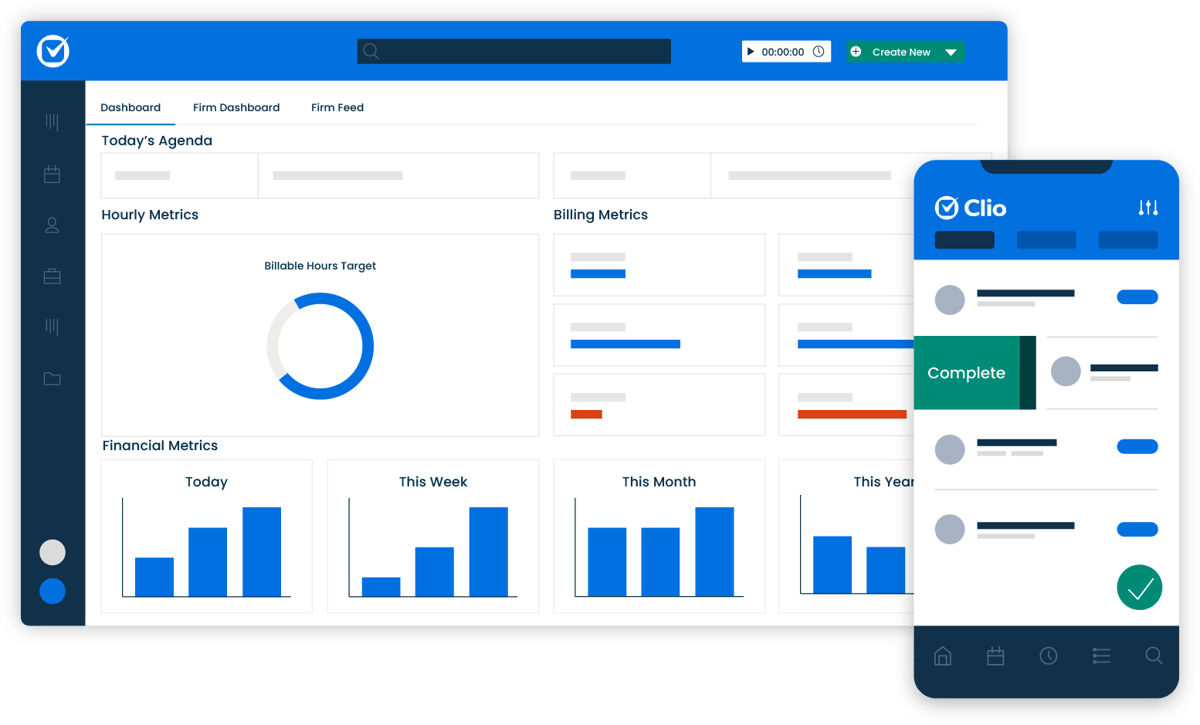
Source: G2
Its user-friendly interface also gives your team instant access to files and matter details from any device with an internet connection.
Clio includes document storage and management tools, so you can upload, edit, search, and share case files without relying on a separate document management system.
For firms looking to simplify legal operations, Clio can serve as the main hub for work completed elsewhere in the tech stack. Its matter management software connects with a wide range of legal tools, including Briefpoint, which can help reduce repeated data entry and support increased productivity.
Best Features
- Matter management: Keep case details, deadlines, notes, and communications connected in one place.
- Time and billing: Track billable work and create invoices from recorded time and expenses.
- Document management: Store, organize, edit, and search legal files in the cloud.
- Calendar tools: Manage appointments and case deadlines through a shared firm calendar.
- Client portal: Give clients a secure place to view updates and communicate with your team.
- App integrations: Connect Clio with other software used throughout your legal tech stack.
3. Lawmatics for Client Intake and CRM
Lawmatics is client management software designed to help law firms manage prospective clients from the first inquiry through onboarding.
Your legal team can track leads, schedule consultations, collect intake details, and keep every interaction connected to the same contact record.
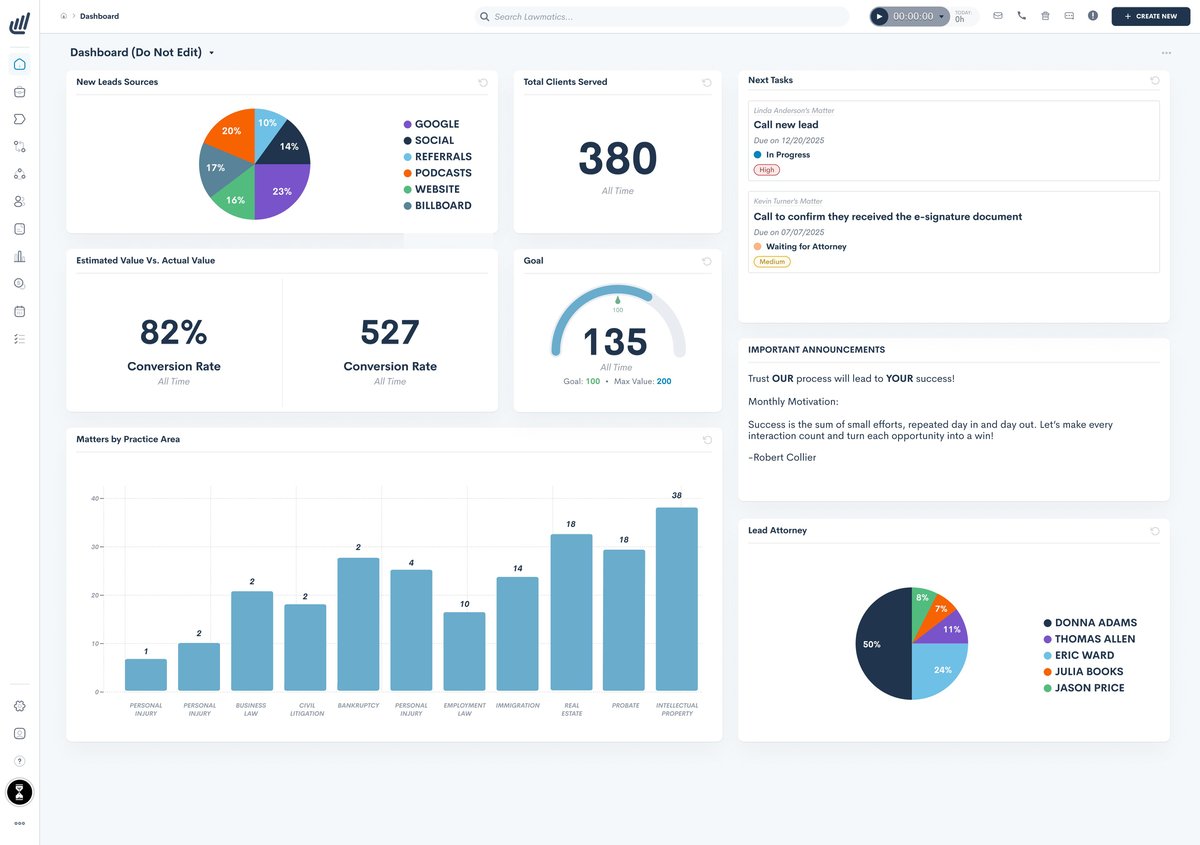
Source: G2
Much of the intake process can also run through automated workflows. You can send follow-up messages, deliver forms, request signatures, and assign internal tasks without relying on the same manual processes for every new lead.
That can help your firm respond faster, minimize errors, and create a smoother experience at a stage where clients expect clear communication.
Lawmatics also gives you reporting tools for reviewing lead sources and conversion activity. For firms exploring technology solutions to streamline operations, it can serve as the client-facing part of the legal tech stack while practice management software handles active casework.
Best Features
- Legal CRM: Track prospects, contacts, and intake activity in one organized system.
- Custom intake forms: Collect information based on the practice area or case type.
- Automated follow-ups: Send emails and reminders at predefined stages of the intake process.
- Appointment scheduling: Let prospects book consultations through an online calendar.
- Document automation: Create and send intake documents and engagement agreements.
- E-signatures: Allow new clients to review and sign paperwork electronically.
- Lead reporting: Review where inquiries come from and how they move through the intake pipeline.
4. QuickBooks Online for Legal Accounting
QuickBooks Online is cloud-based accounting software that can help your firm manage its finances from the same technology stack used for the rest of the business.
It allows you to track income and expenses, send invoices, record payments, and monitor cash flow without relying on disconnected spreadsheets.

Source: G2
Time tracking is available on select plans, making it easier to connect recorded work with invoices and project costs. Your accountant or other authorized users can also receive secure access to the books, which supports collaboration without repeatedly exporting financial records.
QuickBooks Online is not built solely for legal practices, so firms may still need separate tools for trust accounting or legal billing requirements.
Even so, it can be a practical option for firms that want to streamline operations, use their financial resources more carefully, and get maximum value from a widely supported accounting platform.
Best Features
- Income and expense tracking: Keep an updated record of money coming into and leaving the firm.
- Invoicing and payments: Create invoices, accept payments, and track outstanding balances.
- Cash flow tools: Review current financial activity and identify upcoming cash needs.
- Time tracking: Add tracked time to invoices on eligible plans.
- Financial reports: Generate reports for profit and loss, accounts receivable, and other business activity.
- Cloud access: View and manage financial information from supported computers and mobile devices.
- App integrations: Connect QuickBooks with other tools used throughout your technology stack.
5. Lexis+ AI for Legal Research
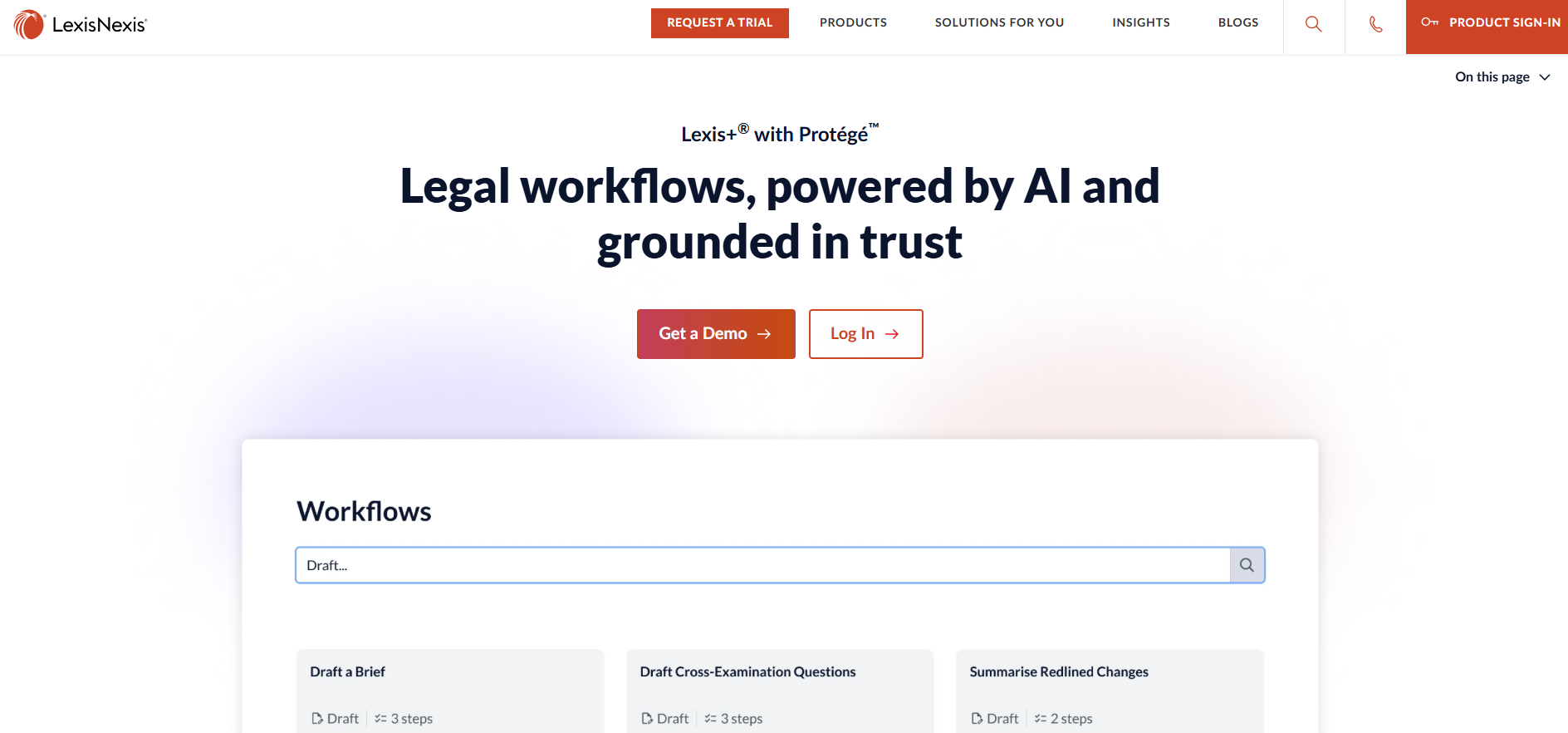
Lexis+ AI, now offered as Lexis+ with Protégé, is an AI-powered tool for legal research, drafting, and document analysis.
You can ask legal questions in conversational language, review answers linked to supporting authority, and move directly into the cited cases or other source material.
Source: LexisNexis.com
The platform can also summarize uploaded documents, identify relevant arguments, and help create an initial draft based on LexisNexis content. Shepard’s Citation Service lets you evaluate how a case has been treated before relying on it in your work.
These features can reduce the manual work involved in reviewing long result lists and piecing research together from separate screens.
For firms where research is a recurring pain point, the platform may improve efficiency and streamline processes within a single workspace.
Its cost may require closer evaluation, but teams that use legal research tools frequently may find a stronger ROI than those with occasional research needs.
Best Features
- Conversational research: Ask questions in natural language and receive answers connected to legal sources.
- Linked citations: Open the authorities supporting an AI-generated response.
- Shepard’s Citation Service: Check the subsequent treatment and current status of cited cases.
- Document analysis: Upload legal documents to identify citations, arguments, and possible risks.
- Drafting support: Develop initial legal drafts using research and source material already in the platform.
- Practical Guidance: Access forms, checklists, and practitioner resources covering numerous practice areas.
- Integrated workspace: Move between research, analysis, and drafting without switching platforms.
How to Build the Right Legal Tech Stack
Start with the work your team handles every day and look for tools that solve a clear operational need. New technology should support long-term success instead of acting as a series of quick fixes that create more systems to manage.
Here are several steps you can follow:
- Map your current workflow: Review how work moves through the firm, including client intake, legal project management, billing, and document review. This helps you identify which tools are essential.
- Prioritize integration: Check whether each platform connects with systems your team already uses, such as Google Workspace, Microsoft Office, or your practice management software.
- Review security controls: Look closely at data security, access permissions, cloud storage policies, and how the provider handles confidential client information.
- Consider total cost: Compare subscription fees with possible cost savings, reduced legal spend, and the time your team may recover through automation.
- Plan for document control: Document management software should support reliable search, permissions, and version control so your team can find the correct file quickly.
- Choose tools that can grow: Your needs may expand into areas like contract management or more advanced reporting, so select software that can adapt as the firm changes.
Build a Tech Stack That Fits Your Firm
A strong legal tech stack should reflect how your firm works, where your team loses time, and which tasks create the most friction.
You do not need every available platform. A smaller set of well-chosen tools can give you a cleaner workflow and make future growth easier to manage.
Start with your biggest operational need, then add software that connects well with the systems already in place. Review usage over time, remove tools that overlap, and keep looking for areas where repetitive work can be reduced.
For litigation teams, written discovery is often a practical place to start.
Briefpoint helps you draft and respond to interrogatories, RFAs, and RFPs, collect client answers through a secure link, and prepare Bates-cited production packages. It also supports discovery work in all 50 states and 98 federal district courts.
7 Best Legal AI Software for Lawyers in 2026
What Is Legal AI Software?
Legal AI software supports lawyers with tasks that would otherwise require hours of manual effort. These tools can support legal work such as reviewing documents, drafting initial versions of filings, researching case law, and organizing information from client files.
Some products focus on a specific part of the practice. For example, discovery platforms may draft requests and responses, while contract tools can flag unusual terms or suggest revisions. Other AI tools work throughout broader legal workflows and connect with software a firm already uses.
Legal platforms also differ from general AI tools. A public chatbot may provide a quick summary or help brainstorm language, but legal software is usually designed around attorney tasks, firm security requirements, and source materials tied to a matter.
The strongest options give you a usable starting point while leaving the final judgment and review in your hands.
What Can Legal AI Software Help Lawyers Do?
The exact capabilities will become clearer when we look at the individual tools later. For now, legal AI software can help legal professionals handle several parts of their work with less manual effort.
- Draft legal documents: Create a first draft of discovery responses, contracts, letters, or internal memos using matter-specific information.
- Review documents: Scan files for key language, missing details, and potential issues that may need closer attention.
- Support legal research: Find relevant authorities, summarize decisions, and organize research into a format that is easier to review.
- Analyze contracts: Help transactional lawyers compare clauses, identify unusual terms, and suggest revisions based on specific needs.
- Organize case information: Pull facts from large files, connect related documents, and make important details easier to locate.
- Handle repetitive work: Reduce the time spent formatting documents, entering information, or preparing routine materials.
The level of intelligence behind these platforms varies. Some handle a narrow task well, and others support a broader portion of the legal workflow. So, the best fit depends on the work your team wants to improve.
The 7 Best Legal AI Software Tools for Lawyers
The best legal AI software for you depends on the work you want to make easier. As you compare the tools below, look at how each one fits your current workflow and the tasks taking up the most time:
1. Briefpoint
Briefpoint is legal AI software built for litigation teams that want to spend less time preparing written discovery. You can use it to draft and respond to interrogatories, requests for admission, and requests for production using the complaint and other matter details.
The platform also helps collect client answers and files through Bridge. Clients receive a secure, mobile-friendly link where they can respond in plain English, while their answers are mapped back to the correct requests.
For document-heavy RFP responses, Autodoc searches uploaded case files for responsive material, creates page-level Bates citations, and prepares a Bates-numbered production package.
Briefpoint then generates a formatted response in Microsoft Word for attorney review. It focuses on discovery rather than court filings or general tasks within the legal profession, which makes it a practical option for legal teams handling recurring litigation work.
Best Features
- Discovery request drafting: Creates interrogatories, RFAs, and RFPs from complaints and case details.
- Objection-aware responses: Drafts answers and discovery objections for your team to review and revise.
- Bridge: Collects client answers and documents through a secure link written in plain English.
- Autodoc: Finds responsive documents and prepares Bates-cited Word responses.
- Production packages: Organizes selected files into a Bates-numbered package for service.
- Supplemental responses: Updates earlier responses while preserving the prior language.
- Jurisdictional support: Supports state and federal discovery documents throughout the United States.
Pros
- Built specifically for written discovery
- Gives attorneys control over document selection and final edits
- Reduces repetitive drafting and formatting work
- Connects client input directly to discovery requests
- Produces editable Microsoft Word documents
- Supports both propounding and responding to discovery
2. Harvey
Harvey is a broad legal AI platform designed for law firms and in-house teams handling complex work. Its AI models can assist with legal research, due diligence, litigation tasks, and contract work from one secure workspace.

Source: Harvey.ai
The platform is a strong fit for larger teams that want AI support beyond one narrow workflow. Lawyers can use Harvey to analyze large document sets, draft and revise legal materials, or work through questions that require legal reasoning.
Plus, its Contract Intelligence product helps teams review agreements, surface key terms, and prepare for negotiations.
Best Features
- Legal research: Researches complex legal and regulatory questions using connected sources.
- Contract Intelligence: Reviews agreements and surfaces information that can guide negotiations.
- Harvey Agents: Carries out multi-step legal workflows with less manual prompting.
- Vault: Stores and analyzes large collections of legal documents in a secure environment.
- Due diligence support: Helps lawyers review deal documents and organize findings.
- Shared Spaces: Gives internal and external legal teams a secure place to collaborate.
Pros
- Useful for transactional and litigation practices
- Handles complex legal reasoning and document analysis
- Combines research with contract drafting and review
- Suited to firmwide AI adoption
- Works with internal sources and existing legal systems
3. CoCounsel Legal
CoCounsel Legal is Thomson Reuters’ AI platform for legal research, drafting, and document analysis.
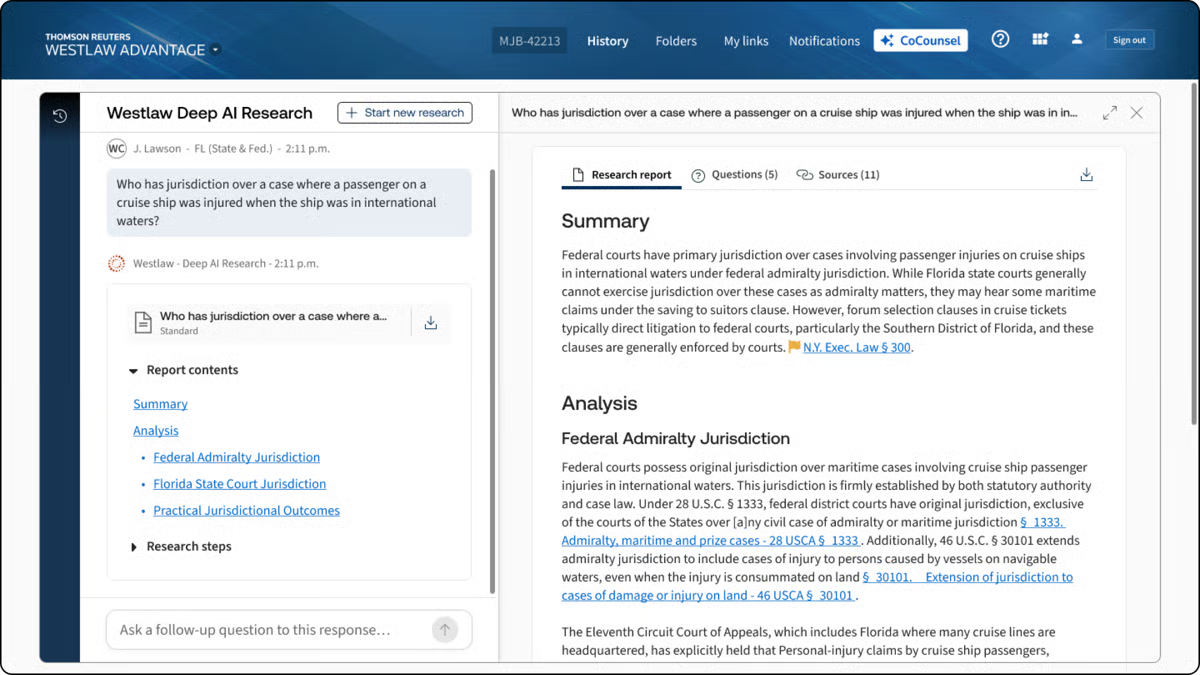
It draws from Westlaw and Practical Law, giving lawyers access to authoritative legal content without moving between separate research systems. The platform can also account for the relevant jurisdiction and provide citations that let you verify its work.
Source: G2
Its legal research capabilities are a major part of the appeal. You can ask a detailed question, review a synthesized answer, and trace the supporting sources.
CoCounsel Legal also works with uploaded matter documents, so you can use it to summarize records, compare language, or prepare an initial draft based on your own data.
Best Features
- Deep research: Investigates complex questions using Westlaw and Practical Law, then returns cited findings.
- Jurisdictional research: Tailors results to the jurisdiction connected to your legal question.
- Document analysis: Reviews uploaded files and extracts relevant facts or issues.
- Drafting workflows: Helps prepare legal documents using research and matter materials.
- Practical Law access: Finds templates, practice notes, and other attorney-developed resources through natural-language requests.
- Microsoft Word integration: Brings CoCounsel tools into the document lawyers are already editing.
Pros
- Grounds research in established Thomson Reuters content
- Provides citations for easier verification
- Combines legal research with drafting and document review
- Adjusts research based on the relevant jurisdiction
- Gives lawyers access to Westlaw and Practical Law in one workspace
4. Eve Legal
Eve Legal is built for plaintiff firms handling work such as personal injury and employment cases. Its EveOS platform supports casework from intake through litigation while keeping documents and matter details connected in one system.
Source: Eve.Legal
You can use Eve to draft demand letters, summarize medical records, prepare discovery, and review files for missing information.
Eve Agents can take on recurring tasks using your firm’s documents and preferred writing style, while attorneys keep control of the final work product.
Best Features
- Demand letter drafting: Creates customized demands using case facts and supporting records.
- Medical record summaries: Organizes treatment history into a clearer format for attorney review.
- Discovery support: Helps firms prepare discovery requests and responses.
- Eve Agents: Handles recurring casework using the firm’s documents and internal processes.
- Eve Auditor: Reviews active files for overlooked injuries, deadlines, and other potential case issues.
- Client communication: Supports routine updates and outreach during the life of a case.
Pros
- Built for plaintiff-side practices
- Covers pre-litigation and litigation work
- Learns from the firm’s documents and writing style
- Connects case data with drafting and review workflows
- Supports sensitive records with encrypted infrastructure and security controls
5. Lexis+ With Protégé
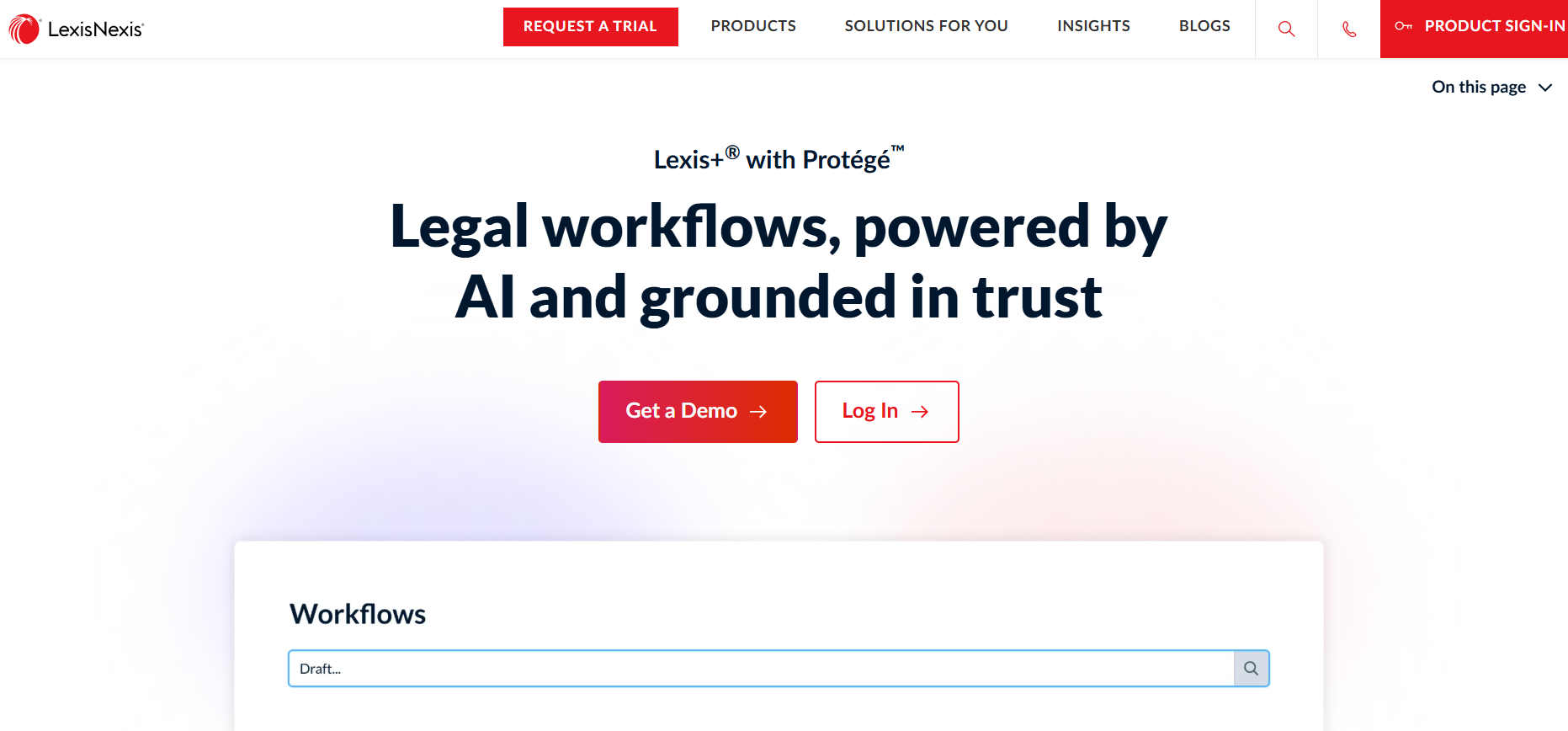
Lexis+ with Protégé combines legal research, drafting, and document analysis in one AI-powered workspace.
The platform is built on LexisNexis content, which gives you access to primary law, secondary sources, and Practical Guidance while you work through a legal question.
Source: LexisNexis.com
Protégé can help you prepare drafts, summarize uploaded files, and review evidence for relevant details. Its responses can draw from your organization’s documents along with LexisNexis sources, rather than relying only on publicly available data.
For teams already using Lexis products, it may be the right tool for bringing AI into an established research process.
Best Features
- Conversational research: Answers legal questions using authoritative LexisNexis content and cited sources.
- Legal drafting: Prepares initial drafts using research materials, uploaded files, and firm documents.
- Document analysis: Summarizes records and identifies relevant facts, conflicts, or missing information.
- Protégé workflows: Guides multi-step legal tasks while letting lawyers review the proposed approach.
- Shepard’s integration: Helps users verify citation status and treatment before relying on an authority.
- Practical Guidance: Connects research with forms, checklists, and attorney-developed practice materials.
Pros
- Draws from the company’s extensive collection of legal documents
- Connects AI research with Shepard’s citation tools
- Uses firm materials alongside trusted LexisNexis sources
- Fits naturally into existing Lexis research workflows
- Supports drafting and evidence review within one platform
6. Spellbook
Spellbook is a legal AI tool built for lawyers who spend much of their day drafting and reviewing contracts. It works inside Microsoft Word, which allows you to analyze an agreement or revise language without moving the document into a separate platform.
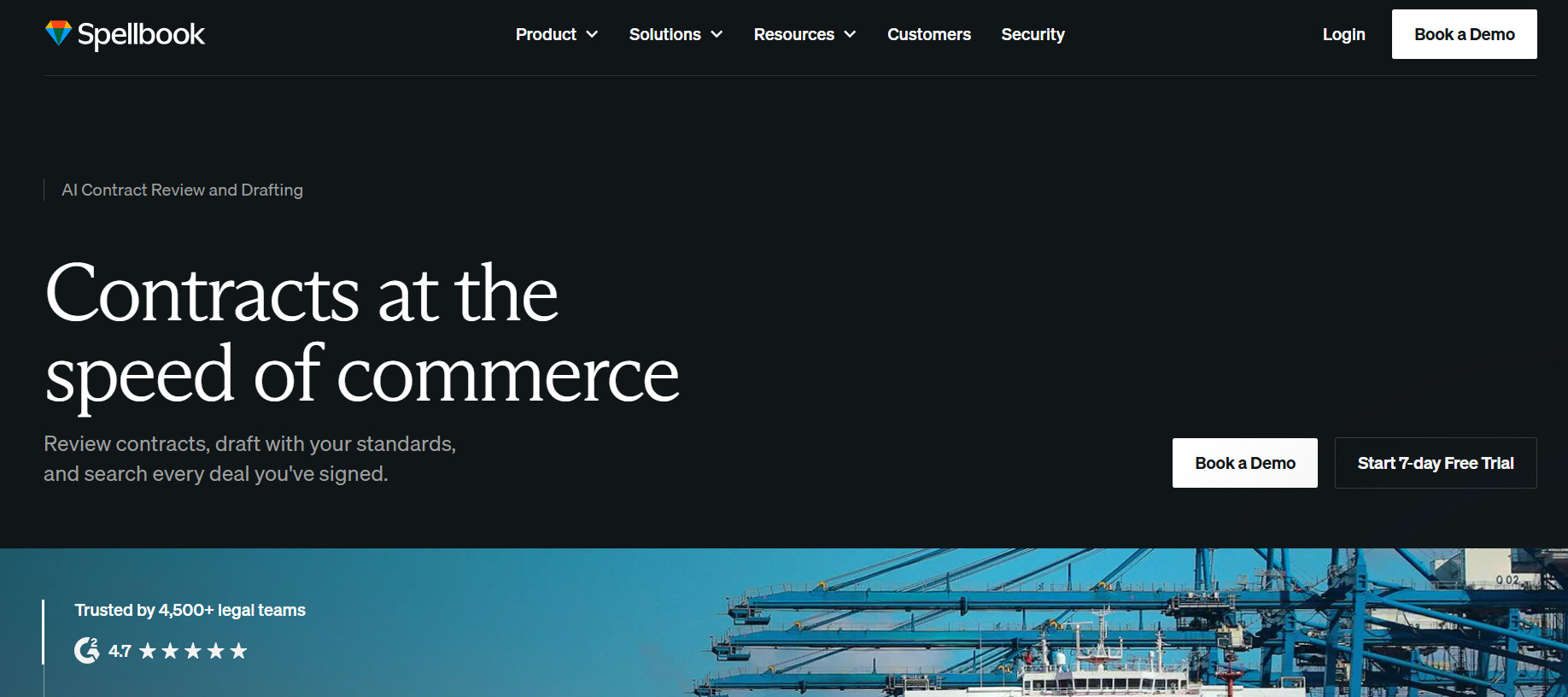
Source: Spellbook.com
The software can suggest clauses, create redlines, and answer questions about the contract in front of you. Its Playbooks let firms apply their preferred positions and review standards to recurring agreements.
Spellbook Associate extends those capabilities to multi-document contract analysis and custom workflows, such as comparing agreements or updating a template from reference files.
Best Features
- Contract review: Flags unusual terms, missing language, and possible risks within an agreement.
- Drafting tools: Generates clauses or full drafts using your instructions and existing document.
- AI redlining: Suggests edits based on the represented party and desired negotiation position.
- Playbooks: Reviews contracts against reusable rules and preferred terms created by your firm.
- Spellbook Associate: Compares multiple documents and answers questions using the selected files.
- Custom workflows: Turns recurring multi-document processes into templates your team can reuse.
Pros
- Works directly inside Microsoft Word
- Focuses closely on contract drafting and review
- Adapts reviews to firm playbooks
- Supports both single-document and multi-document work
- Makes recurring contract workflows easier to standardize
7. Everlaw
Everlaw is a cloud-based ediscovery platform for litigation, investigations, and document-heavy legal work.
It gives you tools for processing data, reviewing evidence, and preparing a case within one workspace. Its AI features are grounded in the documents uploaded to the platform, so lawyers can trace findings back to the source material.
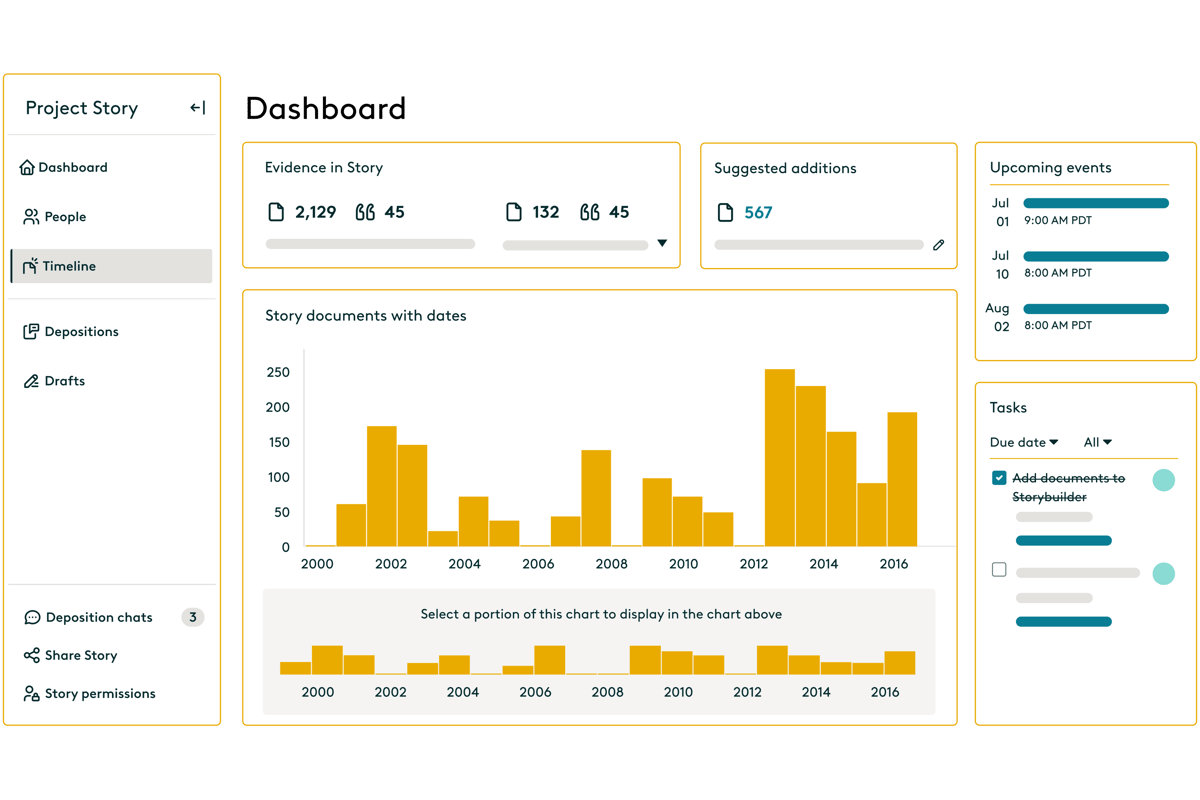
Source: G2
The platform is better suited to teams with substantial discovery needs than small firms handling only occasional matters. You can use it to identify responsive records, review material for privilege, and organize the evidence that may eventually be produced to opposing counsel.
In general, Everlaw supports the discovery process rather than researching statutes or answering general legal questions.
Best Features
- AI-powered review: Summarizes documents and surfaces information relevant to the case.
- Predictive coding: Prioritizes records that are likely to be responsive during large reviews.
- Storybuilder: Turns key evidence into timelines, deposition materials, and case narratives.
- Early case assessment: Helps teams understand the size and content of a dataset before a full review.
- Legal holds: Manages preservation notices and tracks custodian compliance.
- Production tools: Prepares reviewed documents for delivery in the required format.
- Security controls: Protects sensitive data with permissions, encryption, and compliance safeguards.
Pros
- Handles large and complex discovery matters
- Connects document review with case preparation
- Keeps AI findings tied to source documents
- Supports review, production, and legal holds in one platform
- Gives distributed teams a shared cloud workspace
How to Choose the Best Legal AI Software for Your Team
Start with the work your team actually wants to improve. A powerful AI assistant may sound appealing, but paying for broad capabilities makes little sense if you only need help with one part of your practice.
Here are several factors you should consider:
- Match the tool to your workload: Look for software built around the tasks taking up the most time, such as discovery drafting, contract review, or legal research.
- Check your existing systems: See if the platform connects with your case management or practice management software. A tool that fits your current setup is usually easier to adopt.
- Review data protections: Confirm how the provider stores client data, who can access it, and if your information is used to train its models.
- Consider the learning curve: Ask how much training lawyers and staff will need before they can use the platform confidently.
- Compare pricing with usage: Some tools charge per user, while others offer plans designed for enterprise teams. Choose a structure that reflects how often the software will be used.
- Test the output: Run the tool through a realistic legal task and check how much editing the result requires.
Choose Legal AI That Fits the Work
Legal AI software can save your team time, but the strongest choice depends on the work filling your day. A research platform may suit complex legal questions, while contract software can help teams review agreements.
Litigation practices may benefit more from a tool built specifically for discovery.
Briefpoint focuses on written discovery from drafting through document production.
It can prepare and respond to interrogatories, RFAs, and RFPs in jurisdiction-specific formats. Client Bridge collects answers and files through a secure link, then maps the information back to the relevant requests.
Autodoc handles the document-heavy side of RFP responses. It identifies responsive files, removes irrelevant material, adds page-level Bates citations, and creates a Bates-numbered production package. Briefpoint then generates an editable Microsoft Word draft for attorney review.
7 Best AI Legal Document Drafting Tools in 2026
What Is AI Legal Document Drafting?
AI legal document drafting gives you a quicker way to move from raw information to a usable first draft. You provide the relevant facts, instructions, or source material, and the software helps shape them into a document you can review and refine.
In practice, AI legal drafting works like a focused drafting assistant. For example, it can help organize legal content, follow a familiar structure, and reduce the amount of repetitive writing that usually slows you down.
For legal professionals, this can make writing legal documents feel much more manageable. You spend less time rebuilding standard language and more time on more important steps like reviewing the substance, adjusting the strategy, and making sure the final draft fits the case.
Artificial intelligence can support many types of legal work, from discovery documents to contracts. Still, the final call stays with you. The tool may speed up the first draft, but your judgment is what makes the document accurate and ready to use.
How Does AI Legal Document Drafting Work
AI legal drafting usually starts with the information you already have. You upload source documents or enter details from the case file, then the software uses generative AI to turn that material into a structured draft.
Many legal writing tools rely on large language models, though platforms built for legal work often add templates and document-specific rules on top of the underlying AI technology.
A typical workflow looks like this:
- Provide the source material: Add the relevant case files, client details, or drafting instructions so the tool has a clear foundation.
- Generate the first draft: The system organizes the information and produces language suited to the selected document.
- Review and revise: You check the facts, adjust the legal reasoning, and confirm that the final wording fits the situation.
- Save and reuse: Approved language can often be carried into future work to maintain consistency and keep saving time.
This makes AI for legal drafting a valuable tool when the work follows a repeatable process. General AI tools may help with basic writing, but purpose-built platforms usually provide more control over legal structure and source documents.
Top 7 AI Legal Document Drafting Tools Today
AI legal drafting software varies widely in focus and depth. Here are the top options worth looking at today:
1. Briefpoint
If discovery drafting takes up too much of your week, Briefpoint gives you a faster way to handle it. The platform is built specifically for written discovery, so you can prepare discovery requests, draft responses, and collect client information in one focused workflow.
You can upload the relevant files, review suggested responses, and make changes before exporting the finished document to Word. For legal teams, this cuts down the time-consuming work that usually comes with formatting, repeated language, and document review.
Briefpoint can help with client communication too. Client Bridge turns legal questions into plain language and gives clients a secure link for submitting answers or files. Their responses are then mapped back to the correct requests, which makes review much easier.
Best Features
- Discovery drafting: Creates RFAs, RFPs, interrogatories, and responses using your case information.
- Client Bridge: Collects client answers and documents through a secure, mobile-friendly link.
- Autodoc: Reviews source files and prepares Bates-cited RFP responses for attorney review.
- Supplemental responses: Updates earlier responses while preserving the existing record.
- Review controls: Lets you remove irrelevant files, check supporting documents, and revise the final language.
2. MyCase IQ
MyCase IQ works inside the MyCase practice management platform, so you can use AI during the same workflow where you already manage case information.
That can help you work faster because the system can draw on the legal context connected to a matter rather than treating every prompt like a standalone request.
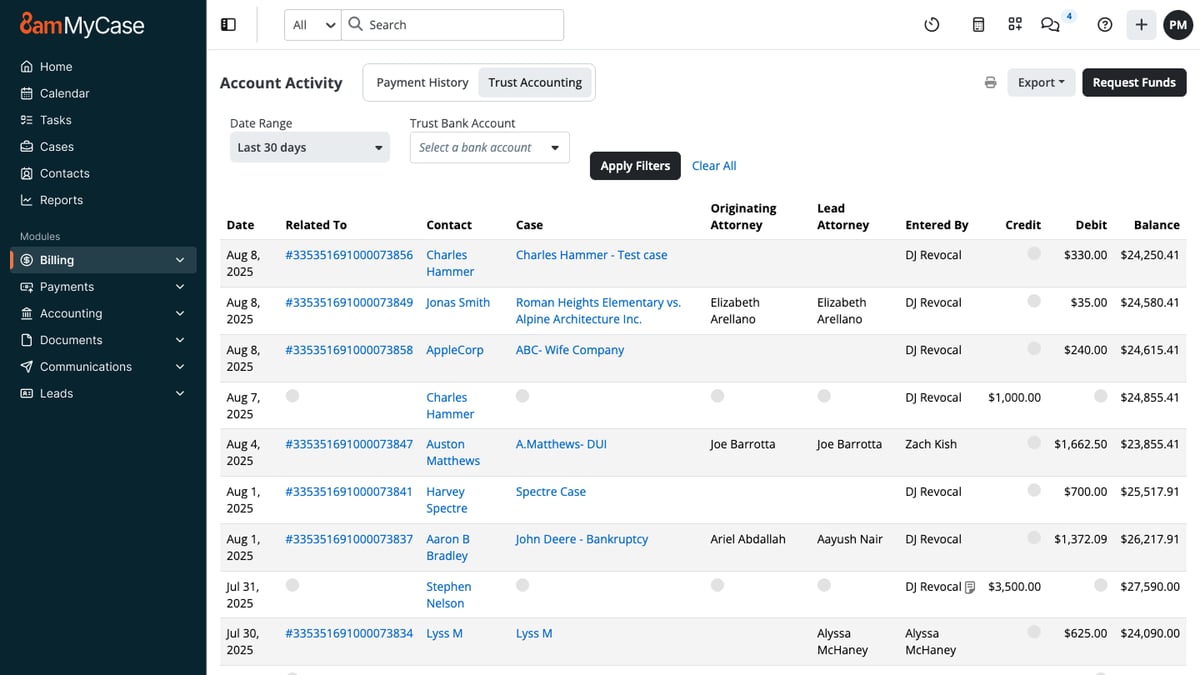
Source: G2
You can use it to create routine documents, refine existing text, and summarize case files before you begin drafting.
It can also support legal research tasks at a basic level by helping you locate and organize relevant details, though your own expertise still guides the final result.
Best Features
- Matter-based drafting: Uses information linked to a case to support a more relevant drafting process.
- Document creation: Helps prepare routine documents and client-facing content.
- Case summaries: Pulls key information from files so you can review the main points faster.
- Writing support: Revises tone, wording, and structure inside the MyCase platform.
- Built-in workflow: Keeps drafting tools close to the rest of your case management work.
3. Clearbrief
Clearbrief is a good fit when you already have a draft but need stronger support behind the claims. It works inside Microsoft Word, so you can connect statements to source material without leaving the document or rebuilding your workflow.
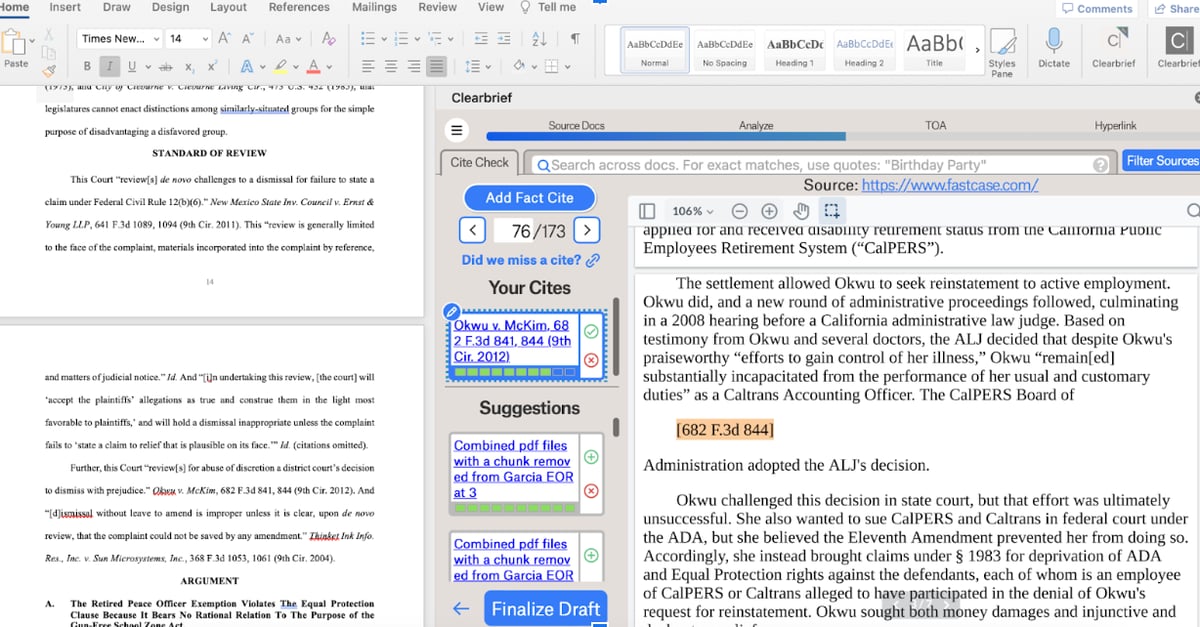
Source: G2
The platform can help with document creation from a blank page, but its strongest use is checking and strengthening legal writing.
Clearbrief can find supporting pages, flag possible inconsistencies, and help you review citations before filing. That added layer can reduce human error when AI use is part of your drafting process.
It can also assist with summarizing documents and turning large records into timelines or other usable work product. Clearbrief is less focused on business contracts and more suited to litigation documents where factual support and citation accuracy carry a lot of weight.
Best Features
- Add Fact Cite: Finds the pages that best support a selected sentence.
- Mistake Detection: Flags possible conflicts between your writing and the source documents.
- Hyperlinked Summaries: Creates summaries and timelines connected to the underlying record.
- Citation tools: Checks legal citations and generates tables of authorities.
- Word integration: Keeps drafting and verification inside Microsoft Word.
4. Legalyze.ai
Legalyze.ai helps lawyers turn their own case files into summaries, chronologies, and legal drafts. You upload the relevant documents, then use the platform to ask questions or create new work based on the information already in the record.
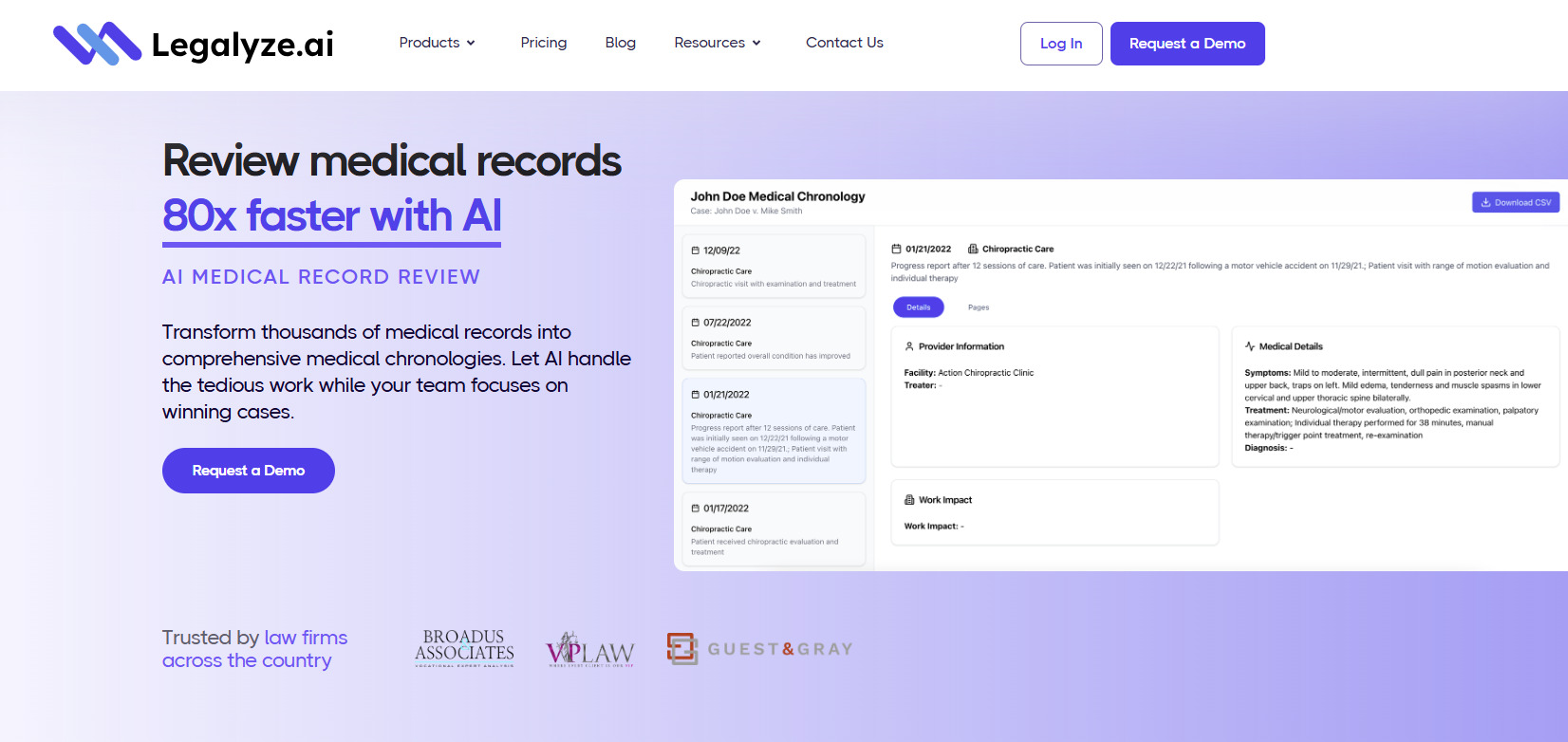
Source: Legalyze.ai
That feature can be useful for law firms handling document-heavy cases, particularly when reviewing medical records or preparing routine correspondence. Each answer can include page-level sources, which gives you a clearer path back to the original material during review.
Solo practitioners may find the focused workflow helpful when they need to move through large files with limited support. Nevertheless, Legalyze.ai does not replace legal research into current case law, and lawyers still need to check citation formats before using a draft.
Best Features
- Case Chat AI: Lets you ask questions about uploaded records and receive source-cited answers.
- Drafting AI: Creates documents such as motions and letters using your case files as context.
- Medical chronologies: Organizes medical events into a timeline linked to the source records.
- Document summaries: Extracts key information from large files and points you to the relevant pages.
- Case management integrations: Connects with platforms such as MyCase and Smokeball.
5. Spellbook
Spellbook is designed for lawyers who spend much of their time drafting and reviewing agreements in Microsoft Word. Since it works inside the document, you can generate new language, revise clauses, and review contract terms while staying close to your usual workflow.
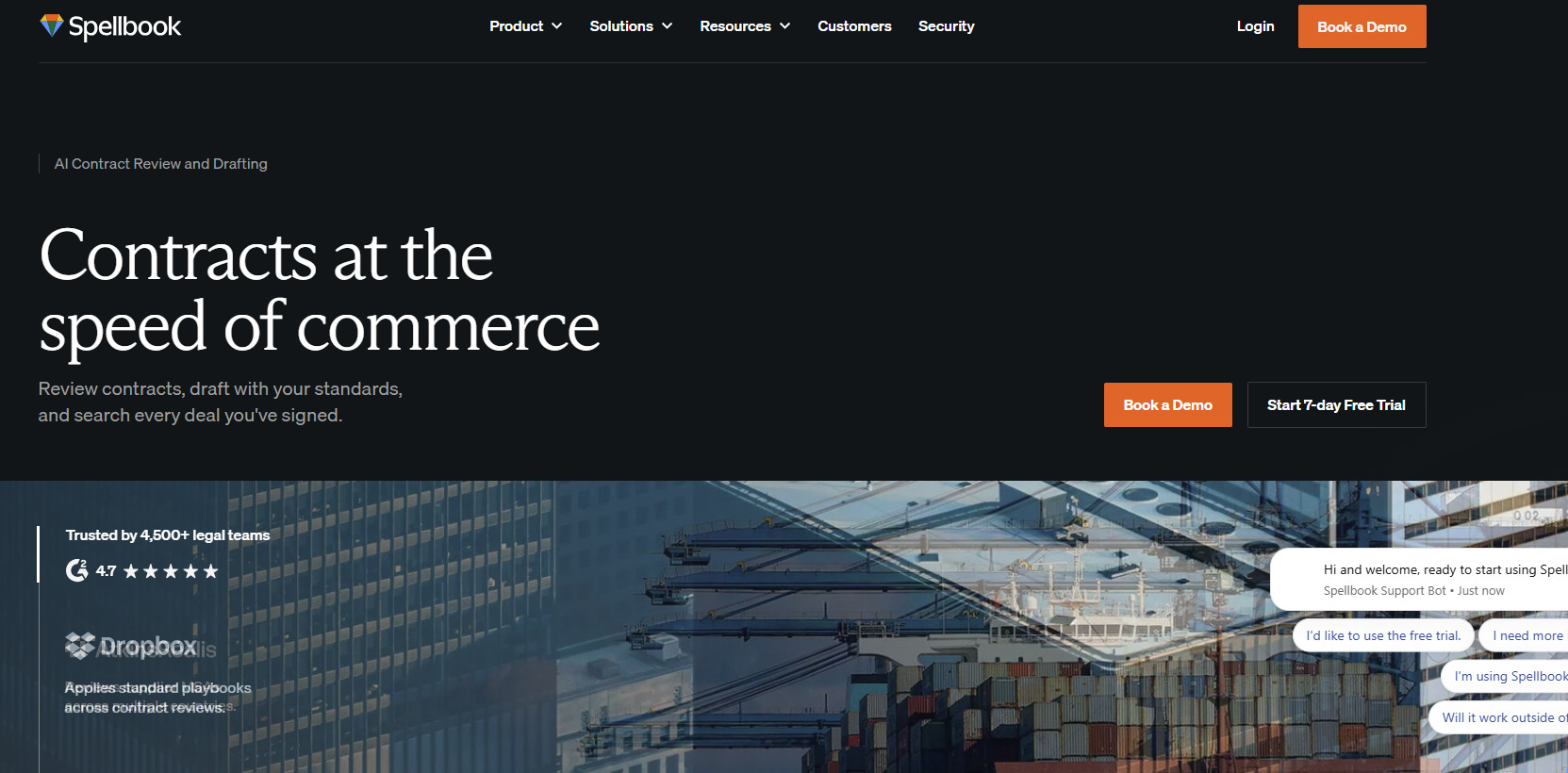
Source: Spellbook.com
You can use Spellbook to prepare a full draft from a blank document or add language to something already in progress. It can also draw from your clause library, which helps reduce repetitive tasks and keeps preferred wording easy to reuse during client work.
For review, Spellbook can compare an agreement against selected standards and suggest fixes for missing or unexpected terms. Those suggestions can help you spot potential issues earlier, though attorney review remains necessary to ensure accuracy before the document is finalized.
Best Features
- New Document: Generates complete agreements from the details you provide.
- New Clause: Drafts fresh contract language or pulls relevant wording from your library.
- Reviews: Produces suggested redlines and flags possible problems in the document.
- Benchmarks: Compares the agreement against selected standards and identifies missing terms.
- Playbooks: Applies your own review rules and preferred language to future work.
6. Gavel
Gavel is a strong option if your work involves repeatable documents or contract review. Its two main products cover both sides of that process: Gavel Workflows automates document creation, while Gavel Exec helps counsel draft and review contracts in Microsoft Word or online.
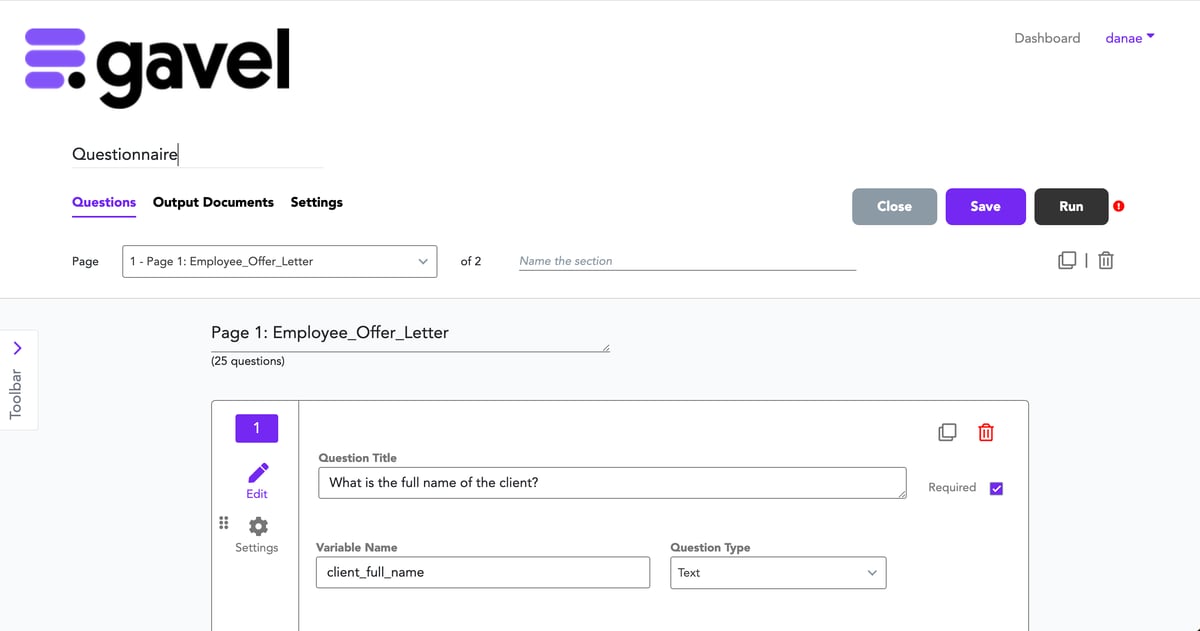
Source: G2
For document automation, you can connect a questionnaire to your existing Word or PDF templates.
Gavel then fills in the right language based on the user’s answers, which can save billable hours on forms and other rules-based documents. It can also handle defined terms and conditional clauses through custom logic.
Gavel Exec is geared more toward the negotiation process. It can redline full agreements, draft new clauses, and apply your playbooks or prior language during review.
Best Features
- Gavel Workflows: Turns questionnaire responses into completed Word or PDF documents.
- Gavel Exec: Supports contract drafting, review, and redlining in Word or online.
- Custom logic: Adjusts document language based on the answers entered.
- Playbooks: Applies your preferred positions and drafting standards during contract review.
- Template automation: Converts existing legal forms into reusable document workflows.
7. Claude AI
Claude AI can help you work through long legal documents, build a first draft, or revise language based on detailed instructions. You can upload case materials, explain the document you need, and ask Claude to organize the information into a clearer structure.
Source: Claude.com
Its broad flexibility works well for early drafting and document review. For example, you might use it to summarize an agreement before preparing a client update or compare proposed language against an internal standard.
Projects can keep related files and custom instructions together, which is helpful when the work continues over several sessions.
Claude is a general AI platform, so it requires human oversight throughout the legal workflow. Its output should be checked against the original documents, current law, and your own human expertise before it reaches a client or becomes part of a filing.
Best Features
- Large document review: Reads uploaded files and helps identify relevant information.
- Draft generation: Produces first drafts based on your instructions and supporting materials.
- Projects: Keeps related documents and custom guidance in one workspace.
- Document comparison: Highlights differences in wording or position between drafts.
- Flexible revision: Reworks tone or structure as your needs change.
Take the Drag Out of Legal Drafting
AI legal document drafting can make repetitive work easier to manage, but the best results still come from choosing a tool that fits the type of document you handle most often.
A general platform may help with early drafts, while a purpose-built tool can give you more structure and control.
For discovery work, Briefpoint offers a much more focused workflow. You can draft requests and responses, collect client input, review supporting files, and prepare Word-ready documents without piecing the process together across separate tools.
Autodoc helps identify responsive materials and create Bates-cited drafts, while Client Bridge gathers answers and files through a secure link. Supplemental Responses makes it easier to update earlier work as the case develops.
Book a demo today and see how much time Briefpoint can take out of your discovery workflow.
Top 9 Clio Integrations to Simplify Your Legal Practice
9 Best Clio Integrations You Should Consider
Here’s a list of Clio integrations that can make a big difference in your day-to-day work:
1. Briefpoint
If you’re spending hours on discovery requests and responses, Briefpoint can seriously lighten your load. It’s one of the most helpful Clio integrations for law firms dealing with civil litigation, personal injury, or employment matters.
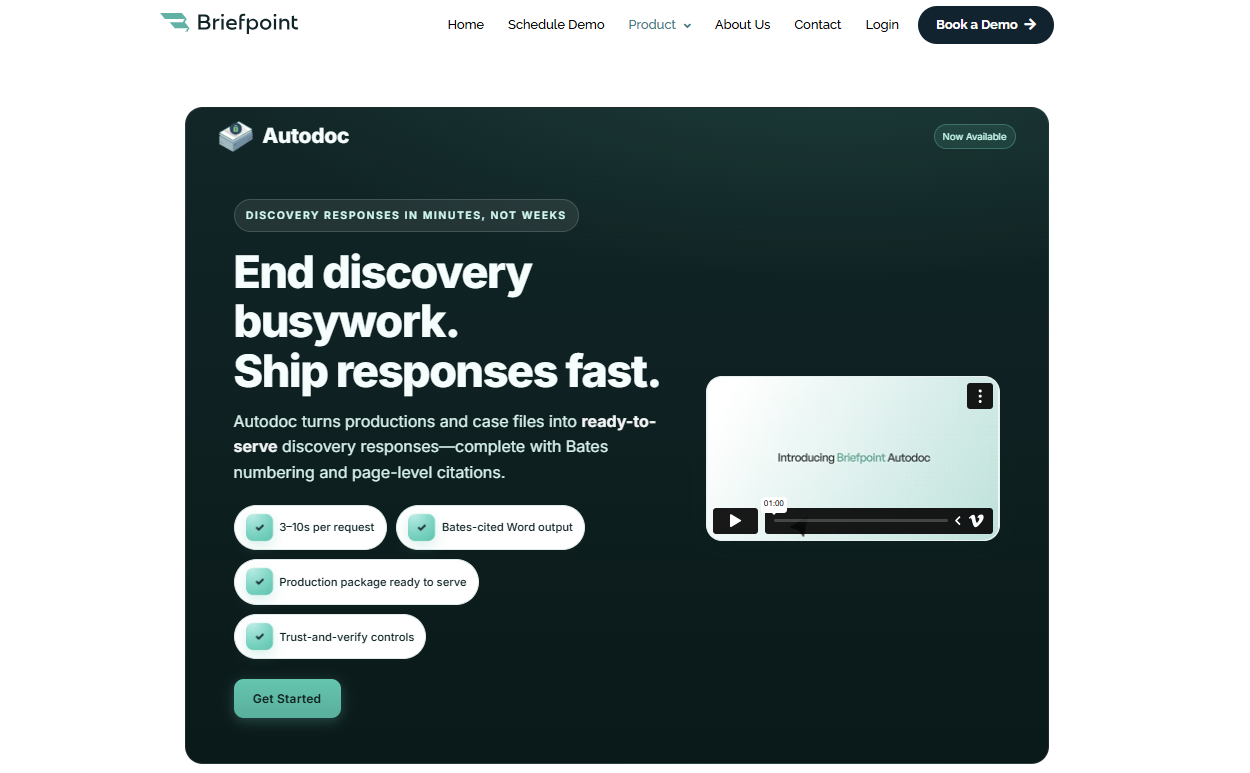
With Briefpoint, you can draft your discovery documents in minutes. Its document automation tools handle requests for admission, requests for production, and interrogatories for every U.S. state and D.C.
Autodoc reviews uploaded discovery materials, identifies responsive documents, and helps generate draft responses with page-level citations. Supplemental responses make it easier to update prior answers as new information comes in or the case develops.
Plus, Briefpoint’s Bridge feature sends your client a secure, mobile-friendly questionnaire written in plain English or Spanish. Once they submit their answers and upload any relevant files, Briefpoint adds that information directly to the draft discovery responses for attorney review.
Getting started is easy. There’s no setup or onboarding. Just sign in and go. Inside Clio, you’ll upload the opposing counsel’s request, add objections (which Briefpoint can help write), and let the tool collect responses from your client.
2. NetDocuments
NetDocuments is a smart choice if you want better control over your Clio documents. As part of a strong practice management software setup, it helps you organize everything in one secure place, which can save time spent searching through messy folders.
It’s built for legal practice needs, making it easy to search, edit, and share documents without slowing down your day. Since it’s cloud-based, you can access your case files anytime, anywhere, whether you’re handling a court deadline or meeting prospective clients.
Clio integrates with NetDocuments to keep matter files connected and reduce repetitive administrative tasks. If document management has been a pain point for your firm, the integration can clean up your workflow fast and keep your legal practice running smoothly.
3. Casetext
Casetext, now known as CoCounsel, is a great Clio integration if you want to make legal research faster and less of a grind.
It connects right to your Clio matter, so you can jump into searching court records, statutes, and case law without switching tools.
You can run keyword searches across millions of digital documents and get results that actually match the legal issues you’re working on. It’s built to save you time and cut down on duplicative data entry. Plus, it lets you link your research directly to the case you’re handling.
4. Docusign
Docusign is one of the easiest ways to improve client relationships while cutting down on delays. Instead of waiting for clients to print, sign, and send back paperwork through postal mail, you can send everything electronically right from your Clio software.
It’s perfect for things like case initiation documents, engagement letters, and other forms you need signed fast. Also, it’s a huge help during client onboarding by making the first steps simple and professional.
By adding Docusign to your Clio setup, you can move past slow administrative processes and get your matters moving quicker. For example, instead of mailing out a retainer agreement and waiting a week, you can send it through Docusign and have it back the same day.
5. Docket Alarm
Docket Alarm makes it easy to stay on top of court filings without all the manual checking. It connects directly to your Clio platform, so you can pull in important updates quickly.
You can import data like case statuses, bankruptcy notices, and new filings straight into Clio Manage. Unlike other apps that keep court information separate, the Clio app connection keeps those updates tied to the correct matter.
It even helps with client intake by letting you know right away when there’s a completed proof of service or a major update tied to your client’s case.
For instance, instead of waiting for a court to mail a filing notice, Docket Alarm can send it straight to your dashboard, help you respond faster, and keep your cases moving.
6. Lawmatics
Lawmatics is a smart Clio integration if you want to make lead generation and client intake easier. It helps you bring in new clients by automating things like intake forms, follow-ups, and scheduling.
Everything is automatically synchronized with your Clio account, so once a lead becomes a client, their information is already in place. You can also keep the matter status updated as the client moves through intake.
Lawmatics also integrates seamlessly with Clio Manage, so you can streamline various aspects of intake, marketing, and client communication. If you’re looking to create an enhanced client experience without piling more admin work on your plate, Lawmatics is a great pick.
7. QuickBooks
When it comes to handling firm finances, QuickBooks makes client billing feel almost effortless. Instead of juggling spreadsheets or worrying about missed payments, you can connect QuickBooks to your Clio account and pull billing info straight from your existing matters.
Integrating Clio with QuickBooks lets you sync invoices, payments, and Clio time entries, so new data does not need to be entered twice.
Everything lines up, which means fewer mistakes and less time fixing errors. That’s a big plus when you’re trying to streamline operations, build a stronger client experience, and avoid legal billing headaches later.
QuickBooks is one of the best tools out there for lawyers who want to spend less time crunching numbers and more time focusing on their clients.
8. CaseMail
CaseMail is a good Clio integration if you’re tired of dealing with the hassle of certified mail. It lets you send documents electronically while still meeting compliance requirements, which means no more standing in line at the post office.
It’s built for legal work, so whether you’re filing something with the Supreme Court, an appellate court, or just serving documents in a regular case, CaseMail keeps everything official and trackable.
On top of that, it stores the legal information you need alongside your Clio matters. It keeps the same facts organized without any extra busywork.
9. AgileLaw
AgileLaw is built to help you run depositions more efficiently, especially if you’re looking to cut down on the paper trail. It brings everything online (e.g., exhibits, annotations, and transcripts) so you’re not stuck shuffling documents around.
What makes it stand out is the way you can build a custom action for each deposition. That means smoother workflows and fewer surprises during the process. It also drastically cuts the time you’d normally spend organizing and sharing exhibits.
If you’re already using Clio to manage your cases, Agile Law fits right in by keeping your deposition prep fast, simple, and completely digital.
Need A Great Clio Integration? Start With Briefpoint
If you’re new to Clio integrations and not sure where to begin, Briefpoint is a smart starting point. Available through the Clio App Directory, it connects discovery drafting directly to the matters you already manage in Clio.
Briefpoint helps you prepare requests and responses, collect client input through Bridge, and update prior answers with supplemental responses.
Autodoc can also review uploaded materials and identify responsive documents, which cuts down on the manual work involved in discovery.
While some firms may need custom integrations for highly specific workflows, Briefpoint is designed to work with Clio with minimal setup. You can connect your account, pull in the relevant matter information, and start drafting.
Legal Document Automation: Templates, AI and Review
Legal Document Automation: Templates, AI and Review
Legal content overseen by Nathan Walter, Esq., attorney licensed in California (State Bar No. 313299).
An in-house team sends counsel a policy, a spreadsheet of dates and three versions of a party name, and the draft has to reconcile all of them. Legal document automation addresses that problem. It is software that assembles a document from matter inputs and configured rules, and some tools also generate new text.
This guide follows the mechanics from inputs to an editable draft, separates template logic from generative AI, and covers what attorneys still review.
For vendor shopping, see our page on legal document automation software comparisons.
What is legal document automation?
Legal document automation is the use of software to assemble repeatable document components from inputs and rules someone has configured. You enter or import facts such as party names, dates and a matter number. The software places them in a draft and includes or omits sections according to the rules.
A saved precedent is a file you copy and edit by hand. An automated process asks for the variable information, applies the rules and produces a draft with those values already in place. Some tools add generative AI on top, which writes new wording instead of selecting stored wording.
Automation can reduce repetitive assembly work. It does not guarantee a complete or correct draft. A wrong input or an outdated template can carry errors into later drafts.
Legal document automation is also narrower than broader legal automation, which can include intake, routing and other workflow steps. This page stays with the document itself.
Repeatable structure, matter-specific facts
An automated document can combine these kinds of content:
- Fixed text that stays the same in every draft.
- Variable fields that change with the matter, such as names, dates and addresses.
- Optional sections that appear only when an input calls for them.
Fixed text is only as current as its last review. Someone has to own the template and update it when the underlying wording changes.
Templates and generative AI do different jobs
A template assembles language that someone approved in advance. Generative AI proposes new wording from a prompt and the material it is given. A single tool can combine the two, so it helps to know which part of a draft came from which source.
The two approaches fail in different ways, and each needs a different check. Our guide to types of legal drafting software covers how these categories are usually grouped.
| Approach | What it contributes | What to check |
|---|---|---|
| Template assembly | Approved language, fields and if/then rules | Input accuracy, template version, and whether each rule fits the matter |
| Generative drafting | New wording based on a prompt and supplied material | Every statement against the facts and sources |
Templates assemble predefined language
A template holds fixed text, fields and conditional logic. A conditional rule is an if/then branch: if an input says one thing, a clause appears, and if it says another, a different clause or none appears.
The software applies the rules the template owner configured. A configured rule can select a clause, but whether that clause is legally suitable for the matter remains a human judgment.
Generative AI proposes new wording
With generative AI, the same prompt can yield different wording on different runs, and the output can include statements the source material does not support.
Check generated text against the facts and any cited sources. Fluent wording can still be wrong.
How inputs become an editable draft
The steps below describe the general mechanics. For adoption and setup, see implementing document automation for lawyers.
1. Identify the source facts
Start with the facts the document depends on: party names, matter details, dates and the documents that support them. Where a fact is unresolved, it stays a question. A blank or flagged field is safer than a guessed value.
Missing data and a negative answer are different things. “We have not found the policy” is not the same as “no policy exists,” and the software cannot tell them apart unless someone records which one applies.
2. Apply the approved structure
The template supplies the structure: fixed text, fields and optional language. A template owner maintains the versions so that drafts use the current approved wording.
This is a general description of how assembly works. It does not promise any particular integration or feature in any particular product.
3. Assemble or generate the draft
Stored wording or generated text enters the draft at this stage. A citation here can mean two different things. A Bates reference points to a page of a produced document. A citation to legal authority points to a rule or case.
Placing a Bates reference to a document page does not establish that a separate citation to legal authority is accurate or current.
Briefpoint drafts discovery responses and objections, with output you can edit in Microsoft Word.
4. Review the editable output
Review the draft against the source facts and the document’s requirements. Mechanical checks still matter: names, numbers, dates, cross-references and any field the software left blank. Substantive review follows, and it belongs to the attorney.
Which document components are good candidates?
Automation fits best at the level of components, not whole documents. Recurring party blocks, repeatable internal forms and stable structures with variable facts all assemble well. Contracts, internal legal forms and discovery documents each contain components like these.
That does not make every document in those categories a good fit, and it does not mean any given product supports all of them.
Stable components with controlled inputs
A party block, a signature section or an approved clause is easy to assemble because the wording is settled and only a few inputs change. The inputs can be checked before the draft is built.
A novel substantive argument may need individual analysis and drafting even when its surrounding document structure is repeatable.
Exceptions that need individual drafting
Some situations fall outside what a template can handle:
- Facts are unresolved or disputed.
- The document has an unfamiliar structure.
- The matter calls for analysis specific to its circumstances.
In those cases, drafting by hand, or at least heavy individual editing, is the more reliable route. Whether a given document can be automated depends on the workflow and the inputs available, not on the document’s label.
What attorneys still need to review
The checks in the first subsection are practical review points, not requirements quoted from an ethics rule. The federal discovery rules cited in the last two subsections apply to civil discovery in United States federal courts. They are not rules for every legal document or every state court.
Facts, sources and document versions
Compare names, request numbers and dates against the source documents. Look for inputs that were missing or left at a default. Confirm that the template version matches the one the matter calls for. Check any legal citation independently; its presence in a draft does not establish its accuracy or currency.
Request-specific responses and objections
In federal civil discovery, Federal Rule of Civil Procedure 34 governs requests for production. Under Rule 34(b)(2)(B), the response for each item or category must either state that inspection and related activities will be permitted as requested or state with specificity the grounds for objecting, including the reasons.
Rule 34(b)(2)(C) adds that an objection must state whether any responsive materials are being withheld on the basis of that objection. An objection to part of a request must specify the part and permit inspection of the rest.
A preset list of objections, selected only by case type, does not by itself satisfy those request-specific requirements. In an attorney-led workflow, counsel evaluates each response and objection against the specific request. Our page on discovery responses covers the broader process.
Scope and protected information
Federal Rule of Civil Procedure 26(b)(1) sets the scope of discovery. Unless a court order limits it, parties may obtain discovery regarding any nonprivileged matter that is relevant to any party’s claim or defense and proportional to the needs of the case. The rule lists the proportionality considerations: the importance of the issues at stake in the action, the amount in controversy, the parties’ relative access to relevant information, the parties’ resources, the importance of the discovery in resolving the issues, and whether the burden or expense of the proposed discovery outweighs its likely benefit. Automation does not resolve those case-specific questions.
Rule 26(b)(5)(A) covers withheld information. A party that withholds otherwise discoverable information as privileged or as trial-preparation material must expressly make the claim. The party must also describe the nature of the documents, communications or tangible things not produced, in a manner that will enable other parties to assess the claim without revealing the protected information itself.
An in-house discovery handoff in practice
The example below is invented. It shows how the pieces stay separate in a federal employment dispute where an in-house team supports outside or in-house counsel.
Suppose a request for production asks for documents about an employee handbook policy. Within the scope of Rule 26(b), Rule 34(a)(1) reaches designated documents and electronically stored information (ESI) in the responding party’s possession, custody, or control. The team’s practical role is to help counsel locate potentially responsive material within that scope.
The same separation of facts, draft language and document references applies to in-house teams using discovery drafting software.
Keep facts, response text and document references distinct
Four things move through the handoff, and each one has its own source:
- The client answer: The business identifies which version of the policy applied.
- The supporting files: The handbook versions and related documents back up that answer.
- The draft language: The response text addresses the request.
- Counsel’s evaluation: The attorney reviews the response and decides whether any objection applies and what it must say.
If the client answer, the files and the draft language blur together, an error in one is hard to trace. Kept apart, each can be checked against its own source.
Return unresolved questions to counsel
Suppose the team cannot tell when the policy changed. That gap goes back to counsel as an open question. Until the date is confirmed, the draft can carry a flagged placeholder instead of an asserted answer.
Draft discovery responses with Briefpoint
Briefpoint drafts responses and objections to interrogatories, requests for production and requests for admission. Its output is editable in Microsoft Word, so the attorney can review and revise the draft rather than treating generated language as final.
Draft language, client answers and responsive documents
Client Bridge sends clients plain-language questions through a secure link. Clients can answer those questions and upload documents for attorney review. In the handoff described above, those answers and uploads provide material for counsel to examine alongside the draft.
Autodoc finds responsive documents, adds page-level Bates citations and builds a Bates-numbered production package. Those citations identify document pages; they are distinct from citations to legal authority.
The response language, client answers and document references each remain part of the attorney’s review. Attorneys keep final review of the editable Word output.
Book a demo to explore Briefpoint’s discovery response drafting.
See how Briefpoint drafts discovery responses:
FAQs About Legal Document Automation
What is legal document automation?
Legal document automation is software that builds a document from inputs and configured rules. A reusable template is a saved file you edit by hand, while automation fills fields and includes optional sections for you.
For example, entering a party name once can place it in every spot that calls for it. Review is still needed because incorrect inputs carry through to the draft.
Is legal document automation the same as generative AI?
No. Template-based automation assembles predefined language according to configured rules. Generative AI writes new wording that can vary from run to run.
A single tool can combine both, with a template supplying fixed text and generated text filling gaps. Each part needs its own check: template inputs and versions for one, facts and sources for the other.
Which legal documents can be automated?
Components of documents are more automatable than whole documents. Recurring internal forms, approved agreement language and discovery document structures often contain stable text with variable facts.
Suitability depends on the workflow and the inputs available, and a document with unresolved facts or a novel structure may need individual drafting. No category is automatable in every case.
Do automated legal documents still need attorney review?
In an attorney-led workflow, yes. The attorney evaluates whether the draft fits the matter.
For example, federal Rule 34(b)(2)(B) requires each item or category’s response to state that inspection and related activities will be permitted as requested or state specific grounds for objecting, including the reasons. Applying those requirements to a particular request calls for counsel’s analysis.
Can legal document automation help with discovery responses?
It can help with part of the drafting. Discovery responses depend on client facts, the source documents and the specific request, and automation can assemble draft language around those inputs.
It does not supply the facts or evaluate objections. Counsel still reviews each response, and automation does not by itself handle service, filing, verification or legal compliance.
The information provided on this website does not, and is not intended to, constitute legal advice; instead, all information, content, and materials available on this site are for general informational purposes only. Information on this website may not constitute the most up-to-date legal or other information. This website contains links to other third-party websites. Such links are only for the convenience of the reader, user or browser. Readers of this website should contact their attorney to obtain advice with respect to any particular legal matter. No reader, user, or browser of this site should act or refrain from acting on the basis of information on this site without first seeking legal advice from counsel in the relevant jurisdiction. Only your individual attorney can provide assurances that the information contained herein – and your interpretation of it – is applicable or appropriate to your particular situation. Use of, and access to, this website or any of the links or resources contained within the site do not create an attorney-client relationship between the reader, user, or browser and website authors, contributors, contributing law firms, or committee members and their respective employers.
READ MORETop 7 RFP Response Automation Software in 2026
What Is RFP Response Automation Software?
RFP response automation software helps you manage incoming questions, find relevant source material, and prepare answers with less manual drafting.
Most platforms focus on requests for proposal, where sales and proposal teams need to respond to detailed requirements from potential customers.
This is still a fairly specialized corner of business software. The market has fewer well-known platforms than broader categories like CRM or project management, though there are now several established RFP response tools built for specifics like proposal teams, enterprise bids, and security reviews.
The term can cover another use case too. In litigation, an RFP usually means a request for production. Legal teams use purpose-built software to review requests, locate responsive documents, draft objections and answers, and prepare production materials.
Because those workflows are so different, there is no single type of RFP software that fits every organization. The best option depends on what the abbreviation means in your work and which parts of the RFP response process take the most time.
What Types of RFPs Can Be Automated?
RFP automation covers a few different workflows, and the right software depends on what you are responding to. Some tools are built for sales proposals, while others support legal discovery or risk reviews:
Requests for Proposal
Requests for proposal are common in sales, procurement, and vendor selection. If your team handles these regularly, automation can help you review requirements, assign questions, pull approved content, and draft answers from an existing knowledge base.
It can also track progress through the RFP process and flag sections that still need input. This is useful when several people contribute to one bid or the submission has strict formatting rules.
Requests for Production
In the litigation process, RFP usually means a request for production. These requests ask a party to identify and produce documents relevant to a case.
Legal RFP automation can read the requests, locate responsive files, and draft objections or substantive responses.
In some cases, the software can connect written answers to supporting documents and prepare Bates-numbered production materials. Since the workflow involves procedural rules, privilege, and case evidence, you need software built specifically for legal discovery.
Security Questionnaires
Security questionnaires ask vendors to explain how they protect data and respond to risk. You will often see the same questions appear in slightly different forms from one customer to the next.
RFP response tools can match new questions with approved language from earlier submissions, internal policies, and security documentation. Your team can then review the suggested answers and update anything that has changed.
This can save a great deal of time on long questionnaires, though technical and legal reviewers should confirm every claim before the entire response goes out.
Due Diligence Questionnaires
Due diligence questionnaires (DDQs) help organizations evaluate a company before a transaction or business relationship moves forward. The questions may cover company records and compliance practices, along with financial or operational information.
Automation can organize due diligence inquiries, send them to the right contributors, and reuse approved answers from previous reviews. It can also keep supporting RFP documents linked to each response, which makes later follow-up easier.
7 Best RFP Response Automation Software
The best RFP response automation software depends on the type of request your team handles and how much of the response process you want to automate.
We’ve compiled the tools below to cover legal discovery, sales proposals, security reviews, and other common RFP workflows:
1. Briefpoint for Legal Requests for Production
Briefpoint is built for litigation teams responding to requests for production, so its version of RFP automation looks very different from proposal software.
You upload the requests along with the complaint and case files, then Autodoc identifies responsive documents and prepares a Word response with objections, substantive answers, and page-level Bates citations. It also assembles a Bates-numbered production package for review and service.
These capabilities make Briefpoint a strong choice if document review, response drafting, and production assembly are slowing your team down. You can confirm responsive files, remove irrelevant documents, flag privileged material, and edit the final language in Word.
All this keeps attorneys in control while reducing manual data entry and improving response accuracy. Typical drafting takes around 3 to 10 seconds per request.
Briefpoint can also collect files from clients through a secure, mobile-friendly link, then convert uploads to PDF, apply Bates numbers, and cite them in the response.
For later updates, supplemental responses preserve the original answers so your team can maintain consistency throughout the case.
Best Features
- Autodoc: Finds responsive documents for each RFP and drafts Bates-cited answers.
- Production assembly: Creates a Bates-numbered package that is ready for attorney review.
- Trust-and-verify controls: Lets you approve files, exclude irrelevant material, and flag privileged documents.
- Client Bridge: Collects client files through a secure link that works in English or Spanish.
- Supplemental responses: Builds updated responses from the original set while preserving earlier answers.
- Jurisdiction-ready formatting: Supports written discovery in all 50 states and 98 federal district courts.
Pros
- Built specifically for legal requests for production
- Cuts response time for document-heavy discovery
- Produces editable Word drafts with page-level citations
- Reduces repetitive review and production work
- Gives attorneys control over what gets produced
- Includes SOC 2 Type II security and zero-retention AI protections
2. Loopio for Sales and Proposal Teams
Loopio is an AI-powered RFP software platform built for proposal professionals, sales teams, and security teams handling recurring questionnaires and competitive bids.
It brings proposal creation into one workspace, where your team can import an RFP, assign questions, track progress, and prepare a first draft using approved company content.
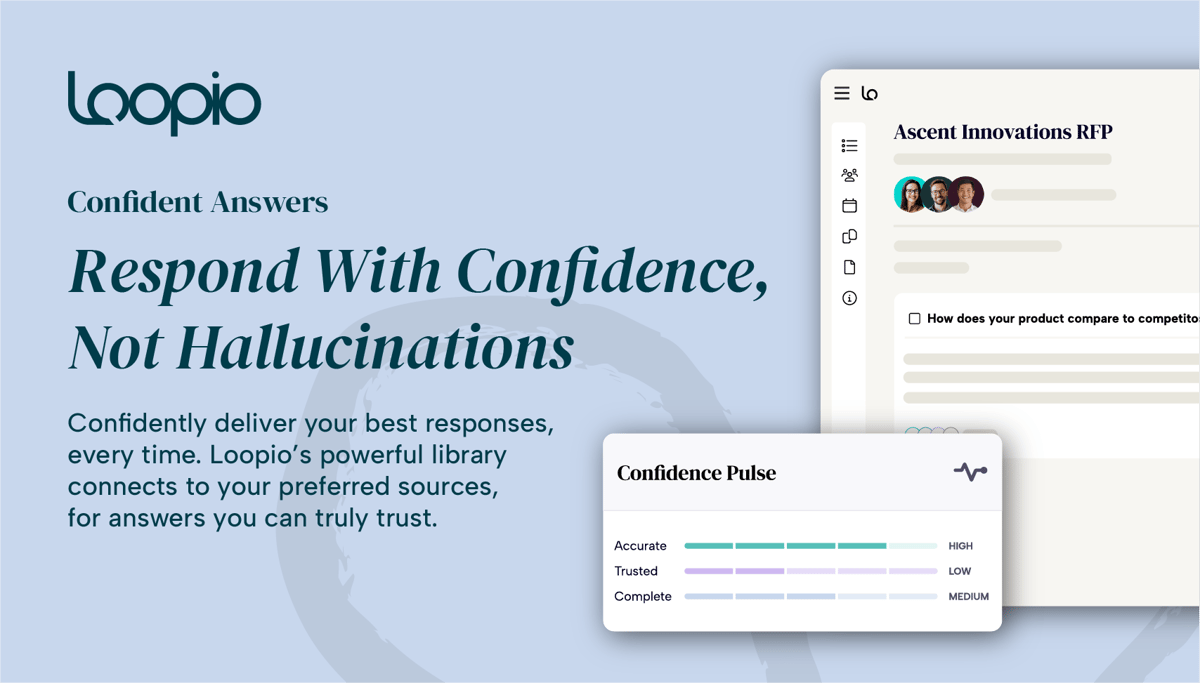
Source: G2
Its centralized content library is a major part of the platform. Teams can organize vetted answers, product information, and supporting material, then use automated matching to find relevant content for new questions.
Loopio can generate tailored responses from trusted sources and show citations, which gives reviewers more context when checking AI-generated responses.
Plus, Loopio supports several response formats, including traditional RFPs, security questionnaires, and due diligence questionnaires. It’s a practical fit for established teams that want proposal generation, content governance, and contributor workflows in the same system.
Best Features
- Centralized content library: Stores approved answers in a searchable, structured knowledge base.
- Automated Answers: Matches incoming questions with relevant content and prepares draft responses.
- Response Intelligence: Generates answers from connected sources and provides citations for review.
- Project workflows: Assigns questions, tracks progress, and coordinates input from internal contributors.
- Content connectors: Pulls current information from sources like Google Drive, SharePoint, and company websites.
- Copilot Agent: Surfaces approved Loopio content inside supported Microsoft 365 workflows.
Pros
- Supports several sales and risk response formats
- Keeps reusable proposal content organized
- Helps teams maintain consistency between submissions
- Gives reviewers visibility into answer sources
- Combines proposal drafting with workflow management
- Works well for mature, collaborative response teams
3. Responsive for Enterprise RFP Management
Responsive is designed for companies where RFP work involves large teams, formal review steps, and a steady flow of complex requests.
Rather than centering the experience on proposal creation alone, the platform gives response leaders a clearer view of workloads, deadlines, ownership, and project status.
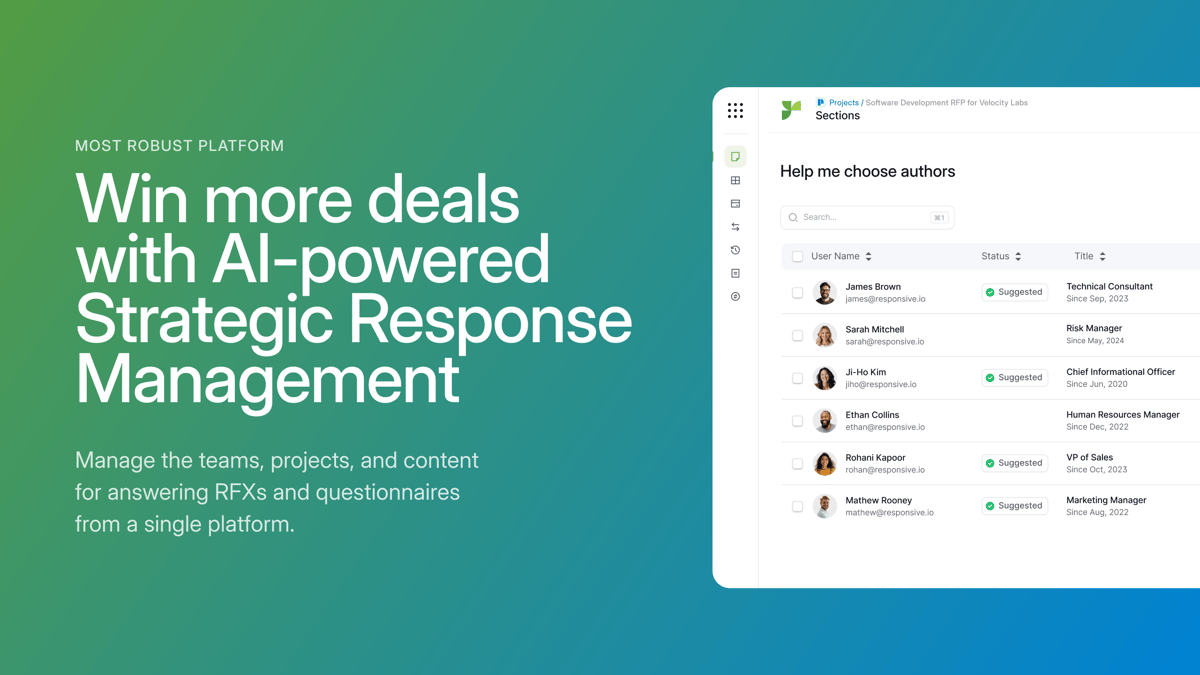
Source: G2
You can break an RFP into sections, route questions to the right contributors, and monitor the full project from a shared dashboard. Built-in controls support version control, approvals, and permission settings, which can be useful when legal, security, finance, and product teams all need to contribute.
Responsive also uses generative AI to produce draft answers and recommend relevant material from approved content libraries. Teams can review the source behind each suggestion and measure performance over time.
This makes the platform a good fit for enterprise organizations that want stronger oversight of the response process while still improving proposal quality.
Best Features
- Project dashboards: Show deadlines, assignments, completion rates, and outstanding work.
- Automated workflows: Route questions and approvals based on team roles.
- Responsive AI: Generates drafts from approved company information.
- Reporting tools: Track turnaround times, contributor activity, and project performance.
- Governance controls: Manage permissions, reviews, and content ownership.
- Integrations: Connect RFP projects with common CRM, storage, and collaboration tools.
Pros
- Built for high-volume enterprise response programs
- Gives managers clear visibility into active projects
- Supports detailed permissions and approval processes
- Helps reduce version control problems
- Makes cross-department contributions easier to manage
- Provides reporting beyond basic proposal writing
4. Conveyor for Security Questionnaires
Conveyor is an RFP response automation platform built around security questionnaires and customer compliance reviews. It fits companies whose sales process regularly includes detailed questions about security controls, data handling, and internal policies.
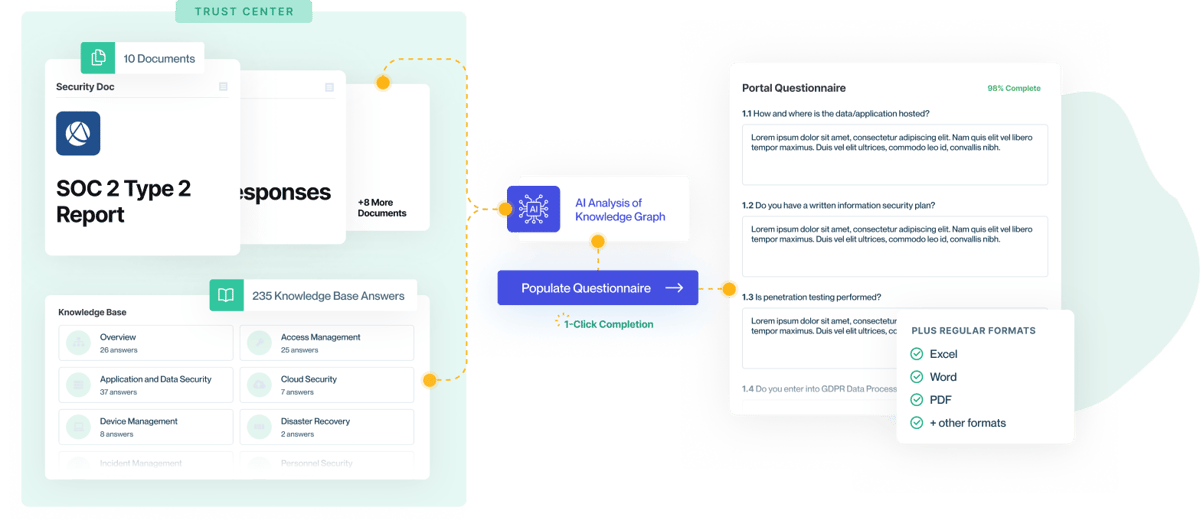
Source: G2
The platform reads incoming questionnaires, drafts answers from approved company sources, and returns the completed file in its original format. Each proposed response includes a citation, which helps reviewers check response accuracy before anything is sent to a prospective customer.
Conveyor also uses AI agents to manage parts of the response workflow, such as sorting incoming requests and routing questions to the right expert. This makes it a strong option when security questionnaires form a major part of your broader RFP process.
Best Features
- Questionnaire automation: Reads incoming files and drafts answers from approved sources.
- Source citations: Shows the policy or document supporting each answer.
- AI agents: Help manage intake, assignments, and review steps.
- Original-format export: Returns completed questionnaires in the submitted file format.
- Review workflows: Routes uncertain questions to internal experts.
- Trust Center: Shares approved security information with potential customers.
Pros
- Designed specifically for security questionnaires
- Connects security reviews to the wider RFP response process
- Gives reviewers traceable answer sources
- Supports detailed compliance requirements
- Reduces repetitive copying between questionnaires
- Creates a clearer audit trail for completed responses
5. AutogenAI for Narrative Proposal Drafting
AutogenAI is built for proposal teams that need to turn detailed RFP requirements into a structured, persuasive response.
Its strongest use case is narrative-heavy work, where the team needs more than short answers pulled from a library. The platform can analyze an RFP, extract deadlines and evaluation criteria, build an outline, and generate a review-ready first draft from approved company content.
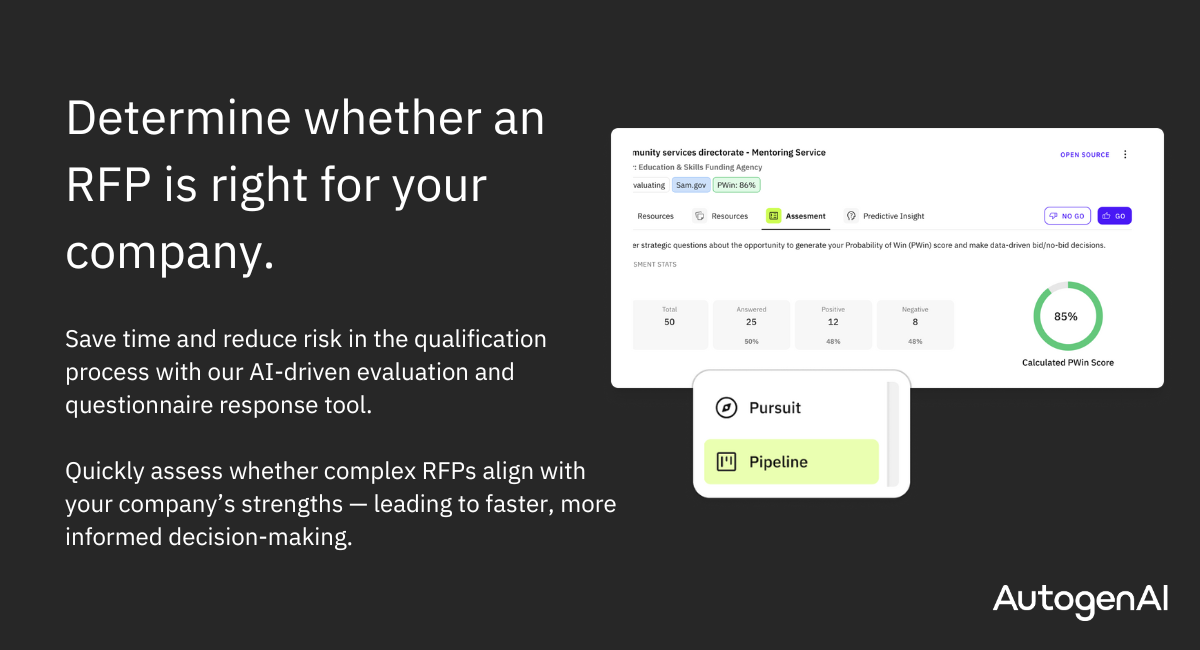
Source: G2
This makes it a practical fit for complex bids and government contracts, where the writing has to follow a clear story while still addressing every requirement.
AutogenAI can create compliance matrices, track the proposal lifecycle, and help teams see how well each section maps to the buyer’s scoring criteria. Its federal platform is designed for regulated proposal work and operates in a FedRAMP High-authorized environment.
If your team wants to scale bid volume, the platform can reduce the time spent building outlines and drafting long sections. However, writers must still refine the language, strengthen the argument, and confirm that each approved response reflects the current offer.
Best Features
- RFP extraction: Pulls requirements, deadlines, and evaluation criteria from uploaded solicitations.
- Narrative drafting: Creates tailored proposal sections from your company’s trusted sources.
- Compliance matrices: Maps requirements to the relevant response sections.
- Project Hub: Tracks milestones, document status, and time remaining before submission.
- Collaborative workflows: Keeps writers and reviewers working within the same proposal project.
- AutogenAI Federal: Supports government contractors with secure tools for compliant proposal development.
Pros
- Strong fit for long, narrative-based proposals
- Helps teams move from RFP analysis to first draft faster
- Supports regulated and government contracting workflows
- Keeps proposal content aligned with evaluation criteria
- Gives writers a structured starting point for complex bids
- Can help teams pursue more opportunities with the same staffing level
6. Thalamus AI for Agent-Based RFP Automation
Thalamus AI is an AI-native platform for proposal teams that want support throughout the full bid lifecycle.
Its agent-based approach separates the RFP process into focused tasks, such as bid qualification, requirement extraction, SME coordination, compliance checks, and response drafting. This gives teams a broader form of AI automation than a basic answer-retrieval tool.
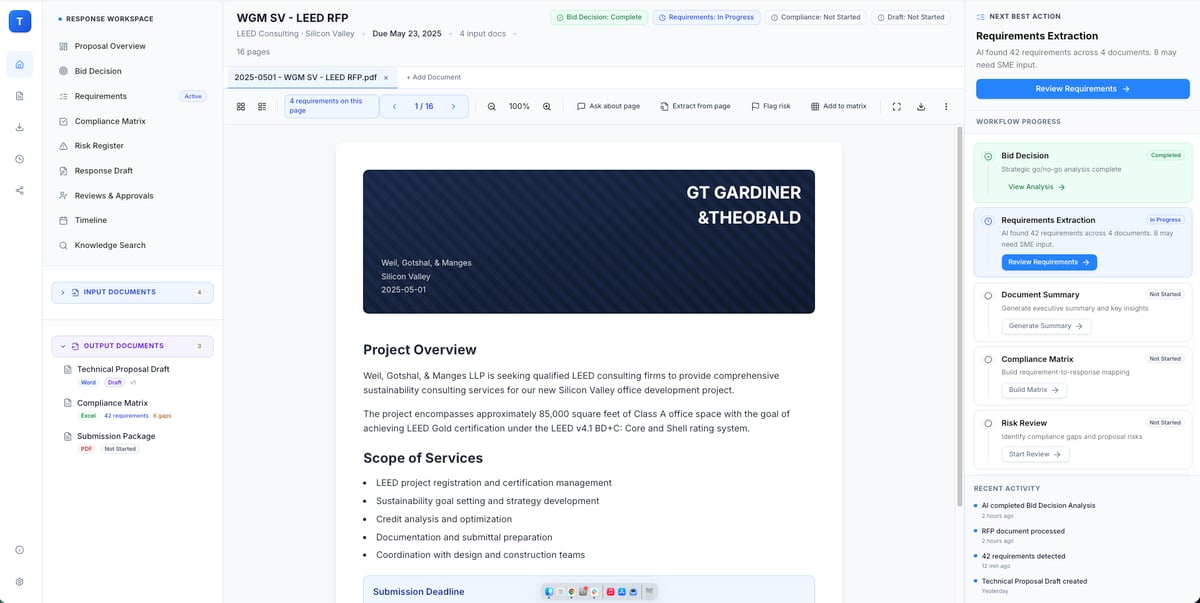
Source: G2
The platform can work with past responses, reviewer feedback, win themes, and approved company knowledge to create more relevant drafts over time.
It also tracks changes, roles, deadlines, and compliance requirements in one workspace. As each bid progresses, proposal leaders can see who owns each section and which responses still need attention.
Thalamus AI may suit enterprise teams handling complex RFPs, RFIs, due diligence questionnaires, or long-form proposals. Its AI-powered response engine helps produce compliant responses while keeping source material and reviewer decisions connected to the project.
Best Features
- Specialized AI agents: Handle focused stages of the response process, from qualification through compliance review.
- Requirement mapping: Extracts RFP requirements and connects them to response sections.
- Institutional memory: Learns from past responses, reviewer edits, and bid outcomes.
- SME coordination: Assigns authors and reviewers at the section or subsection level.
- Version tracking: Records edits and lets teams accept, reject, or restore changes.
- Lifecycle management: Supports planning, drafting, review, submission, and post-bid learning.
Pros
- Covers more of the RFP lifecycle than drafting alone
- Gives proposal teams clear ownership and review roles
- Uses prior bid knowledge to improve future responses
- Supports detailed compliance tracking
- Works with several RFx formats
- Includes enterprise access controls and secure audit trails
7. 1Up for Rapid Knowledge-Based Responses
1Up is RFP response software built for teams that want quick answers from trusted internal sources.
You connect the platform to company documents and knowledge systems, upload an RFP, and let the AI tool draft responses in minutes. It can handle common formats such as Word, Excel, PDF, and browser-based questionnaires.
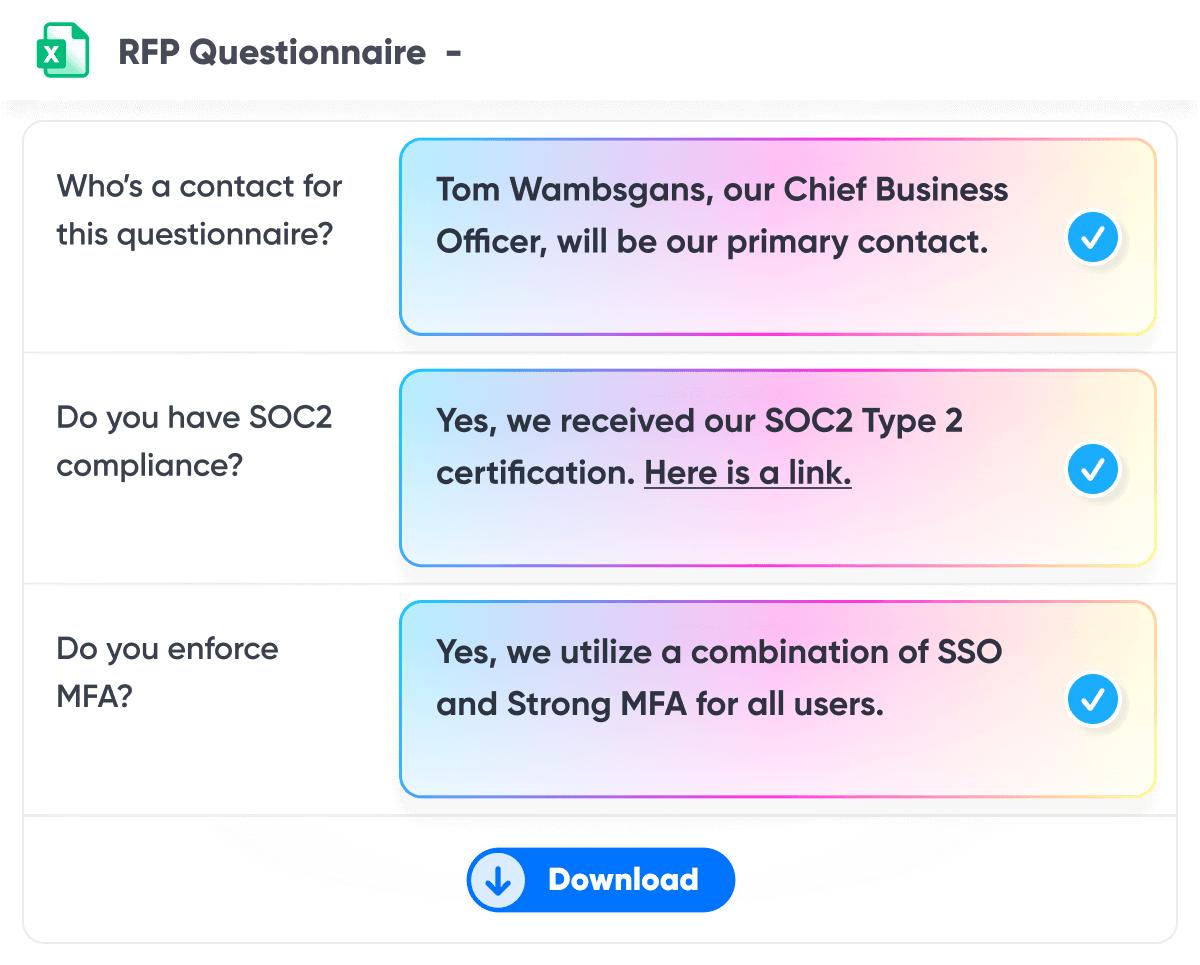
Source: G2
The platform keeps its focus fairly narrow. It is less concerned with heavy project administration and more focused on automating responses accurately and quickly.
That can work well for lean proposal teams or sales engineering groups that already have strong source material but spend too much time searching for it.
1Up also supports real-time collaboration, task assignments, and progress tracking when a question needs extra input. Since answers come from connected company knowledge, reviewers can work from a stronger first draft rather than sorting through old document versions.
Best Features
- RFP automation: Generates large batches of responses from trusted company sources.
- Multi-format support: Works with Word, Excel, PDF, and online questionnaires.
- Browser extension: Helps teams answer questions directly inside web portals.
- Knowledge connections: Pulls current information from internal documents and business systems.
- Collaboration tools: Lets users assign questions and monitor completion.
- Answer Hub: Gives teams a central place to review and manage company knowledge.
Pros
- Quick to set up compared with heavier response management platforms
- Strong fit for lean proposal teams
- Useful for RFPs and security questionnaires
- Reduces time spent searching past responses
- Supports browser-based submissions
- Keeps generated answers tied to approved internal sources
Benefits of RFP Response Automation Software
The biggest advantage of AI RFP automation software is that it gives your team a stronger starting point and a clearer way to move each response forward.
Here are the main benefits you can expect:
- Faster first drafts: An AI-generated answer gives your team something useful to review, so writers can focus on improving the response rather than building it from scratch.
- Easier content reuse: The software can pull from approved libraries and past submissions, helping teams adapt proven material for the current opportunity.
- Better proposal management: Assignments, deadlines, reviews, and project status stay in one place, which makes it easier to see what still needs attention.
- More consistent responses: AI platforms can apply approved terminology and current company information throughout a submission, even when several people contribute.
- Quicker expert input: Questions can be routed directly to the right reviewer, reducing delays when a response needs specialized knowledge.
- Safer generative AI adoption: Purpose-built tools often ground drafts in private company sources rather than public AI models alone, giving reviewers more context and control.
How to Choose RFP Response Automation Software
Start with the type of RFPs you manage most often, then compare the features that will have the biggest impact on your day-to-day workflow:
- Match the tool to your use case: Some AI RFP software is built for proposal teams, while other platforms focus on legal discovery or security reviews. Choose one that understands your documents and review requirements.
- Check the source controls: Look for software that drafts from approved company material and shows where each answer came from. Compliance checking is easier when reviewers can trace the source.
- Review collaboration features: Subject matter experts should be able to answer questions, approve drafts, and track assignments without a steep learning curve.
- Look at workflow automation: Strong tools can route questions, trigger reviews, and flag missing responses before submission.
- Test compatibility: Confirm that the platform works with Microsoft Office and the other systems your team already uses.
- Compare security settings: Role-based AI permissions can limit who accesses sensitive content and who approves final responses.
- Ask for a realistic trial: Test the software with one of your own RFPs so you can judge response quality, setup effort, and editing time.
Choose the RFP Software That Fits the Work
Where does your RFP process lose the most time?
The answer will usually point you toward the right software. Proposal teams may care most about reusable content and collaboration, while litigation teams need help with discovery requests, case documents, and production work.
Briefpoint is specifically built for that legal workflow. It helps you review requests for production, find responsive documents, draft objections and answers, add Bates citations, and prepare the production package for attorney review.
All these features mean litigation teams can save 30 or more hours per case while keeping attorneys in control of the final response.
Book a demo to see how Briefpoint can make legal RFP responses easier to manage.
7 Best Clio Workflow Automations for Law Firms
What Is Clio Workflow Automation?
Clio workflow automation helps you move routine work forward without handling every step manually. You set a trigger, such as opening a new matter or updating a case status, and either Clio or a connected tool carries out the next action.
You might use automated workflows to assign a task, send a reminder, create a document, or update a matter record. The setup depends on how your firm already works and which parts of the process take up the most time.
For example, once a client signs an intake form, the system could open a matter and alert the assigned attorney.
These small changes make a noticeable difference when your team repeats the same process every day. When you do it correctly, task automation helps you automate repetitive tasks while still keeping control over work that needs legal judgment or a personal response.
7 Clio Workflow Automations Worth Using
Clio can handle a surprising amount of routine work once you connect the right tools and set clear triggers. The following Clio workflow automations can help you cut down on repetitive steps and keep each matter moving:
1. Automate New Client Intake
Client intake can be time-consuming when your team has to do every step of the process manually. A Clio intake workflow can handle much of that setup as soon as a prospective client completes a form or signs an engagement agreement.
You still decide which details need review, but the routine steps can happen automatically. That cuts down on manual data entry and helps new matters start with cleaner, more complete records.
A typical flow might look like this:
- A prospective client submits an intake form
- Their contact details are added to Clio
- A new matter is created using the appropriate template
- The assigned lawyer or staff member receives a task
- The client gets a confirmation or next-step message
Once the workflow is in place, you can automate routine tasks while giving your team more time to focus on case review and speak with the client.
2. Create Tasks From Matter Updates
Matter updates often lead to another piece of work, but someone still has to remember to assign it. Clio workflow automation can turn those updates into tasks automatically, which helps lawyers and staff respond sooner without adding another manual step.
For example, your legal practice management software could create a task when a matter enters a new stage or when a document is uploaded. The task can include a due date, instructions, and the person responsible for completing it.
Common task triggers include:
- Matter stage changes: Create a follow-up task when a case moves from intake to active.
- New document uploads: Assign a review task when a pleading or client file is added.
- Calendar updates: Prompt the assigned legal professionals to prepare before a scheduled event.
- Status changes: Create a closing checklist when a matter is marked resolved.
This setup supports better efficiency because the next action appears at the right point in the workflow, without relying on someone to create it from memory.
3. Generate Routine Legal Documents
Document generation can give your team a strong first draft without rebuilding the same file from scratch. Clio Draft pulls information from the matter and places it into approved document templates, which cuts down on manual effort and keeps the process moving.
Legal teams may use it for documents such as:
- Engagement letters
- Fee agreements
- Client intake forms
- Demand letters
- Discovery documents
- Closing letters
Integrations can expand what this workflow covers. For example, a tool like Briefpoint can connect discovery drafting with the matter information you already manage in Clio, so your team can prepare interrogatories, RFAs, and RFPs without moving between disconnected systems.
The draft still needs a careful review, of course, especially when the language depends on the facts of the case. Even so, having the basic information and formatting already in place can save a meaningful amount of time.
4. Send Appointment and Deadline Reminders
Clio can send reminders based on events already added to your calendar or matter schedule. When a consultation, hearing, filing deadline, or client meeting is entered, the system can trigger a message at a set time before the event.
You control when each reminder goes out and who receives it. A client might get a confirmation several days before an appointment, followed by a shorter reminder the day before. Your team can also receive internal alerts tied to court dates or filing deadlines.
This gives client communication a more reliable rhythm without requiring someone to send every message manually. Plus, it helps your staff stay ahead of the schedule while keeping conflict checks and calendar updates in the same general workflow.
5. Streamline Time Tracking and Billing
Clio can connect time tracking directly to legal billing, which makes it easier to turn completed work into accurate invoices.
Lawyers and staff can record time from a matter or calendar event, then use those entries during the billing process without re-entering the same details.
A few useful billing automations include:
- Time entry reminders: Notify team members when billable work has not been recorded.
- Invoice creation: Build draft invoices from approved time and expense entries.
- Recurring billing: Schedule regular invoices for clients on fixed payment arrangements.
- Payment follow-ups: Send automatic reminders when an invoice is past due.
- Matter-based rules: Apply rates or payment terms based on a client’s specific needs.
Most firms will still review invoices before sending them, but much of the setup can happen automatically. These features reduce manual effort and help your team streamline operations while keeping billing records current.
6. Automate Client Follow-Ups
Client follow-ups can be tied to specific events in Clio, so messages go out when a matter reaches a certain stage or when your team needs information. You decide what triggers the message and how much time should pass before it is sent.
For example, if a client has not returned a requested document after five days, Clio can send a reminder with clear instructions on what to submit. A separate follow-up might go out after a consultation to confirm next steps or request a signature.
These messages help keep clients engaged without asking staff to track every response manually. They can also improve client satisfaction because people receive more consistent communication while their matter is active.
Additionally, automated case updates can let clients know when a filing has been completed or when the next milestone is approaching.
7. Simplify Discovery Drafting
Legal discovery can involve a large volume of similar drafting work, particularly when your team has to move case information between Clio and separate document tools.
A discovery automation integration can connect the matter record to the drafting process, helping your team prepare documents more efficiently.
Common discovery documents include:
- Interrogatories
- Requests for admission
- Requests for production
- Responses and objections
- Production cover documents
For example, Briefpoint integrates with Clio to pull relevant matter details into its document automation workflow. Your team can draft or respond to written discovery, review the language, and return the finished files to the appropriate matter for document management.
Implementation works best when you begin with a familiar discovery process and clearly define who reviews each draft. This gives staff a smooth transition into the new workflow while attorneys retain control over the final document.
Connecting the two platforms also reduces unnecessary file transfers and keeps discovery work closer to the rest of the case record.
How to Build a Clio Workflow Automation
Start with one process your team repeats often and map out what should happen from beginning to end. A new workflow is easier to test when it has a clear trigger and only a few actions.
- Choose the trigger: Pick the event that starts the workflow, such as a lead submitting a form in Clio Grow or a matter changing status in Clio Manage.
- Define the next action: Decide what the system should do, like creating a task, sending a message, or generating a document.
- Assign responsibility: Set who receives the task or reviews the result before the case moves forward.
- Connect the right tools: Use built-in features or add-ons that support your case management process.
- Test with one matter: Run the workflow on a sample file and check that dates, assignments, and messages appear correctly.
- Refine the setup: Remove steps that add little benefit and adjust the timing where needed.
Remember to keep the first version simple. After your team becomes comfortable with it, you can expand the automation to cover more of the process.
Make Clio Work Harder for Your Firm
Clio workflow automation can take routine work off your team’s plate and make everyday processes easier to manage while improving productivity.
The best place to begin is with one workflow that already follows a clear pattern, then expand as your team gets comfortable with the setup.
Discovery is a strong candidate because it often involves repetitive drafting and document handling.
Briefpoint integrates with Clio to help you propound and respond to interrogatories, RFAs, and RFPs while keeping matter information connected to the rest of your case workflow.
You can also collect client answers through a secure link, prepare Bates-cited responses, and return completed documents to Clio for review.
Book a demo to see how Briefpoint can bring discovery automation into your Clio workflow.
5 Best AI Discovery Drafting Tools of 2026
What Is Discovery Drafting?
Discovery drafting is the process of preparing the written requests and responses exchanged during the information-gathering stage of a lawsuit.
These legal documents may cover work such as:
- Asking the opposing party to answer written questions
- Requesting records connected to the claims or defenses
- Seeking admissions about disputed facts
- Preparing answers and objections to incoming requests
For litigation attorneys, the work involves much more than filling in a standard form. Each request needs to fit the claims and defenses at issue, follow the applicable court rules, and use language that is clear enough to get a useful response (for starters).
Drafting discovery responses brings another layer of judgment, since attorneys must evaluate objections, protect privileged information, and decide how much detail the record requires.
What Are AI Discovery Drafting Tools?
AI discovery drafting tools are legal software platforms that use artificial intelligence to prepare written discovery requests or responses from case information.
Depending on the product, you may upload a pleading, add matter details, or provide existing discovery documents for the system to analyze before it creates a draft.
There are still relatively few tools built specifically for AI discovery drafting. Most legal AI platforms cover broader work, such as research or general document creation, and treat discovery as one feature within a larger system.
Briefpoint is one of the more specialized options, while platforms like Eve and AI.Law include discovery drafting alongside other litigation tasks.
The level of support can vary quite a bit. A tool may help you draft interrogatories and requests for production, while another can prepare responses with proposed objections or pull facts from client intake.
In general, these tools help you reach a strong first draft much faster and give you a clearer starting point for review. You can then refine the language and finalize the document with less time spent building everything from scratch.
What to Look For in AI-Powered Discovery Drafting Software
The best legal AI software should fit the way your team already handles discovery. A polished interface helps, but the real test is how well the platform turns case information into useful, review-ready work.
Look for features such as:
- Discovery-specific drafting: General-purpose AI tools can produce legal language, but software built for legal discovery is usually better equipped to handle interrogatories, requests for admission, requests for production, and responses.
- Case-aware outputs: Strong AI drafts should reflect the pleadings, facts, and issues you provide rather than returning generic language that needs heavy rewriting.
- Simple document intake: Legal professionals should be able to upload existing files or enter case details through a clear workflow. Some platforms use natural language processing to interpret the material and organize it for drafting.
- Flexible editing and export: Legal teams need room to revise objections, adjust wording, and export finished work into familiar document formats.
- Practical workflow support: The right legal tools should assist attorneys beyond the first draft, including client input collection or production preparation when those features are relevant.
For plaintiff attorneys and other litigation teams, the strongest option is usually the one that reduces repetitive work while keeping the final document easy to review and control.
Top 5 Tools For AI Discovery Drafting
AI discovery drafting is still a fairly specialized category, so the strongest choices range from purpose-built discovery platforms to broader legal AI tools with useful drafting capabilities.
Here are five options worth looking at and how each one approaches the work:
1. Briefpoint
Briefpoint is one of the few AI legal writing platforms built specifically for written discovery.
While general AI tools may help with broad legal document creation, Briefpoint gives law firms a structured workflow for propounding and responding to interrogatories, RFAs, and RFPs.
You can upload a complaint or incoming discovery set, review the proposed language, apply objections, and download a Word-ready draft formatted for the relevant jurisdiction.
Briefpoint supports all 50 states and 98 federal district courts, which makes it practical for legal teams handling matters in different venues.
The platform goes further than document drafting. Client Bridge collects answers and files through a secure link in English or Spanish, then maps the information back into the response workflow.
Autodoc handles document review for RFPs, finds responsive materials in uploaded case files, and generates Bates-cited responses with a production package.
Best Features
- Discovery drafting in both directions: Generate objection-aware requests or prepare responses to incoming discovery.
- Client Bridge: Send clients plain-language questions through a mobile-friendly link and bring their answers directly into the draft.
- Autodoc production workflow: Locate responsive documents, add page-level Bates citations, and prepare the accompanying production.
- Supplemental responses: Create updated responses from the original set while preserving the prior answers for reference.
- Jurisdiction-ready formatting: Download Word documents with the appropriate caption, numbering, and local formatting.
Pros
- Purpose-built for drafting legal documents during discovery
- Supports interrogatories, RFAs, and RFPs
- Saves law firms an average of 30 or more hours per case
- Includes SOC 2 Type II security and zero-retention AI
- Integrates with legal practice platforms such as Clio and Smokeball
2. Eve Legal
Eve Legal, now positioned as EveOS, is an AI legal assistant built for plaintiff law firms. Its discovery tools support both propounding requests and preparing responses, with drafts shaped around the facts already stored in the platform.
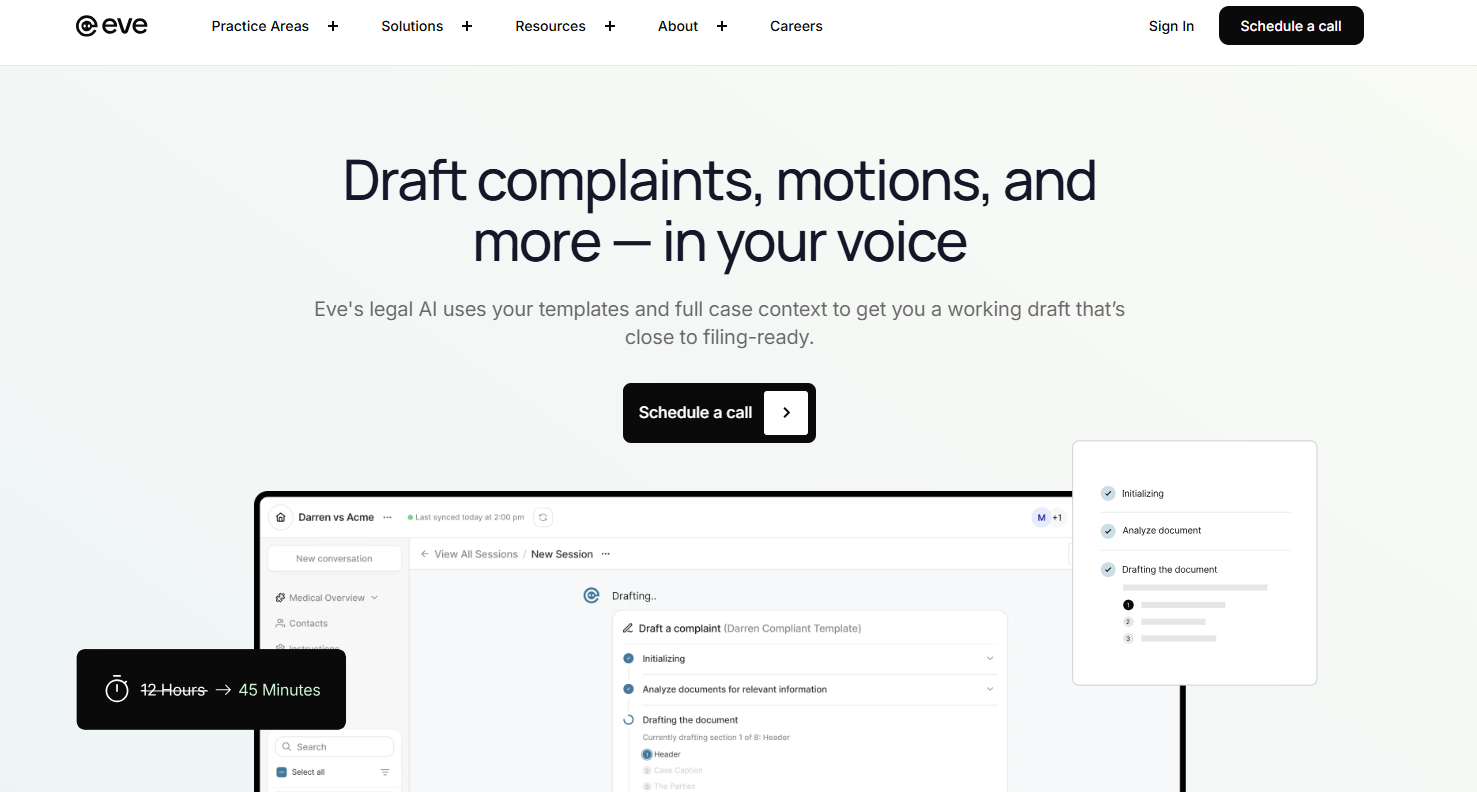
Source: Eve.Legal
The software is particularly relevant for personal injury practices and other plaintiff-side teams that want one system covering a wider portion of the case lifecycle.
Along with discovery, Eve can help draft court filings and other litigation documents in the firm’s preferred style. Firms can provide completed examples so the platform learns their formatting and language patterns.
Best Features
- Propounding discovery: Creates case-specific questions and can format them to match the firm’s captions, structure, and pleading paper.
- Responding to discovery: Uses selected case documents to prepare initial answers, which helps reduce repetitive copying and manual data entry.
- Firm-style drafting: Learns from existing work product and applies those patterns to discovery and other legal documents.
- Broader case support: Extends into areas like client communications, intake, medical record analysis, and litigation drafting.
Pros
- Strong fit for plaintiff-side litigation practices
- Brings discovery drafting into a broader case workflow
- Works well for personal injury matters
- Adapts drafts to the firm’s existing style
- Reduces repetitive intake and document preparation work
3. Harvey
Harvey is a broad AI legal tool built for law firms and corporate legal departments, with litigation support covering research, document review, drafting, and trial preparation.
For discovery work, it can use relevant case files and legal authorities to prepare requests or responses grounded in the record.

Source: Harvey.ai
This makes Harvey a better fit for teams looking for one platform that supports several stages of a matter. Attorneys can work through lengthy documents, develop legal briefs or memos, and create other generated documents from the same case materials.
Harvey also integrates with Word, which gives lawyers a familiar place to revise drafts as the work develops.
Best Features
- Case-grounded discovery drafting: Prepares discovery requests and responses using selected litigation files and relevant legal authority.
- Document analysis: Reviews large sets of legal data and helps surface useful facts for drafting or case strategy.
- Legal research support: Connects drafting with case law research so attorneys can develop arguments from the same workspace.
- Custom workflows: Lets firms build reusable processes for complex litigation tasks through configurable Workflow agents.
- Microsoft integrations: Brings Harvey into tools like Microsoft Word, Outlook, and SharePoint.
Pros
- Covers discovery within a much wider litigation workflow
- Well suited to large firms and enterprise legal teams
- Helpful for document-heavy cases
- Connects research directly to drafting
- Extends into transactional work such as contract drafting and analysis
4. AI.Law
AI.Law is a litigation-focused platform that combines discovery drafting with broader case management and document automation.
Its discovery tools can prepare interrogatories, RFAs, RFPs, and full response sets using the facts, documents, and legal issues already stored in the matter.
Source: AI.Law
For responses, the platform reviews each incoming request, proposes request-specific objections, and drafts substantive answers based on the case file.
Attorneys can compare the original request with the suggested response side by side, make edits, and export the completed set with jurisdiction-aware formatting.
AI.Law may appeal to firms looking for a wider litigation workspace rather than a standalone drafting product. The same system can help organize productions, compare deposition testimony with prior discovery answers, and build future legal workflows from the evidence in the file.
Best Features
- Case-based drafting: Uses uploaded records and matter facts during initial drafting rather than relying on a blank prompt.
- Request-specific objections: Suggests objections based on the language of each request, including proportionality and privilege concerns.
- Side-by-side review: Displays the request next to the AI draft so attorneys can revise responses in context.
- Client discovery portal: Explains requests in plain language, gathers follow-up details, and returns structured answers for review.
- Connected litigation tools: Links discovery work with production organization, case strategy, and document analysis.
Pros
- Gives smaller litigation teams a broad set of AI-assisted workflows
- Keeps drafting connected to the wider case record
- Offers guided client input for discovery responses
- Supports both outgoing requests and incoming response sets
5. Anytime AI
Anytime AI is an AI assistant built for plaintiff law practices handling complex litigation. Its discovery response tool pulls from uploaded case files to draft answers to interrogatories, Bills of Particular, and requests for production, with each response tied back to the underlying record.
Source: Anytime.AI
The platform can match a firm’s preferred formatting and language from an uploaded example, which helps keep generated work consistent with existing templates.
For RFPs, Anytime AI prepares the written responses while attorneys select the files that belong in the final production. It can also support court filings, document analysis, and other litigation work through the same case data.
Best Features
- Case-grounded responses: Uses medical records, intake information, prior responses, and other uploaded materials to prepare discovery answers.
- Source-linked drafting: Connects responses to supporting case documents through built-in citation tables.
- Template matching: Follows the firm’s established formatting and writing style from a sample document.
- RFP response support: Drafts the written portion of production responses while leaving final document selection with the legal team.
- Broader litigation drafting: Creates work product such as motions, complaints, and demand letters from synced case information.
Pros
- Geared toward medical-heavy plaintiff litigation
- Grounds discovery answers in the existing case file
- Preserves familiar firm templates and language
- Fits into a wider case preparation platform
- Useful for firms managing a high volume of complex claims
Are AI Discovery Drafting Tools Reliable?
AI discovery drafting tools can be reliable, much like any other AI tool applied to legal work, when you use software built for the task and review the output carefully. Leveraging AI can give you a solid first draft much faster while keeping legal judgment in your hands.
A few factors make the biggest difference:
- Quality of your source material: Clear case files and accurate client data give the platform stronger information to work from.
- Legal-specific design: AI tools built for discovery usually handle objections, formatting, and legal arguments better than general-purpose platforms.
- Your review process: You still need to check the reasoning, refine the wording, and confirm that each response fits the case.
- Security controls: Any legal technology you use should have clear protections for client confidentiality and sensitive information.
- Jurisdictional fit: Before treating a draft as court-ready, confirm that it reflects the applicable rules and any relevant case law.
Make Discovery Drafting Easier With the Right AI Tool
AI adoption in the legal profession is making discovery work faster and far less repetitive. The best legal AI tools can help you prepare stronger first drafts, organize case information, and move toward court-ready documents with less manual effort.
The right choice depends on how much of the process you want the software to handle. Some platforms support broad litigation work, while Briefpoint focuses closely on written discovery, including requests, responses, client input, and production preparation.
If your firm wants to spend less time formatting documents and more time preparing for opposing counsel, Briefpoint is the best place to start. It keeps client data secure while giving your team a clearer, more efficient discovery workflow.
AI for Request for Production Responses: What to Check
AI for Request for Production Responses: What to Check
Legal content overseen by Nathan Walter, Esq., attorney licensed in California (State Bar No. 313299).
AI for request for production responses can help prepare drafts, but evaluating a tool means checking more than fluent wording. In federal litigation, assess each response and objection under Federal Rule of Civil Procedure 34, then compare its withholding and production statements with the documents your team plans to produce.
In this guide, a request for production (RFP) is the federal device for asking a party to produce documents, electronically stored information (ESI) or tangible things. For background, see our overview of requests for production in civil litigation.
The sections below cover the Rule 34 checks, Bates citation review and an invented pilot for defense teams comparing a draft with the client’s records.
What AI for request for production responses should deliver
Judge two outputs separately: the written response and the production itself. A draft that reads well proves neither that the response satisfies Rule 34 nor that the documents it describes exist.
An editable response is one output
The draft should respond to each numbered request in order, propose objections with stated grounds and flag what it cannot determine from the file. Briefpoint, for example, drafts responses and objections that open in Microsoft Word, where your attorney edits the language.
Check the grounds, the facts and the description of what will be produced before anything is served.
The production is a separate output
Responsive documents, their references and the final production package are a second output. Uploading files or generating a draft does not show that anything has been collected completely, reviewed or produced.
For the workflow around a pilot, see how to automate responses to requests for production. If you are still choosing among products, the comparison of RFP automation tools for legal teams covers the category. This guide stays with how to judge the output.
Test responses and objections against Rule 34
The checks below apply to federal civil cases under the Federal Rules of Civil Procedure. State-court matters follow their own rules.
Require an answer to each item or category
Under Rule 34(b)(2)(B), the response to each item or category must either state that inspection and related activities will be permitted as requested or state with specificity the grounds for objecting, including the reasons. The responding party may say it will produce copies instead of permitting inspection. Production must then be completed by the time for inspection specified in the request or another reasonable time specified in the response.
Test whether the draft addresses every request, whether each objection gives reasons specific to that request and whether the response states when production will be completed. A reply that skips a request, or repeats the same objection text across unlike requests, fails this test.
Make withholding clear
Rule 34(b)(2)(C) requires an objection to state whether any responsive materials are being withheld on the basis of that objection. An objection to part of a request must specify the part and permit inspection of the rest.
Read each objection and ask whether you can tell what is being held back. Language that objects “subject to” the objection and then agrees to produce “responsive documents” may leave the withholding question open. The rule does not ban any phrase. It requires the statement, so the test is whether the draft makes one.
Separate privilege disclosures from other objections
A statement that material is being withheld does not by itself satisfy Rule 26(b)(5)(A). When a party withholds otherwise discoverable information as privileged or as trial-preparation material, it must expressly make the claim and describe the nature of what was not produced, without revealing the protected information, in a way that lets other parties assess the claim.
Keep privilege decisions with the reviewing attorney. Check that your review process brings potentially protected documents to counsel’s attention and does not treat a generic withholding sentence as the disclosure the rule describes.
Check production promises and Bates citations
A response that says documents “are produced at” a page range makes a promise your team has to verify. Rule 34 requires the written response and separately governs how documents are produced. A Bates range alone does not make a response complete.
Open the cited pages
For each citation in the draft, open the page in the intended production. Confirm that the page exists, that it supports the statement it is cited for and that no page cited in the draft was changed, redacted or withheld after the draft was written.
Bates numbering gives each page a unique identifier, and a Bates number on a page shows only where the page sits in the set. It does not show that the page is responsive, that the collection is complete or that privilege review is finished. Rule 34 does not prescribe Bates numbering. Page-level citation is a practical way to trace each response to its documents.
Inspect organization and ESI form
Rule 34(b)(2)(E) applies unless the parties stipulate or the court orders otherwise. A party must produce documents as they are kept in the usual course of business or organize and label them to correspond to the categories in the request. If the request does not specify a form for ESI, the party must produce it in a form in which it is ordinarily maintained or a reasonably usable form, and need not produce the same ESI in more than one form.
Under Rule 34(b)(2)(D), a response may object to a requested ESI form, and if it does, or if the request specified none, it must state the form the party intends to use. Check that the draft says so. An editable Word response is the format of the written response and says nothing about the format of the produced ESI.
Evaluate the tool on a controlled defense example
The following example is invented. Run a pilot on invented or sanitized records, or on real records only with the client’s permission and your firm’s data policies in place, rather than uploading confidential client files without limits.
Compare the output with known facts
A defense firm represents a store in a premises-liability case. The requests ask for inspection logs and incident communications. You build a test file with three items: an inspection log, an email whose attachment is missing from the file, and a document you have marked for counsel’s privilege assessment.
Because you know what is in the file, you can tell what the draft got wrong. Do not decide privilege from the type of document. Whether the third item is protected is an attorney’s call under the facts.
Record defects, not a compliance score
These are proposed evaluation criteria for your pilot, not features of any product. For each draft, log what you find against these checks:
- Omitted request: compare the numbered requests with the numbered responses. Reject the draft if a request has no response.
- Unsupported completed-production statement: look for wording that says documents “have been produced” before anything has been served. Reject the draft if it describes production as done.
- Unexplained withheld material: read each objection for a withholding statement under Rule 34(b)(2)(C), and check the privilege item against Rule 26(b)(5)(A). Reject the draft if the file contains held-back material the response does not mention.
- Wrong Bates page: open every cited page. Reject the draft if a citation points to a page that does not support the statement.
- Completeness claim despite the missing attachment: check whether the draft says the email is complete. Reject it if it does.
- Correction in Word: edit a defective response in the document. Reject the tool if you cannot fix the output where you review it.
A fluent answer that cites a page that does not exist fails the pilot, even if the objection wording looks polished. A less polished draft that flags the missing attachment and sends the privilege item to counsel may be the better result, because your reviewer starts from accurate statements. For response patterns to compare against, see these examples of responses to requests for production.
Keep legal decisions and data review with counsel
Whatever the draft says, attorneys decide scope, grounds and what is served.
Review sources, scope and unresolved facts
Rule 26(b)(1) limits discovery to nonprivileged matter that is relevant to any party’s claim or defense and proportional to the needs of the case, and information within that scope need not be admissible to be discoverable. Rule 34(a)(1) reaches items in the responding party’s possession, custody, or control. A draft that asserts a proportionality objection, or says nothing exists, should show what it relied on.
A tool that sees part of a client’s records cannot say what the client holds elsewhere, so treat any inference from the uploaded subset as a red flag. Questions about control over a client’s or insured’s records need an attorney’s judgment. Defense teams can find more on this in our page on discovery support for defense firms.
Ask for evidence of data handling
Before you put client material into any tool, ask the vendor in writing who can access uploaded files, how long they are retained, whether third parties process them and what the terms say about training models on your data. Get answers you can verify. Security credentials do not by themselves guarantee confidentiality.
Measure review burden as well as speed: log the time your team spends correcting drafts, checking citations and rewriting objections, and include it in the comparison. Recording that time during a pilot is suggested firm practice, not a rule requirement.
State rules
This guide covers the Federal Rules of Civil Procedure. If your case is in state court, use that state’s rules for response standards and deadlines, and do not carry over the federal timing or objection requirements described here. The requests for production overview linked above is a starting point for orientation.
Review production responses with Briefpoint
Briefpoint drafts responses and objections to requests for production. Its discovery response drafting output is editable in Microsoft Word, final review stays with your attorneys, and the draft is what you run through the checks above.
Autodoc finds responsive documents, adds page-level Bates citations and builds a Bates-numbered production package, so your reviewer has citations to open and a package to compare with the written response. Client Bridge sends clients plain-language questions through a secure link so they can answer and upload documents for attorney review.
These tools give your team outputs to test; they do not establish that a draft passes, that an objection is legally correct, that a collection is complete or that a production has been served.
Book a demo to see how Briefpoint supports production-response drafting and review.
See how Briefpoint drafts discovery responses in minutes:
FAQs About AI for Request for Production Responses
How long do you have to respond to a federal request for production?
The default is a written response within 30 days after service under Rule 34(b)(2)(A). For early requests delivered under Rule 26(d)(2), the 30 days run from the parties’ first Rule 26(f) conference.
A different time may be stipulated under Rule 29 or ordered by the court. Production completion is governed separately by Rule 34(b)(2)(B).
Can you get more time to respond to requests for production?
Yes, by stipulation under Rule 29 or by court order, as Rule 34(b)(2)(A) provides. Under Rule 29(b), a stipulation extending time needs court approval if it would interfere with the time set for completing discovery, hearing a motion or trial. Asking the other side for more time is not an extension until they agree or the court orders one, and a court order may control.
What if you find more documents after serving your responses?
Rule 26(e)(1) requires you to supplement or correct a response to a request for production in a timely manner if you learn it is incomplete or incorrect in some material respect. The duty applies only if the additional or corrective information has not otherwise been made known to the other parties during discovery or in writing. A court may also order a supplement.
Are an insurer’s claim-file documents automatically protected work product?
No. Under Rule 26(b)(3), ordinary protection depends on preparation in anticipation of litigation or for trial by or for a party or its representative, including its insurer—not a claim-file label.
Exceptions include otherwise discoverable material for which the requester shows substantial need and cannot obtain its substantial equivalent elsewhere without undue hardship, subject to Rule 26(b)(4). Courts ordering discovery must protect counsel’s or other representatives’ mental impressions, conclusions, opinions and legal theories concerning the litigation.
The information provided on this website does not, and is not intended to, constitute legal advice; instead, all information, content, and materials available on this site are for general informational purposes only. Information on this website may not constitute the most up-to-date legal or other information. This website contains links to other third-party websites. Such links are only for the convenience of the reader, user or browser. Readers of this website should contact their attorney to obtain advice with respect to any particular legal matter. No reader, user, or browser of this site should act or refrain from acting on the basis of information on this site without first seeking legal advice from counsel in the relevant jurisdiction. Only your individual attorney can provide assurances that the information contained herein – and your interpretation of it – is applicable or appropriate to your particular situation. Use of, and access to, this website or any of the links or resources contained within the site do not create an attorney-client relationship between the reader, user, or browser and website authors, contributors, contributing law firms, or committee members and their respective employers.
READ MORE